Amnesty International demands Tehran halt execution of Kurdish activist | Iran International
Amnesty International demands Tehran halt execution of Kurdish activist
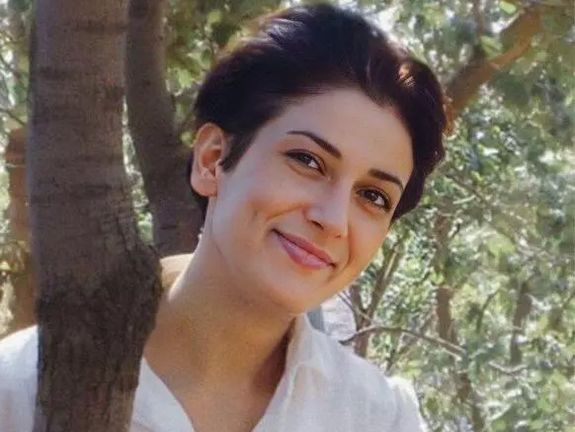
Amnesty International has condemned Iran's Supreme Court for upholding the conviction and death sentence of Kurdish activist Pakhshan Azizi, calling her trial and punishment unjust.
"Iran's authorities must halt any plans to carry out her execution and release her immediately," Amnesty said in a post on X Tuesday, adding that Azizi was sentenced in connection with her peaceful humanitarian and human rights work.
Azizi’s lawyer, Amir Raeisian, criticized the judicial process, saying the Supreme Court failed to address critical flaws in her case.
“We filed an appeal, but ... the Supreme Court reviewed the appeal and unfortunately rejected it without addressing the numerous flaws in the case, thereby confirming the death sentence,” Raeisian told Tehran-based newspaper Sharq Daily on Wednesday.
Azizi was arrested at her home in Tehran in August 2023, by state security forces who allegedly held a gun to her head.
She asserts that she was denied legal counsel during detention and was tortured to confess to things she had not done---something rights groups say is a routine tactic used by Iranian authorities against activists.
Azizi was sentence to death in July 2024 for “armed rebellion against the state” and imposed an additional four-year prison sentence for alleged membership in the Kurdistan Free Life Party (PJAK), accusations her lawyers have denied.
In a letter from prison right after her sentence, Azizi described instances of torture and harassment, including mock executions.
At least 54 political prisoners including Azizi are currently facing execution across various prisons in Iran, according to US-based rights group HRANA.
Iran has faced mounting international criticism for its use of the death penalty, particularly against political prisoners and activists.
The leader of the Japanese crime syndicate Yakuza has pleaded guilty in a Manhattan federal court to conspiring to traffic uranium and weapons-grade plutonium to an informant posing as an Iranian general, according to US authorities.
Takeshi Ebisawa on Wednesday admitted to trafficking nuclear materials from Myanmar, as well as narcotics and arms charges.
US authorities charged Ebisawa in February 2024 with conspiring to supply nuclear materials to Iran for potential use in nuclear weapons development.
"As he admitted in federal court today, Takeshi Ebisawa brazenly trafficked nuclear material, including weapons-grade plutonium, out of Burma (Myanmar)," said Acting US Attorney Edward Kim for the Southern District of New York.
"At the same time, he worked to send massive quantities of heroin and methamphetamine to the United States in exchange for heavy-duty weaponry such as surface-to-air missiles to be used on battlefields in Burma and laundered what he believed to be drug money from New York to Tokyo."
US authorities said the scheme was detected and stopped through international cooperation with Indonesia, Japan and Thailand.
Around 30,000 general practitioners in Iran are unwilling to practice due to low doctor's fees, according to Mohammad Raiszadeh, head of the Medical Council.
"The problem we are facing is that general practitioners are not interested in pursuing specialization or working in the medical field. This issue cannot be resolved with such extremely low fees," Raiszadeh, who leads the non-governmental licensing and regulatory body for the medical profession, said Thursday.
The same official noted in November that, compared to the salaries of civil servants and the wages of workers, doctors' incomes have experienced minimal growth in recent years. Moreover, due to a persistent inflation rate exceeding 40%, nominal incomes have lost much of their purchasing power since 2019.
The Iranian government strictly regulates medical fees and annually announces chargeable rates for private general practitioners, specialists, and dentists.
In early April, for instance, doctor's fees for general practitioners and specialists were set at 1.26 million rials ($20) and 1.89 million rials ($30), respectively, for the next twelve months. The medical community argues that these tariffs for medical services do not align with inflation and has strongly objected to them.
Iran’s Islamic Revolutionary Guard Corps (IRGC) has unveiled its latest loitering munition drone, the Rezvan, during the ongoing military drills codenamed Great Prophet 19.
The drone, with a range of 20 kilometers and an operating time of 20 minutes, is designed for rapid deployment and targeted attacks, particularly in complex terrain, according to the IRGC.
"Our drones carried out several rounds of firing and drone operations, and in our scenario, we successfully destroyed hypothetical enemies and terrorists attacking Iranian bases," said Mohammad Pakpour, the commander of the IRGC Ground Forces, on the sidelines of the exercise in the Azgeleh region in the western Kermanshah province.
The suicide drone is fired from a cylindrical launcher and transmits live video to the operator, allowing for precise target selection and engagement, IRGC media Tasnim reported.
Also on Thursday, the Iranian Army announced that it will incorporate 1,000 new drones into its combat forces in the coming days. These drones were designed and manufactured jointly by the Iranian Army and the Ministry of Defense.
Commander of the the Army's Ground Force Brigadier General Kioumars Heidari said that the new military equipment joining the Army has capabilities like maneuverability, precision, and smartness, but he did not elaborate on details.
IRGC commander-in-chief Hossein Salami said Thursday that the ongoing military exercises aim to make the enemies refine their assessments of Iran’s defense capabilities and demonstrate that the country’s deterrence is unaffected by external events, a tacit reference to the fall of Tehran’s longtime ally Bashar al-Assad in Syria.
"The goal of the exercises is to adjust and refine the enemy's calculations regarding Iran's defense power so that they do not make decisions based on incorrect calculations," Salami said. "Foreign developments do not affect our deterrence."
He discussed what he characterized as enemy attempts to depict Iran's defense capabilities as diminished, particularly in the wake of developments in Syria. "The enemy has invested heavily in psychological and media operations, especially after recent events in Syria, to foster the perception that the defensive and deterrent power of the Islamic Republic of Iran has weakened and that Iran has lost its regional deterrent assets," he said.
The Great Prophet 19 exercise is the latest in a series of drills conducted by Iran's military to showcase its capabilities and project a message of strength in the region, following consecutive defeats for its allies since September.
Italian Prime Minister Giorgia Meloni said Thursday that she had no information if US tech billionaire Elon Musk was involved in the release of Italian journalist Cecilia Sala from detention in Iran.
Meloni also addressed the case of Alireza Abedini, an Iranian-Swiss detainee in Italy, noting that the matter remains under active review by the Ministry of Justice. She explained that the evaluation involves both technical and political aspects, conducted in accordance with the treaty between Italy and the United States.
"This matter requires continued discussion with our American friends," Meloni said. "I would have liked to discuss it with President Biden, who had to cancel his trip, and to whom we extend our solidarity."
Abedini, accused of transferring drone technology to Iran, was arrested at Milan Airport on a US warrant. According to Washington, the technology was used in a February attack near the Jordan-Syria border that killed three American soldiers. Iran denies the allegation.
His arrest has been linked to the detention of Italian journalist Cecilia Sala, who was apprehended in Tehran last month while on a standard journalistic visa. Sala was released on Wednesday following diplomatic efforts.
Gunmen killed a border guard on Thursday in Mirjaveh County, located in Iran's restive southeastern province of Sistan-Baluchestan, state-run media reported.
The province, which borders Afghanistan and Pakistan, has been a hotspot for sporadic deadly clashes involving militant groups, armed drug traffickers, and Iranian security forces.
Among the groups active in the region is Jaish al-Adl, known for ambushes, bombings, and other violent operations that have claimed the lives of civilians and security personnel.
Jaish al-Adl advocates for an independent Baluchestan, encompassing Baluch populations on both sides of the Iran-Pakistan border, and has carried out numerous attacks in southeastern Iran.
Sistan-Baluchestan is one of Iran’s least developed regions, with strained relations between its predominantly Sunni Muslim population and the country’s Shiite-led establishment.