Lawyers Ask Iran To Let Iranian American Go Abroad For Surgery
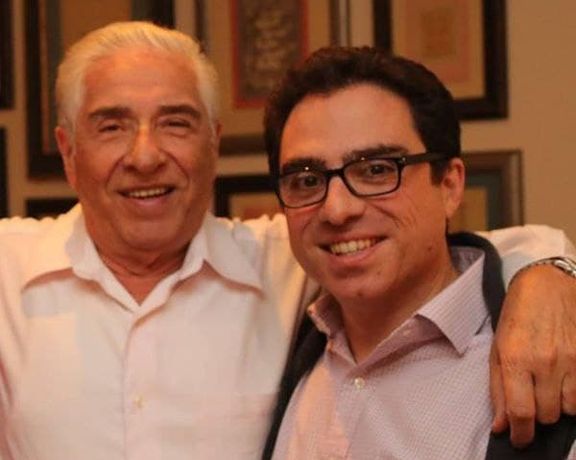
Baqer Namazi and his son Siamak in photo before their ordeal in Iran.
Lawyers for an 84-year-old Iranian American, who was formerly imprisoned by Iran and whose son remains jailed there, urged Tehran on Monday to let him leave the country for medical care, saying he needs immediate surgery for an arterial blockage.
Baquer Namazi was convicted of "collaboration with a hostile government" in 2016 and sentenced to 10 years in prison. Iranian authorities released him on medical grounds in 2018 and closed his case last year, commuting his sentence to time served.
However, his son, Siamak Namazi, 49, remains in prison in Iran after being convicted of the same charge. The U.S. government has described the charges against both as baseless.
Iranian Americans, whose U.S. citizenship is not recognized by Tehran, are often pawns between the two nations, now at odds over whether to revive a fraying 2015 pact under which Iran limited its nuclear program in return for sanctions relief.
In a letter to the U.N. Special Rapporteur on the Right to Health, a lawyer for the family, Jared Genser, said the elder Namazi needed immediate surgery for a 95%-97% blockage in one of his internal carotid arteries, which supply blood to the brain.
It cited one physician as saying he required surgery within seven to 10 days and it argued this must be performed outside Iran both because recovery requires a stress-free environment and because Iranian hospitals are struggling with COVID-19.
The Iranian mission to the United Nations did not immediately respond to a request for comment.
Genser said Namazi has been under an effective international travel ban since his case was closed, arguing that this, as well as his prior treatment by Iranian authorities, constitutes a violation of his "right to health" under the International Covenant on Economic, Social and Cultural Rights.
Genser asked the special rapporteur to investigate and to urge Iran to let Baquer Namazi travel abroad for treatment. He also told a virtual news conference he wanted U.S. President Joe Biden to "personally engage" to allow Namazi to travel.
"My dad is dying," another son, Babak Namazi, told Reuters by phone from Dubai.
"My father has already lost so much precious time," he told the virtual news conference, at times crying. "I am begging Iran to let him spend whatever small amount of time he has left with his family, my brother Siamak included."
Insisting there was “no substitute” for Iran’s 2015 nuclear deal, the foreign ministry spokesman Monday dismissed any urgency in restarting talks to revive it.
Saeed Khatibzadeh pointed out that United States president Joe Biden had been in office for three months before talks began in Vienna on renewing the agreement, the JCPOA (Joint Comprehensive Plan of Action).
With new Iranian president Ebrahim Raisi (Raeesi) in office “for less than 55 days,” said the spokesman, “a new negotiation team may have their own views” while other parties to the Vienna talks were realizing they needed to be more flexible.
Studying the issue
The new team, the spokesman said, were studying “all the issues” in the six past rounds of Vienna talks, which formally involve remaining JCPOA signatories − China, France, Germany, Iran, Russia and the United Kingdom − as well as indirectly the United States, which under former US president Donald Trump left the deal in 2018 and imposed stringent sanctions on Tehran that remain in place.
The European signatories, while calling on both the US and Iran to abide by the JCPOA, have become increasingly uneasy at the expertise Iran is gaining with steps taken since 2019 expanding the nuclear program beyond JCPOA limits. The Europeans also sense that the Raisi administration may believe it is in stronger position with some signs of recovery in the Iranian economy.
The German foreign ministry Monday issued a statement that Iran could not “set further conditions for resuming the talks,” which should “resume as soon a possible.” Berlin’s statement followed a suggestion from Iran’s foreign minister Hossein Amir-Abdollahian Saturday, that while in New York last month for the United Nations general assembly he told US officials through intermediaries that he would accept their request for a meeting if Washington as a good-will gesture released $10 billion of Iran’s assets frozen abroad.
Asked about this Monday, Khatibzadeh said the US should release funds “to show they mean what they say.” The spokesman referred to reports that the US wanted the Vienna talks to include Iran’s missile defence by stressing there was “no substitute for the JCPOA,” and that “if all sanctions in an effective way are removed, Iran will stop all [nuclear] actions in reducing its commitments.”
Plans B and C
Asked about a ‘plan B’ should the Vienna talks fail, Khatibzadeh said that while any government in the world would have a ‘plan B and C,’ all should focus on plan A.
The Vienna talks, which began in April and were suspended in June pending the Iranian presidential election and subsequent transition, struggled to agree which US sanctions were incompatible with the JCPOA and exactly how the Iranian nuclear program would be returned to JCPOA limits.
The Biden administration has said it is willing to lift all ‘non-nuclear’ sanctions, but the Trump administration made no secret that sanctions introduced ostensibly on other grounds were intended to stymie subsequent efforts at reviving the JCPOA. Tehran also highlights a general commitment in the deal to allow it access to world markets.
While some aspects of the JCPOA limits on Iran’s nuclear program are relatively clear-cut − for example enriching uranium to just 3.67 per cent rather than levels now reaching 60 percent − Tehran is constantly gaining experience and technical knowledge. It has also replaced older centrifuges, the devices used to enrichment, with more advanced ones barred by the JCPOA, in some cases because of attacks on nuclear sites widely attributed to Israel.
Talks between the Islamic Republic of Iran and Saudi Arabia “are in their best state”, foreign ministry spokesman Saeed Khatibazadeh said in Tehran on Monday.
Khatibzadeh told reporters that there are no pre-conditions by the two sides in the current talks.
The Iranian spokesman did not confirm reports that a Saudi delegation will visit Tehran to reopen its embassy after Riyadh cut relations following the sacking of its diplomatic mission by Iranian protesters in January 2016.
Iran President Ebrahim Raisi (Raeesi) and his foreign policy team have several times emphasized that the priority of the new government in Tehran is to improve relations with regional countries. The United States and its regional allies demand a change in Tehran’s interferences in the rgion.
Saudi Foreign Minister Prince Faisal bin Farhan al-Saud had said Sunday that the latest round of talks had taken place on Sept. 21. He did not give the location of the meeting. But he emphasized that talks were still in their early stages.
"These discussions are still in the exploratory phase. We hope they will provide a basis to address unresolved issues between the two sides and we will strive and work to realize that,” he said.
Israel accused Iran on Monday of orchestrating an attempted attack against Israelis in Cyprus after Cypriot police said an armed individual had been arrested.
"This was a terrorist incident directed by Iran against Israeli businesspeople living in Cyprus," Matan Sidi, spokesman for Prime Minister Naftali Bennett, said in a statement.
Iran's embassy in Cyprus on Monday described Israel's claims as 'baseless' that Tehran had plotted against Israelis on the island.
"This regime is always making such a baseless allegation against the Islamic Republic of Iran," the Iranian embassy said in an emailed response to a comment sought by Reuters.
Earlier on Monday, Cypriot police chief Stelios Papatheodorou told reporters: "A person has been arrested, in whose possession a pistol and cartridges were found."
"It is a sensitive case, which is why a remand request was held behind closed doors," Papatheodorou added.
Cypriot media, citing a police source, have reported that the suspect, who has not been charged, was arrested on Sept. 27 in the capital Nicosia, just after crossing by car from a checkpoint linking the Turkish-controlled north and the southern parts of the ethnically divided island.
A silencer was also found in his vehicle, the reports said. People using the checkpoint at the time reported extensive searches of vehicles during the crossover transit.
Israel appeared to hint that its intelligence services had contributed to Cyprus' foiling of the suspected attack plot.
"There are security threats. As you can see, the Shin Bet, the Mossad, all of the security forces know how to handle them," Foreign Minister Yair Lapid told reporters when asked about the incident. "The fact is that we're there. We're minding matters."
Cypriot media have also reported that the suspect was on the island for about 20 days prior to his arrest and rented two cars in succession. They said he used an electric scooter to travel frequently to the north side of the island via a pedestrian crossing.
In his statement, Sidi denied local media reports on Sunday that described the arrest as having thwarted a criminally motivated assassination attempt against Teddy Sagi, an Israeli magnate.
Germany rejects Iran's demands for the US to release frozen Iranian assets as a condition for nuclear talks to resume, German foreign ministry said on Monday.
"Iran cannot set any further conditions for resuming the talks," a German foreign ministry spokesman said after Iranian foreign minister Hossein Amir-Abdollahian's demand for assets worth 10 billion dollars to be released as a goodwill gesture.
Under President Donald Trump, the United States unilaterally withdrew from the 2015 agreement with Iran, Britain, France, China, Russia and Germany aimed at stopping Iran from developing a nuclear weapon.
President Joe Biden aims to restore the deal, but the sides disagree on which steps need to be taken and when, with the key issues being what constraints Tehran will accept and what sanctions Washington will remove.
"We call on Iran to resume talks as soon as possible," the German foreign ministry spokesman said, adding he expects an agreement on a specific date.
Amid fresh Azerbaijani assertiveness after the 2020 Nagorno-Karabakh war, the Armenian foreign minister, landed in Tehran Monday to confer on regional tensions.
At a joint news conference with Iranian foreign minister Hossein Amir-Abdollahian, Ararat Mirzoyan stressed Yerevan’s commitment to the Minsk process − chaired by France, Russia and the United States, and involving Iran − to deal with issues left unresolved by the war.
Mirzoyan said he had briefed Amir-Abdollahian on current developments, including efforts to build new transit roads to connect Iran and Armenia, as well as on the role of foreign "mercenaries" in the Karabakh war. Turkish, which reportedly sent in Sunni militiamen from Syria during the war, begins Tuesday army exercises along the border.
Amir-Abdollahian, who noted this was his third meeting with his Armenian counterpart in as many weeks, said that the “region and our northern neighbors” were “in dire condition, particularly due to the presence of Zionists and terrorists...”
Relations between Iran and Azerbaijan have been in flux since last year’s Armenia-Azerbaijan war over the disputed enclave of Nagorno-Karabakh. But the atmosphere soured last month when Azerbaijan arrested two Iranian truck drivers for entering Azerbaijan from Armenia through the Goris-Kapan road "without a permit.”
The road, connecting the towns of Goris and Kapan in the Armenian region of Syunik, runs through territory that Baku regained control over with the Russian-brokered deal ending the six-week Armenia-Azerbaijan war. Azerbaijan has been stopping Iranian truck drivers using the road both to reach Armenia and markets further north, and levied a $130 tax.
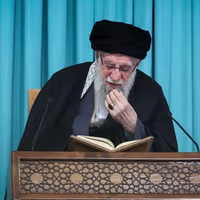
Tehran is also concerned over Turkey’s military and diplomatic backing for Azerbaijan. In a speech Sunday, Iran's Supreme Leader Ali Khamenei reminded Turkey that "the person who digs a well [to trap] his brothers is the first one to fall into it."
Mojtaba Zulnuri, a conservative member of the Iranian parliament’s National Security and Foreign Policy Committee, said Monday that Azerbaijan and Turkey would be "slapped hard if they want to threaten Iran's interests."
Previously, Iranian officials had generally avoided mentioning Turkey's role while expressing disquiet over Israel’srelations with Azerbaijan, which have included arms supplies and reportedly access to Azeri airfields.
In response to such remarks, Leila Abdullayeva, spokesperson for the Azeri foreign ministry, Monday denied “the presence of third-country forces near the Azerbaijan-Iran border” or any “provocation” by such forces.
Armenian prime minister Nikol Pashinian Sunday criticized sections of the Iranian press for alleging Yerevan planned changes detrimental to Iran. "Armenia has never been and will never be involved in any conspiracy against Iran, because we extremely value those relations and we will never forget that Iran was the path of life for Armenia in the early 90s," he said.
But the Azeris have put forward their own demand for a ‘land corridor’, in this case through Armenia to link Azerbaijan’s western regions with Nakhchivan. Armenian Security Council Secretary Armen Grigoryan said October 2 that while Yerevan might open its roads to Azerbaijan and Turkey, it would retain control with no "sovereign corridor" inside Armenian territory. Grigoryan said existing infrastructure, including the Yerevan-Tbilisi-Baku-Russia railway, could facilitate such trade.