Iran Says Delisting IRGC Not Main Obstacle At Vienna Talks
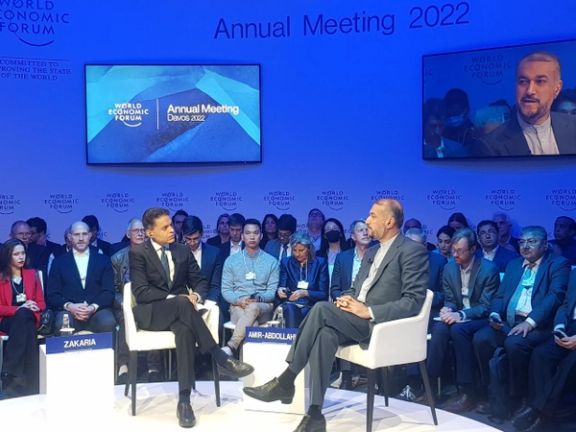
Iran’s Foreign Minister Hossein Amir-Abdollahian (right) speaks at the World Economic Forum in Davos, Switzerland, on May 26, 2022.
Iran's foreign minister says the country’s demand to remove the Revolutionary Guards from the US list of foreign terrorist organizations is a "minor" issue in the negotiations to revive the 2015 nuclear deal.
Hossein Amir-Abdollahian said in a Thursday interview with CNN’s Fareed Zakaria at World Economic Forum’s annual meeting in the Swiss city of Davos that the Islamic Republic still considers the removal of Western economic sanctions as a key stumbling block in the Vienna talks to restore the Joint Comprehensive Plan of Action (JCPOA).
He said from Tehran’s point of view, the administration of President Joe Biden is continuing Donald Trump's maximum pressure policy, stressing the need to lift the Trump administration’s sanctions in order to see progress at the talks.
He said Iran is “keeping the window of diplomacy open,” noting that delisting the IRGC is not the main snag hindering a deal as long as Iran is guaranteed economic benefits.
“In fact, the IRGC being on the US blacklist of terrorist groups is a secondary issue that has been magnified by the pro-Israeli lobby and our main priority is the interests of the Iranian nation,” Iran’s top diplomat said.
“Now, we have reached a point that if the American side makes a realistic decision, an agreement would be within reach,” he said, adding that “Zionists do not want an agreement in the Vienna talks... Zionists tell many lies about Iran’s nuclear issue, but Americans know exactly what they must do if they want to return to the JCPOA.”
Amir-Abdollahian’s statement about IRGC’s terror listing as a minor issue contradicts remarks by Iranian officials who have said Tehran’s demand to delist the entity is “red line”.
An explosion in one of the research centers at Iran’s Parchin military complex near the capital Tehran has killed one engineer and injured another employee.
Fars news agency, close to Iran’s Revolutionary Guard, cited the Defense Ministry on Thursday that investigations into the cause of the Wednesday evening “industrial accident” were underway.
“On Wednesday evening, in an accident that took place in one of the research units of the Defense Ministry in the Parchin area, engineer Ehsan Ghadbeigi was martyred and one of his colleagues injured,” the ministry said.
The ministry did not elaborate on the accident or provide further details, but identified the engineer who died as Ehsan Ghadbeigi.IntelliTimes blog said that he specialized in mechanical engineering at Sheriff University and worked in materials-related fields, that could integrate with Iran's missile or nuclear programs.
Located 60 kilometers (37 miles) southeast of Tehran, Parchin is a sensitive military site housing several industrial and research units, where Western security services believe Iran carried out tests related to nuclear bomb detonations more than a decade ago. It is also closely linked with the Khojir missile production complex.
The International Atomic Energy Agency previously said it suspected Iran conducted tests of explosive triggers that could be used in nuclear weapons at the site.
In 2015, Tehran allowed the UN nuclear watchdog to take environmental samples at the military site to make an assessment of "possible military dimensions" of the Islamic Republic’s nuclear program.
Iran’s missile and space programs have suffered a series of mysterious explosions in recent years. In 2020, a giant explosion occurred in the area of Parchin at a gas storage facility, rattling the capital and sending a massive fireball into the sky near Tehran.
Last April, Natanz nuclear facility in the central province of Esfahan was hit by what Iran described as "sabotage" a day after it unveiled feeding gas to several centrifuges. A blackout that seemed to have been caused by a deliberately planned blast hit the nuclear facility, causing damage to the electrical distribution grid.
Iranian officials, including the then-head of the Atomic Energy Organization of Iran, Ali Akbar Salehi, as well as several Israeli media said this operation was a cyber-attack carried out by the Mossad intelligence service.
"Condemning this despicable move, the Islamic Republic of Iran emphasizes the need for the international community and the International Atomic Energy Agency to deal with this nuclear terrorism," Salehi said, adding that "Iran reserves the right to take action against the perpetrators."
Israel publicly rejected to confirm or deny any responsibility for the incident. The attack included a cyber-warfare known as the Olympic Games that involved the use of the Stuxnet computer virus, destroying hundreds of centrifuges.
Canada Soccer has cancelled a controversial friendly match with Iran’s national team after many Iranians objected to the visit of Iranian football officials.
The match planned to take place in Vancouver on June 5 was part of the Canadian men’s team’s preparation for World Cup in Qatar later this year.
Earlier in May as news emerged that Iranian football officials with ties to the country’s Revolutionary Guard (IRGC) were to accompany the team, many Canadian-Iranians launched campaigns to cancel the match.
At the forefront of the movement were families of victims who died when the IRGC shot down a Ukrainian airliner over Tehran in January 2020, killing all 176 onboard.
Hamed Esmaeilion, the chief spokesperson for the Association of Families of Flight PS752 Victims, in an opinion piece for Canada’s Globe and Mail last week said that soccer in Iran is controlled by the IRGC, which is expected to send members to accompany the Iranian team and said it is shocking that Canada Soccer is inviting the Iranian national team.
Later, a photo emerged showing the Iranian team’s manager Hamid Estili with a man in Tehran in April who is wanted by the US Federal Bureau of Investigation for involvement in an alleged kidnapping plot of a New York-based Iranian activist.
The decision by Canada Soccer will be seen as a victory by Iranian human rights activists who have become much more vocal and effective in Europe and North America in recent years.
The New York Times has quoted an Israeli intelligence official as saying that Tel Aviv has informed American officials it was responsible for the killing of a Revolutionary Guard colonel in Tehran.
The intelligence official, who spoke on the condition of anonymity, said the Israelis killed him as a warning to Iran to halt the operations of a covert group within the Quds Force known as Unit 840, tasked with abductions and assassinations of foreigners around the world, including Israeli civilians and officials.
According to the article, Khodaei was the deputy commander of Unit 840 and in charge of its operations in the Middle East and countries neighboring Iran. Over the past two years, he had also been involved in attempted terrorist attacks against Israelis, Europeans and American civilians and government officials in Columbia, Kenya, Ethiopia, the United Arab Emirates, and Cyprus.
A European security official, told Iran International on Tuesday that Khodaei was responsible for a number of terrorist operations against Israelis in three continents of Asia, Europe, and Africa, including an attack in the Indian capital New Delhi on February 13, 2012.
Khodaei was killed outside his home on a residential street in Tehran on Sunday when two gunmen on motorcycles approached his car and fired five bullets at him. Iran blamed Israel and vowed revenge for the killing.
Iran’s Foreign Ministry summoned Wednesday the Greek chargé d'affaires to protest the seizure of a vessel carrying Iranian crude oil in Greece's territorial waters.
The ministry said it notified the Greek envoy of his country's "international obligations" regarding the vessel's emergency stop due to a technical difficulty.
The Russia-flagged aframax Lana, formerly named Pegas, was detained on April 15 by Greek authorities and had been waiting at Karistos port pending a court ruling. On Monday afternoon, a tanker owned by Dynacom Tankers Management, called Ice Energy, was chartered by the US Department of Justice and started a ship-to-ship transfer of the US-sanctioned Iranian crude on the basis of Russian sanctions.
The operation, first reported by watchdog group United Against Iran, was verified using Lloyd's List intelligence data.
The head of the Mediterranean and East European affairs at the Iranian ministry condemned Greece’s "unacceptable" surrender to "illegal" US sanctions, saying the "seizure of the cargo of the ship with the flag of the Islamic Republic of Iran was an example of international piracy."
Lana, which arrived off Greece early in April with reports of a possible mechanical failure and anchored south of the Greek island of Evia, was identified as the Russian-flagged Pegas and the assumption at the time was that it was laden with Russian crude.
"The seizure came at the request of the Americans because the cargo came from a sanctioned country and moved on a sanctioned ship," a Greek official told Dow Jones on Wednesday.
Tehran and Moscow have signed a number of major memoranda of understanding (MoUs) to expand energy and trade ties, as Russian Deputy Prime Minister Alexander Novak visited Iran.
The agreements were signed in Tehran on Wednesday during a meeting attended by Novak and Iranian Oil Minister Javad Owji.
"Iran and Russia are both under oppressive sanctions, which, God willing, can be neutralized by working together and developing relations in various fields," Owji was quoted as saying by the oil ministry’s news agency, Shana.
"Good agreements were reached in the fields of rail, road transport, shipping and aviation," he said, without expanding further, adding that both sides have "good capacities for cooperation in energy, banking, transportation, agriculture, nuclear energy, industry and trade".
"We plan to increase the level of Iran-Russia trade relations in these fields to $40 billion a year," the oil minister added. Current annual bilateral trade is around $4 billion.
According to Russia's Interfax news agency Novak and Owji discussed the potential for oil and gas swaps, as well as "increasing joint investments in oil and gas projects" with the Russian official emphasizing that "Energy is one of the most important sectors of our trade and economic cooperation."
"We agreed to switch over to the use of national currencies as much as possible," Novak added, noting that "A path is being pursued to increasing trade, economic, logistics, investment, financial and banking cooperation, despite the unprecedented pressure that Russia is currently experiencing from unfriendly countries."
While Tehran has been chafing under sanctions for years, especially after the US pulled out of the nuclear deal in 2018, Western governments have imposed tough sanctions on Russia after it invaded Ukraine in February.