Iran Claims $6 Billion Frozen Funds Still Being Released By Qatar
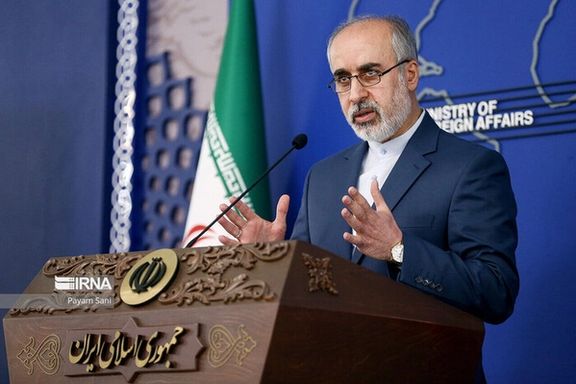
Iran's Ministry of Foreign Affairs spokesman Nasser Kanaani
Iran's Ministry of Foreign Affairs claims that the $6 billion in resources released by the United States in Qatar are accessible to Iran in spite of calls from Washington to withhold it.
Nasser Kanaani said Monday that “the country has the freedom to utilize the funds based on its needs", in response to the approval of a bill in the US Congress aimed at blocking Iran's assets in Qatar.
Kanaani said, "The bill necessitates approval from the US Senate and the President of the United States to become operational. The US government, bound by its international commitments and agreements with Iran concerning the released financial resources involving third-party countries, is obligated and committed. We have secured necessary assurances in this regard."
On Thursday, the US House of Representatives passed a bipartisan measure titled the "No Funds for Iranian Terrorism Act." The measure aims to prevent Iran from accessing the $6 billion recently transferred by the US in a prisoner swap. Republicans pushed for the step in response to Iran's alleged involvement in the Hamas attacks on Israel on October 7, which triggered the worst conflict in Gaza since the Iran-backed group took control in 2007.
The tentative agreement between the US and Iran in August led to the release of five detained Americans in Tehran and an undisclosed number of Iranians imprisoned in the US. The agreement involved the transfer of billions of dollars in frozen Iranian assets from banks in South Korea to Qatar. However, following the Hamas attack, the US and Qatar agreed to restrict Iran's access to the funds, stopping short of a complete refreeze.
Three Baha'i citizens in northern Iran, have collectively been sentenced to 33 months of imprisonment for establishing and operating a daycare center.
According to the judgment issued on Saturday, Soha Sabeti received a sentence of 33 months of punitive imprisonment, a 13-year prohibition from engaging in any educational activities, and a cash penalty of approximately $750.
Similarly, Behrouz Rahmani and Sanaz Alizadeh Roshankouhi were each handed a 10-year ban on educational activities, accompanied by a cash penalty of around $500.
The charges include "managing and membership in groups, societies… within the country with the aim of undermining national security, promoting the interests of groups or organizations opposing the Islamic Republic system, engaging in educational activities, and promoting the Baha'i Faith."
The revolutionary court judge claimed the group were involved in educational activities and the implicit promotion of the Baha'i Faith, incorporating its principles and beliefs, especially aimed at children, forbidden under the Islamic Republic which only permits the practice of Christianity, Judaism, Zoroastrianism and Islam.
Recent weeks have witnessed a surge in pressure from security and judicial institutions targeting the roughly 300,000 strong Baha'i community.
Baha'is constitute the country's largest non-Muslim religious minority and have faced systematic persecution and harassment since the revolution of 1979 and the establishment of the Islamic Republic.
Iran denies challenges in obtaining foreign currency, contradicting tangible signs of shortages of vital imports in the Iranian market and a plummeting rial.
Amid the government's faltering attempts to assert control over the foreign exchange market, Mohammad-Reza Farzin, the governor of the Central Bank of Iran (CBI), said Sunday that Iran faces no obstacles in acquiring dollars or euros. He also emphasized that the government has access to recently released funds from South Korea that are on deposit in Qatari banks. However, the market realities in Iran tell a different story.
The United States agreed to unblock the funds and allow Iran to use the money for imports of non-sanctionable goods, presumably for vital needs such as food and medicine. The funds reached Qatar in September but so far there have been no reports of Iran spending it to ease shortages in the country.
In addition to animal feed that is essential for the country’s food supply chain, shortages have also hit Iran’s pharmaceutical industry which heavily relies on the government for hard currency to import raw materials. In November, the Food and Drug Organization of Iran reported a shortage of approximately 100 types of essential drugs within the country.
The economic challenges faced by Iran, exacerbated by US oil sanctions, have strained the government's ability to allocate foreign currencies. Despite an increase in oil exports in recent months, reaching nearly six times the 2019 levels at approximately 1.5 million barrels per day, the Iranian rial is near an all-time low. With inflation soaring above 60 percent, the country is facing a complex economic situation that is directly affecting the healthcare sector and the well-being of its citizens.
With the Iranian currency rial in historic decline, the government has implemented various measures to curb devaluation, with little impact. Government-controlled currency exchange mechanisms and fixed rates ordered by the authorities have proven ineffective, with the official rate significantly lower than the open market. Limited availability of foreign currency at the lower government rate has pushed buyers toward the unofficial black market. In an attempt to keep tabs on the unofficial foreign currency exchange market, the Iranian government has also criminalized a broad spectrum of "unauthorized" transactions, including those in the virtual space. However, these measures seem to have little impact on the currency's downward spiral.
“We aim to gradually move towards making the country's exchange center the primary reference for currency exchange rates," Farzin said in a desperate attempt to foster hope.
Officials repeatedly claim to conduct business with friendly countries using local currencies such as the Chinese yuan and Russian ruble. Farzin has gone so far as to suggest replacing local currencies with the dollar and euro. “We are pursuing the substitution of local currencies in dealings with neighbors, including Iraq, Turkey, and Syria,” Farzin said.
As the government desperately tries to control the currency market, the Iranian rial tithers on the verge of another large devaluation. Since the US withdrawal from the JCPOA nuclear accord in 2018, the currency has lost 12-fold of its value. The rial is currently trading at over 500,000 to the US dollar, a stark contrast from around 250,000 rials just a year ago.
In the current climate of a possible wider conflict across multiple borders from Yemen to Iraq, Palestine to Syria, Iran continues to dedicate billions of dollars to its domestic and foreign armies, with capabilities showcased in grand displays from Iran to Lebanon.
A delegation of Sudanese officials has visited Iran on a mission to purchase Iranian-made drones, as a UN arms trade embargo expired in October.
Informed sources disclosed to Iran International that the delegation's primary objective was to acquire knowledge on the operation and utilization of the drones, which have been seen to be used in the likes of Russia's war on Ukraine and by the Houthis against Saudi Arabia and the United Arab Emirates. Russia has used hundreds of Iranian kamikaze drones against infrastructure and civilian targets in Ukraine.
The move comes in the wake of the US Defense Department's revelation that it had detected an Iranian drone flying over Sudan. Iran International has now learned that this particular drone is part of a broader initiative by the IRGC to sell unmanned aerial vehicles to Sudan, aiming to enhance its influence in the region.
Sudan has been garnering attention for its use of Chinese and Iranian-made drones, which are proving to be potent assets in the country's ongoing conflicts. The deployment of the unmanned aerial vehicles (UAVs) is seen as having the potential to significantly impact the dynamics of the long-standing hostilities between government forces and various rebel groups.
For years, Iran has been a key supplier of drones to Sudan, with the country steadily building up its capabilities from reconnaissance to attack. Among the Iranian-made drones deployed by Sudan is Ababil-3, a small and lightweight UAV capable of carrying a 45-kilogram warhead.
A view of drones during a military exercise in an undisclosed location in Iran, in this handout image obtained on August 24, 2022.
Additionally, Sudan operates drones from the Mohajer series, including the Mohajer-2, Mohajer-4, and the latest Mohajer-6, showcasing the country's commitment to advancing its drone capabilities.
The Iranian Revolutionary Guard (IRGC) has faced accusations of contributing to regional destabilization by supporting proxy groups in the Middle East and beyond. Critics argue that the IRGC's involvement in various conflicts raises concerns among international stakeholders about Iran's influence and its potential impact on regional stability.
Under the 2020 US-brokered Abraham Accords, normalizing relations with Arab states and Israel, Sudan quietly agreed to sign up, with the promise of being removed from the US terror list, but as yet, it has still not formalized ties with the Jewish state, the archenemy of Iran.
Sudan, still a conduit for weapons being passed from Iran to its proxies including Hamas and Islamic Jihad in Gaza, is yet to sign a formal deal, and fears are that the lure of Iran amidst Sudan's civil war, may be enough to sidetrack it from its US-brokered entry into 'the new Middle East'.
Three Iranian singers have released an album in memory of the former IRGC commander Qasem Soleimani.
Titled "Qasem is Still Alive," the album features songs by Ali Reza Eftakhari, Sadeq Ahangaran, and Gholamreza Sanatgar. Published by the Center for the Arts Music Department, the album seeks to immortalize Soleimani, who was killed in a US drone strike near Baghdad International Airport in 2020.
The strike was ordered by then-President Donald Trump, who claimed Soleimani was actively planning attacks on American diplomats, service members, and members of the administration in the region.
Despite the Islamic Republic's efforts to portray Soleimani as a national hero, ordinary Iranians have expressed their discontent by setting fire to or destroying statues and banners depicting him as an icon of the Islamic autocracy.
Instances of such protests occurred during the anniversary of Soleimani's death, with people in various cities, including Tehran, Karaj, Zarinshahr, Rafsanjan, and his hometown Kerman, burning statues and posters in defiance.
Soleimani's legacy remains contentious, with many Iranians viewing him as responsible for spreading violence in the region through Iran's proxies, and contributing to violent repression at home.
Iran has declared a comprehensive ban on the entry of Afghan nationals into 16 provinces across the country.
The Director General of Citizenship and Foreign Nationals Affairs of Kermanshah Province, Hamzeh Soleimani, confirmed on Sunday that settlement and employment of Afghan citizens are currently prohibited in provinces including Kermanshah, under a newly issued directive.
The directive, comprising eight stages for the identification, detention, and deportation of unauthorized nationals in Kermanshah, has been underway since the start of the year (March 21).
“Numerous housing construction projects, greenhouses, horse stables, and livestock farms underwent inspection under the plan, leading to the arrest and expulsion of Afghan workers from the province,” noted Soleimani.
The official also reported the detention of employers who had hired the individuals, emphasizing the severity of the measures taken.
Although specific provinces were not mentioned in the announcement, the Farda-e-Eghtesad website disclosed a list of 15 provinces where the residence of Afghan citizens is now prohibited. These include East Azarbaijan, West Azarbaijan, Ardabil, Zanjan, and others.
Simultaneously, Ahmad Vahidi, the Minister of Interior in Ebrahim Raisi's administration, revealed the expulsion of approximately 400,000 migrants living “illegally” in Iran. However, details regarding their nationality and the timeframe for their return to their home countries were not provided.
The development follows over 540 artists, lawyers, doctors, journalists, and activists demanding an end to harassment against Afghan migrants in Iran in October. Amnesty International has also warned of the serious risks, particularly for Afghan women and girls, exposed to harassment and abuse solely based on their gender.
Afghan refugees have been streaming through the border in recent years, with their total number now estimated to be between six to seven million, according to the Iranian Parliament’s Research Center expert.