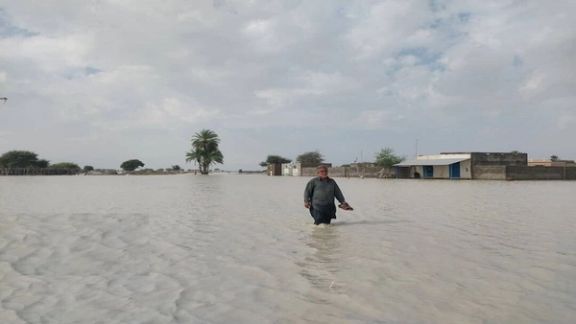
File photo of flood-stricken areas in Sistan-Baluchestan province
Heavy rainfalls and flooding of local rivers have so far claimed the lives of at least eight people in Sistan-Baluchestan, dealing a heavy blow to the infrastructure of the southeastern Iranian province.
According to the Iranian Red Crescent Society, the flooding resulted in the collapse of a loader and the deaths of three employees of Iran’s Railway company in Khash to Iranshahr road.
Meanwhile, Majid Mohebbi, the director general of Sistan-Baluchestan’s Crisis Management Department, said that heavy rains and flooding caused the closure of 45 rural roads, 12 sub-roads and one main road in the south of the province.
We have reports of the disconnection of telecommunications in 60 villages of Zarabad, Konarak and Chabahar towns due to a problem in their optical fiber, Mohebbi said, further adding that the amount of rainfall in the last two days in the province has “exceeded the forecast.”
A 5-year-old Baloch girl in the village of Kach, Dashtiari district, lost her life after falling into a water hole created due to recent rains and floods.
According to the Iranian media, the relief forces managed to rescue 70 passengers of three buses which were caught in flood on Nikshahr-Chabahar route.
Local officials have urged people to take precautions and avoid unnecessary travels in the province.
Issa Ghazi, agricultural director of Konarak, said that according to the preliminary estimates, the heavy rains over the past two days inflicted more than 5,000 billion rials ($8 million) of damage to the facilities and infrastructure of the agricultural sector, including poultry houses, orchards and farms.
In Nikshahr, 12 villages have lost power as a result of heavy rainfalls and storms.
In a statement issued on Thursday, Sistan and Baluchestan’s Department of Environment warned of the detrimental impacts of the recent flooding on the wildlife.
“Following recent rains, flooding of all rivers and collapse of most dams in the province, it is not unexpected to witness stress and tension in wildlife, especially among native crocodiles. There is a possibility that the crocodiles will leave their primary habitat pond,” the statement added.
Mugger crocodiles, also known as “gando” in the local Baluchi dialect, are medium-sized broad-snouted crocodiles native to southeastern Iran and the Indian subcontinent.
State-sponsored Borna news agency wrote that despite its damages, the heavy rainfalls “revived hopes for an end to the drought” in the province.
In February, the torrential rains in southern Sistan-Baluchestan triggered extensive flooding, particularly in the Dashtyari region, leading to submerged residential areas and the closure of numerous roads. Hundreds of households also incurred damage due to the floods.
Furthermore, monsoon rains in the province in July 2023 led to the flooding of local rivers, closure of at least 42 roads and damage to hundreds of hectares of palm groves – an important source of income in the impoverished and arid region.
Experts attribute the recent flooding in Sistan-Baluchestan, a heavily drought-stricken region, to the consequences of global warming and climate change.
In an interview with Etemad daily Mehdi Zare, a geologist, remarked that “global warming tends to increase the intensity of extreme rainfall events,” further adding heavy rainfall is a telling aspect of the water cycle.
Sistan-Baluchistan is an economically challenged province in southeastern Iran adjacent to Afghanistan and Pakistan and home to a substantial Sunni community, which has been largely oppressed by the Iranian regime over the past decades.
Activist and Islamic scholar Sedigheh Vasmaghi, imprisoned for her opposition to the mandatory hijab in Iran, was sent to hospital from Tehran's notorious Evin prison on Monday without a headscarf.
It is an unprecedented move from Iran's authorities who refuse treatment to prisoners unless they comply with compulsory hijab regulations. High profile cases such as Nobel Laureate Narges Mohammadi have been the face of the regime's brutality for prisoners compelled to wear hijab in exchange for medical treatment. Mohammadi was the sole activist reportedly granted hospital visits without hijab on three separate occasions.
Vasmaghi's Instagram account reported on Wednesday that she was taken to the hospital for eye tests with three male and female agents while refusing to wear a headscarf. It is unclear how the regulations were waived when so many cases have been denied treatment.
The outspoken activist was arrested in early March for her criticism of the compulsory hijab law and for describing Supreme Leader Ali Khamenei as a “dictator” and the regime in power as “oppressive.”
Over 300 political and civil activists in Iran have campaigned for her release in the past week and expressed concern for her health. They expressed their dismay that Vasmaghi had been imprisoned despite her severe visual impairment.
Prior to this, Vasmaghi was denied access to adequate medical care. Iran International had learned from a family source that her health deteriorated on Monday morning, with her heart rate exceeding 120 and her blood pressure exceeding 160.
Narges Mohammadi, a Nobel laureate and jailed Iranian human rights activist, also expressed concern about Vasmaghi’s well-being and wrote on her Instagram account on April 2: "I protest against the government's terrible and deadly repression against Iranian women."
Nevertheless, Vasmaghi, the former professor at Tehran's university, has been vocal in her protests while in prison. Against the backdrop of Iran's recent crackdown on women for hijab rules, in a message from April 2024, Vasmaghi condemned the government's actions as "antipatriotic and contrary to national interests."
The finance ministers of the Group of Seven (G-7) condemned Iran’s “unprecedented attack” against Israeli territory, vowing close cooperation to impose new sanctions on Tehran.
“We will ensure close coordination of any future measure to diminish Iran’s ability to acquire, produce, or transfer weapons to support its destabilizing regional activities,” read the statement released Wednesday by G-7 finance ministers following negotiations on the sidelines of the International Monetary Fund and World Bank Group Spring Meetings in Washington, DC.
The ministers also warned against any regional escalation and its concomitant economic risks, particularly those to international shipping.
Italian Foreign Minister Antonio Tajani, who hosts this round of G7 summit, said Thursday that the foreign ministers of the group “will address the most sensitive issues on the agenda.” He elaborated, “We will certainly discuss the Middle East issue. We are friends of Israel, and we support Israel, but we want de-escalation in that area. We will also have to address how to sanction Iran in some way for the attack with hundreds of missiles and drones against Israel.”
“We will also have to deal with the other situation in the Middle East, and the maritime traffic through Suez and the Red Sea, an issue that involves all our countries since the merchant traffic is threatened by the Houthis,” he added.
Since November, Iran-backed Yemeni Houthis have been engaged in a blockade in the Red Sea, the Gulf of Aden, and the Bab el-Mandeb Strait in a bid to force a ceasefire on Israel. The group launched its campaign to attack Israeli vessels but it has since expanded to all global shipping.
Meanwhile, European Union leaders pledged more sanctions against Iran, urging the regime and its proxies to put an end to their attacks in the region.
The EU “will take further restrictive measures against Iran, notably in relation to unmanned aerial vehicles and missiles,” said the statement issued Wednesday after the first day of the bloc leaders’ summit in Brussels.
On Saturday night, Iran launched its first ever direct offensive against Israeli territory with more than 350 drones and cruise and ballistic missiles.
French President Emanuel Macron stressed that the new sanctions should target “those who are helping to produce the missiles and drones that were used” in Iran’s offensive.
Israeli Foreign Minister Israel Katz welcomed the EU's decision to ramp up Iran’s sanctions, calling it “an important step on the way to defanging the snake.” According to Katz, “Iran must be stopped now before it is too late.”
Amid a wave of international condemnation, the Permanent Representatives of 48 countries at the United Nations condemned Iran’s attack on Israeli territory in a joint statement on Wednesday.
“We unequivocally condemn the April 13 attacks by the Islamic Republic of Iran and its militant partners on the State of Israel, which involved launching several hundred ballistic missiles, cruise missiles and attack drones against multiple targets, and note this large-scale attack could have caused significant damage and loss of life,” read the statement.
They also lambasted Iran’s move to “violate” the airspace of several regional countries such as Jordan which helped intercept the barrage, noting that it endangered the lives of innocent people.
A Kurdish political prisoner who self-immolated at the Central Prison of Orumieh, was transferred to solitary confinement after going on hunger strike.
According to Hengaw Human Rights Organization, Hassan Omarpour, 29, who went on strike to protest his prison conditions and the prosecutor's harsh treatment of his family who have also been intimidated since his imprisonment, has been deprived of all his fundamental rights since Sunday.
Omarpour was sentenced to 10 years in prison in March last year on the charge of "cooperating with Israeli intelligence and espionage."
A year earlier, he and nine other citizens were arrested on similar charges. Following several months of torture in solitary cells, four were executed in January, according to Hengaw.
Omarpour self-immolated in February in response to prison guards attacking him and his inmates.
Kurds continue to come under disproportionate oppression in Iran along with minorities such as the Bahai and Baluch.
Of last year’s record numbers of executions, large numbers were Kurds and minorities.
The United States could get into war with Iran if Tehran launches a major attack on Israel, Joe Biden has said, amid a cacophony of threats and counter-threats from officials in Tehran and Jerusalem.
In an op-ed for Wall Street Journal Wednesday, President Biden called on the US Congress to pass military aid for Israel to ensure that it’s “fully stocked and ready” to defend herself.
“If Iran succeeds in significantly escalating its assault on Israel, the US could be drawn in,” Biden warned. “Israel is our strongest partner in the Middle East; it’s unthinkable that we would stand by if its defenses were weakened and Iran was able to carry out the destruction it intended this weekend.”
President Biden has been trying hard since October 7 to avert a full-scale war in the Middle East, exhausting overt and covert diplomatic channels to restrain Israel and Iran. His job has become much more difficult since April 13, when the Iranian regime launched more than 300 drones and missiles towards Israel in response to the bombing of one of its buildings in the Damascus embassy, which killed the IRGC’s top commander in Syria and his deputy.
In the past few days, officials in both Israel and Iran have hardened their rhetoric, uttering threats that seem to get more severe by the day.
On Wednesday, Israel’s finance minister Bezalel Smotrich said that Israel’s response to Iran’s attack should inflict a “disproportionate toll” and “rock Tehran” so that the leaders of the country “regret the moment they even thought about firing”.
Smotrich is the leader of the far-right Religious Zionism party, He is not a member of the war cabinet, but wields considerable power because a ‘coalition deal’ means he is technically also a minister in Israel’s defense ministry. Speaking to Israel’s Army Radio (GLZ), he called for an Israeli retaliation that would make the Iranian regime “realize they shouldn’t mess with” Israel. “This is the language spoken in the Middle East,” he said.
In Tehran, President Ebrahim Raisi proved that this was indeed the language spoken in the Middle East. Even the “tiniest” Israeli attack on Iran, he said at a military parade, would bring “a severe and harsh response.” The IRGC commander in charge of missiles and drones, Amir Ali Hajizadeh, seconded the president. Asked by a reporter if they would strike Israel again if they retaliate against Iran's attack, he said “one-hundred percent.”
But this wasn’t the end. There were more threats to come from Israel.
Former director of intelligence at Mossad, Zohar Palti, suggested in an interview that targeting nuclear facilities can be an option. “Everything is on the table right now,” he told the British broadcaster Sky News. Asked whether that included targeting nuclear facilities, he said, “including everything.”
Palti is not an Israeli official. But Smotrich is. So are Raisi and Hajizadeh and many more voices on both sides calling for severe measures to establish ‘deterrence.’
The Biden administration –and other world leaders to a lesser extent– will have a difficult task de-escalating a situation that seems to be getting more tense by the day.
The US and the EU have announced their intention to impose more sanctions related to Iran, targeting those individuals and entities that help Tehran's destabilizing activities. However, that the effective way to exert pressure is to enforce the oil export sanctions already in place that the Biden administration has not pursued vigorously.
After a meeting with the British and German foreign ministers, Israeli Prime Minister Benjamin Netanyahu stated that Israel will make its own decisions regarding its response to Iran's missile and drone attacks.
"I thank our friends for their support for Israel's defense, both in words and in deeds. They also have various proposals and advice, which I appreciate, but I want to clarify that we will make our own decisions. The State of Israel will do whatever is necessary to defend itself…,” Netanyahu said.
British Foreign Secretary David Cameron and German Foreign Minister Annalena Baerbock had traveled to Jerusalem amid the escalating tensions between Iran and Israel,
Experts say their visit was likely intended to express solidarity following Iran's attack on Israel and to discuss the ongoing war in Gaza, including the humanitarian aid situation.
While Cameron emphasized the importance of minimizing escalation and ensuring a “smart” approach, he told reporters after the meeting that “it's clear the Israelis are making a decision to act".
The British Foreign Secretary also wrote on Xthat during the meeting he told the Israeli Prime Minister that they “must maintain [their] focus on getting more aid into Gaza and getting hostages out".
Echoing those comments, Baerbock reiterated Germany's solidarity with Israel while she cautioned against escalation, stating that “everyone must now act prudently and responsibly”.
“A spiraling escalation would serve no one, not Israel’s security, not the many dozens of hostages still in the hands of Hamas, not the suffering population of Gaza, not the many people in Iran who are themselves suffering under the regime, and not the third countries in the region who simply want to live in peace,” Baerbock said.
Iranian President Ebrahim Raisi meanwhile threatened that even the slightest incursion into Iran would trigger severe retaliation, like increasing the diplomatic pressures on Israel to avoid a major escalation.
Speaking today at Iran’s annual Army Day, which was relocated to a barracks without any explanation from the authorities, Raisi warned that even the "tiniest invasion" by Israel would be met with a "massive and harsh" response from Iran.
G7 foreign ministers are also meeting this week in Italy to discuss targeted sanctions against Iran and are widely expected to issue a joint plea urging Israel to show restraint in its response to Iran.
Italian Foreign Minister Antonio Tajani, who is hosting the talks, told AFP that the ministers were "working" on implementing some form of sanctions against Iran.
The US, Israel's key ally, has similarly pledged to impose further sanctions in the coming days.