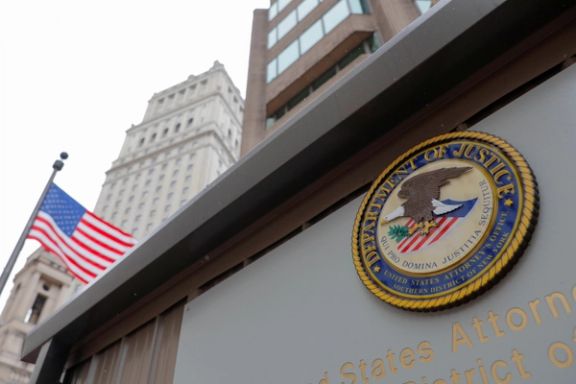
The seal of the United States Department of Justice is seen on the building exterior of the United States Attorney's Office of the Southern District of New York in Manhattan, New York City, U.S., August 17, 2020.
The US State Department on Monday released its annual report on Iran's human rights situation, stressing that the country's "already severe restrictions on human rights worsened in a number of areas" during 2023.
The report outlines an increase in government restrictions and violence against citizens. It also highlights discriminatory laws and executions, including those of juveniles. It documents arbitrary killings, enforced disappearances, and widespread torture by the Iranian government forces aimed at suppressing any opposition.
“Women continued to face discrimination, including through enhanced means for enforcing the mandatory dress code, which led to acts of civil disobedience,” read the report.
Notably, the report mentions the sharp increase in executions, with 798 citizens executed, marking a 37% rise from the previous year. Many of these executions involved minor or politically motivated charges, often after unfair trials or forced confessions, the report said. “There were numerous reports that the government or its agents committed arbitrary or unlawful killings, including extrajudicial killings, during the year.”
The role of the Iranian judiciary, especially the Revolutionary Courts, is particularly criticized for denying fair trial rights and due process.“As documented by international human rights observers, so-called revolutionary courts continued to issue the majority of death sentences and failed to grant defendants due process,” read the report, adding that the courts “regularly denied defendants legal representation and, in many cases, solely considered as evidence confessions often extracted through coercion or torture.”
The report also discusses severe restrictions on freedoms of expression, assembly, religion, and the press, with the government imposing harsh penalties on those who dissent. Internet and media freedoms are severely curtailed, with the regime employing censorship, surveillance, and intimidation to control information and suppress activism.
The US State Department specifically singled out the Islamic Republic’s threats against Iran International journalists, which forced the network to temporarily relocate its studios to Washington.
“In February, media outlet Iran International temporarily relocated its headquarters from London to Washington, DC, after London’s Metropolitan Police warned the organization that their journalists were facing threats that posed an imminent, credible and significant risk to their lives and those of their families,” the report noted.
The report also referred to a statement by Iranian Intelligence Minister Esmail Khatib, who said in November 2022 that “the Islamic Republic recognized Iran International as 'a terrorist organization' and that anyone affiliated with the channel would be pursued.”
Additionally, the report underscores the plight of ethnic and religious minorities, who face systemic violence and discrimination. It also notes the government's failure to address gender-based violence and the mistreatment of women and LGBTQ+ individuals.
The spokesperson for the Iranian Foreign Ministry denied Monday that the Swiss ambassador in Tehran was summoned by the Revolutionary Guards over recent tensions between Iran and Israel.
The controversy began last week when Mojtaba Abtahi, an advisor to the minister of interior, claimed that "At 3 AM on Monday, April 14, when the Iranian attack on Israel was nearly finished, the Swiss ambassador, representing US interests, was summoned not to the ministry of foreign affairs, but to a Revolutionary Guards base."
The story was backed by a report in The New York Times, which stated that during the attack on Israel, the Swiss ambassador was indeed summoned, but to a Guards' base.
In a press conference on Monday, Nasser Kanaani claimed that "there has been continuous contact with the Swiss ambassador in Iran, and the diplomatic apparatus has acted completely professionally." He also highlighted Switzerland's role as a crucial conduit for diplomatic communications between the US and Iran.
Such a move would be a breach of diplomatic protocol, as traditionally, any official dealings with an ambassador -- even those concerning military or economic issues -- are managed by the host nation's foreign ministry. The alleged bypassing of official diplomatic channels is another proof for the potential sway of the Guards over the Iranian foreign ministry.
Last Saturday, Tehran launched350 or more missiles and combat drones in retaliation for Israel’s April 1 air strike on the Iranian consulate in Damascus, killing a senior IRGC-Quds Force commander and several IRGC personnel. Israeli forces, backed by the US and other allies, intercepted approximately 99%, while the few that survived caused only minor damage. On Friday night, an air defense system at an Iranian air base in Isfahan was hit by an Israeli attack.
For the first time in nine years, Iran has resumed sending Muslim pilgrims to Saudi Arabia for Islamic pilgrimage to Mecca, after receiving approval from Riyadh.
Two groups, each consisting of 85 people from Iran, began their journey to Saudi Arabia to perform what’s known as the Umrah.
The non-mandatory Islamic pilgrimage can be undertaken at any time of the year, unlike the Hajj which has specific dates according to the Islamic lunar calendar.
After years of diplomatic estrangement between Tehran and Riyadh, and aninitial cancellation of the flights, the first departure was marked on Monday from Tehran’s main airport.
Representatives of Supreme Leader Ali Khamenei and Saudi Arabian Ambassador to Iran, Abdullah bin Saud Al-Anzi, were reportedly in attendance.
Nearly two years ago, with mediation from China, Tehran and Riyadh reached an agreement to reopen embassies and exchange ambassadors, thereby restoring diplomatic ties.
In 2016, Saudi Arabia severed ties with Iran after protesters stormed its embassy in Tehran. This occurred amid waves of protest against Riyadh's execution of a Shiite cleric.
Relations deteriorated further due to subsequent events, including missile and drone attacks on Saudi oil facilities and tankers in the Persian Gulf, carried out by Iran-backed Houthi militia in Yemen.
On Monday, Iran announced that it would operate two daily flights, each carrying 260 passengers, from various cities across the country.
The flights are set to continue until May 12 from different airports, with a total of 44 round trips scheduled, to fly 5,610 Iranian pilgrims to Saudi Arabia.
The European Union has reached an agreement to bolster sanctions against Iran in response to Tehran’s attack on Israel this month, following a meeting of the bloc's foreign ministers.
In a press briefing held in Luxembourg on Monday, EU foreign policy chief, Josep Borrell, said EU members had agreed for new sanctions to cover the production of missiles and enlarge the catalog of prohibited drone-related components.
The measures are expected to build upon existing sanctions imposed on Iran for its involvement in supplying drones to Russia for its invasion of Ukraine.
“The sanctions would also be expanded beyond Russia to cover drone and missile deliveries not only to Russia but also to proxies in the region," Borrell added.
Citing the use of Iranian missiles against Israel, Lithuanian Foreign Minister Gabrielius Landsbergis pointed to the need to restrict the transfer of missile components.
Lithuania, and a coalition of nine countries including Germany, France and the Netherlands, had previously called for an expansion of sanctions targeting Iran's drone and missile industry.
Josep Borrell, High Representative of the EU for Foreign Affairs and Security Policy, during an EU Foreign Ministers’ meeting in Luxembourg on April 22, 2024
Israeli Foreign Minister Israel Katz welcomed the move, expressing his support for the sanctions on X. In the post, written in Persian, Katz underscored the significance of the EU's action in sending a clear message to the Iranian regime – tagging the country’s Supreme Leader Ali Khamenei.
Israel had also called on Western countries to list the state’s paramilitary force – the Islamic Revolutionary Guards (IRGC) – as a terrorist entity.
While the EU has sanctioned a number of individual IRGC members on human rights grounds following domestic acts of repression, it has not followed through with a designation arguing there are no legal grounds for it. This despite the European Parliament’s approval of a resolution calling on the bloc to consider the “terrorist” designation early last year.
Several foreign ministers voiced concerns about the stagnation of nuclear negotiations with Iran – although the issue was not on Monday's EU foreign ministers' agenda.
Landsbergis expressed skepticism about the viability of the Joint Comprehensive Plan of Action (JCPOA) - abandoned by the Trump administration in 2018, while his Austrian counterpart, Alexander Schallenberg, likened Iran's nuclear ambitions to a "black box," citing a lack of transparency and trust in international efforts to monitor its activities.
Sweden's Foreign Minister Tobias Billstrom, meanwhile, emphasized the importance of including Tehran’s proxies in the sanctions, recognizing their role in exacerbating regional tensions in the Middle East.
The Iranian foreign ministry claimed on Monday that nuclear weapons have no place in its nuclear doctrine.
The statement came in response to heightened tensions with Israel and recent remarks by a Revolutionary Guards commander that suggested potential changes to Iran's nuclear policy under external threats.
"Nuclear weapons have no place in our nuclear doctrine," said ministry spokesperson Nasser Kanaani during a press briefing in Tehran. He once again claimed that Iran's nuclear program is “strictly for peaceful purposes,” a position consistently maintained by Tehran despite international scrutiny.
Iran's Supreme Leader, Ayatollah Ali Khamenei, had previously issued a fatwa banning the development of nuclear weapons.
However, nuclear experts are almost unanimous in their assessment that enrichment to the levels and in the amounts that Iran has been doing since 2021 cannot be justified in the absence of a weapons program.
Despite Kanaani's reassurance of peaceful intentions, he addressed recent regional escalations, particularly the Iranian missile and drone attack on Israel earlier this month, which Tehran says was a retaliatory act for the attack on its consulate in Damascus.
The incident at Isfahan has further strained relations, with reports from The New York Times indicating significant damage to a defense radar near Natanz, Iran’s principal nuclear site, after the attack on 8th Shekari Air Base.
Iran’s Judiciary has mandated provincial justice departments to cease registering legal complaints against state officials, a move widely seen as a way to further shield government and military officials from facing accountability.
The latest directive instructs that instead of allowing individuals to file legal complaints directly, they are now told to go to the administrative offices or public relations departments of the relevant government organization.
While the Iranian judiciary lacks independence, individuals file legal complaints, akin to those in the West, before initiating lawsuits to assert their rights.
Prominent journalist and political analyst Abbas Abdi criticized the directive, saying the move is not lawful.
“This resolution is not legal because neither 'government officials and state leaders' have been defined, nor has any legal article been mentioned. These are futile patches sewn onto regulations to block the paths of protest," Abdi said.
In Iran, numerous high-ranking officials and military organizations – including members of the Islamic Revolutionary Guards (IRGC) – possess legal immunity, shielding them from prosecution.
In one prominent case, when the IRGC shot down Ukraine International Airlines Flight PS752, resulting in the deaths of all 176 people onboard – families were told by the Tehran Military Prosecutor’s Office that several government and military organizations and several high-ranking officials cannot be legally prosecuted.
Critics have long argued that it is one more indication of the regime’s culture of impunity – where corruption, abuse of power, and human rights violations by officials are not confronted with legal consequences.