Rumors, Conspiracy Theories Abound After Raisi’s Death
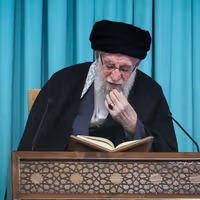
Mojtaba Khamenei, the Supreme Leader’s son, during a demonstration
Iranians flooded social media platforms with jokes and speculations about the circumstances and the cause of the air-crash that killed President Ebrahim Raisi, many pointing fingers at Mojtaba Khamenei, the Supreme Leader’s son.
Mojtaba is widely seen as the frontrunner to succeed his 85-year old father. The premise of, and the main theme running through, most such posts is that Raisi could have been a contender in the unofficial, unspoken race to become the next ruler of the Islamic Republic, and therefore had to be ‘removed.’
The word ‘removed’ (or ‘erased’) is, in fact, quite telling, as it suggests a human intention and action instead of an accidental air crash.
There is, of course, no conclusive evidence—nor even much circumstantial evidence, so soon after the incident—to prove the assertion that Raisi’s death wasn’t an accident or that Mojtaba had any involvement. But evidence is the purview of courts of law; it is an integral part of due process. Neither exists in Iran today, nor does public trust in the state and its institutions. What does exist in abundance, however, are rumors, hearsay, and conspiracy theories.
“In Iran's conspiratorial political culture few will believe Raisi’s death was accidental,” Karim Sadjadpour of Carnegie Endowment for Peace posted on X Sunday night, hours before it Raisi’s death was confirmed.
And there was no need to wait, as far as ordinary Iranians are concerned. There was no need, no point, in waiting for official announcements, because “they never tell the truth anyway,” according to Amirhossein, a 35-year electrician turned activist after losing a close relative when the IRGC shot down a Ukrainian aircraft minutes after it took off from Tehran’s international airport.
“They lied then, they lie now. They’re actually incapable of telling the truth,” Amirhossein added. “Many hours after [Raisi’s] death was confirmed, they published pictures of the crash scene that were found out to be from another crash a few years back. Why would you do that if you didn’t think that real photos of the crash site could contain clues that would help experts establish this wasn’t an accident?”
This has indeed been a recurring question by many Iranians on social media: why publish photos of another accident if you have nothing to hide?
Not everybody is that serious, of course. Many Iranians' preferred reaction is to ‘mock and walk’, not attaching enough value to official statements to try and disprove or discredit them. The regime, as far as these Iranians are concerned, has been completely found out. Suffice it to remind the crowd of what they all know, have a laugh, and move on.
As far as the Iranian regime is concerned, the jokes are perhaps hardest to suppress –and perhaps most impactful. They spread around like wildfire and reduce the officials, from the Supreme Leader down to local apparatchiks, to burnt sticks, devoid of all authority –and clothes.
There are several theories as to what may have led to the chopper crash that killed Iran's President Ebrahim Raisi and other officials in the mountainous terrain near Azerbaijan.
From humorous "conspiracy theories" about an alleged Israeli Mossad agent named "Eli Kopter" planning the crash, to the more plausible theory of inclement weather, there is no shortage of speculation.
According to Iran experts, one narrative emerging from Iranian regime insiders seems to play over and over again like a broken record: blame the US.
Iran's former foreign minister, Mohammad Javad Zarif, who was part of the administration responsible for the shooting down of Ukraine International airlines PS752 in January 2020, said the US sanctions on Iranian aviation were one of the main factors behind the crash.
In a phone interview with state TV on Monday, Zarif said the sanctions prevent Iran from having good aviation facilities.
"One of the culprits behind yesterday’s tragedy is the United States, because of its sanctions that bar Iran from procuring essential aviation parts," said Zarif during the interview.
Hossein Mousavian, a controversial Princeton University academic, who is being investigating by the US Congress for his pro-Iran regime activities echoed Zarif's sentiments on the platform X.
Patrick Clawson, a Research Counselor at The Washington Institute said he's not surprised regime loyalists would blame the US.
"It certainly fits with Iranian style, right? I've seen. Iranians are prone to believe in conspiracy theories, personal life, business life, and political life," said Clawson.
Clawson said since the year 2000, there have been at 20 deadly crashes in Iran, killing more than 1700 people, and that figure is not including the shooting down of PS752.
"Out of those 20 crashes. Well, eight of them were US made planes. And nine of them Russian made planes or planes with license to the Russians. And three of them European planes. So there weren't any sanctions on the Russian?
"20 crashes ...give me a break, folks. Your aircraft safety record is just dreadful," Clawson told Iran International.
Blaming US sanctions, he said, is a joke.
"Who the heck takes off in a helicopter, which is a hard thing to fly in in foggy weather and rain and night approaching with the president on board? Give me a break," he added.
Defense and security analyst Farzin Nadimi, a Senior Fellow with the Washington Institute, specializing in Iranian military affairs, said "this is a clear case of choice. To fly or not to fly."
Nadimi said "they chose to fly on US made helicopter that was built 30 or 40 years ago. Yes that was their choice."
While he acknowledges that the helicopter was under US sanctions, and that Iran would likely have to get spare parts using methods that are not recommended by the original manufacturer, he also said they had Russian made helicopters at their disposal.
"They shouldn't have any problems with that," said Nadimi referring to the Russian made helicopters.
The crash, he said, is the responsibility of the Iranian government, not the country that sanctioned them.
Senior fellow with the Atlantic Council and curator of The Iranist newsletter Holly Dagres said the onus is on the Islamic Republic.
"The upper echelons of the clerical establishment are always looking to find a way to blame the United States and Israel for their failings and mishaps. In this latest iteration, former Foreign Minister Mohammad Javad Zarif is blaming US sanctions on why the helicopter crashed when it was flying in adverse weather conditions," said Dagres.
Dagres, an Iranian-American, said this has more to do with Islamic Republic's mismanagement than it does with US sanctions.
"This is just another classic example of the Islamic Republic’s systemic mismanagement. Who decided to put the Iranian president and foreign minister on a helicopter without visibility due to dense fog?, " said Dagres.
She said the Iranian regime has no issues investing in drones and missiles even in the face of crippling sanctions.
"It’s well-known that the Islamic Republic has an outdated air fleet that uses parts purchased on the black market due to US sanctions. But this is the same government that believes in a “resistance economy” and prides itself on domestically made drones and missiles, which begs the question of why it hasn’t invested in aviation," said Dagres.
Could Zarif's messaging be an attempt to impress Iran's Supreme leader Ali Khamenei in a time of political turmoil?
Dagres said "Zarif talks like he wants to run for president."
The helicopter in question was a US Bell chopper made in the 1970s and purchased by Iran during the monarchy. The government confiscated it from an oil company in the 1980s and used it for official business, probably without making sure that it had the necessary parts to keep it in a safe flying condition.
The Islamic government also has close ties with Russia and China and could have acquired newer helicopters with a steady stream of spare parts.
The death of Iranian President Ebrahim Raisi has triggered a mix of official condolences contrasted with backlash from critics around the globe who see the condolences as approval of Raisi’s legacy as the 'Butcher of Tehran'.
Many European leaders and officials have voiced strong dissent against the European Council’s condolences. Geert Wilders, a well-known far-right leader from the Netherlands, vehemently rejected EU sentiments of sorrow, declaring them unrepresentative of their views and launching the hashtag "not in my name" on the social network X.
Wilders further criticized the current Iranian regime, expressing hope for a secular future for Iran free from what he describes as an "oppressive and barbaric Islamic mullah regime.”
President of the European Council, Charles Michel had released a statement saying "the EU expresses its sincere condolences for the death of President Raisi and Foreign Minister Abdollahian, as well as other members of their delegation and crew in a helicopter accident. Our thoughts go to the families.”
Wilders' statements rejecting the condolences have resonated across social media, garnering support from other European politicians like Charlie Weimers, Benjamin Haddad, David Lega, Nathalie Goulet, and Theo Francken, all of whom have publicly criticized the act of consoling Raisi’s death.
Critics argue that extending condolences to such a regime implicitly legitimizes its actions, which include suppression of dissent, support for terrorism, and ongoing human rights violations. At the age of 25 in 1984, Raisi became the deputy head of the Revolutionary Court, and by 1988, as deputy prosecutor of Tehran, he was part of the Death Committee, which oversaw the mass execution of thousands between August and September of that year.
French Parliament representative Benjamin Haddad openly questioned the appropriateness of mourning a regime that "hangs its freedom-loving young people, attacks its neighbors, produces drones that kill Ukrainian civilians, and supports terrorism."
Hannah Neumann, a member of the European Parliament and a critic of the Islamic Republic, told the people of Iran that Michel issued the condolence message in his personal capacity, not on behalf of Europe.
Amidst the international reactions, figures like Sergio Mattarella, the President of Italy, and Xi Jinping, President of China, also shared their condolences, with Xi calling the loss "a great tragedy for the people of Iran" and claiming "the people of China have lost a good friend." The sentiment faced criticism on Chinese social networks, with some users calling the crash "the best gift for Iranian women," reflecting the deep divisions in public opinion regarding Raisi’s rule.
The response from media outlets has been equally sharp, with the Australian Financial Review branding Raisi as an “executioner,” referring to his alleged role in mass executions and crackdowns during his time in power, well over 500 last year alone in a record wave of executions.
Iran's neighbors have been more sympathetic to the news. Pakistan declared a national day of mourning, a move that drew varied responses domestically and internationally. Similarly, leaders from Syria and Lebanon announced official mourning periods, underscoring the divisive nature of Raisi's influence.
Prominent leaders like Turkey’s Recep Tayyip Erdogan and Azerbaijan’s Ilham Aliyev have also paid their respects.
President Ebrahim Raisi's death in a helicopter crash is likely to impact the succession process for the 85-year-old Supreme Leader Ali Khamenei.
A new session of the Assembly of Experts, the body responsible for selecting the next leader of the Islamic Republic, was scheduled to begin on Tuesday, May 21. Whether the session will proceed as planned remains uncertain. Although Khamenei has declared five days of public mourning, the Majles (Parliament) has announced it will hold its session as usual on Tuesday.
However, Tuesday's session of the Assembly of Experts was particularly significant as an internal vote would be held on the opening day to determine the Assembly's new chairman and his deputies.
According to Iranian reporters Ebrahim Raisi who was the Assembly's most senior deputy chairman was the most likely candidate for the post of chairman. As the search was taking place for Raisi's body on Sunday, Iran International analyst Morad Veisi highlighted the significance of the session and Raisi's intended role in it. Since the election of the next Supreme Leader will depend on a relatively small group of clerics and politicians, the chairman’s role would be a crucial factor.
Meanwhile, alluding to conspiracy theories about the crash, Hossein Bastani, another Iranian analyst, reposted a line from one of his previous writings about succession in Iran while emphasizing that Khamenei's old age calls for more attention to succession in the coming round of the Assembly of Experts.
Bastani wrote: "The Leader has reached an age that insiders worrying for their interests in the future see no solution other than ripping each other apart." Most users commenting under the post were adamant that the helicopter crash was "engineered".
Several Iranian analysts, including Mehdi Khalaji, who spoke to Iran International TV in recent weeks, have said that Raisi was expected to play a key role as a kingmaker in the Assembly of Experts, potentially grooming Khamenei's son Mojtaba or a group of clerics for the country's leadership.
Although many speculated about Raisi being a contender for the position of Supreme Leader, analysts, including Khalaji, believe his role would have been limited to influencing the selection of the next leader. His task would have been to assist those operating behind the scenes in steering the Islamic Republic in a way that secures their power and financial interests.
In another talk show on Iran International, Khalaji said that as Khamenei made most of the key decisions in Iran and other politicians are not capable of handling major domestic political and international issues, his absence on the scene will bring about a serious crisis in Iran.
Key players, such as elements within the IRGC, may strike deals with others to seize political power. However, analysts suggest that the crisis may take much longer to resolve, potentially leading to the regime's collapse, similar to the Soviet Union's downfall, requiring the announcement of the end of the current regime and the start of a new one.
Khalaji, however, emphasizes that moderates or reformists have no chance of taking over the government due to a change in leadership, as this would imply a shift in ideology.
He suggests that the faction of the IRGC with economic ambitions is more likely to maintain the current ideology while negotiating some form of compromise with the rest of the world, breaking the deadlock in relations with the United States, and becoming a more acceptable international player.
However, Khalaji warns that the more likely outcome is "power falling into the hands of someone who has a weapon in one hand and the key to a prison in the other."
Three police officers were killed Sunday night following a gunfight which broke out after a police chase, with the assailant also losing his life.
According to a detailed report by the IRGC-affiliated Tasnim News Agency, “officers from Narmak police station were patrolling when they encountered a suspicious young man near his motorcycle. Upon detecting the police, the man immediately opened fire with his handgun, critically wounding one officer who subsequently succumbed to his injuries at the hospital”.
Tasnim identified the assailant as a well-known criminal involved in drug trafficking, describing him as a “top-level thug” as Iran cracks down on drug crime.
The situation escalated when police officers traced the suspect and attempted an arrest. However, the confrontation quickly turned deadly as the suspect engaged the officers with gunfire, killing two additional policemen and severely wounding two others.
“The gunman was ultimately neutralized by police fire during the shootout, ending his spree of violence,” added Tasnim.
The two officers injured in the exchange are now receiving urgent medical care in a local hospital, with their condition reported as critical.
After the death of Iranian President Ebrahim Raisi, the Association of Families of the Ukrainian Plane Victims released a statement accusing him of complicity in the downing of the airliner.
The flight was shot down by two air-defense missiles fired by the Islamic Revolutionary Guard Corps (IRGC) on January 8, 2020, shortly after taking off from Tehran's Imam Khomeini International Airport, killing all 176 aboard.
The group accused him of not only being complicit in maintaining open Iranian airspace during the shooting down of Ukraine International Airlines Flight PS752 but also in actively obstructing the victims' families' quest for truth.
In July, Britain, Canada, Sweden, and Ukraine lodged formal complaints against Iran at the International Court of Justice, accusing the Islamic Republic of intentionally shooting down the plane. Additionally, in January, these nations submitted a complaint to the UN Aviation Council, seeking to hold Iran responsible for the aircraft's downing.
The association's statement highlighted Raisi's involvement as a member of the Supreme National Security Council on the night of the downing.
“We demanded a fair trial and punishment for him to confess to his crimes and taste the punishment. This opportunity was taken from us, but it must be said that we are not sorry for his death. We neither forget nor forgive the killers of Iran's children," the association's statement said.
In April, the Tehran military court sentenced the operator responsible for firing the missiles at the plane to 13 years in prison and ordered him to pay compensation. Among the military personnel accused, none of the high-ranking military or government officials of the Islamic Republic are named.