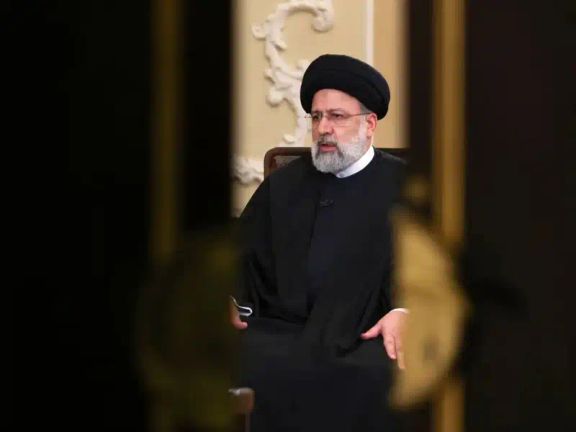
Ebrahim Raisi, Iranian president who was killed in an air crash on May 19, 2024
The death of Iranian President Ebrahim Raisi has triggered a mix of official condolences contrasted with backlash from critics around the globe who see the condolences as approval of Raisi’s legacy as the 'Butcher of Tehran'.
Many European leaders and officials have voiced strong dissent against the European Council’s condolences. Geert Wilders, a well-known far-right leader from the Netherlands, vehemently rejected EU sentiments of sorrow, declaring them unrepresentative of their views and launching the hashtag "not in my name" on the social network X.
Wilders further criticized the current Iranian regime, expressing hope for a secular future for Iran free from what he describes as an "oppressive and barbaric Islamic mullah regime.”
President of the European Council, Charles Michel had released a statement saying "the EU expresses its sincere condolences for the death of President Raisi and Foreign Minister Abdollahian, as well as other members of their delegation and crew in a helicopter accident. Our thoughts go to the families.”
Wilders' statements rejecting the condolences have resonated across social media, garnering support from other European politicians like Charlie Weimers, Benjamin Haddad, David Lega, Nathalie Goulet, and Theo Francken, all of whom have publicly criticized the act of consoling Raisi’s death.
Critics argue that extending condolences to such a regime implicitly legitimizes its actions, which include suppression of dissent, support for terrorism, and ongoing human rights violations. At the age of 25 in 1984, Raisi became the deputy head of the Revolutionary Court, and by 1988, as deputy prosecutor of Tehran, he was part of the Death Committee, which oversaw the mass execution of thousands between August and September of that year.
French Parliament representative Benjamin Haddad openly questioned the appropriateness of mourning a regime that "hangs its freedom-loving young people, attacks its neighbors, produces drones that kill Ukrainian civilians, and supports terrorism."
Hannah Neumann, a member of the European Parliament and a critic of the Islamic Republic, told the people of Iran that Michel issued the condolence message in his personal capacity, not on behalf of Europe.
Amidst the international reactions, figures like Sergio Mattarella, the President of Italy, and Xi Jinping, President of China, also shared their condolences, with Xi calling the loss "a great tragedy for the people of Iran" and claiming "the people of China have lost a good friend." The sentiment faced criticism on Chinese social networks, with some users calling the crash "the best gift for Iranian women," reflecting the deep divisions in public opinion regarding Raisi’s rule.
The response from media outlets has been equally sharp, with the Australian Financial Review branding Raisi as an “executioner,” referring to his alleged role in mass executions and crackdowns during his time in power, well over 500 last year alone in a record wave of executions.
Iran's neighbors have been more sympathetic to the news. Pakistan declared a national day of mourning, a move that drew varied responses domestically and internationally. Similarly, leaders from Syria and Lebanon announced official mourning periods, underscoring the divisive nature of Raisi's influence.
Prominent leaders like Turkey’s Recep Tayyip Erdogan and Azerbaijan’s Ilham Aliyev have also paid their respects.
Outrage Over Official Condolences for Iran's Dead President | Iran International
President Ebrahim Raisi's death in a helicopter crash is likely to impact the succession process for the 85-year-old Supreme Leader Ali Khamenei.
A new session of the Assembly of Experts, the body responsible for selecting the next leader of the Islamic Republic, was scheduled to begin on Tuesday, May 21. Whether the session will proceed as planned remains uncertain. Although Khamenei has declared five days of public mourning, the Majles (Parliament) has announced it will hold its session as usual on Tuesday.
However, Tuesday's session of the Assembly of Experts was particularly significant as an internal vote would be held on the opening day to determine the Assembly's new chairman and his deputies.
According to Iranian reporters Ebrahim Raisi who was the Assembly's most senior deputy chairman was the most likely candidate for the post of chairman. As the search was taking place for Raisi's body on Sunday, Iran International analyst Morad Veisi highlighted the significance of the session and Raisi's intended role in it. Since the election of the next Supreme Leader will depend on a relatively small group of clerics and politicians, the chairman’s role would be a crucial factor.
Meanwhile, alluding to conspiracy theories about the crash, Hossein Bastani, another Iranian analyst, reposted a line from one of his previous writings about succession in Iran while emphasizing that Khamenei's old age calls for more attention to succession in the coming round of the Assembly of Experts.
Bastani wrote: "The Leader has reached an age that insiders worrying for their interests in the future see no solution other than ripping each other apart." Most users commenting under the post were adamant that the helicopter crash was "engineered".
Several Iranian analysts, including Mehdi Khalaji, who spoke to Iran International TV in recent weeks, have said that Raisi was expected to play a key role as a kingmaker in the Assembly of Experts, potentially grooming Khamenei's son Mojtaba or a group of clerics for the country's leadership.
Although many speculated about Raisi being a contender for the position of Supreme Leader, analysts, including Khalaji, believe his role would have been limited to influencing the selection of the next leader. His task would have been to assist those operating behind the scenes in steering the Islamic Republic in a way that secures their power and financial interests.
In another talk show on Iran International, Khalaji said that as Khamenei made most of the key decisions in Iran and other politicians are not capable of handling major domestic political and international issues, his absence on the scene will bring about a serious crisis in Iran.
Key players, such as elements within the IRGC, may strike deals with others to seize political power. However, analysts suggest that the crisis may take much longer to resolve, potentially leading to the regime's collapse, similar to the Soviet Union's downfall, requiring the announcement of the end of the current regime and the start of a new one.
Khalaji, however, emphasizes that moderates or reformists have no chance of taking over the government due to a change in leadership, as this would imply a shift in ideology.
He suggests that the faction of the IRGC with economic ambitions is more likely to maintain the current ideology while negotiating some form of compromise with the rest of the world, breaking the deadlock in relations with the United States, and becoming a more acceptable international player.
However, Khalaji warns that the more likely outcome is "power falling into the hands of someone who has a weapon in one hand and the key to a prison in the other."
Three police officers were killed Sunday night following a gunfight which broke out after a police chase, with the assailant also losing his life.
According to a detailed report by the IRGC-affiliated Tasnim News Agency, “officers from Narmak police station were patrolling when they encountered a suspicious young man near his motorcycle. Upon detecting the police, the man immediately opened fire with his handgun, critically wounding one officer who subsequently succumbed to his injuries at the hospital”.
Tasnim identified the assailant as a well-known criminal involved in drug trafficking, describing him as a “top-level thug” as Iran cracks down on drug crime.
The situation escalated when police officers traced the suspect and attempted an arrest. However, the confrontation quickly turned deadly as the suspect engaged the officers with gunfire, killing two additional policemen and severely wounding two others.
“The gunman was ultimately neutralized by police fire during the shootout, ending his spree of violence,” added Tasnim.
The two officers injured in the exchange are now receiving urgent medical care in a local hospital, with their condition reported as critical.
After the death of Iranian President Ebrahim Raisi, the Association of Families of the Ukrainian Plane Victims released a statement accusing him of complicity in the downing of the airliner.
The flight was shot down by two air-defense missiles fired by the Islamic Revolutionary Guard Corps (IRGC) on January 8, 2020, shortly after taking off from Tehran's Imam Khomeini International Airport, killing all 176 aboard.
The group accused him of not only being complicit in maintaining open Iranian airspace during the shooting down of Ukraine International Airlines Flight PS752 but also in actively obstructing the victims' families' quest for truth.
In July, Britain, Canada, Sweden, and Ukraine lodged formal complaints against Iran at the International Court of Justice, accusing the Islamic Republic of intentionally shooting down the plane. Additionally, in January, these nations submitted a complaint to the UN Aviation Council, seeking to hold Iran responsible for the aircraft's downing.
The association's statement highlighted Raisi's involvement as a member of the Supreme National Security Council on the night of the downing.
“We demanded a fair trial and punishment for him to confess to his crimes and taste the punishment. This opportunity was taken from us, but it must be said that we are not sorry for his death. We neither forget nor forgive the killers of Iran's children," the association's statement said.
In April, the Tehran military court sentenced the operator responsible for firing the missiles at the plane to 13 years in prison and ordered him to pay compensation. Among the military personnel accused, none of the high-ranking military or government officials of the Islamic Republic are named.
Following Iranian President Ebrahim Raisi's death in a helicopter crash, dissident Saeed Afkari, brother of the executed wrestler Navid Afkari, has publicly shared his joy.
In a message on X, Saeed remarked, "I haven't seen my mother this happy in years." The sentiment reflects the scars left by Raisi's tenure as head of the judiciary, a period characterized by repression and injustice, particularly for families like the Afkaris who suffered directly under his rule.
Navid Afkari was executed on September 12, 2020, after enduring a controversial trial marred by inconsistencies and accusations of torture that occurred during Raisi's tenure.
His execution, amid international condemnation, became a symbol of the regime's oppressive tactics against dissent and its punitive measures against those who dare to challenge its authority.
The torment endured by Navid's family continued as Saeed recounted an incident involving another brother, Vahid. He described how, after Navid’s execution, representatives from Raisi's office coerced Vahid with a life-threatening ultimatum in the shadows of Adelabad Prison in Shiraz, underscoring the impact of Raisi’s policies on countless Iranian lives.
As news of Raisi’s death spread, reactions within Iran were divided, with the majority expressing their jubilation on social media—a contrast to the official mourning period declared by the Supreme Leader. The celebrations reflect a pent-up resentment and opposition toward a regime viewed as suppressive and economically disastrous, highlighting the deep divisions within Iranian society.
The comment by Afkari comes amid an escalating use of the death penalty in Iran, following the unprecedented nationwide protests in 2022. An Amnesty International report released last month, titled "Don't Let Them Kill Us," highlighted an unprecedented surge in executions in Iran in 2023. The report noted that at least 853 individuals were executed, with a significant portion of those executed being minorities, including Kurds.
In the wake of the helicopter crash that killed President Ebrahim Raisi, Iran’s Supreme Leader appointed Vice President Mohammad Mokhber as acting president.
“Mr. Mokhber will manage the executive power in line with Article 131 of the Constitution and will coordinate with the heads of legislative and judicial branches to elect a new president within fifty days,” stated Ali Khamenei in a message of condolence. The swift transition underlines the regime's intent to maintain a firm grip on power amidst potential instability.
At 68, Mokhber, who has historically maintained a low profile, is stepping into the limelight under controversial circumstances. His tenure as the head of the Execution of Imam Khomeini's Order (EIKO), and former chairman of the board at Sina Bank, has been marked by ambitions overshadowed by inefficiency and opacity, particularly noted during Iran's struggle to produce a COVID-19 vaccine. Promises of widespread vaccine availability were unfulfilled, raising questions about the allocation of resources and government accountability.
EIKO is an extensive tax-exempt, "charitable" business conglomerate controlled by Khamenei's office, which has its tentacles on a range of sectors in Iran's economy.
Despite the controversies, Mokhber's academic credentials include a doctorate in international law and he has been a member of Iran’s Expediency Council since 2022. His past inclusion and subsequent removal from the European Union's sanctions list for alleged involvement in nuclear or ballistic missile activities adds a layer of international scrutiny to his new role as acting president.
Amidst the leadership upheaval, Ali Bahadori Jahromi, the government spokesman, revealed another significant appointment. Ali Bagheri Kani, previously a political deputy at the Ministry of Foreign Affairs and a former Deputy Secretary of Iran's Supreme National Security Council, has been named head of the government's Foreign Relations Committee.
Iran's Chief Nuclear Negotiator Ali Bagheri Kani leaves the Palais Coburg, the venue where closed-door nuclear talks take place in Vienna, Austria, August 4,2022.
Kani, known for his role in the September 2023 prisoner release deal with the United States, represents a continuity of Iran's hardline stance in its international negotiations.
The death of former foreign minister Hossein Amir-Abdollahian was an opportunity for Mr. Khamenei to appoint a more seasoned and "moderate" figure to try to find some common ground with the United States over its controversial nuclear program and regional issues.
As Iran observes five days of national mourning declared by Khamenei, the recent events not only cast a shadow over Iran's internal governance but also signal potential shifts in its foreign policy approach under new leadership fraught with challenges and skepticism.