UN Report Accuses Iran of Genocide During 1980s Political Purges
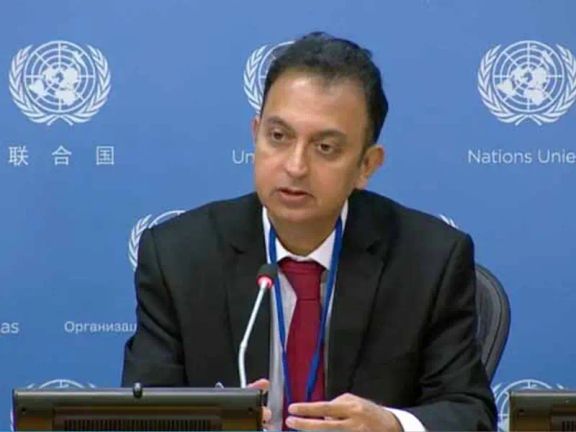
The UN Special Rapporteur on Iran Javaid Rehman
The United Nations Special Rapporteur on human rights in Iran, Javaid Rehman, has labeled the mass executions of political prisoners in the 1980s as "genocide" and "crimes against humanity."
Speaking at a side session of the UN Human Rights Council in Geneva on Wednesday, Rehman unveiled his detailed report, which shows systemic state-sponsored atrocities during a brutal crackdown on dissent.
Rehman's investigations found that thousands of political prisoners, including members of minority groups like Baha'is, Kurds, and those affiliated with organizations such as the Mojahedin-e-Khalq (MEK) and other leftist groups, were executed in the 1980s, particularly during the summer of 1988.
The prisoners were executed following a fatwa issued by Iran's then-leader, Ruhollah Khomeini, with the approval of a four-member death committee.
The committee included Hossein Ali Nayeri, a Sharia judge; Morteza Eshraghi, a prosecutor; Ebrahim Raisi, a deputy prosecutor who later became Iran’s president; and Mostafa Pourmohammadi, a representative of the ministry of intelligence.
The report states that the death committee was responsible for a sweeping purge that targeted those accused of opposition to the government, many of whom were executed without a fair trial, marking a clampdown that included torture, sexual assault, and other inhuman treatments. The most intense period of the executions occurred over a few months in 1988, a chapter that has long been shrouded in secrecy and denial by Iranian officials.
“This is not a historical issue, as many people think," Rehman asserted during his presentation. "It is a current issue. There are serious concerns about gross violations of human rights that continue to this day.”
Rehman's findings highlight the continuation of oppressive tactics by Iranian authorities, linking past atrocities with ongoing human rights violations, including the recent international outcry over the death of Mahsa Amini in police custody, which sparked protests and global scrutiny of Iran’s human rights record. Sanctions have since been levied by the international community against Iran in the wake of the crackdowns.
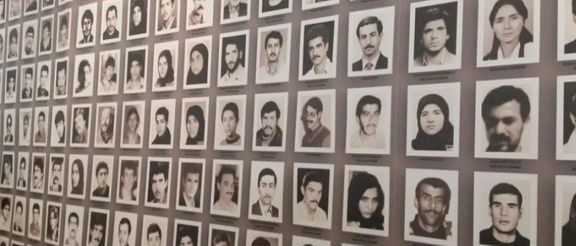
Some of the prisoners summarily executed in Iran in 1988
The significance of Rehman’s report extends beyond its historical account as it seeks to challenge the prevailing impunity enjoyed by Iranian officials. For the first time, the atrocities have been formally classified as "genocide," a term that carries profound legal implications. The classification aligns with the definitions established by the United Nations Genocide Convention of 1951.
Rehman’s call for accountability was echoed by Wolfgang Schomburg, a former judge at the International Criminal Tribunals for Yugoslavia and Rwanda, who spoke at the event. Schomburg emphasized the potential for the UN's findings to lead to international warrants against current Iranian figures linked to the 1980s events, which could curtail their ability to travel internationally without facing arrest.
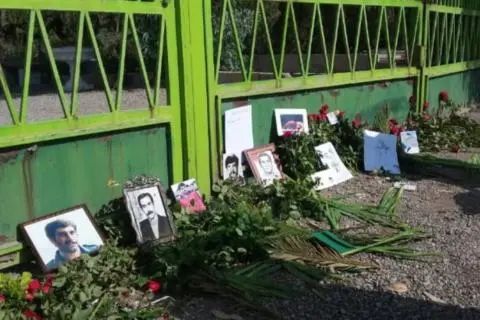
Photos of victims at a memorial commemorating those killed during the mass executions in the 1980s, Khavaran cemetery in Tehran, Iran, 2020.
The report, which the United Nations will formally release in the coming days, has spurred a wave of calls for action against Iran from various countries including Canada, Italy and Sweden, and rights group Amnesty International. However, the push for legal and moral accountability continues, as many of the perpetrators remain in high-ranking positions within the Iranian regime.
Four prisoners received a combined sentence of 33 years in prison and 518 lashes for a 2022 fire incident at Iran's notorious jail, rights group reported.
According to The US-based Human Rights Activists News Agency (HRANA) Loghman Aminpour, Meysam Dehbanzadeh, and Majid Roshan Nezhad were each sentenced to six years in prison and 74 lashes for "destruction of property," along with 16 months and 74 lashes for "disturbing prison order".
The event took place amid protests in support of the nationwide uprising which followed the death in morality police custody of Mahsa Amini.
Additionally, Reza Salmanzadeh received a five-year prison sentence and 74 lashes for "destruction of property," along with a two-year sentence for charges of "disrupting prison order" and "disobeying officers' orders."
While Iranian authorities blamed prisoners for the incident, evidence gathered by Amnesty International suggests they used the situation to justify a harsh crackdown, claiming it was to manage the fire and prevent escapes.
Official records document eight prisoner deaths and 61 injuries resulting from the fire.
In the past 15 months, 30 workers in Iran have died in mine accidents and collapses amidst protests by thousands of miners over poor working conditions and wage grievances.
On Thursday, Iran's Etemad reported on the "exploitation" of mine workers, noting that in addition to fatal accidents, job insecurity is a significant concern.
The report highlighted that thousands of coal, copper, iron ore, and chrome miners across Iran have staged protests lasting from several hours to weeks over the past 27 months.
Etemad's report indicated that over 83 percent of these protests demanded wage increases and addressed delayed payments, with coal miners demonstrating for extended periods.
The newspaper also pointed out that over the past two decades, mine safety and job security for workers have drastically declined, particularly in privately owned mines. Workers are increasingly employed on unstable contracts, ranging from one to three months, often with promissory notes.
The "Zemestan-Yurt mine" incident is still cited as a symbol of miners' oppression and one of the most significant documented cases of mine safety issues in Iran over the last two decades. During a 2017 explosion at the Yurt coal mine in Golestan province in north Iran, 43 workers died. At the time, none had insurance for hazardous jobs, and they had not been paid for months.
Iran’s ambassador and permanent representative to the United Nations has denied supporting its Yemeni militia, the Houthis, calling the claim "unfounded".
Amir Saeid Iravani voiced his criticism of the US claims in letters addressed to the UN Secretary-General and the President of the Security Council on Wednesday amid the Houthis' blockade of the Red Sea region.
The denial followed a statement from Robert Wood, the US representative at the UN, who told a Security Council briefing on Yemen in June that Iran continues to support and enable Houthi attacks in the Red Sea, violating the arms embargo.
Wood emphasized that “Iran should not be permitted to hide behind the Houthis. It must comply with the Council’s resolutions and cease its provision of weapons.”
Iravani, in his response, wrote: “On numerous occasions, Iran has made it clear that it is committed to the Security Council's relevant resolutions on the situation in Yemen and has not engaged in activities contravening these resolutions.”
However, Iran arms, trains and funds the militia, which has been at the heart of a decade-long civil war in Yemen.
Since November, the Houthis, who control Yemen's capital and its most populous regions, have attacked international shipping in the Red Sea in solidarity with Palestinians in Gaza.
During this period, they have conducted over 60 targeted attacks on specific vessels and launched additional missiles and drones, resulting in the deaths of four sailors and kidnap of dozens more.
The attacks commenced following a call from Iran’s Supreme Leader Ali Khamenei in early November for Muslim nations to blockade Israeli trade.
Iran's Supreme Court has overturned the death sentence of a football coach accused of sexually assaulting eight boys with a retrial set to commence after winning an appeal.
The accused, 40, was convicted of assaulting several teenage boys under the pretext of teaching football and consequently given a death sentence in a court in Tehran last year.
The boys, who were 12 and 13 years old, said the coach lured them to his house for football training. Victims claim he forced them to have sexual relations with each other, then filmed and blackmailed them, according to Iranian media outlets.
One of the students' fathers reported the coach to the police, stating: “Not long after my son's registration, I noticed his behavior had changed. His behavior had become aggressive, nervous, and withdrawn.
“After following the story with my wife, my son revealed a terrible secret that shocked us: the coach took him to his house and abused him there."
In the aftermath of the first complaint, seven other individuals reported similar experiences with the abuser.
In court, the coach denied any wrongdoing. The Tehran judges, however, found him guilty of rape and sentenced him to death. A lawyer for the defendant objected to the court's decision, arguing that he had not committed any rape but admitted sexual assault. Iran's Supreme Court subsequently reversed the death sentence, and the accused will now be retried.
Canada's official designation of Iran’s Islamic Revolutionary Guard Corps (IRGC) as a terrorist organization has garnered global praise from political figures both inside and outside Iran.
After years of campaigning, Canada's designation follows a series of plots uncovered in Canada where the IRGC is said to have both raised money and recruited agents.
Michael Chong, Conservative Shadow Minister for Foreign Affairs, and Melissa Lantsman, Deputy Leader of the Conservative Party of Canada, said in a joint statement, “Trudeau and his Liberal government took six years to list the IRGC... As a result of that delay, the IRGC has been able to grow stronger as a result of Trudeau’s inaction.”
The US designated the group in 2019 and until now, Canada has imposed multiple rounds of sanctions on several terrorist designated entities that have benefited from the IRGC’s patronage and that have helped advance Iran’s interests and foreign policy, including Hezbollah, Hamas, the Palestinian Islamic Jihad, and the Taliban.
The designation has triggered others to push again for designating the group globally. Senator Claire Chandler, Chair of the Senate Foreign Affairs, Defense, and Trade Committee in Australia, reacted on X by saying, "While Canada acts, in Australia the Albanese Govt is refusing to even consider listing the IRGC."
The Australian Jewish Association also welcomed Canada's decision to declare the IRGC a terrorist organization and called on Australia to do the same. AJA CEO Robert Gregory stated, “The Albanese Government is the weakest link in the West when it comes to standing up to Iranian Regime terrorism and oppression.”
However, designation has been impacted by governments trying to appease the Iranian government amid its ongoing nuclear program. Countries such as France and the UK have seen massive lobbying from parliamentarians only to be pushed back under claims of pursuing a diplomatic solution. However, at the same time it should be noted that UK has issued many sanctions targeting Iran's malign activities and weapons proliferation.
In London, Iranian-born opposition figure and human rights activist Nazanin Boniadi expressed hope that the UK, EU, and Australia would follow suit in listing the IRGC as a terrorist group. The UK's top intelligence chief said last year that Iran was among the biggest foreign threats on UK soil after multiple plots had been foiled, including attacks and threats to Iran International journalists.
Israeli Foreign Minister Yisrael Katz also welcomed Canada's decision, calling the IRGC "the largest terrorist organization in the world."
In the announcement, Canada stated "there are reasonable grounds to believe that the IRGC has knowingly carried out, attempted to carry out, participated in or facilitated a terrorist activity, or has knowingly acted on behalf of, at the direction of, or in association with an entity that has knowingly carried out terrorist activity".
Journalist and activist Masih Alinejad, who has been the target of multiple assassination plots by the IRGC in the UK and US, also welcomed the Canadian government’s decision and called on G7 countries to follow the US and Canada in this regard.
"This is a step that took many years to come together. But better late than never," she said. "I want to strongly urge the rest of the G7 countries to follow the US and Canada’s lead to also designatie the IRGC as a terrorist organization."
Exiled Crown Prince Reza Pahlavi also praised the decision, calling it "an important but overdue step" in holding the "criminal" Islamic Republic regime accountable.
Iran’s Foreign Ministry Spokesman Nasser Kanaani condemned the move as "disgusting." He stated, “This irresponsible and provocative move continues the wrong path that the Canadian government has pursued for over a decade.”
Kazem Gharibabadi, Deputy for International Affairs of the Judiciary, also condemned Canada’s "hostile" decision, stating that the IRGC "is responsible for guarding Iran's national security and confronting terrorism in the region."