Zarif's transition council criticized for lack of representation
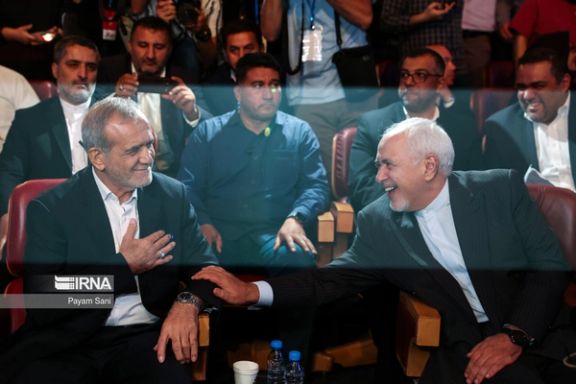
Iran's President-elect Masoud Pezeshkian (left) and former foreign minister Mohammad Javad Zarif during an event in Tehran
Mohammad Javad Zarif, the head of the Pezeshkian administration's Strategic Council for Transition announced on Wednesday that results of consultations about the makeup of the new cabinet will be announced next week.
The council for transition formed to search and propose ministerial candidates is a new phenomenon in Iranian politics, apparently designed to show the public that President-elect Masoud Pezeshkian wants to remain true to his campaign promise of using experts to address critical issues.
At the same time, Zarif announced in a July 17 tweet on the social media platform X that committee members may not contact their nominees for the cabinet anywhere outside the committees' official meetings. If they do contact the nominees directly, that would be tantamount to the committee member's resignation.
The initial list of 16 members of the main strategic committee consists of 16 ‘reformist’ figures including Zarif himself, former Government Spokesman Ali Rabiei, Pezeshkian's campaign manager Ali Abdolalizadeh, reformist academics Hadi Khaniki and Mohsen Renani, former Minister of Economy Ali Tayyebnia, former Culture Minister Reza Salehi Amiri and former Reformist lawmakers Ali Tajernia and Ali Shakouri-Rad.
A more comprehensive list released later includes 25 members of the main committee with 3 women on board and the addition of Former ITC Minister Mohammad Javad Azari Jahromi, former Central bank Governor Abdoh Tabrizi and former presidential aide Shahindokht Molaverdi among others.
The committee members will lead their own subcommittees to determine various ministers. Each subcommittee, comprising up to 25 members, is tasked with nominating between 3 to 5 potential cabinet ministers. In total, hundreds of individuals will be involved in selecting candidates. Nonetheless, Pezeshkian’s aides have been criticized for including a very limited number of women in these committees. There is only one woman, a librarian, in the main committee. Another criticism is that nearly all of the members of all committees and subcommittees come from the reformist camp.
According to Zarif's tweet, if any committee or subcommittee member is nominated for a ministerial post, should immediately step down as member and should be immediately replaced by a new member.
The nominees will be introduced to Pezeshkian, who will make the final choice for his cabinet ministers. However, there are many exceptions to these rules. For instance, traditionally up to six of the cabinet ministers are directly appointed by Supreme Leader Ali Khamenei, although this is not stipulated by law. These ministers include those of Defense, Intelligence, Interior, Culture, Oil, and Foreign Affairs.
However, according to Iranian Constitutional Law, the President is responsible for appointing all 19 cabinet ministers and several vice presidents. However, political observers, including Iran analyst Mehdi Khalaji, note that only President Akbar Rafsanjani was able to independently appoint all his cabinet ministers during his first term in office.
Regardless of how many ministers are directly chosen by Khamenei, the President gives the full list to him for his review before giving the names to the parliament (Majles) for its vote of confidence to the ministers.
According to the main function of the committees is to convince the majority who did not take part in the elections that the ministers will be chosen in a more or less democratic process and although the President represents a small number of eligible voters, his cabinet will be more representative. Khalaji however added that even many reformists are not represented in the committees. Those who are, are exactly the same groups that supported Pezeshkian in the election.
Meanwhile, reformist cleric Rahmatollah Bigdeliwho is close to Pezeshkian has said that no committee member should be nominated for any post in the government to avoid conflict of interest.
An armed attack on a Sufi Sheikh resulted in the deaths of two followers, with the Sheikh succumbing to his injuries on Thursday, according to Kurdish human rights sources.
The attack occurred at the Sufi lodge of Sheikh Azad in Saqqez on Wednesday night, resulting in the deaths of two men identified only by their first names, Peyman and Parviz.
The head of the Kordestan (Kurdistan) Province Judiciary stated that the attackers have been identified, and a judicial case has been filed. "Efforts are currently underway to apprehend them," Hossein Hosseini said.
Although Sufism, a mystical branch of Islam, is not illegal in Iran, rights groups accuse the Iranian government of systematic harassment and discrimination against its followers, including the Gonabadis, one of the largest Sufi sects. While the Gonabadi Dervishes identify as Shi'a Muslims, Iran’s Supreme Leader and other influential figures dismiss their beliefs as “false mysticism.” As a result, Amnesty International says Gonabadi Dervishes have been subjected to systematic discrimination and harassment, in spite of the sect not being deemed illegal as other minority religions are under the Islamic Republic.
The rights group has seen cases of arbitrary arrests and detentions, imprisonment, flogging sentences, and attacks on the group's sacred sites.
While the Abrahamic faiths, Islam, Judaism and Christianity, are legal under the Islamic Republic, according to the latest International Religious Freedom report by the US Department of State, Iran has persistently oppressed Sufis, extending its campaign of repression even to members of the community living abroad.
A Polish state-owned company sold parts which were used in Iranian combat drones, private broadcaster Radio Zet reported on Thursday without naming sources, adding that prosecutors had been investigating the issue since 2022.
Iran has supplied thousands of Shahed-136 "kamikaze" drones to Russia during its invasion of Ukraine launched in February 2022. They have been used to exhaust Ukrainian air defences and hit infrastructure far from the front lines.
Polish prosecutors confirmed in an email that they were investigating the possible export of dual-use products manufactured in Poland without mentioning Iran.
Poland, a NATO member, has been one of Ukraine's biggest supporters, both under the previous nationalist government and Donald Tusk's current pro-European administration.
However, according to Radio Zet, a Polish company belonging to the Industrial Development Agency was selling fuel pumps which ended up in Iranian drones.
According to Radio Zet, WSK Poznan sold parts to Iran Motorsazan Company, which produces agricultural tractors, but the pumps ended up in Iranian factories producing military unmanned aerial vehicles, which were then purchased by Russia.
It said the issue had been investigated by the Internal Security Agency (ABW) which notified the prosecution.
In its emailed statement, the prosecutor's office said it was "conducting proceedings regarding the export from Poland of products manufactured in Wytwornia Sprzetu Komunikacyjny Poznan sp. z o.o. being dual-use products without the legally required permit of the Minister of Development and Technology."
As part of the ongoing investigation, the CEO of the company at the time was charged with selling products of strategic importance without appropriate clearance, it said, facing up to 10 years in prison.
The ABW, Industrial Development Agency, State Assets Ministry and the company did not immediately reply to Reuters' requests for comments.
In a letter from Tehran's Evin Prison, jailed ‘reformist’ Mostafa Tajzadeh who had shunned the recent Iranian presidential elections, blamed the nation's economic and other crises on Supreme Leader Ali Khamenei's policies.
In the letter titled "Why Didn't I Vote but Kept Silent?" published on Tajzadeh’s social media channels Wednesday, he provided a detailed analysis of why he boycotted the elections.
"The current crises are rooted in the flawed political and legal structure of the regime and the poverty-inducing, corruption-breeding, and obstructionist policies of the Leader," wrote Tajzadeh.
Tajzadeh further pointed to Khamenei holding the utmost power in the context of the Presidential elections process.
Iran’s presidential candidates go through a vetting process by the 12-member Guardian Council all of whom directly and indirectly are appointed by Khamenei. Their role in supervising elections and approval or disqualification of candidates extends beyond presidential elections to Parliamentary elections and Iran’s Assembly of Experts elections. Moreover, the Council has veto power over legislation passed by the Iranian Parliament.
“In any society, the concentration of authority and its lifelong transfer to one person makes elections meaningless, the government and the parliament ineffective, and the judicial system a tool to suppress critics and legal opponents," Tajzadeh added.
One of the handpicked candidates for Iran's presidential race, Masoud Pezeshkian was declared the winner on July 6 becoming the country’s ninth president.
Tajzadeh stated that if Khamenei's policies remain unchanged, he expects president-elect Masoud Pezeshkian to encounter the same challenges as Hassan Rouhani did during his second term. Rouhani served as Iran’s President from 2013 to 2021 across two consecutive terms.
In 2015, under Rouhani Iran reached a nuclear deal - the Joint Comprehensive Plan of Action (JCPOA) with several world powers, including the United States, which limited Iran’s nuclear program in exchange for International sanctions relief. However during Rouhani’s second term, in 2018 former President Donald Trump withdrew from the deal marking the beginning of what he termed 'maximum pressure' sanctions on Tehran.
Tajzadeh added: “Rouhani's second administration failed due to three reasons: the [Supreme] Leader's opposition, his own mistakes, Trump's maximum pressure and America's withdrawal from the JCPOA.”
He further criticized Khamenei's foreign policy, stating that the Supreme Leader's decisions have placed Iran at the forefront of a conflict with Israel and imposed heavy, avoidable costs on the nation through unnecessary anti-Americanism.
Meanwhile, throughout his campaign, Pezeshkian has maintained that he would be following the policies of Khamenei. In this light, Tajzadeh criticized Pezeshkian stating: “I find the attempt to implement the guidelines and policies of Mr. Khamenei to be the continuation of the status quo and complicity in the atrocities and corruption of the government.”
Tazjadeh stated that Khamenei changed his election strategy from 2017 onwards and instead of "maximum participation with an unknown result", he adopted the strategy of "minimum participation with a guaranteed result."
More than 60% of eligible citizens did not participate in the first round of presidential elections, and over 50% abstained from voting in the runoffs.
Tajzadeh outlined three conditions for justified participation in elections: meaningful competition, a citizen participation rate above 50%, and the ability of elected candidates to fulfill their promises. He stated that none of these conditions were met in the recent elections.
Tajzadeh’s letter comes following his boycott of the snap presidential elections alongside 100 other political prisoners, including Nobel Peace Prize laureate Narges Mohammadi and former MP Faezeh Hashemi Rafsanjani, daughter of former two-term president Ali Akbar Hashemi Rafsanjani.
While many dissidents inside Iran called for the boycott of the elections and abstained from participating, Tajzadeh refrained from urging the nation to boycott.
In his letter, the former advisor to Iranian President Mohammad Khatami explained his rationale for not calling for a boycott.
“I remained silent and did not urge anyone to abstain from voting because I did not want to hinder the progress of Pezeshkian's election campaign and his supporters, especially Mr. Khatami who believed that despite the election engineering, this time, unlike in 2021, the victory of a candidate critical of the status quo was within reach.”
He further added that he didn't want to “disappoint friends” who view Pezeshkian being allowed to run for the presidency as a step forward. He added that while he hopes this development is positive, he remains skeptical about Khamenei.
Iran’s acting foreign minister categorically rejected the idea that his country could have had a plan to assassinate Donald Trump, contradicting several statements by high-ranking officials who have threatened the former US president in the past few years.
In an interview with CNN’s Fareed Zakaria, Iranian foreign minister Ali Bagheri-Kani confirmed Iran’s will to “bring to justice” those who killed the country’s most prominent military figure Qasem Soleimani, in 2020, but insisted that all efforts to that end would be “legal and judicial”.
General Soleimani was killed in a ‘targeted assassination’ ordered by the then US president Trump. The killing shocked Iran’s Supreme Leader Ali Khamenei, who mourned the loss of his top general and vowed to punish the perpetrators with a “harsh revenge.”
That promise was taken up by several Iranian officials who translated Khamenei’s words to issue direct threats against Trump. There’s no evidence, of course, to suggest that Trump’s shooter, Thomas Matthew Crooks, had any links to Iran, but the threats have been clear and well-documented, contrary to what Iran’s acting foreign minister told CNN.
Below comes a number of instances where prominent Iranian figures spoke of the regime’s intention to target Donald Trump.
January 2021, Supreme Leader Khamenei
Following Khamenei’s proclamation of a “harsh revenge”, his official account on X (then Twitter) published an image of Trump on a golf course under the shadow of a drone, hinting at his targeting. That post has since been deleted.
Khamenei’s official website also released an animation with the same theme, showing IRGC forces killing Trump using a robot.
Screenshot of Khamenei's website where on the left side there a screengrab of the video showong Trump on crosshairs
December 2020, Qaani, Commander of IRGC Quds Force
On the anniversary of Soleimani’s assassination, his successor, Ismail Qaani, hinted at the intention to target Trump in an address to Iran’s parliament. “American agents involved in the assassination of martyr Soleimani should learn the secretive life of Salman Rushdie because the Islamic Republic will avenge his unjustly-spilled blood.”
January 2021, Qaani, Commander of IRGC Quds Force
Qaani reiterated his threat in yet another occasion to commemorate his predecessor. This time more directly: “Trump and others who were with him are all known to us. From [Mike] Pompeo, who no one humiliated as much as martyr Soleimani, to the US president and all those involved in this crime, [they] are all under the microscope (not only of Muslims but) of all free people of the world.”
January 2022, President Raisi
"If Trump and (former Secretary of State Mike) Pompeo are not tried in a fair court for the criminal act of assassinating General Soleimani, Muslims will take our martyr's revenge.”
July 2022, Foreign Minister Amir-Abdollahian
Two years before dying in a helicopter crash, Iran’s foreign minister Hossein Amir-Abdollahian said what had happened to Soleimani would “never be forgotten.” He did explain Iran’s legal and diplomatic efforts, including appeals to the International Law Commission.
In an interview with Iran’s state TV, he said: “One action we have taken has been to place the perpetrators and instigators of this crime on the terrorist blacklist, and those who have been listed do not sleep easily… They wanted to resolve this through intermediaries, but we rejected their offer.”
February 2023, Hajizadeh, Commander of IRGC Air Force
Amir Ali Hajizadeh, the IRGC Aerospace Commander, appeared on a TV program to explain Iran’s actions to avenge Soleimani. He said, “We did not intend to kill [US soldiers]. God willing, we will kill Trump, Pompeo, [Frank] McKenzie, and the military commanders who ordered [Soleimani’s assassination].”
The Biden administration warned Iran privately over the country’s nuclear program last month, after the US and Israel detected suspicious activities by Iranian scientists “under an academic umbrella” that could be relevant to the production of weapons.
In an exclusive report Wednesday,Axios quoted three American and Israeli officials as saying their intelligence communities have been trying to ascertain if there is a change of policy by Iran's Supreme Leader Ali Khamenei, believing that he may have refrained from publicly approving the activity “to leave room for plausible deniability.”
Iran maintains that its nuclear program is peaceful, and all accusations otherwise are politically motivated. The UN nuclear watchdog, however, has repeatedly said that Iran’s enrichment program, and its stockpiling of near-weapons-grade uranium is hard to explain outside a weapons program.
The US officials speaking to Axios have expressed concern about Iran's nuclear “escalation”, while suggesting that there are no current indications of Iran undertaking the activities necessary to produce a testable nuclear device.
Last week, Iran’s president-elect Masoud Pezeshkian claimed in an open letterwritten in English that his country had been treated “unfairly” by the US and its western allies, accusing them of “abusing” the NPT and “fabricating” a crisis over Iran’s nuclear activity.
“The US and its Western allies not only missed a historic opportunity to reduce and manage tensions in the region and the world, but also seriously undermined the Non-Proliferation Treaty (NPT) by showing that the costs of adhering to the tenets of the non-proliferation regime could outweigh the benefits it may offer,” Pezeshkian wrote.
Pezeshkian, elected on a ‘reformist’ ticket, is viewed by many inside and outside Iran as “powerless” when it comes to issues of foreign policy, defense and the nuclear program.
The Axios report Wednesday seems to suggest that backchannel communications have been ongoing and that the Biden administration has been trying to dissuade Iranians from further escalation of their nuclear activities.
The recent meeting of the US-Israel Strategic Consultative Group marked the first high-level discussion about Iran's nuclear program since March 2023. The assessments were aligned, according to reports, indicating no “top-down directive from Khamenei” to proceed with nuclear weapon production.
All US administrations in the past two decades have warned Iran that weaponization is a red line, and the US would consider all options to stop it.