Harris condemns flag burning as ‘despicable,’ White House blames Iran
Pro-Palestinian demonstrators burn US flag, as Israeli PM Benjamin Netanyahu's speaks before Congress
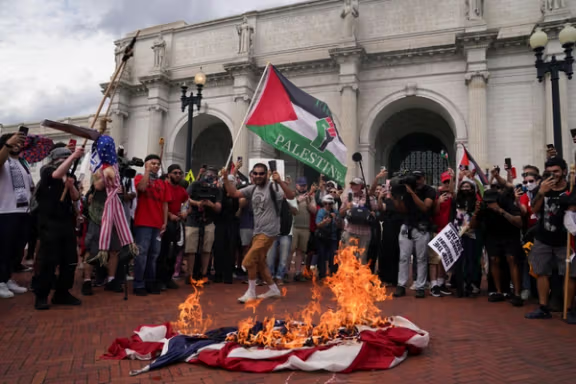
Vice President Kamala Harris has condemned Washington demonstrators who burned the American flag and supported Hamas during Netanyahu's visit, as despicable acts by unpatriotic individuals.
Thousands of protesters were rallying against Israeli Prime Minister Netanyahu’s speech before Congress on Wednesday when many protesters engaged in violent acts, burning the US flag and defacing monuments.
Netanyahu’s speech not only pinpointed Iran as the instigator of all the turmoil in the Middle East, but also made special note of the protesters. Referencing Iran’s role in promoting and funding protests in the US, he went further than Harris, calling the demonstrators “Iran’s useful idiots."
“That’s not a phrase we would use,” National Security Communications Adviser John Kirby told reports on Thursday, when asked to react to that characterization by Netanyahu. “We know that Iran certainly has tried to meddle here. They’ve tried to sow discord. They’ve obviously contributed to some funding of some protesters,” Kirby said.
Asked whether he would describe Wednesday’s protest near the Capitol as “pro-Palestinian, pro-Hamas or anti-Israel,” Kirby said it was “a little bit of all those things.”
Earlier this month, US Director of National Intelligence Avril Haines’s assessment said that Iran is attempting to covertly stoke protests in the United States related to the conflict in Gaza, posing as activists online and, in some cases, providing financial support to protesters.
Republican Senator Marco Rubio, meanwhile, took a tougher stance, urging other Senators to consider a resolution that would see visitors and foreign nationals on a visa who support Hamas in the US forced to leave the country.
“If you’re in the United States on a visa and vandalizing property with phrases like ‘Hamas is coming,’ it’s time for you to go,” Rubio said on X. At a critical moment in negotiations over a possible Gaza hostage and ceasefire deal, Vice President Harris had her meeting with Netanyahu – her first with a foreign leader since starting her presidential campaign.
Harris, who did not preside over Netanyahu’s speech, held a press conference after their meeting. While expressing support for Israel’s right to defend itself, she emphasized the importance of how Israel does so. Harris voiced her refusal to stay silent on the human suffering in Gaza, pointing to the tragic images of dead children and displaced, desperate civilians.
David Friedman, the US Ambassador to Israel during the Trump administration, also weighed in, taking to X to critique Harris' statement, accusing her of failing to condemn Hamas and instead offering generic statements about complexities, nuances, and peace.
Netanyahu, who met with President Joe Biden before his meeting with Harris, is also scheduled to meet with former President Donald Trump on Friday.
Israel's Foreign Minister Israel Katz says that the sabotage of France's rail infrastructure ahead of the Paris 2024 Olympics was influenced by "Iran's axis of evil and radical Islam."
On Friday, French train operator SNCF announced that the high-speed network suffered "malicious acts," including arson attacks, causing significant disruption just hours before the Olympic opening ceremony. Up to 800,000 passengers will face travel disruptions this weekend due to the attack.
Shortly thereafter, Israel’s Katz, attributed the attack to Iran, noting that he had previously warned French authorities about potential threats from Tehran targeting Israeli athletes in France.
"The free world must stop Iran now - before it's too late," Katz wrote on X.
In a letter on Thursday, Katz had alerted his French counterpart, Stéphane Séjourné, to an Iranian-backed plot aimed at the Israeli delegation participating in the 2024 Games.
“There are those who seek to undermine the celebratory nature of this joyous event,” wrote Katz. “We currently have assessments regarding the potential threat posed by Iranian terrorist proxies and other terrorist organizations.”
Also on Thursday, Israeli media reported that a group of anti-Israeli hackers, identifying themselves as “Zeus,” claimed responsibility for publishing personal information about Israeli athletes, including supposed images from their military service.
The National Cyber Directorate of Israel attributed this social media campaign to Iran, asserting that its primary goal is to intimidate the Israeli delegation. According to the Directorate's investigation, hackers have created social media channels to disseminate personal data about delegation members and send them threatening messages.
The hackers reportedly established social media profiles under the guise of GUD, a French far-right student union, using the encrypted chat application Telegram to post sensitive information such as bank account details, home addresses, and ID numbers of Israeli athletes. They also circulated alleged photos of the athletes during their IDF service, accusing the army of sending undercover operatives to the Games.
Gabi Portnoy, head of Israel's National Cyber Directorate, remarked, “Iran is exploiting an apolitical international sporting competition to promote digital terrorism against Israel and its right to participate in these competitions.”
These reports emerged just a day after Israel’s National Security Council issued safety guidelines for Israelis traveling to the Olympics, highlighting the threat from Iran-backed terror organizations targeting Israeli and Jewish individuals. The NSC also referenced recent arrests of French teens linked to the Islamic State.
The Olympic Games will be held from July 26 to August 11, followed by the Paralympic Games from August 28 to September 8.
A media outlet that publishes official news about Mahmoud Ahmadinejad confirmed many details of Iran International's report on a failed assassination attempt against the former president and has called for an official response.
According to the exclusive report by Iran International, on the afternoon of July 15, Ahmadinejad and his entourage were headed to Zanjan to participate in a religious ceremony. Before departure, the head of the security team checked a recently repaired Land Cruiser intended for Ahmadinejad and, complaining that the air conditioner was not properly fixed, requested Ahmadinejad to ride in another Land Cruiser.
In Mehr-e-Farda's report, published on the media's X account, it was mentioned that despite the original plan for Ahmadinejad to travel in the recently repaired Land Cruiser, the head of security decided that the former president should ride in another vehicle, while some members of the security team took the targeted Land Cruiser.
According to the channel affiliated with Ahmadinejad’s office, the security team realized mid-journey that the steering and brakes of the Land Cruiser were malfunctioning. The vehicle collided with other cars and eventually stopped on the side of the highway.
Iran International's report also emphasized that the steering and brakes of the Land Cruiser carrying the security team failed suddenly on the Karaj-Qazvin highway in the Abyek region. The vehicle spun around three times, veered left and right multiple times, hit the concrete barrier in the middle of the highway, collided with another vehicle in Ahmadinejad's convoy, and finally stopped after hitting a passing Peugeot on the right side of the highway.
Mehr-e-Farda pointed out that the investigation into this incident is ongoing. In a post on the channel's Telegram account, it asked, "Who is responsible for this assassination attempt?" This post was deleted without explanation early Friday morning.
Sources previously told Iran International that Ahmadinejad's office informed "responsible officials" of the incident on July 21, five days after the failed assassination attempt, and complained about multiple previous attacks and attempts on Ahmadinejad's life.
Information received by Iran International indicated that the Land Cruiser, which was sabotaged, was under the custody of the Presidential Office for repairs. However, instead of being sent to an authorized repair shop, it was handed over to unidentified "special security agents" and taken to an unknown location.
Given their organizational positions, these special security agents could belong to the higher ranks of one of three IRGC subunits: the IRGC Intelligence Organization, the IRGC Counterintelligence Organization, or the IRGC's Vali-e-Amr unit. These units have the authority to retrieve Ahmadinejad's vehicle from the Presidential Office's repair unit without coordination with the Ansar Protection Corps and could potentially carry out the alleged sabotage.
Iran International's exclusive report on the assassination attempt received widespread coverage in multiple international and some Iranian media outlets.
Among domestic media, Khabar Online noted the assassination attempt report on Ahmadinejad and wrote that "one of the figures close to the former president neither confirmed nor denied this claim."
Saberin News channel, close to security forces, confirmed the issue with Ahmadinejad's escort vehicle but wrote, "All the aforementioned news is false, and nothing happened to Ahmadinejad's vehicle."
However, neither Iran International's exclusive report nor Mehr-e-Farda's later news claimed any problem occurred with Ahmadinejad's vehicle.
Journalist Fariborz Kalantari, a day before Mehr-e-Farda's official response, posted details about the assassination attempt on his social media accounts, stating that Ahmadinejad's office is following up on the issue.
Ahmadinejad has previously spoken about assassination attempts on his life.
On August 26, 2023, the Dolat-e-Bahar Telegram channel, associated with Ahmadinejad, reported that his office sent a letter to senior military and security officials, warning of "very concerning actions" against him and calling for necessary protective measures and action against those responsible.
The channel quoted Ahmadinejad's office stating: "The recent actions clearly indicate an organized effort to assassinate Dr. Ahmadinejad."
On August 29, 2023, Alireza Beigi, a parliament member and close associate of Ahmadinejad, confirmed the Dolat-e-Bahar Telegram channel's report, saying: "Efforts to assassinate Ahmadinejad have increased in the past couple of months, and documentation of these efforts has been submitted to security agencies."
Previously, on March 1, 2021, domestic media reported that Ahmadinejad had responded to a question by saying: "The discussion of my assassination is serious. They will kill me, hold mourning ceremonies, and then accuse others. I have recorded the information I know and placed it in several secure locations."
Multiple rockets were launched at Iraq's Ain al-Asad airbase housing US-led forces late on Thursday, American and Iraqi sources said, with no damage or casualties reported.
Two US officials said the base itself had not been struck in the attack. This was the second such attack this week. Two drones were fired at the base on Tuesday, with no casualties.
The attack came two days after a military summit in Washington where Iraqi and US officials discussed winding down the coalition's work a decade after it was formed to fight Islamic State as it stormed across Iraq and Syria.
No major announcement was made at the end of the talks, though US and Iraqi sources say an announcement that it will begin to gradually wind down is likely in the coming weeks.
Iran’s Islamic government has long campaigned for US troops to leave Iraq, where it has established wide-ranging influence by creating armed militia groups. As a result, Iran-aligned Iraqi political and military factions have pressured the country's government to quickly draw down the coalition's work and say they want all 2,500 troops deployed by the country's one-time occupier to leave.
Washington and the Iraqi government say they want to transition to a bilateral security relationship that would likely see some troops remain in an advisory role.
US-led forces invaded Iraq in 2003, toppled former leader Saddam Hussein and then withdrew in 2011, only to return in 2014 to fight Islamic State at the head of the coalition.
Iran-backed Iraqi armed factions have targeted bases housing US troops in Iraq and Syria over the years and particularly since the Israel-Hamas war began on October 7, though there have only been a handful of attacks since February, when the US retaliated and an unofficial truce took hold.
The latest attacks come after Masoud Pezeshkian, who is presented as a “moderate” won the presidential election in Iran, raising some expectations in the West that he might restart nuclear talks. However, the United States has dismissed such suggestions, giving little credence to major changes under the new president.
Masoud Pezeshkian promised voters to stop hijab patrols and violence against women for violations, but the acting chief of police insists the same policies will continue under the new government.
Speaking at a security meeting in Qazvin Province Wednesday, Qasem Rezaei said implementation of the government's hijab enforcement initiative, known as the Nour (Light) Plan, will continue irrespective of the change in administrations.
Under the Nour Plan, businesses face closure if they fail to ensure compliance with hijab regulations among their customers, and cars are impounded if passengers are unveiled.
At a press briefing in Rasht a few weeks before the recent snap elections, Rezaei claimed that the enforcement of the hijab plan was a popular demand. He labeled unveiling as a "soft threat" and a "sedition" used by the enemy, urging the parliament to urgently pass a bill imposing cash fines and other punishments on women for unveiling.
The bill, originally drawn up by the government of President Ebrahim Raisi in July 2023, is officially titled "Protection of Family Through Promotion of Hijab and Chastity Culture".
The proposed bill secured parliamentary approval in September 2023 but has not yet come into effect due to formal objections raised by the Guardian Council which many believe stemmed from fears of a popular backlashrather than disagreement with its provisions.
Pezeshkian, who defended hijab enforcement in the early years of the Islamic Republic after 1979, has on several occasions in the past few years, including during recent election debates, denounced the deployment of the morality police and violence against women for “a few locks of hair”.
“We have been trying to institutionalize the hijab for forty years. Those behind the Nour Plan should tell us whether its implementation will lead us to light or there is darkness at the end,” Pezeshkian said in a campaign speech to a gathering of women on June 14.
Some women’s rights activists believe that Pezeshkian neither has the strong will to challenge hardliners over hijab and morality patrols, nor is invested with the power to do so as president.
Shirin Shams, a women’s rights activist, told Iran International that the police official’s statement was intended more for those within the ruling establishment, including Pezeshkian, who oppose the use of violence to enforce hijab. It was not aimed at Iranian society or the women who are determined to maintain the progress gained through hijab defiance.
Pointing out that it is unlikely the acting chief of the police was unaware of Masoud Pezeshkian’s promise to end the implementation of the hijab enforcement plan, prominent journalist Ahmad Zeidabadi criticized Rezaei for undermining Pezeshkian a few days ahead of his inauguration.
“The bigger question is why this police official did not say these things when Mr. Pezeshkian was trying to convince the people [who did not want to vote] to go to the ballot boxes … and is underscoring the powerlessness of the president about the matter now that [the election] is over?” Zeidabadi asked in a social media post.
Citizen reporters say enforcement of hijab was somehow relaxed after the death of President Ebrahim Raisi in a helicopter crash in May and during the following weeks when the but has once again picked up after the presidential elections.
The patrols had also largely vanished from the streets following the death of Mahsa (Jina) Amini at the age of 22 in the custody of the morality police in September 2022. Her death sparked extensive protests that persisted for several months. Once the protests were repressed, the enforcement returned in 2023.
There has been a significant increase in the number of unveiled women, even in many traditionally conservative towns and cities, since Amini’s death.
Pezeshkian, who was a lawmaker at the time, strongly condemned the police violence against Amini one day after her death, and the crackdown on protesters in a fiery speech in the parliament.
Republican presidential candidate Donald Trump, in a social media post on Thursday, called for the annihilation of Iran if they ever assassinate him, following reports of such plots by Tehran.
His statement was made alongside a video clip of Israeli Prime Minister Benjamin Netanyahu's speech to the US Congress on Wednesday, where Netanyahu emphasized Iran's threats.
On Truth Social, Trump wrote, “If they do ‘assassinate President Trump,’ which is always a possibility, I hope that America obliterates Iran, wipes it off the face of the Earth — If that does not happen, American Leaders will be considered ‘gutless’ cowards!”
A screenshot of Donald Trump's post on Truth Social
US authorities were reportedly aware of an alleged Iranian plan to assassinate Trump before an attempt on his life occurred at a rally. On July 13, twenty-year-old Thomas Michael Crooks opened fire at a Trump rally in Butler, Pennsylvania, killing a former volunteer fire chief and injuring two others. Trump was slightly injured in his ear.
However, no direct link has been found between the reported Iranian plot and the attempted assassination.
In a recent interview with Iran International, Trump's former national security aide John Bolton said that naturally Trump would take the Iranian threat personally.
Trump withdrew from the Obama-era JCPAO nuclear deal with Iran in 2018 and imposed heavy sanctions, that have crippled Iran's weak economy.
Relations between the US and Iran became more strained since the 2020 US drone strike that killed Qasem Soleimani, the former commander of the Revolutionary Guards Quds Force, and Iran's top military intelligence operative in the Middle East.
Iranian officials, both political and military, have persistently issued threats against Trump and former members of his administration to avenge Soleimani's death, who orchestrated Iran's proxy operations throughout the region. For instance, in February 2023, Amirali Hajizadeh, the head of the Revolutionary Guards aerospace force, explicitly declared that the Islamic Republic intends to kill Trump.
In January 2022, Iran's former President Ebrahim Raisi vowed retaliation for Soleimani's killing unless former US President Donald Trump was brought to trial.
"If Trump and (former Secretary of State Mike) Pompeo are not tried in a fair court for the criminal act of assassinating General Soleimani, Muslims will take our martyr's revenge," Raisi said in a televised speech.
In 2022, the US Justice Department brought charges against a member of the IRGC for plotting to assassinate John Bolton, Trump's former national security adviser, likely in retaliation for Soleimani's death. Similar threats have been directed at other former Trump administration officials, including Mike Pompeo and Robert O'Brien, who continue to have security details due to ongoing risks.
Soleimani played a crucial role in Iran's external military and intelligence operations, often orchestrating hostilities against US forces in the region. Despite Iran's denials, the security concerns for those involved in the decision to kill Soleimani remain significant, necessitating ongoing protection measures.
Trump's post echoes his controversial rhetoric from 2019, when he threatened the "obliteration" of Iran if they attacked "anything American."