Iran coerces confession from woman shot by police over hijab
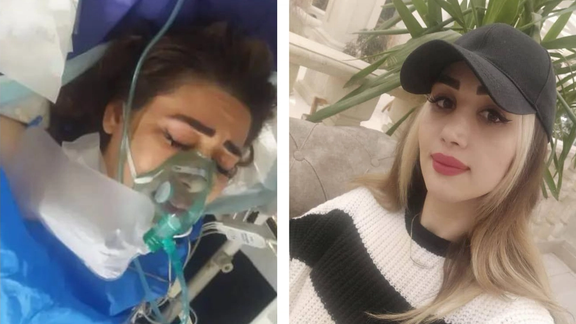
Badri before and after being shot by the police in July
Iran’s state security forces have forced 31-year-old Arezou Badri, who was shot by police for allegedly violating hijab rules, to give a coerced confession despite her critical condition in hospital, Iran International has learned.
Badri, who is hospitalized with severe injuries to her spine and lungs, was pressured into confessing while in extreme pain, unable to sit or eat, sources told Iran International on Sunday.
Sources revealed that Badri, who broke down in tears from pain multiple times during the forced confession, was threatened by security agents and coerced into a video interview. The agents also forced her close family members, including her sister, to make coerced confessions.
Badri was shot on July 22 while returning home with her sister in Nour County, northern Mazandaran Province.
Reports obtained by Iran International reveal that police opened fire from the rear driver's side of the car stopped on a dirt road, striking Arezou Badri in the back and severely damaging her spinal cord and lungs.
A seizure order had been issued for the vehicle in which Badri was a passenger, allegedly due to a violation of Iran's mandatory hijab law. Police issue vehicle seizure alerts if the driver or a passenger are seen without hijab in a car.
Mazandaran Provincial Police confirmed the shooting, claiming the driver continued to flee despite police orders, leading officers to open fire "according to the law on the use of weapons."
Meanwhile, Ahmadreza Pourkhaghan, head of the Judicial Organization of Iran's Armed Forces, announced that the officer who shot Badri is currently in prison under temporary detention.
Despite this development, President Masoud Pezeshkian, who had promised during his election campaign to stop hijab patrols and violence against women for violations, has remained silent on the incident, amid growing calls on social media for him to address it.
Sources told Iran International that a court hearing regarding the family's complaint has been held, but the family is dissatisfied with the proceedings and is under pressure to drop the case.
Badri, a sales associate and mother of two, was initially taken to a local hospital in Nour before being transferred to Imam Khomeini Hospital in Sari, and eventually to Vali-e-Asr Hospital in Tehran under tight security.
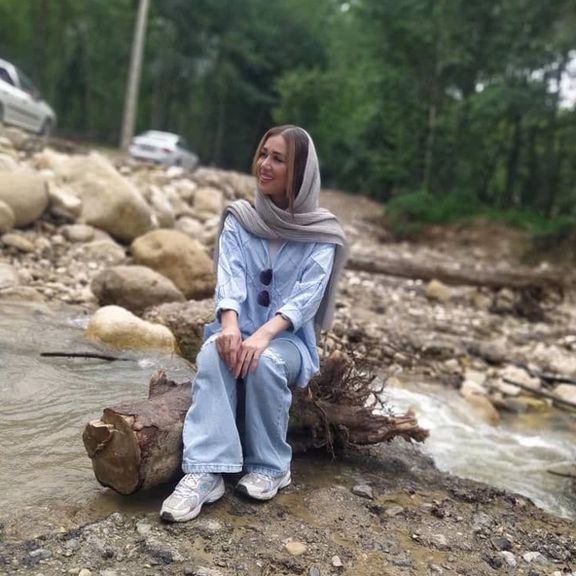
Arezou Badri
Exclusive information received by Iran International revealed that Badri had undergone another surgery on Wednesday due to fluid buildup in her lungs, and her condition remains critical.
Additionally, security forces on Thursday prevented her family from leaving their hotel to visit her in the hospital. They were allowed to leave the hotel on the next day, but were denied visitation when they arrived. Sources said that before allowing the visit, several members of parliament sought to meet with the family to gain their cooperation.
Iranian authorities have long been notorious for using forced confessions as a tactic to silence dissent and push their narrative. These confessions, often extracted under duress or torture, are frequently broadcast on state media to cover up abuses and justify harsh crackdowns.
The case of Badri is the latest example, underscoring the state’s reliance on coercion to control the narrative and suppress opposition.
Badri’s story has been widely viewed as yet another example of the Iranian state's escalating violence against women over the mandatory hijab, fueling further outrage within the country and drawing condemnation from rights groups.
In December 2022, amid nationwide protests sparked by the death of Mahsa Amini in morality police custody, the European Union sanctioned Iran's state broadcaster, IRIB, for “producing and broadcasting the forced confessions of detainees.”
The United States in November 2022, extended its 2013 sanctions against IRIB to include several IRIB officials for their role in airing coerced confessions.
Iran’s new president, Masoud Pezeshkian, was scheduled to present the core of his executive plan during a 2.5-hour speech on the first day of the parliament proceedings to review his plan and cabinet.
However, due to the commotion and disorder in the parliamentary session, he reduced his speech to just 53 minutes, struggling to even read his notes correctly. He ceded the remainder of his time to parliament members to defend him, despite there being ample time under parliamentary rules for both support and opposition.
In his speech, Pezeshkian did not outline a specific plan, contrary to the parliament's expectations. Instead, he stated that his plan is the Seventh Development Plan (approved by the parliament) and the policies endorsed by Ali Khamenei—documents that no one in the current parliament would dare to review or criticize. Moreover, Khamenei’s declared policies and the development plan are general wish lists, not road maps to get things done.
Yet, his remarks, much like his statements during the debates, reveal four key confusions and contradictions that are likely to trouble his administration over the next four years, some of which are already evident in the composition of his cabinet.
Tribe or nation-state
To persuade his Islamist audience, Pezeshkian frequently cites passages from the Qur'an and centuries-old Shiite texts to justify his decision-making process. However, he seems unaware that the words of the Prophet of Islam and the First Shia Imam were articulated within the context of a tribal society in Hijaz, Arabia, 14 centuries ago. Even if these teachings were effective in that era, they cannot serve as a roadmap for the present day. Pezeshkian fails to grasp that Islamism and strict textualism reduce the worldview of Islamists to that of a single Arab tribe, the Quraish, which no longer reflects the complexities of modern life.
Religious texts offer guidance and sermons, not blueprints for effective governance. They do not address the complexities of legislative processes, policy-making, or decision-making in response to evolving needs, principles, institutional contributions, and public opinion.
Foreign enemy or internal ruling class?
Pezeshkian frequently oscillates between blaming imperialism and sanctions for hindering "Islamic rights and justice" and acknowledging the weaknesses, problems, and incompetence of Iran’s rulers. This back-and-forth leaves his administration's direction unclear—whether its focus will be on combating the "system of global domination" or addressing corruption, inefficiency, discrimination, and waste within the ruling class.
As a result of this back and forth, Pezeshkian sidesteps the root causes of the country's problems—namely, anti-Western foreign policy, regional expansionism, and the nuclear agenda. He avoids addressing the diversion and expenditure of resources toward international conflicts and propaganda, the more than one trillion dollars lost due to the nuclear program, and the economic isolation that has shuttered trade opportunities with the world. These issues go far beyond mere differences or incompetence within the ruling class; they are systemic flaws that cannot be ignored.
National unity or gang cohesion
In defending his cabinet and governance approach, Pezeshkian portrays his administration as a government of national unity. However, his unwavering adherence to the opinions and policies of Ali Khamenei and the composition of the cabinet suggest a factional and clique-driven government. Ali Khamenei has consistently represented the interests of Iran's most totalitarian and authoritarian factions, never playing a cross-factional role.
In Pezeshkian’s proposed cabinet, influential factions and mafias within the government have been allocated power in proportion to their influence within Khamenei’s office and the IRGC’s economic empires, military-industrial complexes, and the repression and propaganda apparatus. As a result, Pezeshkian’s administration is neither a government of national unity nor one representing the unity of the Islamic Ummah; rather, it is a government of factional cohesion. In this view, the "nation" is synonymous with the ruling elite and the factions within its ranks.
Implementation or non-implementation: that's the question
Whenever Pezeshkian addresses the country's problems and crises, he retreats to the Islamic idealism of the 1970s. This idealism holds that all issues stem from neglecting Islamic principles, which lead to "wrong and injustice." Khamenei paved the way for Pezeshkian to assume the presidency and secure victory in the engineered elections, aiming to revive this failed Islamic idealism.
In Pezeshkian’s view, the ultimate remedy lies in the word of God, as conveyed by the Prophet, the first Shia Imam, and today, by the Supreme Leader whose decrees are enforced by the state. However, the lived experience under the Islamic Republic has demonstrated that Iran’s current problems and crises are rooted in a government that enforces Sharia orders and rulings to secure absolute, unaccountable power. This approach is at odds with modern common sense, meritocracy, the rule of law, and the principles of limited government.
Amid an escalating electricity crisis in Iran, several citizens have reached out to Iran International, sharing accounts of continuous power outages amid the oppressive heat gripping the country.
These audio and video messages, sent in from various regions, underscore a growing public sentiment that attributes the widespread electricity shortage to what they describe as the "incompetence of Islamic Republic officials."
Over the past several years, the Islamic government has struggled to meet the nation's electricity demand, with repeated failures plunging hundreds of cities and villages into darkness each summer.
This year, however, the situation appears to have reached a critical juncture, as the frequency and duration of blackouts have intensified as the gap between supply and demand has widened.
Citizens, in messages and videos sent to Iran International, have highlighted the ongoing disruptions and expressed their frustration and anger toward the authorities.
Many view the government's mismanagement and misallocation of resources as the root cause of the current predicament.
One resident poignantly remarked, “These officials talk about waging war against Israel, yet they have squandered Iran's resources by funneling money to groups like Hamas and Hezbollah, leaving the nation to suffer the consequences.”
Another citizen from Shahin Shahr, Isfahan, central Iran, sent a video to Iran International highlighting the recurring power cuts in the area. Addressing the country's leadership, he lamented, "For years, you have been waging a global battle over nuclear energy, yet you cannot even ensure a stable electricity supply for the nation." He criticized the government for years of “empty promises about building power plants,” which he says have “only burdened the people with substantial costs.”
"We have made the entire world our enemy—for nothing," he continued. "How long must we live in humiliation? The Islamic Republic only refrains from missteps when it faces external pressure."
On Friday, the ILNA News Agency reported on the growing complaints from residents of Shiraz, who have been enduring frequent and unannounced power outages. These sudden blackouts have disrupted daily life and inflicted heavy financial losses. The report highlighted the cascading effects of these outages, which are manifold—ranging from damage to electrical appliances to the crippling of local businesses.
In some areas, frustration has spilled onto the streets. On Thursday, merchants at the Noor commercial complex in Tehran protested after enduring a six-hour power outage. When their appeals went unanswered, they took their grievances public, blocking traffic and disrupting bus lines until law enforcement arrived and the power was restored.
It appears that the government has prioritized religious ceremonies despite the widespread hardships faced by ordinary citizens and businesses.
On the same day as the Tehran protest, Mohammad Moradi, CEO of the Kermanshah Province Electricity Distribution Company, announced that power supply for Arbaeen pilgrims in the province had been secured. Ninety billion rials had been allocated to ensure stable lighting along pilgrimage routes and facilities.
This announcement has been met with mixed reactions, particularly as it comes at a time when many Iranians are struggling with basic electricity needs.
Each year, Shia pilgrims converge on the Iraqi city of Karbala to observe Arbaeen, a significant religious commemoration. In recent years, many Iranians have begun their pilgrimage from the western regions of Iran, undertaking a long walk to Karbala.
On Tuesday, Tehran City Council member Habib Kashani confirmed that the Electricity Distribution Company had resorted to planned power cuts, acknowledging the necessity of informing residents in advance due to the impact on water supplies in buildings with electric pumps. This admission reflects the broader challenges local and national officials face in managing the country’s energy needs.
In response to the ongoing crisis, some provincial governments have taken drastic measures, continuously shutting down or partially closing government offices since early July. This approach, however, needs to do more to alleviate the underlying issues.
Experts have identified several factors contributing to the current electricity shortfall, including inadequate investment in the power sector, a lack of power plant development, an aging production and transmission infrastructure, and energy prices that have exacerbated the supply and demand imbalance.
As the electricity crisis deepens, the voices of those affected continue to grow louder, painting a stark picture of the challenges facing Iran's energy infrastructure and the mounting public frustration with the government's handling of the situation.
Despite President Masoud Pezeshkian’s defense of his proposed ministers during the first parliamentary confirmation hearing, several lawmakers criticized him for a lack of planning and the "incongruous mix" within the cabinet.
To shield themselves against criticism, Pezeshkian and his ministers emphasized the implementation of the general policies of the Islamic Republic and Supreme Leader Ali Khamenei.
Over the next four days, lawmakers will debate the nominees in alphabetical order by ministry, culminating in a vote of confidence for the entire cabinet on Wednesday.
For each nominee, the relevant parliamentary committee(s) will present their reports, followed by lawmakers speaking for or against the proposed minister after the nominee delivers their address.
Alireza Kazemi, nominated to lead the Ministry of education, was the first nominee to be reviewed. He is one of Pezeshkian’s most controversial nominees for whom reformists have widely criticized him.
In his speech to lawmakers, he enumerated the problems the educational system is facing including lack of money and human resources. He stressed that under his leadership, the ministry would address the “religious identity crisis” and that the “collaboration of home, school, and mosques can create a happier atmosphere for students.
“With Jihadi efforts”, he said, his ministry will educate students to be patriotic and obedient to the Supreme Leader.
Kazemi is an advocate of compulsory hijab and its enforcement in schools.
The Parliament heard from the Education, Research, and Technology Committee's spokesman that the majority of its members had approved Kazemi’s nomination.
Kazemi, who served as acting education minister in President Ebrahim Raisi’s cabinet for several months, met no opposition from the lawmakers none of whom had signed up to speak against him.
Kazemi’s brother, Mohammad Kazemi, heads the Intelligence Organization of the Revolutionary Guard (IRGC).
The second minister to be debated was Sattar Hashemi, the youngest member of the proposed cabinet, nominated to lead the Ministry of Communications and Technology.
The Parliament’s Cultural Committee, dominated by ultra-hardliners from the Paydari (Steadfastness) Party, rejected Hashemi’s nomination in their report to lawmakers, offering little criticism of his plans but presumably opposing him due to his character and political/ideological views.
In contrast, the Industries and Mines Committee unanimously endorsed Hashemi's plans and qualifications in their report.
Several lawmakers who spoke for and against Hashemi brought up the problem of internet anti-filtering software which most Iranians, including online and other businesses, are forced to use to access thousands of blocked websites including social media platforms such as Instagram.
In his speech, Vali Dadashi, an independent who had signed up to speak against Hashemi’s lack of relevant plans to expand access to fast internet, demanded action from the future minister against the so-called “mafia” that controls the hugely profitable anti-filtering software trade.
Many believe those who benefit from the trade have used their influence to impose restrictions on Internet access and will oppose Pezeshkian and his government if they try to lift Internet bans.
The need for anti-filtering software, Dadashi said, doubles the cost of access to the Internet. “Why do people have to pay for anti-filtering software?” he asked.
“Hashemi’s first step should be increasing the speed of the internet and his second to convince the members of the Supreme Cyberspace Council to lift filtering,” Ahmad Fatemi, a lawmaker who supported Hashemi’s nomination, told the Parliament.
The Council formed by Supreme Leader Ali Khamenei’s order in 2012 consists of the president who heads it, the speaker of the Parliament and chief justice, the head of the state broadcaster, and several ministers including the ministers of intelligence and defense. The commanders of the Revolutionary Guards and Police also sit on the Council.
Pezeshkian criticized filtering policies in his campaign speeches and debates. His supporters expect him to oppose these policies as the head of the Council in which hardliners and ultra-hardliners have a near absolute majority now.
In a wave of protests across cities like Arak, Mashhad, and Yasuj, Iranian nurses have taken to the streets, demanding better working conditions, fair pay, and respect for their profession.
The demonstrations, which began on August 5, have escalated into strikes, with nurses chanting slogans like "We've heard many promises, but seen no answers" and "We're the symbol of patience, but our patience has run out." The message is clear: the nurses' patience with the Iranian government’s neglect has reached its limit.
The protests follow the death of Parvaneh Mandani, a 32-year-old nurse at a hospital in Fars Province. Mandani’s death on August 2, attributed to overwork or Karoshi Syndrome, has become a rallying point for healthcare workers across the country.
Mohammad Reza Sharifi-Moghaddam, Secretary-General of the Nursing House, described her death as "suspicious," adding that "another nurse in Kermanshah, west of Iran, also took her own life by ingesting aluminum phosphide tablets."
The nurses’ demands are straightforward: "an immediate increase in wages, elimination of mandatory overtime, proper and immediate implementation of nursing tariffs, payment of arrears, improvement of harsh working conditions, and an end to security crackdowns on protesting nurses." These are not just demands for better pay, but for recognition of the critical role nurses play in Iran’s healthcare system.
However, the Iranian government has a huge budget deficit, estimated to be more than 50% and can ill afford giving in to the nurses' demands. Other sectors have similar grievances with most workers surviving with around $200 per month.
Sahar Motallebi, a physician and researcher in international population health, highlighted the financial struggles facing Iranian nurses. "Nurses earn between $200 to $250 per month, which is well below the poverty line," she explained. Motallebi pointed out that the problem stems from the health ministry’s decision to delegate nurse payments to the facilities where they work, leaving them at the mercy of underfunded hospitals and clinics. "These facilities, funded by their own income, often pay the nurses less than what is expected," Motallebi added.
The situation has become so dire that Fereydoun Moradi, a member of the Supreme Council of the Nursing System, revealed that "150 to 200 nurses migrate monthly" in search of better opportunities abroad. The combination of low pay, unpaid wages, and frequent physical assaults from patients' families has left many nurses feeling abandoned by the government. In Yasuj, for example, a nurse lost an eye after being attacked by a patient's family, and reports of stab wounds and fractures among nurses are becoming alarmingly common.
Despite promises from the University of Medical Sciences to pay overdue claims, the strikes continue. Videos from the protests show nurses chanting "Inflation in dollars, our salaries in rials," a reminder of the economic pressures they face. In Arak, nurses at Vali-Asr Hospital declared, "We are tired of promises" and "If we don't get our rights, we won't go to our shifts," only to be met with threats from the hospital’s security office.
As the protests gain momentum, support is growing from other sectors. The Progressive Student Association has called on all members of society, particularly medical students, to join the nurses' movement. The Teachers' Association of Fars Province has also issued a statement supporting the nurses' strike, emphasizing the legality and necessity of their protest.
Iran’s new president, Masoud Pezeshkian, urged lawmakers on Saturday to approve his cabinet, emphasizing its commitment to "ensuring the civil rights of all Iranians." However, events that same day sharply contrasted with his message, highlighting ongoing repression.
In Nazarabad, Alborz Province, a court sentenced Mashallah Karami, the father of executed protester Mohammad Mehdi Karami, to eight years and ten months in prison, according to pro-Bono legal group Dadban on Saturday.
The court also imposed a fine of 19 billion and 200 million rials (approximately $33,000) and ordered the confiscation of his assets, including a car and a house. Karami was charged with “acquiring property through illegal means” and “participating in money laundering.”
These allegations were linked to public donations that Karami’s lawyer emphasized in an interview with Shargh News were entirely legitimate.
Condemning the sentence, Dadban said that the sentence appears to be an attempt to discourage public support for families of executed protesters, rather than a legally sound decision.
Karami’s son, 21-year-old Mohammad Mehdi Karami, was executed on Jan. 7, 2023, following what rights groups have condemned as an unfair trial based on forced confessions. He was executed in connection with the nationwide 2022 "Woman, Life, Freedom" protests sparked by the death of Mahsa Zhina Amini in police custody.
Rights groups have criticized the detainment of Karami as part of a broader campaign against families connected to the protests.
Simultaneously, Iranian bodybuilder Sahand Nourmohammadzadeh, another protester from the 2022 uprising, was forced to return to Kahnuj Prison in Kerman Province.
Despite needing further medical treatment for his deteriorating vision, he was sent back to the remote and harsh facility where he is serving a 10-year sentence in exile.
Initially sentenced to death in November 2022 for "enmity against God" after allegedly damaging and setting fire to public property, his sentence was reduced following a retrial in April 2023.
His lawyer, Hamed Ahmadi, warned that without proper treatment, his client could lose sight in his right eye.
Nourmohammadzadeh was temporarily released in March 2024 for eye surgery, but he was returned to prison before his treatment could be completed on Saturday, raising serious concerns about his health in prison.
His father, previously revealed that his son was taken to the gallows three times for mock executions, underscoring the psychological torment he endured during his imprisonment.
In a farewell message on Instagram Saturday, before going to prison to serve his sentence Sahad said: "I’m at a loss for words...Goodbye...I hope no one else ever has to feel this way..."
While the president seeks support for his "government of national unity," the harsh treatment of protesters and their families underscores the widening gap between his promises and the reality of repression, casting doubt on the future of civil liberties in Iran.