Iran renews threats to attack Israel as Gaza ceasefire talks stall
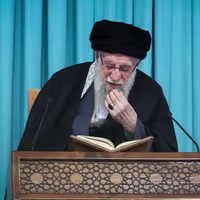
Iran's Supreme Leader Ali Khamenei and other Iranian officials saying prayers to the dead body of Ismail Haniyeh in Tehran
The chief-commander of Iran's Revolutionary Guard (IRGC) hinted at an imminent retaliatory attack on Israel on Saturday, adding fuel to speculations that the long-awaited avenging of Hamas chief Ismail Haniyeh may take place in coming days.
Iranian officials have been outspoken in their vows to avenge Haniyeh's killing, which they blame on Israel. However, the daily headlines predicting an 'imminent attack' from Iran against Israel since the killing of Haniyeh haven't materialized yet.
"You will hear good news about Iran's revenge," IRGC Chief-Commander Hossein Salami told a crowd of people during a visit to a border area in western Iran, when asked about the promised retaliation.
Media reports and official remarks suggest that Iran may proceed with its promised retaliation following the end of Arba'een pilgrimage on Monday, with Israeli media anticipating an attack by Lebanon's Hezbollah "in coming days".
Israel estimates that Hezbollah's retaliation strike will come within the next few days and may be "rapid and immediate," Israel's Channel 12 reported.
IDF Spokesman Rear Adm. Daniel Hagari said Saturday Israel is ahead of "a significant week amid the ongoing negotiations in Cairo, the fighting in Gaza and [on] the northern border. Our readiness is very high in attack and defense."
Hagari also called on the public to continue to be alert, adding that the military will update on "any development immediately."
On August 13, Reuters quoted three Iranian officials as saying that only a ceasefire deal in Gaza stemming from the ongoing talks would hold Iran back from direct retaliation against Israel for the assassination of Haniyeh. However, Iranian authorities have publicly announced that the response to Israel is not related to the Gaza ceasefire, though Tehran may launch the attack in a way that would not harm the truce talks.
Iran's Foreign Minister Abbas Araghchi in a Saturday phone call with his Egyptian counterpart underscored the Islamic Republic's "legitimate right to respond" to Israel's killing of Haniyeh in Tehran.
As part of diplomatic efforts to prevent further destabilization, Egypt's Foreign Minister Badr Abdelatty in his conversation with Araghchi expressed hope that mediation efforts could "ease regional tensions and prevent a cycle of violence and escalation."
Top US general, General Charles Brown, began an unannounced visit to the Middle East on Saturday, signaling Washington's concern over the potential for a new escalation in tensions that could lead to a broader conflict.
Brown, the chairman of the Joint Chiefs of Staff, underscored the need to deter any type of broader escalation and ensure that appropriate steps are taken to avoid a larger conflict.
“As I talk to my counterparts, what are the things we can do to deter any type of broader escalation and ensure we're taking all the appropriate steps to [avoid]... a broader conflict," Brown told Reuters before landing in Jordan.
Brown's visit to the region, which includes stops in Jordan, Egypt, and Israel, comes at a critical time as the United States seeks to broker a ceasefire deal between Israel and Hamas.
The Saudi channel Al-Hadath reported Saturday that Hamas has rejected the American proposal and firmly opposes any Israeli presence along the Philadelphia Axis and the Netzarim corridor, further complicating the prospects of a truce.
The conflict, now in its 11th month, has already triggered border clashes between Israel and Lebanon's Iranian-backed Hezbollah. US troops have also come under attack by Iran-aligned militias in Syria, Iraq, and Jordan, further complicating the situation.
Iranian authorities have ramped up their crackdown on nationwide nurses' protests, resulting in multiple arrests and one nurse falling into a coma after her detention.
Among those detained is Firoozeh Mojrian-Shargh, a nurse at Qaem Hospital in Mashhad, who was arrested on Tuesday night by security forces. Shortly after her detention, Mojrian-Shargh fell into a coma, raising serious concerns about her treatment in custody.
Mojrian-Shargh remains in critical condition in the ICU, her case drawing parallels to the tragic death of Mahsa Amini, who received traumatic head injuries and died after being detained by Iran’s morality police in 2022. Her death sparked widespread protests that lasted until early 2023 during which security forces killed atleast 550 people.
Firoozeh Mojrian-Shargh
The crackdown is part of a broader effort by Iranian authorities to suppress the growing protests, which began on August 5 and have since escalated into widespread strikes affecting around 50 hospitals and medical centers across seven provinces. Nurses, frustrated by the government's unfulfilled promises and unpaid wages. They have been chanting slogans such as "We've heard many promises, but seen no answers" and "Our patience has run out."
In addition to Mojrian-Shargh, Zahra Tamadon, the head nurse of Ward 10 at Masih Daneshvari Hospital in Tehran, was detained on Wednesday, along with several other nurses.
Zahra Tamadon
According to Norway-based rights group Hengaw, her arrest may be linked to the recent protests and strikes. Additionally, two protesting nurses were arrested in Arak, further illustrating the sweeping nature of the crackdown. According to information received by Iran International, at least 18 protesting nurses have been summoned to security agencies in recent days across various cities.
Despite the intensified crackdowns, nurses in several Iranian cities, including Khorramabad in western Iran, Babol in the north, Khomeyni Shahr in central Iran, and Sabzevar in the northeast, launched a fresh wave of strikes and rallies on Saturday, continuing their demands for better pay, elimination of mandatory overtime, and improved working conditions.
The protests gained momentum after the death of 32-year-old nurse Parvaneh Mandani on August 2, reportedly due to over-work-induced Karoshi syndrome, which has become a rallying point for healthcare workers.
Meanwhile, reports emerged on Friday that another Iranian nurse, Elaheh Kazemi, has fallen into a coma due to extreme work-related stress.
Elaheh Kazemi
Kazemi, who worked in clinics in Tehran, had been suffering from severe fatigue and body pain, which led her to frequently use painkillers. Her brother shared in an Instagram video that Kazemi has been unconscious for five days and is currently hospitalized at Loghman Hakim Hospital in Tehran.
These incidents highlight the dire working conditions faced by healthcare workers in Iran. Mohammad Reza Sharifi-Moghaddam, Secretary-General of the Nursing House, revealed that in just one month, three nurses died in their sleep, deaths attributed to "Karoshi syndrome," a condition caused by extreme overwork.
Iran’s new Health Minister, Mohammad Reza Zafarghandi, admitted that the government owes nurses a staggering 75 trillion rials (approximately $117 million) in unpaid wages but offered only vague assurances that the payments would be made “as soon as possible.” That amount is a huge sum in Iran where nurses earn just $200 a month.
As Iran’s healthcare crisis deepens, the state’s prioritization of suppressing dissent over addressing the systemic issues driving the nurses' protests underscores a broader strategy focused on maintaining control rather than resolving the underlying problems that have led to widespread unrest.
A coalition of Iranian human rights activists and dissident groups has urged the Körber Foundation in Germany to sever ties with the government in Iran.
The Hamburg-based organization has gone to great lengthsto promote Seyed Hossein Mousavian, who was an Iranian diplomat when over 20 Iranian dissidents in Europe were assassinated during the 1990’s.
“In May 2024, Brigadier General Christian Freuding and 39 high-ranking German Foreign Ministry and Army officials met with Mousavian under the auspices of the Körber Foundation,” the group pointed out in the campaign letter.
“Mousavian, a known apologist for the Islamic Regime of Iran, has a documented history of involvement in terrorist activities on European soil. His participation in such high-level meetings legitimizes his views and poses potential risks to Germany’s national security,” wrote the coalition statement in both English and Persian.
Mousavian, an academic at Princeton University, is currently being investigated by the US Congress and is subject to a campaign by rights groups for his dismissal due to his alleged connections to state-sponsored terror.
The letter written by the coalition also noted that Adnan Tabatabai was another frequent invitee of the Körber Foundation.
“Tabatabai has well-documented connections to the Islamic Republic of Iran (IRI). His perspectives, often sympathetic to the regime, overshadow the voices of countless Iranians who suffer under the gender apartheid and authoritarian rule of the IRI,” the activists wrote.
The coalition comprises major organizations such as the Alliance Against Islamic Regime of Iran Apologists (AAIRIA), International Committee Against Death Penalty and Organization for Human Rights Hengaw.
Körber has also hosted Iranian regime official Massoumeh Ebtekar, who participated in the taking of American hostages at the US embassy in 1979, openly writing on X: “We were honored to welcome Dr. Massoumeh Ebtekar @ebtekarm, Vice President of #Iran at Körber Foundation for a Background Discussion today.”
The letter was also signed by a number of prominent German-Iranian and German activists and human rights experts such as Gazelle Sharmahd, the daughter of the German-American hostage in Iran, Jamshid Sharmahd. He is one of an unknown number of dual-nationals held by Iran as part of its policy of diplomatic hostage taking.
Golaleh Sharafkandi, whose uncle, Dr Sadegh Sharafkandi was assassinated by Iranian agents in the Mykonos restaurant in Berlin in 1992, targeting Kurdish dissidents, is also a signatory.
Mousavian, who was ambassador to Germany at the time, allegedly permitted a clandestine division to work at Iran’s embassy in Bonn to carry out assassinations.
In November, referring to the Mykonos case, Mousavian denied his involvement. He told Iran International: “The 398-page verdict is published and everyone can have access to it. The Berlin court verdict does not contain any direct or indirect allegations against me.”
When approached about the latest letter on Friday via WhatsApp and Emails, Mousavian declined to comment.
The letter noted that “The Körber Foundation, established by industrialist Kurt A. Körber, has a complex history, including connections to the Nazi regime during World War II.
“As an organization with this past, it is even more crucial for the Foundation to promote justice, human rights, and democracy actively. By cutting ties with apologists of oppressive regimes and supporting the Iranian people's fight for freedom, the Körber Foundation can help remedy its dark past and contribute positively to a just future.”
The letter also referenced delegations Körber sponsored to Iran in 2017 where staff met with Iranian officials and visited the state-run Press TV, sanctioned by both the US and UK.
Lothar Dittmer, the chairman of the Körber Foundation, and Henriette Viebig, a spokeswoman for the Körber company that finances the foundation, did not immediately respond to Iran International press queries.
In his first state TV interview as Foreign Minister, Abbas Araghchi on Friday hinted at a diplomatic shift, stating that ongoing tensions with the West shouldn't burden the Iranian nation.
"The overarching approach of the 14th administration's foreign policy reflects a nuanced balance between continuity and transformation," Araghchi said. He suggested that should Europe abandon its “aggressive” stance, "they will become Iran’s priority" once more—a position currently occupied by Russia and China.
The statement comes amid a backdrop of strained relations between the EU and Iran, with the bloc accusing Tehran of failing to curb its nuclear activities, supporting Palestinian militant group Hamas, backing Russia's aggression in Ukraine, and committing human rights violations.
Regarding relations with the US, Araghchi said that tensions exist between the two countries and that "In our foreign policy, it is our responsibility to minimize the costs of the [US] aggression to the greatest extent possible and to avert the formation of an international consensus against us," Araghchi said.
Although similar nuanced statements by Iranian officials in recent weeks are far from being a clear signal of a significant foreign policy shift, they could be attempts to explore the diplomatic environment prior to the US elections.
Additionally, Iran has so far refrained from retaliating against the killing of Hamas leader Ismail Haniyeh. With Europe and the US firmly backing Israel and labeling Iran as a regional sponsor of terrorism, any aggressive move could solidify Iran's position as the antagonist in the eyes of the international community. Moreover, with Iran's economy in dire straits, even the desire to respond might be overshadowed by the harsh realities of their financial limitations.
Meanwhile, Tehran appears intent on conveying that this restraint is not a sign of weakness but rather a deliberate display of strategic flexibility—or perhaps even an act of calculated magnanimity. Araghchi, after all, had earlier asserted that retaliation remains Iran's right, making it clear that any decision to withhold action is deliberate, not due to lack of resolve.
Araghchi already appears to be setting his diplomatic wheels in motion. On Thursday, he called for dialogue with the European Union to address bilateral issues following a conversation with the bloc’s top diplomat.
“The Islamic Republic of Iran welcomes the development of relations with the European Union in an environment based on mutual respect,” Araghchi stated late Thursday.
In a subtle move that could yet be another signal of a shift in tone, Iran extended congratulations to Ukraine on its Independence Day on Saturday. This gesture comes despite its ongoing support for Russia, including the supply of hundreds of Shahed drones since mid-2022, which have been used extensively to target civilian infrastructure and urban centers in Ukraine.
Whether this gesture signifies a significant change or a deft diplomatic maneuver remains uncertain, and Russia’s response to Iran’s potential diplomatic recalibration will undoubtedly draw keen attention.
Araghchi's Friday statements hinted at a nuanced recalibration in Iran's foreign policy, but he anchored every remark in the words of the Supreme Leader. He acknowledged a strategic pivot towards unity between the presidential administration and the "nezam" (regime) citing this as a key issue in the West's troubled relationship with Iran.
For many years, it has been evident that Tehran's officials often present a narrative to the West suggesting that Supreme Leader Khamenei must be persuaded to take any significant conciliatory steps. However, this tactic appears to have lost its impact, as the West increasingly sees any perceived divergence within the Iranian establishment—especially from Khamenei, the ultimate decision-maker—as largely inconsequential.
Araghchi also highlighted the Supreme Leader’s dual strategy: On one hand, there is the long-standing tactic of circumventing sanctions—a practice he subtly indicated falls outside the Foreign Ministry’s purview. On the other hand, the immediate and pressing priority is the removal of sanctions, primarily through negotiations with the West.
The practice of circumventing sanctions, often driven by the Revolutionary Guards, has not only failed to bolster the economy but has also exacerbated many of Iran's current challenges by fueling widespread corruption through illicit activities such as money laundering.
“During a meeting with members of Parliament, the Supreme Leader emphasized that sanctions can be lifted through honorable means, and it is the responsibility of the Ministry of Foreign Affairs to initiate and lead these efforts,” Araghchi said.
"If the opportunity arises to lift the sanctions, we will not hesitate for even an hour; our commitment to removing these sanctions—whether through negotiation or any other honorable and dignified means—will be unwavering and persistent," he added.
This tonal shift has subtly surfaced among Iran's leadership in recent days. On Friday, Iranian lawmaker Mojtaba Zonnour, once famously known for symbolically burning a copy of the 2015 nuclear deal in parliament, expressed support for the accord, provided broad consensus exists on its revival.
Even figures typically associated with more hardline rhetoric are signaling a change. Hassan Aboutorabi-Fard, Tehran's Interim Friday Prayer Imam, remarked that "the Islamic Republic has become a tangle of unresolved problems," cautioning that "if we neglect reform today, tomorrow may indeed be too late."
On Friday, Meta reported potential hacking attempts on the WhatsApp accounts of US officials by Iranian actors amidst growing concerns over Tehran’s interference in US elections.
These officials are associated with both President Joe Biden and former President Donald Trump. The company attributed these attempts to APT42, an Iranian hacker group widely believed to be linked to an intelligence division within Iran's military. This group has a history of conducting invasive surveillance operations, often targeting political figures and activists abroad.
According to Meta, the parent company of Facebook, Instagram, and WhatsApp, the hacking attempts were identified as part of a "small cluster of likely social engineering activity on WhatsApp." The attackers reportedly posed as technical support representatives from companies like AOL, Google, Yahoo, and Microsoft to gain unauthorized access. However, Meta intervened quickly, blocking the accounts after they were flagged as suspicious. There is no evidence that any targeted WhatsApp accounts were successfully compromised.
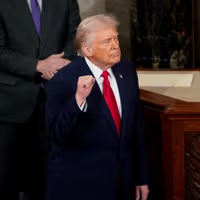
Republican candidate, former US President Donald Trump, speaks as he attends a presidential debate with the former Democrat candidate, US President Joe Biden, in Atlanta, Georgia, US, June 27, 2024.
Earlier this month, Microsoft and Google reported attempts to breach US presidential campaigns ahead of the November election. The hackers appeared to have focused their efforts on political and diplomatic officials, business leaders, and other public figures in the US, Israel, the Palestinian territories, and the UK.
Last week, US intelligence agencies, including the FBI, the Office of the Director of National Intelligence, and the Cybersecurity and Infrastructure Security Agency (CISA), issued a joint statement confirming Iranian state actors' involvement in recent cyberattacks targeting former President Trump's campaign. The statement highlighted an escalation in Iranian efforts to interfere with the ongoing election cycle, particularly through influence operations and cyber activities aimed at compromising presidential campaigns from both political parties.
According to a Friday report by Reuter, APT42, also known in the cybersecurity community as "Charming Kitten," is notorious for its sophisticated cyber espionage operations. The group has a well-documented history of placing surveillance software on the mobile phones of its targets, enabling them to record calls, steal texts, and even activate cameras and microphones remotely. This invasive approach poses a significant threat, especially given the group's focus on high-value targets in Washington and Israel.
Researchers from Mandiant, a leading US cybersecurity firm, told Reuters about the physical dangers of APT42's activities. There are documented cases where the group's cyber-surveillance preceded the physical targeting of Iranian activists and protesters, some of whom were subsequently imprisoned or threatened in Iran.
Tehran has consistently denied involvement in these cyber activities. In response to the recent US intelligence report attributing the Trump campaign hack to Iranian state actors, Iran's mission to the United Nations in a statement last week described the allegations as "unsubstantiated and devoid of any standing." It emphasized that Iran has neither the intention nor the motive to interfere in the US presidential election and challenged the US to provide concrete evidence of the alleged interference.
These developments seem to be part of a broader pattern of increasing Iranian cyber activities aimed at influencing the US presidential election. Reports from earlier this summer also suggested that Iran had devised a scheme to assassinate Trump, though Tehran has denied these allegations as well.
At least three Iran-affiliated fighters were killed, and ten others were injured in Israeli airstrikes on four military centers and weapons depots belonging to IRGC’s Quds Force and Iran-backed proxy forces in the outskirts of Homs and Hama on the night of Friday, August 23.
According to the UK-based Syrian Observatory for Human Rights, among the targets of these attacks were a weapons depot in northwestern Hama, the command center of Brigade 47, and an air defense facility in Mount Maraan, where members of the IRGC's Quds Force, along with Syrian and non-Syrian militants supported by Iran, are stationed.
Additionally, Israeli forces targeted fuel depots belonging to Syrian members of Hezbollah in the west of the Homs refinery, as well as another site south of Mount Maraan, which served as the command center for the Iran-backed Rapid Response Group.
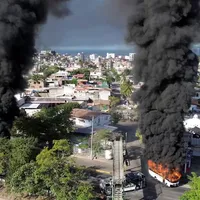
The air defense system stationed at the Hama military airport responded to the attacks but was unsuccessful in intercepting the Israeli missiles. As a result, a weapons depot and fuel tanks were destroyed, causing thick smoke to rise from the targeted sites due to the ignition of the fuel depots.
SANA, Syria's state news agency, confirmed the Israeli airstrike and reported that "seven civilians were injured, and damage was caused."
23 IRGC officers killed in Israeli attacks on Syria in 8 months
Since 2013, Israel has conducted numerous attacks against the IRGC's Quds Force and Iran-backed proxy forces in Syria, primarily targeting their military bases, weapons depots, and infrastructure to prevent the transfer of advanced weapons and equipment to Iran's proxy groups or to reduce their presence in Syria. These attacks have become more frequent in recent years.
In early April, an air strike on a building in Iran’s diplomatic compound in Damascus, killed seven Revolutionary Guard officers, including two generals. The incident led the Iranian military to undertake an unprecedented retaliatory drone and missile strike against Israel on April 13. Almost all of the 350 projectiles were shot down by Israeli air defense and allied warplanes.
According to reports from the Syrian Observatory for Human Rights, Israel has conducted at least 60 air and missile strikes on targets in Syria since the beginning of 2024.
Reports indicate that these attacks, carried out in at least nine Syrian cities, have destroyed nearly 124 targets, including buildings, weapons and ammunition depots, centers, and vehicles belonging to the IRGC's Quds Force and Iran-backed proxy forces.
These strikes have resulted in the deaths of 181 military and militia personnel and injuries to 113 others.
Among those killed, at least 23 were Iranian officers of the IRGC's Quds Force, 116 were Lebanese, Syrian, and Iraqi members of Iran-backed proxy forces, and 42 were Syrian military personnel.