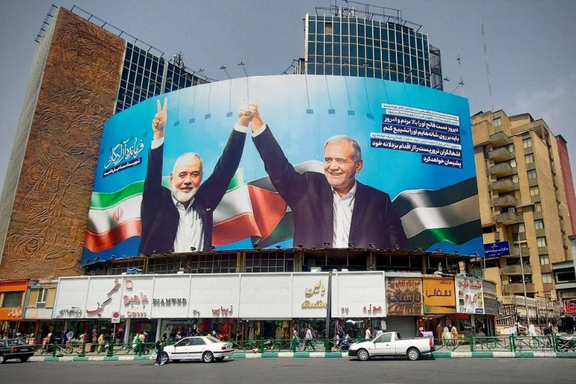
A billboard in Tehran showing Iran's president Masoud Pezeshkian and Hamas leader Ismail Haniyeh
Around 300 Palestinian and Yemeni fighters are holding military training exercises inside Iran, a source familiar with the matter told Iran International, even as President Masoud Pezeshkian is due to deliver a message of regional peace to the UN General Assembly in New York.
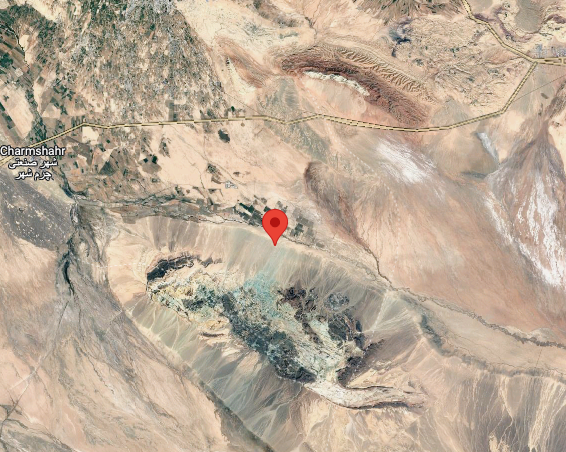
The drills are being held at a base 110 km (68 miles) south of the capital Tehran and come at a time of heightened tension across the region, the source added, particularly in Lebanon where Israeli air strikes have killed nearly 600 people in a single day.
Due to the sensitivity of the matter, the source spoke to Iran International on condition of anonymity.
The Shaheed Shabani facility has regularly hosted training sessions for Iran’s allied armed groups in the region, including Houthis, Hezbollah, Hamas, and Palestinian Islamic Jihad.
Over the past decade, this base has become a hub for training aimed at strengthening what Iran calls the Axis of Resistance, a transnational network of armed Islamists dedicated to confronting Israel and the United States.
This latest drill appears to be part of a broader effort by Iran's Revolutionary Guards (IRGC) to prepare its regional allies for potential future operations.
It is focused on “ground assaults, building seizures, and hostage-taking tactics ... (and) guerrilla warfare techniques, bomb-making, and advanced weapons use,” according to the source speaking to Iran International on condition of anonymity.
Shaheed Shabani base is located 110 km south of Iran's capital Tehran
Multiple such exercises have been held over the past year inside Iran, the source said. Those participating in the trainings arrive from Lebanon, Yemen, and Syria.
Some stay longer than others, getting additional, specialized instructions on the assembly and operation of advanced weaponry, the source added
Earlier this year, the Daily Telegraph reported that Yemen's Houthis were trained at Khamenei Academy of Naval Sciences and Technology in Ziba Kenar on the Caspian coastline north of Iran.
Another site was on Farur Island, a small, uninhabited island in the Persian Gulf controlled by the IRGC's naval forces, the Telegraph report alleged.
Iran’s continued investment in training its regional allies has raised alarm among neighboring countries and Western powers who view these forces as central to Tehran’s strategy of extending its influence in the Middle East.
The Islamic Republic says its actions are part of a defensive strategy to counter threats from Israel and the West.
Iran must prioritize genuine de-escalation as tensions flare in the Mideast, an influential former parliamentarian and political commentator has written ahead of President Massoud Pezeshkian's debut speech at the UN General Assembly.
"Now that Pezeshkian has come into office with the slogan of de-escalation, some are trying to drag him into sanctions and tensions," Heshmatollah Falahatpisheh, a former head of the National Security Committee of the parliament and a foreign policy analyst, told private Iranian news agency Fararu.
"His duty is to the nation, or at least to the part of the nation that trusted and voted for him expecting change, especially in foreign policy."
Some factions oppose Pezeshkian's push to reduce tensions with Western countries to ease sanctions, while supporters hold on to the hope that he will follow through on his promises.
Falahatpisheh emphasized that past diplomatic approaches have failed to yield results and Pezeshkian must pursue a path more committed to genuine change.
No more talk
"The era of speech-centered diplomacy has passed ... Most past presidents have taken trips that haven’t been fruitful," Falahatpisheh said.
"If this trip is no different, it will turn into a costly and ineffective one for the country. Those who have imposed costly foreign policies must be held accountable. The Iranian people have the right to question those who imposed high-tension policies."
Iran's President Masoud Pezeshkian arrived in New York on September 22, 2024 to attend UNGA
Sanctions imposed on Iran, primarily by the United States and its allies, have harmed the country’s economy and the everyday lives of its citizens. These sanctions, especially those targeting Iran's banking, oil, and trade sectors, have led to inflation, reduced purchasing power, and a scarcity of essential goods.
The national currency, the rial, has devalued, making imports more expensive and driving up the prices of food, medicine, and other essentials. While the government attempts to provide basic commodities at subsidized rates, many still struggle with rising costs.
Medicines, particularly those for chronic and rare diseases, are often difficult to obtain despite exemptions on humanitarian goods due to logistical barriers and banking restrictions.
Calls for de-escalation and accountability
Falahatpisheh pointed out that many of those who initially opposed the FATF and JCPOA six years ago now support reviving these agreements, recognizing the need to address the costs of sanctions and tensions.
"If Pezeshkian wants to act differently from the past, he should initiate a serious de-escalation strategy, and this must begin and take shape in New York. We expect him to pursue maximum de-escalation with the world."
Sanctions have also affected employment, with reduced foreign investments and trade opportunities leading to job losses in various sectors. Youth unemployment remains high, while businesses, especially small and medium-sized enterprises, face difficulties in securing the materials and funds needed to operate.
These economic pressures have led to widespread discontent, with many Iranians calling for solutions to ease their daily hardships.
In recent years, the strain has pushed people to the streets in protest, demanding economic relief and political reforms.
"The experience of the past 11 months has shown that since Iran and the US delayed making their indirect negotiations in Oman serious, both sides have entered a highly challenging field designed by Benjamin Netanyahu," Falahatpisheh added, referring to Iranian nuclear talks.
"Despite the enmity between Iran and the US, neither wants tensions in the region. Unfortunately, the Oman negotiation table has been removed, and both sides are now stuck."
Iranian President Masoud Pezeshkian during a meeting with American media representatives in New York, September 23, 2024
Iran's delegation is allowed to travel only within the area between their accommodation at the Millennium Hilton Hotel and the UN headquarters and the route to and from the airport, a security source told Iran International.
A request by the Iranian delegation to travel outside the designated area on Monday was rejected by US security authorities, the source added, angering President Masoud Pezeshkian's entourage.
Following Iran's request, the source added, security authorities reached out to the US State Department, which reaffirmed that the travel restrictions on the Iranian delegation would remain in place throughout the delegation's stay in New York.
Similar movement restrictions had been imposed against Iranian delegations in previous visits to New York.
Israeli President Isaac Herzog on Tuesday rejected an assertion by Iranian President Masoud Pezeshkian the previous day that Israel is trying to draw Iran into direct conflict, accusing Israel's foe of already playing an active role in regional instability.
Speaking to journalists in New York on the sidelines of the United Nations General Assembly on Monday, Pezeshkian accused Israel of trying to provoke Iran into joining the conflict between Israel and the Iran-backed Hezbollah in Lebanon, warning of the "irreversible" consequences of further instability in the Middle East.
"We want to live in peace; we don't want war," he said, calling for a resolution through dialogue.
In an interview with CNBC, Herzog rebuffed Pezeshkian, accusing Iran of destabilizing the region through its Revolutionary Guard Corps - a transnational paramilitary organization which supports armed Islamist groups such as Hezbollah, Hamas, Islamic Jihad, and the Houthis.
"The Iranian president says something, and yet his National Guards are leading the entire region into the abyss by ongoing terror," Herzog said.
Herzog questioned how smaller factions like Yemen's Houthis have acquired advanced weapons such as ballistic and cruise missiles while emphasizing Israel's view of Hezbollah as a grave threat.
"Hezbollah is a terrorist army which has basically hijacked a nation called Lebanon ... We care for them, we want to enable a peaceful future between us and Lebanon."
Pezeshkian, who assumed the presidency following a July election, also reiterated Iran's support for Hezbollah during an interview with CNN that aired on Monday while warning against escalation.
"The danger does exist that the fire of events taking place [in Lebanon] will expand to the entire region," Pezeshkian warned.
The ongoing conflict between Israel and Hezbollah has resulted in significant casualties, with Lebanese health authorities reporting over 550 deaths in recent days from Israeli attacks.
Israel has carried out extensive aerial bombardments it says target Hezbollah infrastructure in Lebanon, marking one of the deadliest periods since Lebanon's civil war.
Iranian President Massoud Pezeshkian's current stay in New York for the UN General Assembly will be the shortest of any of his predecessors, lasting just three days.
This short stay could explain his limited media exposure and help mask his communication weaknesses. Over the past few months, Pezeshkian has shown he’s not a strong speaker, often repeating himself multiple times in the same interview or speech.
Even when reading from a prepared text, he tends to lose his place. On several occasions, he’s even cut speeches short, claiming the audience appeared bored. Although Pezeshkian’s first appearance in New York took place behind closed doors in a meeting with a group of journalists, labeled by his team as "media managers," it is likely that he will delegate interviews with US and international media to his vice president for strategic affairs, former Foreign Minister Mohammad Javad Zarif. Zarif is expected to convey the message that Iran has changed and is ready to engage with the world.
Pezeshkian has described his mission to New York as "telling the world that Iran is more secure and free than you think." However, this message may be difficult to convey, given recent events.
Just recently, Hamas leader Ismail Haniyeh was assassinated in Tehran, and as in previous years, Iranian expats continue to face the risk of being taken hostage on fabricated charges.
Beyond security concerns, the state of freedom in Iran is also under scrutiny, particularly with Nobel Peace Prize laureate Narges Mohammadi, who has spent years in prison for defending the rights of other prisoners and is expected to serve even more time behind bars. Pezeshkian's activity in New York may be limited to a 20-minute speech at the UNGA on Tuesday and a brief five-minute address on advocating global peace. Given Iran's involvement in conflicts across the Middle East and accusations of arming Russia against Ukraine, the Iranian president may have little to contribute to the forum initiated by the UN Secretary-General.
Iranian Foreign Minister Abbas Araghchi arrived in New York a couple of days before Pezeshkian with his own entourage, possibly to give the President an opportunity to pretend that unlike previous presidents he has travelled to New York as the head of a delegation of 40 people including his daughter and son-in-law. Many on Iranian social media demanded an explanation for why the couple is accompanying the President.
As of Monday evening, Araghchi had only given interviews in Farsi with Iranian state TV and the official news agency IRNA, where he expressed his willingness to resume negotiations over Iran's controversial nuclear program.
However, he quickly acknowledged that this would be difficult to achieve. It remains unclear whom he would engage with, even if Supreme Leader Ali Khamenei has given him the green light.
President Joe Biden is largely inaccessible with less than two months before he leaves the White House, and the next president, whose identity remains unknown until the election concludes, won't take office until January.
Pezeshkian, Araghchi, and their entourage are set to meet with a group of Iranians living in the US, where Pezeshkian plans to invite them to invest in Iran. Ironically, many of those invited are university students and academics—not exactly known for their wealth—even if they could trust the officials after enjoying a meal of rice, broad beans, and lamb shank washed down with yogurt drink. Previous Iranian presidents have made similar appeals in past years, all without success.
Convincing Iranians that their country is safe for investment will be even more challenging than persuading foreigners. They know firsthand why they or their families left, often after having their assets confiscated, with little hope of recovering their rights. These experiences make any assurances about security and stability difficult to believe.
The views expressed are the contributor's own and do not necessarily represent the views of Iran International or its staff.
The circus is back in town. A new Iranian president arrives at the United Nations as a smiling mask to an undeterred adversary of the United States and too many credulous media and policy elites in this country cheer on the pageant. This needs to stop.
United Against Nuclear Iran (UANI) has obtained a video in which Iranian foreign minister Abbas Araghchi tells the UN Special Envoy Geir Pedersen that he met with “old friends” from American think tanks the previous evening.
From 2013 to 2021, when he was chief nuclear negotiator, Araghchi – an affiliate of the designated terrorist group Islamic Revolutionary Guard Corps (IRGC) – was part of a core network of officials cultivating individuals and entities in the West to promote the Islamic Republic’s narrative, influence policy debates, and infiltrate key institutions without any public disclosure.
Araghchi indicates that he met these think tankers in the past and seems keen on reviving the relationships now that he has regained power. The United States and its allies must be ready to counter this renewed Iranian regime lobbying campaign aimed at easing international pressure, at a time when the IRGC plots terror attacks on American soil and Tehran interferes in the U.S. election.
This sets the scene for the arrival in New York of the Islamic Republic’s new President Masoud Pezeshkian for the opening of the U.N. General Assembly (UNGA).
Iran follows a well-worn playbook to promote its new presidents in New York: they place an op-ed by a senior official in a major U.S. newspaper, pledging engagement and mutual respect while seeking sanctions relief to enable its malign activities. Tehran offers an interview with the new president to ‘safe’ television networks and anchorsin exchange for such access.
Additionally, the regime schedules meetings with former policymakers, think tankers, and others to influence their analyses of Iran’s policies, banking on these individuals using their media platforms to amplify these exclusive connections.
Inevitably, some participants in these discussions will become champions of a “golden opportunity” for rapprochement between the U.S. and Iran. Like Pezeshkian and Araghchi, whom they will label as “moderates,” these Western voices will use this narrative to express Iran’s desire for renewed nuclear talks and ultimately advocate for sanctions relief for the regime.
Araghchi and his Foreign Ministry cohort Javad Zarif and his deputy, Majid Takht-Ravanchi, played starring roles in leaked email correspondence revealing a significant information operation, dubbed “the Iran Experts Initiative,” to influence American and European policy to better serve the Islamic Republic’s interests.
This modus operandi is not restricted to UNGA or America. While passing a warning from an Iranian embassy to one of the authors of this article that they should not be so outspoken, a European think tanker described how they always attain sign-off from an Iranian ambassador prior to publishing content on Iran – a process they recommended to avoid any future warnings. Iranians who live in the West are uniquely susceptible to such threats from Tehran.
A broader circle of academics and former officials in Iran, backed by its intelligence apparatus, also engage leading Western think tanks under the guise of Track II diplomacy, which the regime greenlighted resuming in early 2023.
In fact, the Islamic Republic’s Foreign Ministry has allocated resources for Track II initiatives with the aim to create a “lobby” in the West for relations with Tehran. These are written into Iranian government documents. One Track II participant is Nasser Hadian, a professor at the University of Tehran and known for having extensive ties to the sanctioned Intelligence Ministry.
The Iranian Mission to the United Nations will ensure that aspects of Pezeshkian’s personal biography are showcased during his program in Manhattan to make him more accessible and sympathetic to an American audience. Specifically, that he is a cardiologist and a widower, whose wife and child died in a car crash—mirroring President Joe Biden’s life story. There will be a heavy emphasis on Pezeshkian the “reformist,” despite widespread electoral suppression and his own role in suppressive hijab enforcement
Pezeshkian’s speech before the U.N. General Assembly this week will likely feature the hallmarks of the Islamic Republic’s foreign policy—seeking to further stoke an international consensus against Israel in its war against Hamas He will also resurrect and repackage concepts that previous Iranian presidents championed like a “World Against Violent Extremism” and “a Middle East free of weapons of mass destruction.”
This is all gaslighting to provide space for the IRGC to continue the advancement of the regime’s nuclear program and regional aggression, including via its terrorist proxies, while thwarting international coercive measures in the delusional hope of empowering so-called “moderates” in Iran.
But the regime in Iran won’t just export smiles to UNGA. Last year, members of the Islamic Republic’s delegation threatened and physically attacked U.S.-based Iranian journalists in New York. It was later revealed that one of the perpetrators – granted a visa to attend UNGA by U.S. authorities - was a longstanding member of the Intelligence Ministry, which supports Iran’s terrorist operations abroad.
These aggressive and intimidatory actions are common tactics the Islamic Republic uses against its critics when it travels across the West.
During a Track II diplomacy conference in a European capital, one of the authors of this article had surveillance conducted on him by regime operatives after the Islamic Republic’s delegation was made aware of his presence by participants closely aligned with Tehran.These acts of transnational repression on Western soil cannot be ignored.
The Iranian regime’s nefarious information operations in the U.S. are on a par with China’s and Russia’s. Last week’s joint statement from U.S. authorities revealed Iran’s regime has escalated its efforts to interfere in November’s presidential elections with intent to “stoke discord and undermine confidence in the U.S. electoral process.”
The statement described these efforts as a “direct threat to the U.S.” that “will not be tolerated.” Yet, instead of denying the Iranian delegation entry to the U.S., Tehran is receiving red-carpet treatment in New York.
The Biden administration should issue a similar statement warning about the influence operations happening this week in New York and immediately deport the visiting Iranian officials.