Iranians outraged as power outages and pollution spread
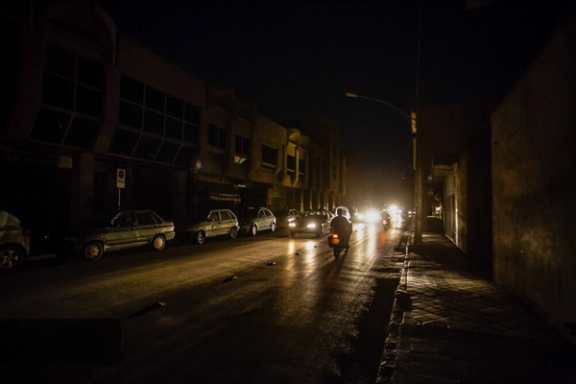
As power outages gain pace with the onset of winter, Iranians are venting their discontent and chronicling the impact of the blackouts on their daily lives in videos and voice notes shared to Iran International.
Iran has implemented rolling power cuts for residential and commercial areas this month due to a severe shortage of natural gas, the primary fuel source for the country's power plants.
Iran holds the world’s second-largest natural gas reserves, yet US-led sanctions have hindered its extraction efforts by restricting investment and access to advanced technology. As a result, Iran's gas production is gradually declining.
Many viewers reached out to Iran International via its social media platforms to anonymously share their experiences on the ongoing power cuts, which they attribute to government incompetence.
From hospitals to schools, businesses to homes, the outages have disrupted routines and caused significant inconvenience.
In one instance, a citizen sent a video showing a medical imaging center operating in the dark. "This is our situation! We've been here for two hours, and a patient is waiting with an IV drip," the person said.
For many businesses, the past week's power cuts have meant closures, as many lack access to emergency power - a struggle apparently not shared by officialdom.
Earlier on Tuesday, the power in Tehran's City Council was cut off during a session, but the meeting continued using emergency power.
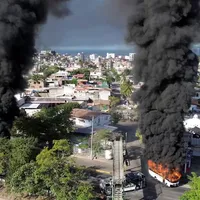
Despite repeated promises to phase out the use of the highly polluting fuel oil - locally called mazut - in power plants, dozens reported continued mazut burning and air pollution.
The government had initially framed these rolling blackouts as a necessary measure to avoid resorting to mazut or diesel. To further complicate matters, officials have confirmed shortages of both mazut and diesel.
"Both the power went out and the mazut burning continued, and the air became polluted," one citizen said. Another sent images of mazut burning at the Rajai power plant in the northern Iranian city of Qazvin, saying, “The Islamic Republic has set us back centuries and ruined our lives.”
Hazardous
The Tehran Air Quality Control Company reported on Tuesday that the capital's air quality had been hazardous for the past 24 hours. Since the beginning of the Iranian year (March 21), Tehran has only had five days of clean air.
Mazut contains high levels of sulfur and other toxic compounds, and its combustion produces large amounts of particulate matter and toxic gases.
These pollutants directly contribute to air pollution and increase the risk of respiratory and cardiovascular diseases.
Some government officials have shifted blame onto the public, urging them to reduce energy consumption or pay extra.
On Sunday, November 17, the government issued a decree ordering an increase in household gas tariffs and authorizing provinces to use mazut in all power plants and industries.
Last week, Mohammad-Jafar Ghaempanah, President Masoud Pezeshkian's executive deputy, blamed the public for the shortages and mazut burning, saying that citizens should reduce their home temperatures by a few degrees and consume less gas and electricity to reduce blackouts.
Pezeshkian echoed this advice, urging people to conserve energy. He also claimed that Iran consumes about three times more electricity than European countries. "I wear warm clothes at home. Other people can do that too,” he said.
"Don't blame the people"
However, these calls have been met with widespread criticism, with many people saying Iran is a resource-rich country and that government ineptitude is the root cause of the crisis.
In September, Hassanali Taghizadeh, the chairman of Iran Electrical Industry Syndicate, rejected claims that domestic use is disproportionately high, saying that Iranian households consume about half the electricity per capita compared to Europe.
"Don't blame the people. Don't falsely claim that people's consumption is high. The average per capita consumption of Iranians is 1,220 kilowatt-hours per year, while in Europe it is 2,120 kilowatt-hours," he said. According to Eurostat, the electricity consumption per capita in the household sector in the EU in 2022 was 1,584 kWh.
In a video widely shared online, a baker in the southern oil-rich city of Ahvaz pasted spoiled dough on the door of the local electricity office to protest the power cuts. In the video, he said he loses 50,000,000 rials (about $75) every week due to power outages. An average Iranian earns about $200 per month.
Several people also reacted to the remarks of Vahid Yaminpour, a state television presenter and secretary of the Supreme Council of Youth at the Ebrahim Raisi administration, who described the power cuts as a "positive event" to strengthen the family foundation.
"In Lebanon, even in non-war conditions, many people have about four hours of state electricity," Yaminpour said. "Be grateful and don't complain."
Rejecting these remarks, one viewer sent an audio file saying that Iran and Lebanon are not equal in terms of natural resources and that Iran is one of the world's most energy-rich countries.
Another said in a video: "There are donation boxes all over the cities to help the people of Gaza and Lebanon, while the officials of the Islamic Republic don't care about the Iranian people at all."
Recounting power outages lasting hours in Fooladshahr in central Iran, another viewer was more harsh, saying Iranian officials are incapable of providing for the welfare of their citizens and only know how to launch missiles.
Experts in Lebanon have called for international backing for the cash-strapped Lebanese Armed Forces if a ceasefire is to be sustained between Iran-backed Hezbollah and Israel.
While US envoy Amos Hochstein suggested a deal is within reach during his trip to Lebanon on Tuesday, the situation on the ground appears far more bleak.
“The army doesn’t even have money to put fuel in the patrol trucks,” said a senior Lebanese politician opposing Hezbollah. He spoke to Iran International on condition of anonymity after successive death threats from the group the US and others deem 'terrorist'.
“UNIFIL has no power militarily and it depends on the LAF [Lebanese Armed Forces], but mostly, the LAF isn’t even able to patrol with UNIFIL, which is a huge reason the latest conflict has escalated to this degree," he told Iran International.
UN peacekeeping forces, UNIFIL, were stationed around southern Lebanon since 2006 under UN Resolution 1701 after the second Lebanon war between Hezbollah and Israel.
Though first created in 1978, following the crisis of 2006 crisis, the UN Security Council strengthened the mandate of UNIFIL, allowing them to "monitor the cessation of hostilities; accompany and support the Lebanese armed forces as they deploy throughout the south of Lebanon; and extend its assistance to help ensure humanitarian access to civilian populations and the voluntary and safe return of displaced persons".
A protest in Beirut, Lebanon against Iranian influence in the country. 2019
However, the politician, who has held senior government positions, warned that without international funding and binding agreements, the LAF risks remaining a “toothless tiger,” as evidenced in recent years.
“The Lebanese economy is in collapse and the army has been one of the biggest losers, which of course, impacts the country’s security at the hands of Hezbollah which has infiltrated every institution and border areas," he said.
Though Israel has severely weakened Hezbollah since it stepped up its offensive in September, it has a barrage of firepower that continues to see dozens of projectiles fired into Israel daily.
In September, targeted air strikes saw Israel take out swathes of the group’s leadership as high as long-time leader Hassan Nasrallah, while a two-day operation saw around 1,500 Hezbollah operatives taken out of action when pagers and walkie-talkies simultaneously exploded.
UN Resolution 1701 aimed to push Hezbollah north and disarm all armed groups in a designated area of southern Lebanon. However, this was never fully implemented, with both Hezbollah and Israel accused of violating the agreement. Additionally, other armed groups, such as Palestinian Islamic Jihad, continued to operate in the region.
Lebanese army troops patrolling in Beirut
Consisting of around 80,000 troops, the LAF has no air force and is not strong enough to take on either Hezbollah or an Israeli onslaught, its role being mostly limited to supporting civilians.
Andrew Fox, a former British paratrooper and fellow at the Henry Jackson Society, said the weakness of the LAF will be a sticking point for any peace moving forward.
Speaking to Iran International he said: "A key issue with this proposed peace deal is the lack of preparation and capability of the Lebanese Army. Even if not sympathetic to Hezbollah, they are far less well armed and motivated."
With Hezbollah still stronger and harder to control, the LAF will need to be ready for a potential re-entry of the group into southern Lebanon if a deal really forces a retreat to north of the Litani River as was proposed previously.
"This will present them with a real issue," added Fox. "If the LAF attempt to police the ceasefire and are defeated in combat, where does this leave the peace deal? It is hard to see how anything will be enforced if the IDF does not have the oversight to be able to step back in and interdict Hezbollah, should they try to reinfiltrate the South."
If a ceasefire is put into place, the Lebanese army will be expected to deploy thousands of troops south in order to maintain peace. However, with Hezbollah still significantly more powerful and better funded by its patron, Iran, the process will not be easy.
"The Lebanese army is in a situation that is sensitive and difficult. It cannot practice normal missions like the armies of other countries because there is another military force in the country," retired Lebanese brigadier general Hassan Jouni told Reuters, referring to Hezbollah.
On Tuesday, LAF chief, General Joseph Aoun, presented proposals for the first phase of a deployment in the south, sharing the army’s needs in terms of armament, logistical and financial support.
In August, the Lebanese government, which is divided on sectarian lines amid years of crisis, issued “initial approval” for Prime Minister Najib Mikati’s proposal to recruit 1,500 new troops for the army, part of a plan prepared by the army to recruit 6,000 soldiers before developing a plan for its deployment.
Ultimately, the government will have to approve the exact nature of the deployment, but in the end, the question remains as to whether Hezbollah will respect its authority.
Hezbollah affiliated Al-Akhbar said there were still significant “knots” in the negotiations. Quoting informed sources, it said problems remained around borders, which it said was “the knot of knots”.
An Iranian political activist has accused security forces of sexual and verbal abuse when he was arrested in Tehran on Monday.
Writing on X, Hossein Ronaghi detailed his allegations. "Inside the vehicle, they restrained both of my hands. The driver kept repeating vulgar insults about my mother. The one seated on my left grabbed my left hand and forcibly placed it on his groin, demanding that I touch him," he said.
He accused multiple officers of having inflicted verbal and physical abuse. "The officer on my left slid his hand under my shirt and commented to the one on his right, 'he's so pale, I want him to be my bride tonight in detention.' The other added, 'I'll take his mother in front of his eyes,'" he wrote on X.
Ronaghi, a 37-year-old blogger and dissident, had staged a sit-in protest to demand justice for fellow activist Kianoosh Sanjari, who committed suicide last week in protest against government oppression.
The journalist and activist had warned in a social media post that he would end his life unless several political prisoners, including Fatemeh Sepehri and Toomaj Salehi, were released.
Ronaghi used X to highlight problems faced by dissidents under the Islamic Republic's legal system, issues highlighted by international rights groups such as Amnesty International which has accused Iran of forced confessions among other practices such as torture.
"These are the same people who use such methods to extract confessions from people in Ekbatan," he wrote, referring to a neighborhood in western Tehran where security forces have been accused of coercing protesters into false admissions.
Last week, Iran's judiciary issued death sentences for six individuals living in Ekbatan accused of involvement in the killing of a Basij militia member during the nationwide protests that erupted in 2022.
Human rights organizations have repeatedly documented the systematic use of sexual violence in Iran’s prisons. Amnesty International reported in March 2023 that detained protesters, including children, were subjected to rape, groping, and electric shocks to the genitals. The organization highlighted these methods as tools to punish and extract confessions from detainees.
Ronaghi has been arrested multiple times since 2009 and has long written of torture in custody. Released on bail in November 2023 after a prolonged hunger strike, he has faced ongoing harassment from authorities.
He lost a kidney during a previous incarceration and continues to suffer from severe health complications. He has currently sewn his lips together in protest in a bid to raise awareness to the case of Sanjari.
Iran’s foreign minister has been reaching out to his counterparts and the head of the UN nuclear watchdog ahead of the agency's Board of Governors' expected passage of a censure resolution against Tehran.
In a phone call with South African counterpart Ronald Lamola on Wednesday, Abbas Araghchi warned that the resolution proposed by three European powers at the IAEA’s Board of Governors meeting would further complicate the situation.
The censure resolution against Iran was officially added to the Board's agenda on Tuesday night. France, Britain, Germany, and the United States are set to present the resolution during Wednesday’s meeting.
Araghchi also reiterated the sentiment in a phone call with the IAEA chief Rafael Grossi, saying that “if the other parties disregard Iran's goodwill and cooperative approach and pursue unconstructive actions by issuing a resolution at the IAEA Board of Governors meeting, Iran will respond in an appropriate and proportional manner."
In another phone call with French Foreign Minister Jean-Noël Barrot Tuesday night, he also said that if Iran's seek confrontation during the BoG meeting, the Islamic Republic will respond appropriately.
“This measure by the three European countries is in blatant contravention of the positive atmosphere created in the interaction between Iran and the Agency,” the Iranian foreign minister told his French counterpart. “It will only make matters more complicated.”
Previous voting patterns suggest that proposals backed by the key Western countries easily pass. A successful resolution could be a catalyst for France, Britain and Germany to trigger a so-called "snapback mechanism" to restore UN sanctions imposed on Iran before a 2015 multilateral nuclear deal.
The United States remains tightly coordinated with its European partners in advance of the IAEA Board of Governors meeting and strongly supports efforts to hold Iran accountable, State Department spokesperson Matthew Miller told Iran International, urging Tehran to cooperate with the IAEA.
A proposed censure of Iran for its lack of cooperation with the UN nuclear watchdog raises important questions at a critical time after Donald Trump’s reelection when Tehran faces regional weakness, economic pressure and Israel.
France, Britain, Germany, and the United States will introduce the resolution at Wednesday's meeting of the International Atomic Energy Agency (IAEA) Board of Governors, Iran International has learned.
Iran and nuclear experts agree on one thing: Trump’s return to the White House will have an impact on the Islamic Republic, but whether and how the incoming administration and the Islamic Republic may engage on the nuclear issue is up for debate.
The Iranian establishment has concern over the censure because of the approaching October 20, 2025 deadline for UN restrictions to be fully lifted. That’s when most restrictions against Tehran's nuclear program will be removed under the UN Security Council Resolution 2231, and the West will no longer be able to apply “snapback” sanctions.
A prior censure was made in June of this year, but it didn't seem to make any difference, however, experts point out the political climate was different a few months ago.
The Europeans could activate or trigger the mechanism, bringing back all of the previously lifted UN sanctions.
Sina Azodi, a professor and researcher at George Washington University, told Iran International that the Islamic Republic would try to avoid internationally mandated sanctions from a political standpoint because it doesn’t serve their interests.
“Iran is under sanctions, but they are US unilateral sanctions. They are not internationally mandated sanctions of the United Nations. From a political standpoint, Iran would try to avoid a snapback of UN sanctions, especially since they're less than a year away from those sanctions to be completely lifted,” said Azodi who specializes in Iran's nuclear and foreign policies.
Iran’s Foreign Minister Abbas Araghchi made comments on Iranian State TV Saturday suggesting that a diplomatic route on Iran’s nuclear ambitions still exists.
"We believe the window for diplomacy is still open, albeit for a short time, provided the other parties demonstrate genuine willingness. Without such commitment, we will pursue an alternative course, "said Araghchi.
Araghchi also said that Iran’s intentions were conveyed to the IAEA chief Rafael Mariano Grossi during his latest trip to the Islamic Republic last week. Iran offered not to expand its stockpile of uranium enriched up to 60% during his visit.
Gregory Brew, an Iran analyst with the Eurasia Group, noted that while Iran appears to signal a willingness to make concessions, it insists on doing so strictly on its own terms.
“Iran will deal, but only if they get what they want—sanctions relief—without having to make sweeping concessions on either their program or other elements of their foreign policy,” said Brew.
Despite the rhetoric, Iran’s actions are proving otherwise.
Tehran has increased its stockpile of enriched uranium to near weapons-grade levels, according to the Associated Press, which viewed a confidential report by the United Nations' nuclear watchdog Tuesday.
Uranium enriched at 60% purity is just a short step away from weapons-grade levels of 90%.
With Trump’s second term around the corner – and Iran’s deterrence proxies Hamas and Hezbollah taking a severe blow by Israel – that leaves Tehran in a predicament.
Does it double down towards nukes or try to deal with the future president, which US intelligence reports say Iran tried to assassinate?
Brew said Trumps’ return was always an element of thinking for Iran, but they are still playing it the same as with the Biden-Harris administration, wanting sanctions relief and will - as he described it - play it nice - until 2231 resolution expires. Then Iran can likely negotiate without JCPOA commitments.
Andrea Stricker, the Deputy Director and Research Fellow at FDD’s Nonproliferation & Biodefense Program, told Iran International that if Tehran makes concessions, it’s because of the incoming US president's use of peace through strength and maximum pressure.
“Tehran sees the writing on the wall that with Trump coming back into office and the E3 also prepared to increase pressure against the regime, that snapback is likely inevitable. It will seek to evade restored sanctions with the help of its patrons Russia and China, and its partner North Korea,” said Stricker.
Stricker said Trump’s maximum pressure will force Iran to tone down its nuclear ambitions and aggression in the region and that if a deal is possible, it would only be due to maximum pressure and fear of Trump.
She said Iran is fearful of Trump who ordered the assassination of General Qasem Soleimani in a targeted strike in Iraq in 2020, withdrew from the Iran nuclear deal, and re-imposed sanctions aimed at cutting Iran's oil sales to zero.
The reported enrichment of uranium stockpiles, Stricker views, as a form of blackmail to the West to prevent the censure and the snapback on UN sanctions.
“It's too little, too late,” she added.
Azodi told Iran International that Tehran has historically reacted with anger to IAEA resolutions. Based on Iran’s behavior, Azodi sees a strong possibility that Tehran would expand their nuclear program to increase the number of centrifuges and inaugurate a new centrifuge center, but he refers to it as a diplomatic play – and not a serious ploy for a bomb.
He’s doesn’t believe Iran would go for a bomb, citing that Israel and the US would do everything in their power to prevent it.
Israeli Prime Minister Benjamin Netanyahu and Trump have repeatedly said that they would not allow Iran to become a nuclear power.
With that knowledge, Azodi said a dash for the bomb would put Iran in a position of an attack - a risk he believes the Islamic Republic would not take for its own survival. Rather, some sort of a deal is more likely.
The Financial Times recently reported that Trump intends on bankrupting Iran to force Tehran to drop its nuclear program and stop funding regional proxies.
Prior to winning the US presidential election, Trump appeared on an American podcast show with host Patrick Bet-David saying he would like Iran to be successful.
“I would like to see Iran be very successful. The only thing is, they can't have a nuclear weapon,” said Trump.
Stricker believes Tehran's rulers are intimidated by Trump, seeing the potential for a deal through his strategy of maximum pressure. Azodi, on the other hand, argues that Trump's interest in striking a deal with Iran is not driven by diplomatic or ideological motives but by a desire to secure his place in history.
Iran's Foreign Ministry on Tuesday night summoned the British chargé d’affaires to protest the latest UK sanctions on Iran’s shipping and aviation industries over Tehran’s alleged missile transfers to Russia.
Iran's Foreign Ministry on Tuesday night summoned the British chargé d’affaires to protest the latest UK sanctions on Iran’s shipping and aviation industries over Tehran’s alleged missile transfers to Russia.
The British envoy was told that Iran's defense cooperation with Russia is legitimate and legal and is not against any third party, according to Iran’s state TV.
The UK envoy was summoned hours after the ambassador of Hungary, the rotating president of the EU, was summoned to receive Iran’s strong protest over similar sanctions imposed by the EU against the Islamic Republic.
The Iranian Foreign Ministry slammed the British and EU sanctions as illegal interference in Iran’s domestic affairs, saying it is not acceptable in any way.
The sanctions, introduced on Monday, targeted several Iranian entities and individuals including the Islamic Republic of Iran Shipping Lines (IRISL) as well as Iran’s flagship carrier Iran Air.
Iran’s Foreign Minister Abbas Araghchi said on Tuesday the EU and the UK have accused Iran of supplying ballistic missiles to Russia and imposed sanctions on Iran’s airlines and shipping without presenting any evidence.
“At the same time, based on documents submitted to court, British media today reveals that the UK, fully aware that its arms and F-35 components are used by Israel in grave violations of international humanitarian law, continues to export these weapons. The UK's justification? Maintaining ties with the US and NATO. This contradictory behavior exposes their double standards and abdication of responsibility toward human rights,” Araghchi tweeted.
Earlier in the day, Iran’s Foreign Ministry spokesman had called the EU and British sanctions “unjustified”, saying they were imposed based on false claims of missile transfers to Russia.
"Iran considers the imposition of new sanctions by the European Union and the United Kingdom against a number of Iranian individuals and legal entities on the false claim of sending ballistic missiles to Russia as an unjustified act that contradicts the norms of international law," Esmail Baghaei said.
Baghaei accused the European parties of violating international law, including the freedom of navigation and maritime trade, via sanctions.
In September, the United States, citing intelligence shared with its allies, reported that Russia had received ballistic missiles from Iran for use in its ongoing conflict in Ukraine. In response, Washington imposed sanctions on the vessels and companies involved in facilitating the weapons transfers.
The new sanctions, imposed on the 1,000th day of the Ukraine war, are part of a wider strategy to economically and diplomatically isolate Iran.