UN rights experts warn of rise in systemic persecution of Baha’i women
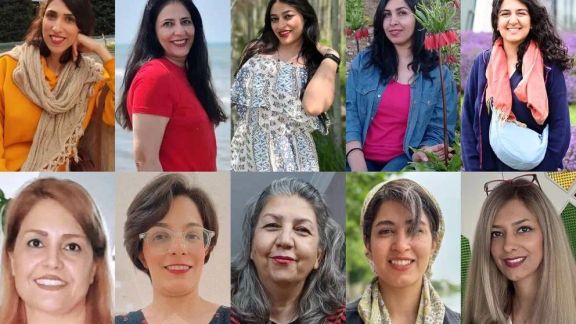
A composite picture of 10 Baha'i women recently sentenced by Isfahan's Revolutionary Court to a total of 90 years in prison.
Independent human rights experts reporting to the United Nations expressed grave concern over the rise in the systematic targeting of women from the Baha’i religious minority in Iran in a joint letter published on Tuesday.
The experts including Special Rapporteur on human rights in Iran Mai Sato highlighted reports of Baha’i women being subjected to arrests, interrogations, enforced disappearances, home raids, confiscation of personal belongings, travel restrictions and prolonged detentions without due process.
Noting that Baha’i women make up two-thirds of all Baha’i prisoners in Iran, the experts said many were being held incommunicado.
This increase in persecution, they warned, represents a worrying deterioration of gender discrimination and persecution of religious minorities in the country.
“In the larger context of the targeting of women in Iran and the challenges with gender equality, this dramatic rise in persecution against Baha’i women is an alarming escalation,” the experts said in a statement Monday.
“This is affecting a group of people who face intersectional discrimination and persecution: as women and as members of the Baha’i religious minority.”
The experts also pointed to the ongoing persecution faced by all Baha’is in Iran, including the denial of higher education, restrictions on economic and cultural participation, and bans on university attendance and public employment.
“We are concerned at the use of ambiguously formulated accusations such as ‘threat to national security’ or ‘propaganda against the State’ to systematically restrict the peaceful exercise of their rights,” they said.
“This may have a significant chilling effect on other members of the Baha’i religious minority and the exercise of their human rights and freedoms.”
The experts, part of the UN Human Rights Council's Special Procedures—a group of independent experts who monitor and investigate human rights issues worldwide—said they raised their concerns directly with the Iranian government.
The experts emphasized that the Iranian government's response contradicts the situation on the ground, where Baha’is continue to face significant challenges to their rights and freedoms.
The Baha’i International Community also warned on Monday that 71-year-old Mahvash Sabet, a Baha’i prisoner in Iran, had undergone open-heart surgery after being denied medical care for years. The BIC called for her immediate release, the cancellation of her sentence and assurances she would not be returned to jail.
Iran needs better dialogue with its neighbors, veteran negotiator Javad Zarif said in an op-ed for the Economist magazine, adding that Tehran erred in focusing too much on threats.
An architect of the 2015 deal over Iran's disputed nuclear program, Zarif is a cogent voice in English-speaking policy circles for greater engagement with Tehran.
"Like all nations, Iran has faced its share of challenges and missteps. The Iranian people, having endured significant sacrifices, are now prepared—with resilience and confidence—to take bold steps," Zarif, now vice-president for strategic affairs, wrote.
"This shift from a threat-centered perspective to an opportunity-driven one aligns with the vision outlined by President Pezeshkian (and myself) during last summer’s presidential campaign in Iran."
The Islamic Republic is now suffering some of the biggest military and economic setbacks in its nearly 50-year history with its armed allies and air defenses largely neutered by punishing Israeli attacks and Donald Trump due to levy harsher sanctions.
Western-educated Zarif and soft-spoken President Masoud Pezeshkian are seen as largely separate from strategic and military decisions which are ultimately in the hands of Supreme Leader Ali Khamenei and the Islamic Revolutionary Guard Corps (IRGC).
To enshrine dialogue, Zarif proposed in his op-ed a Muslim West Asian Dialogue Association (MWADA) spanning Muslim states as far as Egypt but excluding top military power and arch-nemesis Israel.
"A non-aggression pact among MWADA states, coupled with collective regional monitoring, will help institutionalize stability and protect the region from external interference as well as from internal strife."
Zarif cited "much improved relations between Iran, the United Arab Emirates and Saudi Arabia today," saying better Tehran-Riyadh relations would tamp down sectarian tensions plaguing the region.
In another conciliatory gesture to Iran's erstwhile foes, the rebel groups now running Syria, Zarif said the country could rebuild with help from Iran and other neighbors.
"Governance reforms in Syria—as a basis for economic assistance—will promote accountability and lay the groundwork for a safe and stable country where women and minorities can thrive."
Iran's own treatment of women and minorities was recently criticized in a United Nations General Assembly Resolution and Tehran largely quelled a women's rights protest movement in 2022 with deadly force.
Iran’s Supreme Council of Cyberspace on announced Tuesday it would lift restrictions on some digital platforms like WhatsApp and Google Play while maintaining control on others as Iranians continue to face some of the world's toughest internet restrictions.
"Following extensive deliberations, the members reached a unanimous consensus to lift restrictions on access to select widely utilized foreign platforms, including WhatsApp and Google Play, while underscoring the paramount importance of maintaining lawful governance in cyberspace," state-controlled IRNA news wrote.
The decision follows President Masoud Pezeshkian’s election pledge to improve access to foreign platforms, many of which are commercially critical for Iranians, especially those with small businesses.
However, while WhatsApp and Google Play restrictions are being lifted, Instagram, YouTube, and Telegram remain in limbo amid hardliner resistance.
The decision to unblock WhatsApp and Google Play still requires ratification by the office of Iran's Supreme Leader, Ali Khamenei, according to Abolhassan Firouzabadi, the former head of Iran's Supreme Council of Cyberspace, who spoke to state TV on Tuesday.
Iran's ruling clerical and military establishment have been wary of social media platforms as a vehicle for organizing protests, which have played out more on X and Telegram than the apps unshackled by the latest move.
Google Play would enable android phone users to download VPN apps to bypass government internet filtering.
The details of the lifting of restrictions have yet to be published, but the Mehr News agency which is close to the conservative establishment reported on a possible four-stage plan that might represent the actual framework discussed by the Council.
Stage one: Short-term measures
The outlet wrote that the first stage proposes immediate steps to ease access, such as providing more infrastructure to domestic platforms, offering advertising funds to support local messaging apps, and reopening Google Play and WhatsApp.
Stage two: Controlled expansion
The government also proposes a controlled opening for platforms such as YouTube through governance-compliant portals, drafting anti-fake news legislation, and encouraging domestic content creation. Additionally, government agencies would be banned from officially using foreign platforms.
Stage three: Quality improvement
Addressing the need to improve domestic platform quality, Mehr says the government would make certain essential government services like subsidies, legal services, and fuel cards exclusively available through domestic apps. A proposal has, it says, been made to reopen Telegram under strict conditions, or alternatively, integrate it with domestic infrastructure if negotiations fail.
Stage four: Enforcement
The final stage introduces stricter rules and enforcement measures, including criminalizing tools that bypass filtering, taxing foreign platforms, and escalating judicial actions against unauthorized platform use. Proposals include negotiating the reopening of additional platforms, but only if they comply with strict regulatory conditions.
Who decides?
The Supreme Council of Cyberspace, established in 2012 by the Supreme Leader Ali Khamenei, controls Iran’s internet policy. Its members include the President, the Speaker of Parliament, the Judiciary Chief, and several key ministers.
However, its jurisdiction often overlaps with Parliament and the Supreme Council of the Cultural Revolution, leading to conflicts amid blurred lines of authority.
Resistance from MPs and political maneuvering
Student News Network (SNN) wrote Tuesday that 136 members of Parliament had sent a letter to the Council, urging it to retain the restrictions.
According to Khabar Online, MP Reza Taghipour, a former Minister of ICT, has been gathering signatures from other MPs to oppose lifting restrictions.
His efforts have gained support from the Paydari Front, an ultra-conservative political faction, including figures such as Hamid Rasaee and Ghasem Ravanbakhsh.
However, Taghipour’s actions reveal inconsistency, as he previously criticized internet filtering on television, calling it a “business tool.”
In this year's latest Freedom House report on internet freedom, the watchdog ranked Iran the world's third worst country, amid a host of measures to limit open internet usage.
One hundred thirty-six members of Iran's parliament have warned the Supreme Council of Cyberspace (SCC), a government body responsible for overseeing the country’s internet governance, that a proposal to lift internet filtering would be a gift to the enemies in the soft war.
"Raising such an issue, especially in these critical times for the region and the world, is deeply concerning and amounts to a surprise gift to the enemies in the soft war against Iran," the lawmakers said, adding that Iran’s adversaries seek to incite unrest and social turmoil in the country.
They urged the council not to be swayed by emotional and sensationalist rhetoric in making its decision.
Iran has one of the world’s worst internet censorships with tens of thousands of websites blocked since the early 2000s and most major social media platforms banned.
Critics of Iran's President Masoud Pezeshkian have recently said that the ongoing deadlock over enforcing the new hijab law and lifting censorship on the Internet has effectively paralyzed his administration.
The lifting of official bans from two social media platforms on Tuesday may do little to dull the ire of Iranians about persistent government restrictions on their internet access.
As internet restrictions and social media blackouts continue in Iran, in spite of promises from President Masoud Pezeshkian to lift them, even the restricted local media have called for the resignation of his communications minister.
Sattar Hashemi has become a popular scapegoat for Iran’s complex censorship system, even if the dossier is largely out of his hands and run by the country’s ruling clerics and the security establishment.
Sazandegi columnist Faezeh Momeni said that "Hashemi has not even started the process of lifting the filtering, four months after he got the parliament's vote of confidence as IT and Communication Minister.”
An open letter called on President Masoud Pezeshkian, who in his election campaign promised to lift restrictions, "to appoint a new minister who would be committed to put an end to filtering."
The Minister of Economy, Abdolnasser Hemmati, recently said that "80 percent of Iranians use internet blockage circumvention tools [VPNs] to overcome the filtering and that imposes a cost of two million rials per month (around $3) on every Internet user."
He also said that "filtering causes heavy losses for the economy by restricting people's livelihood,” but only said that filtering is likely to be lifted gradually to avoid risking damage to “infrastructure”.
However, Iranian lawyer Kambiz Nowruzi told Sazandegi that lifting internet restrictions requires no specific infrastructure. “The decision to lift filtering only requires the approval of a majority—half plus one—of the 12 members of a committee, six of whom are representatives of the Pezeshkian administration," he said.
“If Pezeshkian can secure the support of at least one of the two representatives from the parliament or one of the four representatives from security organizations, the filtering can be lifted.”
He said the current filtering is illegal as per the country’s constitution which guarantees the public’s right to access information.
"From a legal point of view, the President can lift the filtering, but political and administrative realities of the country do not allow him to do that,” Nowruzi added.
In this year’s Freedom House report on internet freedom, the rights watchdog ranked Iran third in the world’s least free countries on digital freedom.
“The regime has taken steps to make access to the global internet more cumbersome and expensive, and drive users to a domestic version of the internet where authorities can more effectively control content and monitor users,” its report said.
“The regime also employs extensive censorship, surveillance, content manipulation, and extralegal harassment against internet users, making Iran’s online environment one of the world’s most restrictive.”
Since the 2022 uprising, the government has instructed internet service providers to increase their prices as much as 40 percent, making access significantly more expensive while localized internet shutdowns have continued.
In February, the Supreme Council for Cyberspace prohibited the use of unlicensed virtual private networks (VPNs) and pushed users seeking to access blocked or filtered web content to use domestic circumvention tools.
Internet expert Saeed Souzangar told Sazandegi newspaper that "using VPNs imposes a heavy burden on the backbone of the country's Internet system by increasing the volume of data transfers across the network."
It also diverts vast amounts of revenue to foreign companies such as Elon Musk’s Starlink. The website wrote, "There are at least 20,000 Starlink terminals in Iran and every one of them is paying at least $100 to Starlink, which adds up to $2 million per month."
Speaking about the mounting pressure on the minister of communications, Akbar Montajabi, the editor-in-chief of Sazandegi, told Rouydad24, ”The minister fears reaction by hardliners."
He said the minister is "an inefficient man who does not understand the requirements of modern living,” with millions of Iranians depending on the internet for commercial purposes.
Iran's tourism industry has collapsed over the past five years, with one agency owner describing the situation as "the destruction of the tourism industry," Tehran-based Etemad newspaper reported.
The crisis has reportedly forced the US-designated Bonyad-e Mostazafan (Foundation of the Oppressed), a powerful state-run charitable organization that has expanded into various sectors, including tourism, to sell its hotels.
"The condition of this industry is so dire that Bonyad-e Mostazafan has been forced to sell its hotels," the agency owner said.
Last year in December, Ebrahim Pourfaraj, the head of the Association of Iranian Tour Operators, said Iran's tourism industry was at its lowest point.
Iran, historically known for its rich cultural and historical heritage as well as its natural beauty, has struggled to attract foreign tourists in recent years, exacerbated by the detention of foreigners and dual-nationals. Despite its allure, the country faced challenges such as strict dress codes for women and restrictions on alcohol and nightlife.