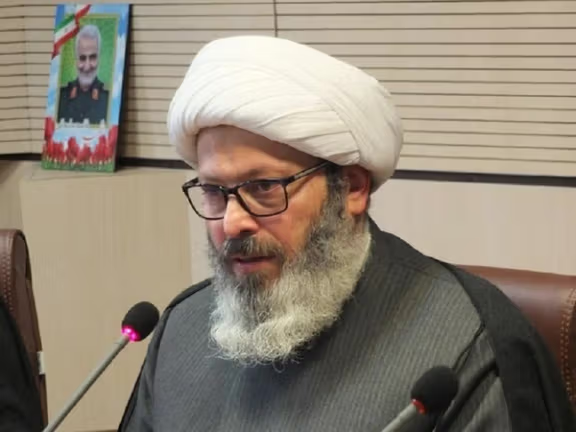
Iranian cleric arrested in Saudi Arabia after critical video
Gholamreza Ghasemian
A senior Iranian cleric affiliated with the office of Supreme Leader Ali Khamenei was arrested in Saudi Arabia during the annual Hajj pilgrimage after publishing a video critical of the kingdom’s religious and cultural policies, Iranian state media reported on Monday.
Gholamreza Ghasemian, a conservative religious scholar and a former head of Iran’s parliamentary library and documentation center, was detained in the city of Medina while performing Hajj rituals, the reports said.
On Tuesday, Iran’s judiciary spokesman said the arrest of Gholamreza Ghasemian in Saudi Arabia was “unjustified and unlawful,” adding that the Foreign Ministry would follow up on the case.
Saudi authorities have not commented publicly on the matter.
In a video posted before his arrest, Ghasemian criticized Saudi Arabia, accusing it of transforming the Islamic holy cities of Mecca and Medina into destinations for entertainment and commercialization.
He also described conditions for pilgrims as highly restrictive, alleging that Saudi authorities prevent worshippers from engaging deeply with Islamic teachings during Hajj.
Cleric linked to 2016 Saudi embassy attack
Ghasemian has been linked by an Iranian documentary filmmaker to the 2016 attack on Saudi diplomatic missions in Iran, which triggered a major rupture in relations between Tehran and Riyadh.
According to the filmmaker, Javad Mogouei, Ghasemian gave a fiery speech at a religious gathering shortly before some attendees went on to storm the Saudi embassy in Tehran.
The assault on the embassy and the consulate in Mashhad came after Saudi Arabia’s execution of prominent Shia cleric Nimr al-Nimr. The incident led Riyadh to sever diplomatic ties, accusing Iran of failing to protect foreign missions. Iranian security forces were widely criticized for allowing demonstrators to set fire to the embassy and destroy diplomatic property.
Saudi and Iran continue to rebuild relations
The arrest comes at a time of cautious rapprochement between Tehran and Riyadh, who resumed diplomatic relations in 2023 after a seven-year break.
In April, Saudi Defense Minister Prince Khalid bin Salman made a rare visit to Tehran, marking only the second such trip since Iran’s 1979 revolution.
Ties have also improved in practical terms. Earlier this month, a direct flight by Saudi carrier Flynas landed in Iran for the first time in nearly a decade, marking the start of Hajj operations under a bilateral agreement that will see around 37,000 Iranian pilgrims flown to Saudi Arabia by July 1. Flynas and Iran Air are jointly operating the routes.
A judge was assassinated in a stabbing attack on Tuesday in Shiraz, the capital of Fars province in southwestern Iran, according to the local judiciary.
"This morning, two individuals attacked and assassinated Judge Ehsan Bagheri, head of Branch 102 of Shiraz Criminal Court 2, on his way to work. Unfortunately, he was martyred in this terrorist act," local judiciary chief Sadrollah Rajaei told Iran’s official IRNA news agency.
"This assassination was carried out with a cold weapon," he added.
Iran’s judiciary chief Mohseni Ejei condemned the assassination, calling it "cowardly," according to a statement published on Mizan.
The statement said that Ejei also ordered an urgent investigation into the incident and called for the perpetrators to be identified and prosecuted swiftly.
No details about the motive behind the assassination or the identities of the attackers have been released by Iranian authorities.
IRNA’s report said that Bagheri was 38 years old and had 12 years of judicial experience.
Iran's judiciary-affiliated news agency Mizan said that before becoming a criminal court judge, Bagheri spent over a decade at the Public and Revolutionary Prosecutor’s Office. The Revolutionary Court system in Iran, where he served, is responsible for handling cases related to national security, political and ideological offenses.
Earlier this year, two Revolutionary Court judges, Mohammad Moghiseh and Ali Razini, were assassinated in Tehran on January 18. Both had decades-long records of issuing death sentences and lengthy prison terms to dissidents in numerous cases.
The source said Asadi originally intended to also target former Revolutionary Court judge Mahmoud Toliyat but changed his mind for unknown reasons before fatally shooting himself.
Authorities have arrested several striking truck drivers in the southern city of Shiraz, according to the provincial prosecutor, as a nationwide truckers’ strike entered its fifth day on Monday.
“Those who have blocked the movement of freight trucks have been identified and arrested under the supervision of security and law enforcement agencies,” Kamran Mirhaji, the prosecutor of Fars province said on Monday.
“Those who obstruct the delivery of goods and cargo by trucks will be dealt with seriously according to the law,” he said, according to Iran's semi-official Mehr news.
Launched on May 22 in the southern port city of Bandar Abbas, the coordinated protest has since spread widely across the country, with truckers pledging to hold out for a full week or longer if their demands remain unmet.
Drivers are demanding better working conditions, higher freight rates, and relief from high insurance costs and fuel restrictions.
The arrests come as videos obtained by Iran International on Monday show the strike entering its fifth day and continuing across multiple regions of the country, including Fars province, where the detentions took place.
A citizen who sent a video to Iran International on Monday described the Shiraz–Marvdasht road in southern Iran as completely deserted, saying, “There is not a single truck in sight.” The road connects Shiraz, a major commercial hub, to Marvdasht in Fars province and is normally a busy route for freight transport.
Other footage shows heavy vehicle drivers refusing to transport goods in cities such as Shahrud in north-central Iran, Torbat-e Jam in the northeast, and Meybod in central Iran.
In a statement on Monday, Reza Akbari, head of Iran’s Road Maintenance and Transportation Organization, downplayed the scope of the strike and blamed the unrest on foreign interference. “A limited number of drivers are trying to create unrest, and these actions are the result of incitement by hostile foreign media that seek to portray the country’s roads as unsafe,” he said.
Akbari said independent Persian-language media based abroad were inflating the scale of the protests and that some domestic outlets were inadvertently amplifying what he described as false narratives. He added that “truck drivers have been very cooperative in efforts to resolve the existing issues.”
Iran and France traded barbs after dissident filmmaker Jafar Panahi won cinema’s most coveted prize at Cannes, but the diplomatic rift between the two countries runs far deeper than red carpets and celebrity politics.
“There have been many transgressions making a mockery of France’s ‘human rights activism,’” Abbas Araghchi wrote on X, posting a screenshot of a Common Dreams headline from November 2024: “‘Pathetic’: France Says It Will Not Enforce ICC Arrest Warrant for Netanyahu.”
“But perhaps nothing has made the hypocrisy as stark as the French approach to the Israeli regime and its war crimes,” he wrote.
Iran summoned the French embassy's chargé d'affaires on Sunday after French foreign minister Jean-Noël Barroti called Panahi a symbol of resistance against what he said was Iran's oppressive policies.
Nuclear disagreements
France is one of the three European signatories to the 2015 nuclear deal—known as the E3—alongside Germany and the UK. It has the power to trigger the snapback mechanism, which would reimpose UN sanctions lifted under the agreement.
The deadline for this is October 18, as set by UN Security Council Resolution 2231.
According to The Jerusalem Post, senior E3 officials have privately warned Washington that Tehran is deliberately dragging its feet in nuclear talks, potentially weakening the ability of the Europeans to reimpose UN sanctions if negotiations collapse.
Some state-linked outlets in Iran have long accused France of adopting the toughest stance within the P5+1 group.
“France has long played the role of a ‘pressure actor’ in Iran’s nuclear dossier,” a Nour News commentary argued last month. “In effect, Paris acted as the ‘bad cop’ in the negotiations, assuming the tactical role of a disruptor within the P5+1 mechanism,” the piece said.
French firms exit Iran
Tensions are also rooted in economic fallout.
Following the reimposition of US secondary sanctions in 2018, several major French companies exited Iran, abandoning multibillion-dollar ventures launched after the 2015 deal.
In 2017, TotalEnergies signed a $4.8 billion agreement to develop Phase 11 of Iran’s South Pars gas field—then the largest Western energy investment in Iran since the nuclear deal. The company withdrew in 2018.
France’s auto sector was similarly hit. PSA Group (Peugeot-Citroën) suspended joint ventures with Iran in June 2018, despite a 2016 deal with SAIPA to invest €300 million. Renault also pulled out of a project to produce 150,000 vehicles annually with plans to expand to 300,000.
Detained citizens
France has repeatedly accused Iran of “hostage diplomacy”—detaining foreign nationals as leverage in negotiations.
On May 16, Paris filed a case against Iran at the International Court of Justice over the detention of two French citizens and Tehran’s refusal to grant consular access for more than a year.
Cécile Kohler, a teacher, and her partner Jacques Paris were arrested in 2022 and later appeared on Iranian state TV making what France says were coerced confessions.
French Foreign Minister Barrot warned in January that the release of detained French nationals would directly affect bilateral ties and potential sanctions.
Tehran, meanwhile, accuses Paris of politically motivated arrests of its citizens.
In April, France arrested dual national Shahin Hazamy over alleged support for Hezbollah and Palestinian groups online. In February, French authorities detained Mahdieh Esfandiari, a language teacher, on charges of inciting violence and defending terrorism. Iran says it has been denied consular access in both cases.
In February, French authorities also arrested Mahdieh Esfandiari, a language teacher and translator, on charges of publicly defending terrorism and inciting violence online.
Iran's foreign ministry spokesman Esmail Baghaei said on April 7 that Iran was denied consular access to her.
Sanctions over rights, Ukraine war
France has sanctioned dozens of Iranian individuals and entities—either unilaterally or with EU partners—for Tehran’s crackdown on popular protests and its provision of drones and missiles to Russia for the war in Ukraine.
Those targeted include senior IRGC figures and executives of state-affiliated media.
The clash over Jafar Panahi may have brought tensions into the spotlight, but the grievances on both sides point to a relationship under sustained and widening strain.
Roozbeh Parsi, head of the Middle East and North Africa Program at the Swedish Institute of International Affairs (UI), has stepped down following the conclusion of an internal investigation into his alleged links to an Iranian influence network.
The investigation found no evidence that Parsi was involved in a state-directed influence campaign orchestrated by the Iranian government. However, it concluded that aspects of his conduct were incompatible with his role at UI, according to a TV4 report.
The inquiry determined that Parsi, an adjunct senior lecturer at Lund University, failed to adequately inform both his university and the UI about his involvement in the Iran-Europe Initiative (IEI), a network linked to the Iranian Foreign Ministry aimed at expanding the country’s influence in the West.
The TV4 report that prompted the investigation cited emails provided by Iran International and followed a 2023 joint exposé by Iran International and Semafor that detailed Tehran’s efforts to cultivate relationships with academics and analysts abroad to expand its influence.
Despite being cleared of formal allegations of collusion with Iran, Parsi received strong criticism for his lack of openness regarding his role in the IEI and contacts with Iranian government representatives, the TV4 report said.
The investigators concluded that this lack of transparency conflicted with the standards expected of a senior official at UI.
UI Director Jakob Hallgren said that the situation had become “untenable” and confirmed that Parsi would leave his post.
“This has been, as I think everyone understands, a very difficult and stressful time for him,” Hallgren said. “We have jointly decided that it is time for a fresh start so that we can focus on the pressing issues concerning the Middle East.”
Hallgren also expressed disappointment over having not been informed that Parsi was involved in running an organization promoting closer ties between Europe and countries like Iran. “As a leader at UI, one is expected to be transparent about such engagements."
UK funding
Parsi has said that he was commissioned and funded by the British Foreign Office during his involvement in the IEI network in 2014–15. However, the investigation found his statement to be “misleading.”
According to the investigation, the IEI network was initially funded through an entity formed by Parsi called the European Iran Research Group (EIRG). “In 2014–15, EIRG received funding for this purpose from the Heinrich Böll Foundation, which is affiliated with the German Green Party,” the investigation said.
The EIRG was later renamed the European Middle East Research Group (EMERG) and received in total around 55,000 pounds from the British Foreign Ministry between 2017 and 2020, the investigation added, noting that the IEI’s contact with the Iranian officials continued in this period.
In a statement on X, Parsi confirmed he is leaving UI, and called the departure "incredibly sad."
"This investigation has been a great personal and professional strain. It was also preceded by a drive with a clearly political character in which influential people with great responsibility for the Swedish debate climate distorted the discussion," he said in his post in Swedish.
In 2023, the joint investigative report by Iran International and Semafor combed through thousands of emails from Iranian diplomats, revealing a network of academics and think tank analysts cultivated by Iran's foreign ministry to extend Tehran's soft power.
Members of the grouping, called the Iran Experts Initiative (IEI), were guided by Iran's Foreign Ministry in their public writing and media appearances. They were key voices in Western think tanks and policy institutions helping promote Iran's stances.
Parsi, listed in the leaked emails as an IEI member, attended its inaugural meeting in May 2014 at Vienna’s Palais Coburg hotel, coinciding with nuclear talks. Documents indicate that Iran’s foreign ministry covered the event’s costs.
Iran remains optimistic about ongoing nuclear negotiations with the United States but continues to reject US demands for halting uranium enrichment, the country's foreign ministry spokesperson said on Monday.
“Enrichment is an inseparable part of Iran’s nuclear industry and must be maintained. We are in no way permitted to show even the slightest flexibility on this issue,” foreign ministry spokesman Esmail Baghaei said Monday speaking at a press conference.
Baghaei denied reports suggesting Iran could freeze enrichment for three years to secure a deal.
“Iran will never accept that,” he said, adding that no date had yet been set for a sixth round of talks with Washington.
Baghaei's remarks come a day come after US President Donald Trump said that “real progress” had been made in recent talks with Iran and suggested there could be “some good news” in the coming days.
“Very importantly, we had some very good talks with Iran yesterday and today, and let's see what happens. But I think we could have some good news on the Iran front. We've had some real progress, serious progress," Trump told reporters in New Jersey before departing for Washington.
Referring to his threats in March that if a deal was not struck within a two-month deadline, there would be "bombing like they have never seen before", Trump said he hopes the diplomatic paths succeed.
"I’d love that to happen because I’d love to see no bombs dropped and a lot of people dead. I really would like to see that happen.”
Baghaei for his part said Iran is awaiting further details from mediator Oman regarding the next meeting. “If there is goodwill from the American side, we are also optimistic, but if talks are aimed at curbing Iran's rights then talks will get nowhere,” he added.
He said that if Washington's aim is simply to ensure Iran’s program remains non-military, that has already been achieved. “But if the goal is to deprive Iran of its rights, we do not believe this process will reach any outcome,” he said.
Enrichment remains a red line for Tehran. Iran is the only non-nuclear weapon state enriching uranium to 60% U-235, a level that causes "serious concern," according to International Atomic Energy Agency (IAEA) Director General Rafael Mariano Grossi.
The IAEA has consistently maintained that there is no credible civilian use for uranium enriched to this level, which is a short technical step from weapons-grade 90% fissile material.
Iran's stockpile of 60% enriched uranium had increased to 275 kg, enough to theoretically make about half a dozen weapons if Iran further enriches the uranium.