Israel ready to strike Iran if next round of talks fails, senior official says
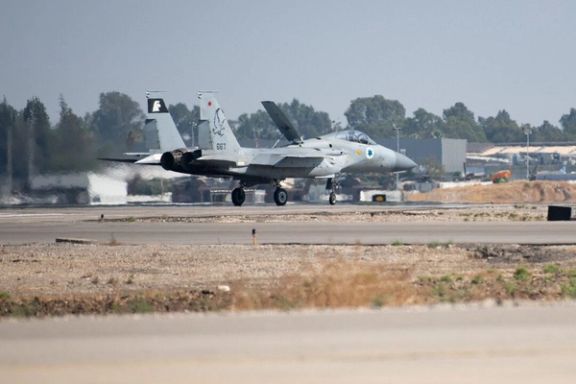
An Israeli F15 Fighter Jet on its way to conduct air strikes in Yemen is seen at an unidentified location in this handout photo released July 20, 2024
A senior Israeli official has warned that Israel is ready to launch a military strike on Iran if the next round of nuclear talks between Tehran and Washington, set for Sunday in Oman, fail to yield results.
The official, speaking to Iran International, said Israel is closely monitoring developments and could act unilaterally if necessary.
“The United States would require approximately three days to evacuate non-essential diplomatic personnel and their families from the region,” the source said. “That evacuation process reportedly began on Wednesday and is expected to be completed by Sunday, aligning with the timeline for the talks.”
According to multiple sources, the United States has already begun evacuating non-essential diplomatic personnel and their families from the region.
Israeli media reported Thursday that Strategic Affairs Minister Ron Dermer and Mossad Director David Barnea are set to meet US Special Envoy Steve Witkoff ahead of the talks in Oman.
Witkoff, speaking at an event for the Israeli medical charity United Hatzalah in New York on Wednesday, stressed that Iran must be permanently denied the ability to develop nuclear or missile capabilities.
“We must stand resolute and united against this danger and ensure that Iran never obtains the means to achieve its deadly ambitions no matter what the cost,” he said.
A senior Iranian official told Reuters that a regional ally had informed Tehran of the potential for an Israeli strike. "The tensions are intended to influence Tehran to change its position about its nuclear rights," the official said, but emphasized that Iran would not compromise on its right to uranium enrichment.
US President Donald Trump said Wednesday that American personnel were being withdrawn due to increasing threats in what he described as a “dangerous place.” He added that Washington remains committed to preventing Iran from acquiring a nuclear weapon.
Iran's Islamic Revolutionary Guard Corps (IRGC) issued a warning Thursday. “If our hands are untied, we will win victories that will make the enemy regret its actions,” IRGC commander-in-chief Hossein Salami said, signaling Iran’s readiness for any military confrontation.
An IRGC-affiliated outlet, Javan, warned that Tehran was prepared to walk away from negotiations if its national demands were not met, saying that Iran was negotiating “from a position of strength” and possessed sufficient nuclear expertise to act as a deterrent.
The New York Times, citing a senior Iranian official, reported Wednesday that Iranian military and government leaders had already held high-level meetings to discuss their response to any possible Israeli military strike.
Attacking Iran without US help
NBC News reported Thursday that while Israel would prefer to coordinate with the US, including intelligence or logistical support for strikes on Iranian nuclear facilities, it is prepared to act alone.
“While Israel would most likely prefer US military and intelligence support... it showed in October that it can do a lot alone,” the report said.
The same report cited five sources saying that Israel’s considerations of unilateral military action have intensified as the US inches closer to a preliminary deal with Tehran—one that reportedly includes provisions on uranium enrichment that Israel finds unacceptable.
US evacuating Baghdad embassy
Tensions have also led to regional security measures with the US embassy in Baghdad set to be evacuated partially.
Iraq’s state news agency also reported that steps to evacuate US personnel were underway not only in Iraq but across several Middle Eastern countries.
The UK Maritime Trade Operations (UKMTO) issued a security advisory on Wednesday, warning that increased regional tensions could impact maritime safety.
“UKMTO has been made aware of increased tensions within the region which could lead to an escalation of military activity having a direct impact on mariners,” the alert read.
The Washington Post reported Wednesday that the nuclear talks might not proceed as planned, citing two US officials who described the diplomatic environment as rapidly deteriorating.
Iran’s Defense Minister Aziz Nassirzadeh warned on Wednesday that Tehran would target American bases in the region if negotiations collapse and hostilities break out. “If a conflict is imposed on us... all US bases are within our reach and we will boldly target them in host countries,” he said.
Despite the rising tensions, Oman’s Foreign Minister Badr al-Busaidi confirmed Thursday that the sixth round of US-Iran nuclear negotiations will proceed as scheduled on June 15.
Iran has begun equipping a third secure uranium enrichment facility and fully upgrading its Fordow site with advanced centrifuges, senior officials said Thursday, following the International Atomic Energy Agency finding Tehran in breach of its non-proliferation obligations.
Atomic Energy Organization spokesman Behrouz Kamalvandi said the newly authorized site will be designed with “very high security standards” and become Iran’s third enrichment complex.
He said that first-generation centrifuges at the Fordow enrichment plant will be completely replaced with IR-6 machines, a move expected to “significantly increase Iran’s enriched uranium production capacity.”
“These steps carry both technical and strategic weight and send a clear message: the more pressure is applied, the stronger Iran’s response will be,” Kamalvandi said during a visit to the Tehran Research Reactor.
He described the IAEA's non-compliance resolution—backed by the US, UK, France, and Germany—as “coercive and unjust,” and warned Western powers against repeating failed pressure tactics.
Kamalvandi also noted that Iran’s 60% enrichment capacity has already increased sevenfold compared to previous cycles and that more capacity is now being added.
Separately, Atomic Energy Organization head Mohammad Eslami said that the location for the third enrichment facility has already been built and prepared, describing it as “a secure site from a security standpoint.” He added that with a formal letter sent to the IAEA on Thursday, “the operation to equip and install machines has now begun.”
“The enrichment industry is part of the Iranian people’s spirit and will not disappear,” Eslami said.
First resolution against Iran in 20 years
The announcement came after the International Atomic Energy Agency’s 35-nation board passed a resolution declaring Iran in non-compliance with its safeguards obligations under the Nuclear Non-Proliferation Treaty (NPT)—the first such move in nearly two decades.
The resolution text, seen by Reuters, cited “many failures to uphold its obligations since 2019” and Tehran’s lack of cooperation “regarding undeclared nuclear material and activities at multiple undeclared locations.”
The resolution was adopted with 19 votes in favor, 3 against, from Iran's allies in Russia, China and Burkina Faso, and 11 abstentions.
In a joint statement, the Iranian Foreign Ministry and the Atomic Energy Organization condemned the resolution, calling it a “politically motivated” move lacking legal and technical basis.
The statement added that Iran had consistently honored its safeguards obligations and that no evidence of diversion had been found in IAEA reports.
“This action is a repeated instrumental use of the Board, based on political motives and lacking technical and legal foundation,” the statement said.
It added, “The Islamic Republic of Iran has always remained committed to its safeguards obligations, and so far none of the Agency’s reports have referred to non-compliance or diversion in Iran’s nuclear materials or activities.”
Later Thursday, a senior IAEA official told Reuters that Iran has informed the agency of its intention to establish a new enrichment site but has not yet provided further technical details.
The UN nuclear watchdog's 35-nation Board of Governors passed a resolution on Thursday formally declaring Iran in breach of its non-proliferation obligations for the first time in almost 20 years.
The resolution cited Iran’s failure to cooperate with the investigations into undeclared nuclear material and activities, saying that Iran has not provided “technically credible explanations” for uranium traces found at several undeclared sites, despite multiple resolutions and years of outreach by the International Atomic Energy Agency (IAEA).
"(The board) finds that Iran's many failures to uphold its obligations since 2019 to provide the Agency with full and timely cooperation regarding undeclared nuclear material and activities at multiple undeclared locations in Iran ... constitutes non-compliance with its obligations under its Safeguards Agreement with the Agency," said the IAEA board resolution text seen by Reuters.
“The Board deeply regrets that, despite repeated calls from the Board and many opportunities offered, Iran has failed to cooperate fully with the Agency, as required by its Safeguards Agreement,” the four-page resolution added.
In its board-mandated comprehensive report published on May 31, the IAEA concluded that three of the four locations in question had been part of a previously undeclared, structured nuclear program conducted by Iran up until the early 2000s, and that some activities had involved the use of undeclared nuclear material.
Both US intelligence and the IAEA have long assessed that Iran operated a secret, coordinated nuclear weapons program that was halted in 2003, although limited activities are believed to have continued for several years after.
IAEA Director General Rafael Grossi said this week that the agency’s findings were broadly consistent with those assessments.
Iran continues to deny that it has ever pursued nuclear weapons.
Potential actionat UN Security Council
While the resolution does not immediately refer Iran to the UN Security Council, it opens the door for such a step, saying the matter is “within the competence” of the Council and that the Board will “address the timing and content” of a potential report to the UN.
The diplomats told Reuters that a second resolution would be required to make such a referral—similar to the process that followed the 2005 non-compliance declaration which led to a referral in February 2006.
Iran’s pattern of non-compliance
The text outlines a years-long pattern of obstruction and non-cooperation by Tehran. The IAEA added that Iran had repeatedly “sanitized locations” and “provided inaccurate explanations,” which the agency said appeared consistent with concealment efforts.
Specifically, the IAEA concluded that Iran had failed to declare nuclear material and related activities at three locations: Lavisan-Shian (Lavizan), Varamin, and Turquzabad. According to the agency, these sites were part of “an undeclared, structured program carried out by Iran until the early 2000s,” with some activities involving undeclared nuclear material.
“The Agency is not in a position to determine whether the nuclear material at these undeclared locations has been consumed, mixed with other declared material, or is still outside of safeguards,” the resolution said.
In a particularly stark passage, the resolution says Iran “retained unknown nuclear material and/or heavily contaminated equipment” at Turquzabad between 2009 and 2018, adding that these items were later removed and the whereabouts of which remain unknown.
IAEA warns against escalation
The resolution lays out urgent actions Tehran must take to avoid further escalation, including providing credible explanations for uranium particles found at undeclared sites, informing the IAEA of the current location of nuclear material and contaminated equipment, and allowing full access to relevant locations for sampling and inspection.
“The Board reaffirms its decision that it is essential and urgent… that Iran act to fulfil its legal obligations and clarify all outstanding Safeguards issues without delay,” it said.
The resolution stressed support for diplomacy: “The Board stresses its support for a diplomatic solution… including the talks between the United States and Iran,” and calls on all parties to constructively engage in diplomacy.
The resolution comes at a time of heightened tensions, with the US evacuating staff based in the Middle East, and Trump warning the region could become dangerous as Washington will not let Iran have nuclear weapons.
The report comes as US-Iran indirect talks appear to stall. The sixth round will be held on Sunday in Muscat, the Omani foreign minister said on Thursday.
Israel is prepared to carry out a military strike against Iran if negotiations with the United States fail during the upcoming round of talks set for Sunday, a senior Israeli politician told Iran International.
"Preparations are in place, and the United States would need roughly three days to evacuate non-essential diplomatic staff and their families from the region—a process that began Wednesday and is expected to conclude by Sunday, coinciding with the talks' timeline," the official said.
The United States ordered a partial staff withdrawal from its Baghdad embassy as a UK maritime authority warned of Persian Gulf threats and the top US commander in the Mideast canceled a congressional appearance to address the situation.
Iran and the United States were due to hold a sixth round of nuclear talks over the weekend as a dispute over Iranian enrichment festers and both sides have mooted the potential for the impasse to devolve into conflict.
However, it looked increasingly unlikely that the talks would happen, the Washington Post reported on Wednesday citing two US officials, as tensions in the Middle East ratchet up.
It is not immediately clear if the security precautions in the region are linked to Iran.
The US embassy in Baghdad is set to be evacuated due to increased security threats in the region, Reuters reported on Wednesday citing an Iraqi security source and a US official.
“The State Department is set to have an ordered departure for (the) US embassy in Baghdad. The intent is to do it through commercial means, but the US military is standing by if help is requested,” one American official was quoted as saying.
The US Central Command chief Michael Kurilla, postponed testimony before congress on Thursday due to the tensions, the agency reported citing two US officials.
Iranian Defense Minister Aziz Nassirzadeh said on Wednesday that Tehran would strike American bases in the region if nuclear negotiations fail and conflict arises with the United States.
"Some officials on the other side threaten conflict if negotiations don't come to fruition. If a conflict is imposed on us... all US bases are within our reach and we will boldly target them in host countries," Nassirzadeh said during a press conference.
Iraq's state news agency, citing a Baghdad government source, said "steps related to evacuation of US diplomatic presence are not only for Iraq, but several states in Middle East."
Earlier on Wednesday the United Kingdom Maritime Trade Operations (UKMTO) warned it had learned of potential threats in the Persian Gulf.
"UKMTO has been made aware of increased tensions within the region which could lead to an escalation of military activity having a direct impact on mariners," it said.
The maritime security firm advised vessels to transit the Persian Gulf, the Gulf of Oman and Strait of Hormuz with caution.
US President Donald Trump said he is growing increasingly doubtful that Iran will agree to halt uranium enrichment as part of a renewed nuclear deal with Washington, while reaffirming his commitment to preventing Tehran from acquiring a nuclear weapon.
“They seem to be delaying, and I think that’s a shame, but I’m less confident now than I would have been a couple of months ago,” Trump said in an interview released Wednesday on Pod Force One, a podcast hosted by New York Post columnist Miranda Devine.
“Something happened to them, but I am much less confident of a deal being made.”
Despite the growing pessimism, Trump stressed that Iran will not be allowed to develop a nuclear bomb. “If they don’t make a deal, they’re not going to have a nuclear weapon, too. So it’s not going to matter from that standpoint.”
“But it would be nicer to do it without warfare, without people dying — it’s so much nicer to do it,” Trump added. “But I don’t think I see the same level of enthusiasm for them to make a deal. I think they would make a mistake, but we’ll see. I guess time will tell.”
In March, Trump threatened to bomb Iran if a new deal was not reached within a deadline which he did not state publicly.
His latest comments come amid a stalled diplomatic effort led by his Middle East envoy, Steve Witkoff, who has held five rounds of indirect talks with Iranian representatives for the past few months without significant progress.
Witkoff has previously suggested allowing limited uranium enrichment for civilian use, echoing terms from the 2015 nuclear deal brokered under President Barack Obama. Trump withdrew from that agreement in 2018, calling it “deeply flawed.”
However, US officials in both the State Department and White House have maintained a hard line, insisting Iran should not be allowed to enrich uranium at all — even for peaceful purposes.
Asked whether China might be influencing Iran’s reluctance to engage, Trump dismissed the idea. “I just think maybe they don’t want to make a deal. What can I say? And maybe they do. So what does that mean? There’s nothing final.”
Also on Wednesday, Iran's Foreign Minister Abbas Araghchi said that a nuclear deal with the US is within reach, framing Tehran’s opposition to nuclear weapons as a potential basis for agreement.
Araghchi wrote on X that Trump says Iran should not acquire nuclear weapons, adding, “That is actually in line with our own doctrine and could become the main foundation for a deal."
Talks are set to resume Sunday, and Araghchi expressed optimism about a rapid resolution, provided key conditions are met.“An agreement that can ensure the continued peaceful nature of Iran's nuclear program is within reach—and could be achieved rapidly.”
Any deal, he added, must preserve Iran’s enrichment capabilities while lifting sanctions: “That mutually beneficial outcome relies on the continuation of Iran's enrichment program, under the full supervision of the International Atomic Energy Agency’s (IAEA), and the effective termination of sanctions.”
In a statement delivered at the IAEA Board of Governors meeting in Vienna earlier in the day, the European Union warned that Iran’s continued production of highly enriched uranium is pushing the Middle East toward a potential nuclear proliferation crisis.
On Tuesday, the Europe-based opposition group National Council of Resistance of Iran (NCRI) released a report estimating Tehran has spent at least $2 trillion on its nuclear program over the past three decades.