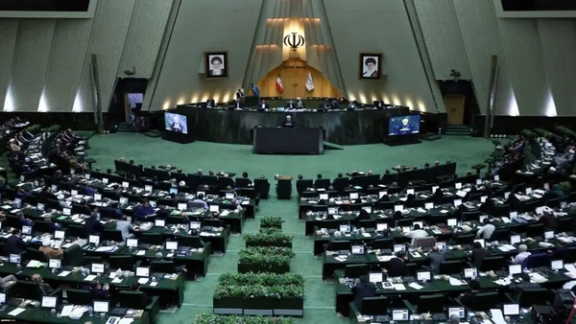
Iran's parliament approves death penalty for cooperation with Israel, US
Iran’s parliament has passed a law imposing the death penalty for cooperation with Israel, the US, or hostile groups, while also criminalizing unauthorized use of tools like Starlink to bypass internet restrictions.
The legislation classifies any collaboration with Israel and the United States as “corruption on earth”, which is punishable by death.
“Any intelligence, espionage, or operational activity for Israel, the US, or other hostile regimes and groups or their agents against the country’s security or national interests is considered corruption on earth and punishable by death,” the law says.
It further criminalizes “any security, military, economic, financial, technological action or any direct or indirect assistance knowingly done to approve, strengthen, consolidate, or legitimize Israel,” also punishable by death.
The third article specifies that manufacturing, transferring, or importing drones with military or sabotage uses against critical infrastructure qualifies for the death penalty. It also includes cyberattacks, disruption of communication networks, and sabotage of public or private facilities.
The law penalizes receiving funds from intelligence agents knowingly, regardless of active involvement.
Political, cultural, media, or propaganda activities causing public fear, division, or damage to national security carry 10 to 15 years imprisonment.
Sharing content with "hostile foreign networks" that weakens morale or creates division results in two to five years in prison.
Illegal wartime protests carry five to ten years imprisonment.
The use or import of unauthorized internet communication tools like Starlink is punishable by six months to two years in prison, according to the law.
Importing more than ten Starlink devices “with intent to oppose the Islamic Republic” results in five to ten years’ imprisonment.
The law applies retroactively to offenses committed before its enactment, violating Iran’s constitution and penal code provisions prohibiting retroactive laws, according to experts.
Iran’s banking sector continues to face severe service disruptions, with Sepah and Pasargad banks still struggling to fully resume operations after cyberattacks blamed on Israeli-linked groups.
Despite some limited card reactivations, Pasargad’s most banking services remain offline, leaving customers unable to perform routine transactions.
In Tehran, customers report that banks are refusing to process checks, urging clients to wait days for resolution.
During the recent Israeli and US airstrikes on Iran’s nuclear sites, a cyber battle erupted targeting critical Iranian infrastructure.
Sepah Bank, Pasargad Bank, and Nobitex, Iran’s largest cryptocurrency exchange, confirmed cyberattacks against their systems.
Internet banking, mobile banking, and ATMs of these banks remain largely nonfunctional.
A physical malware intrusion in Sepah Bank’s systems prevents successful data backup restoration, prolonging the outage, Rouydad 24 website reported Sunday.
The pro-Israel hacker group Predatory Sparrow, known for prior cyberattacks on Iran’s fuel infrastructure, claimed responsibility for disabling Sepah Bank, writing on X that they paralyzed the state bank.
The bank is responsible for processing the payments of military personnel.
Predatory Sparrow also hacked Nobitex. According to the cryptocurrency exchange's CEO Amir Rad, hackers extracted approximately $100 million from the platform.
While no hacker group has claimed responsibility for the cyberattack against Pasargad Bank, Iranian media are portraying it as part of Israel’s campaign against the Islamic Republic.
Tehran’s stock market reopened after a 12-day conflict between Iran and Israel with a sharp collapse, as investor anxiety triggered a sweeping sell-off.
Over 99 percent of listed companies dropped in value, triggering an unprecedented 350 trillion-rial (approximately $416.7 million) sell-off queue.
By the close on Saturday, total sell orders reached 350 trillion rials. The main index fell 62,503 points, or 2.1 percent, to 2,922,101. The equal-weight index lost 15,522 points, ending at 908,163.
The market’s sensitivity to political and security developments deepened investor distrust and anxiety this time. Tehran’s stock market had previously declined amid Tehran’s risky foreign ventures.
In prior crises such as earlier missile strike operations on Israel and after the death of former president Ebrahim Raisi, the Securities and Exchange Organization curtailed daily trading limits to contain losses. Normally, Iran’s daily price fluctuation limit is five percent.
“It was expected the market would start negatively after nine days of closure. Officials tried to control the fallout from Israel’s attack but failed,” economic journalist Arash Hassannia told Iran International.
The market reopened amid crisis signals. Within 90 minutes, over 99 percent of stocks traded in the red. The main index dropped about one percent to 2,957,000 points. The equal-weight index slid nearly 3,800 points, nearing 920,000.
Trade volume in the first 90 minutes exceeded 20 trillion rials ($23.8 million), with nearly 12 trillion rials ($14.3 million) withdrawn by individual investors. Banks and investment firms led trading values with 6.6 trillion rials ($7.85 million) and 2.8 trillion rials ($3.33 million), respectively.
Economy news outlets described the market situation as “a full-scale crisis.” One warned that the military conflict’s end failed to calm the market; instead, uncertainty deepened, with investors fearing new fighting. Analysts see this drop as potentially signaling a longer-term crisis.
Massive sell queues, scarce buyers, broad liquidity outflows, and widespread losses are signs of what analysts call “the start of a psychological and structural crisis.”
Hedayatollah Farzadi, the head of Iran’s notorious Evin Prison fled the site moments before Israeli airstrikes, Fox News reported Saturday, citing leaked messages between Israeli intelligence and Farzadi's son.
Israeli agents warned Amir-Hossein Farzadi that his father would be targeted unless political prisoners were released.
“It will happen in a few minutes,” one message read. Amir relayed the threat to his uncle, who then evacuated Farzadi from the prison compound just before the deadly strikes, the report said.
The Tehran Province Prisons Department dismissed the report, saying that Farzadi was inspecting the prison wards at the time of the strike.
Farzadi has led the notorious prison since 2022 and has been sanctioned by the US and EU for human rights abuses.
“Numerous protesters have been sent to Evin Prison… where they have been subjected to torture and other forms of physical abuse,” the US Treasury Department said in April.
Prior to Evin, Farzadi served at prisons in Kermanshah and Tehran where he oversaw amputations, torture, and alleged sexual violence against inmates. He remains on the US Specially Designated Nationals list.
Throughout its 12-day war on Iran, Israel launched strikes on key state organs tasked with domestic surveillance, protest suppression, detention and propaganda, targeting what it called “repression infrastructure.”
The attacks focused on intelligence and security agencies, judicial and detention systems, and officials overseeing internal control.
Israel framed the strikes as a show of solidarity with Iranian protesters and an effort to disrupt the Islamic Republic’s repressive capacity.
Iranian authorities have summoned and interrogated at least 35 Jewish citizens in Tehran and Shiraz over their contact with relatives in Israel, the US-based human rights group HRANA said.
The inquiries, which focused on personal ties with relatives in Israel, mark the most expansive state action against Iranian Jews in decades, HRANA reported.
“Emphasis was placed on avoiding any phone or online communication with abroad,” the rights group cited a source close to the families as saying.
Jews are not the only minority group being targeted. Iranian security forces raided at least 19 homes belonging to members of the Baha’i community during and after the Israel war, human rights groups say.
Analysts say the moves reflect both the state’s effort to project strength and its its reliance on targeting minorities when facing external setbacks.
Rights concerns
Pegah Bani-Hashmi, a senior legal researcher, told Iran International that the accusations of espionage against Jewish and Bahai citizens are “factually baseless and violate Iran’s own constitution.”
“These communities usually stay out of political activism,” she said. “There’s no legal or security justification for what the state is doing.”
Shahin Milani, director of the Human Rights Documentation Center, told Iran International the arrests expose the government’s failure to identify actual threats.
“Baha’is and other citizens don’t have access to classified information. They’re always under surveillance. Accusing them of spying is just an excuse to deflect blame and intimidate the population,” he said.
Iran’s parliament passed a law in 2011 banning travel to Israel. Many Iranian Jews maintain familial and religious ties there, and rights experts say the law has become a tool for suppression.
Community fears grow
A senior figure in Tehran’s Jewish community told HRANA that “we’ve seen limited cases before, but this is unprecedented.” He said the scale of recent summonses has triggered deep concern about the safety of their community.
Authorities have not issued formal charges but told families the actions are intended to gather information to prevent crimes.
Rights lawyers warn that these measures could constitute discrimination based on religion and ethnicity, in breach of Iran’s obligations under international law.
Rani Omrani, an independent journalist, told Iran International that Tehran’s tactics reflect its inability to confront Israel directly.
“Because they can’t reach Israel, they’re punishing innocent Jews at home,” he said.
Iran held a funeral ceremony in Tehran on Saturday for dozens of people killed during the 12-day conflict with Israel, including senior military commanders and nuclear scientists.
Senior Iranian officials attended the event and delivered remarks touching on a range of themes, including national unity, military resilience, and nuclear oversight.
State media said the ceremony was held for 60 individuals. Among them were at least 16 nuclear scientists and 10 senior military commanders.
Among those commemorated were Mohammad Bagheri, commander of the Iranian armed forces; Hossein Salami, head of the Revolutionary Guards; and Amir Ali Hajizadeh, who led the Guards’ Aerospace Force. All three were killed on June 13, the first day of the conflict.
Ali Shamkhani, a senior advisor to Supreme Leader Ali Khamenei, attended the ceremony, appearing in public for the first time since being wounded in an Israeli strike earlier this month. He had been targeted on the first night of Israeli attacks, and initial reports said he had been killed. State-linked outlets later said he was wounded but survived.
Supreme Leader Ali Khamenei was absent, though in a televised message earlier this week, he said that Israel had been “brought to its knees” and that the United States had “gained nothing” from the war.
Officials denounce IAEA and bar inspectors
Several officials used the occasion to deliver criticism of the International Atomic Energy Agency (IAEA). Judiciary Chief Gholamhossein Mohseni-Ejei said cooperation with the agency “cannot continue as before,” and accused it of passing information to "hostile states".
Lawmaker Hamid Rasaei said parliamentary legislation bars IAEA Director General Rafael Grossi and his team from entering Iran, and that nuclear surveillance equipment had been deactivated. Deputy Parliament Speaker Ali Nikzad called Grossi a liar and said he would face consequences for his role.
Remarks emphasize strength, resistance and imposed ceasefire
Other speakers focused on the war’s outcome. Several described the ceasefire as something forced on Israel and the US, not the result of any concession by Iran.
Parliamentarian Ebrahim Azizi said Iran had never surrendered and instead “forced its enemies to submit to the will of the Iranian people.” Former IRGC intelligence chief Hossein Taeb said Iran was prepared to deliver a stronger blow in the event of renewed hostilities.