Iran teachers’ protest cases remain open under Pezeshkian, activist says
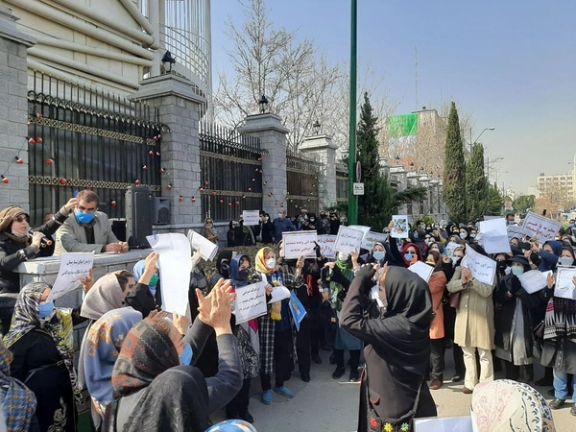
File photo of a protest by Iranian teachers
Court cases against Iranian teachers detained in protests remain unresolved and the administration of President Masoud Pezeshkian has not altered its approach toward labor demands, a teachers’ union spokesman told the reformist daily Sharq.
Mohammad Habibi, spokesman for the Coordinating Council of Teachers’ Trade Associations, said on Monday there was no clear figure for how many teachers had been dismissed since the 2022 protests, as many avoided publicizing their cases.
He said some teachers arrested during a Teachers’ Day rally in Tehran in May were later released on bail but still face trial, while union activists in provincial towns have been summoned or briefly detained.
“The current administration has made no change in the policy toward independent unions, and so far there has been no invitation from the administration or the education ministry to hear our criticisms and demands,” Habibi was quoted as saying.
In recent years, numerous teachers were detained and faced harsh prison sentences over holding protest rallies.
Iran’s Supreme Court has upheld the death sentence of labor activist Sharifeh Mohammadi, convicted of armed rebellion against the Islamic Republic, despite what her lawyer described as unresolved flaws in the case.
Branch 39 of the Supreme Court endorsed the ruling even though none of the flaws it previously cited as the basis for overturning her sentence have been resolved, Mohammadi's attorney Amir Raeisian said on Saturday.
"The Supreme Court was expected to once again overturn the ruling, but contrary to expectations, it did not," the lawyer said.
Mohammadi was convicted on charges of baghi or “armed rebellion against the state”, which carries the death penalty under the Islamic Republic's law.
Human rights groups say her membership in the Committee for Coordinating to Help Form Workers’ Organizations was the grounds for the death sentence.
The Islamic Republic's security forces consider the committee as an affiliate of the Komala, a Kurdish armed opposition group that has been engaged in guerilla warfare against the Islamic Republic. However, both Mohammadi's family and the Komala have dismissed any affiliation.
According to rights groups, during her detention, Mohammadi was deprived of basic prisoner rights, such as in-person visits and phone calls.
For a long time, she was denied visits with her family, especially her child, and was not allowed to contact them by phone.
The decision has drawn sharp criticism by prominent activists including Masih Alinejad.
“This is not just an attack on one woman, it is an attack on every mother who dares to dream of a better life for her children. When injustice threatens the most vulnerable among us, our silence becomes consent. We must raise our voices for Sharifeh, because her fight is the fight of us all,” Alinejad wrote on X.
Last year, 834 Iranians were executed, according to the United Nations, marking a record high and a 50-percent increase from the previous year.
At least 22 of those executed were women, making Iran the world's number one executioner of women. The 2023 figures were the highest since 2014, according to Norway-based organization Iran Human Rights.
In January, the UN called for an end to the "horrific wave of executions" underway, with 67 executions in May alone.
An Iranian police officer was killed and another wounded on Friday night when gunmen from a Sunni militant group opened fire on a military vehicle in the southeastern city of Iranshahr, local police said.
The police have identified the victims as Sgt. Ramin Sadeghi.
The gunmen exchanged fire with police before fleeing, according to the IRGC-affiliated Fars News.
The shooting occurred when a passing car opened fire on security forces moving through the city, according to a report by Haalvsh, a human rights organization that focuses on the restive Sistan-Baluchestan province.
A heavy security presence followed, with dozens of military and plainclothes forces dispatched to the scene, according to witnesses. Checkpoints were set up at the entrances and exits of Iranshahr, where drivers were stopped and asked for identification.
The Sunni militant group Jaish ul-Adl claimed responsibility for the attack in a statement on its Telegram channel.
The incident comes less than three weeks after a deadly assault on a courthouse in Zahedan, the provincial capital of Sistan and Baluchestan, in which nine people were killed — including three attackers — and 20 others wounded.
Jaish ul-Adl said it carried out that attack, which involved gunmen storming the judiciary compound and setting off an explosion.
Sistan and Baluchestan, bordering Pakistan and Afghanistan, has long experienced unrest involving Sunni militant groups, drug traffickers, and security forces.
Jaish al-Adl, designated a terrorist organization by both Iran and the United States, says it fights for the rights of Iran’s Baloch minority but is accused by Tehran of ties to cross-border militant networks.
More than 20 members of Iran’s Baha’i minority in the central city of Isfahan have had their homes, assets and vehicles confiscated in recent weeks, in some cases being informed only by text message, the Baha’i International Community (BIC) said on Wednesday.
The Geneva-based group said the seizures were carried out under Article 49 of Iran’s constitution, which allows authorities to confiscate wealth obtained through illegal means. The BIC accused authorities of misusing the law “without any evidence, legal process, or transparency” to target citizens solely for their religious beliefs.
“Article 49 was designed to return stolen property to its rightful owners, not to plunder the possessions of citizens and deprive families of their homes and livelihoods,” said Simin Fahandej, the BIC’s representative in Geneva.
“What we are witnessing is effectively state-organized theft – confiscation by text message. This action is discriminatory, completely illegal, and aimed at impoverishing a religious minority simply because of their belief.”
The BIC said affected families have faced blocked bank accounts, frozen business transactions, and restrictions on selling or transferring property. In some cases, it said, court files were not recorded in Iran’s official judicial notification system, preventing defendants and their lawyers from reviewing them.
The confiscations were ordered by special courts operating under Article 49, which the BIC said are a branch of the Revolutionary Court overseen by the Executive Headquarters of Imam’s Directive (Setad), a state-controlled conglomerate under the authority of Supreme Leader Ali Khamenei.
The BIC said the measures in Isfahan follow a long-running pattern of property seizures against Baha’is since the 1979 Islamic Revolution, alongside other restrictions including denial of access to higher education, bans on certain jobs, and interference with religious burial sites.
According to the US-based Human Rights Activists News Agency (HRANA), the Baha’i community in Iran has faced systematic repression over the past five years, including the arrest of at least 284 people and more than 1,495 years in combined prison sentences.
HRANA said Baha’is account for an average of 72% of all recorded violations against religious minorities in Iran over the past three years.
Iran’s constitution recognizes Islam, Christianity, Judaism and Zoroastrianism as official religions, but not the Baha’i faith, which emerged in 19th century Iran. Islamic Republic authorities consider it a “cult” and have accused its followers of links to foreign powers, charges the Baha’is deny.
A Shi'ite summer school camp in England, known as Camp Wilayah, has been cancelled due to what its organizer described as safety threats, following accusations by a right-wing political party that it has ties to the Islamic Republic of Iran.
“In light of serious threats to the safety of children at the camp, we regret to announce that this year’s Camp Wilayah will not proceed,” the Ahlulbayt Islamic Mission (AIM) said in a statement.
AIM, a charity dedicated to promoting Shi'ite Islam, organizes the annual four-day summer camp for children aged nine to 14.
The event follows specific Islamic rules, such as gender segregation, mandatory hijab for girls, and loose clothing.
The AIM website does not list its leadership or staff, but social media posts from past events show an apparent association with Hasan Ali al-Taraiki, a Shi'ite cleric.
“No evidence of wrongdoing has ever been found at Camp Wilayah, yet our children are being punished simply for their faith,” the AIM statement said. "To attack such a wholesome and positive tradition is shameful, especially when threats are made by the Reform Party to mobilize protests and disrupt children’s camps."
On social media, AIM has repeatedly praised Iran’s Supreme Leader Ayatollah Ali Khamenei, promoted his books, and shared his speeches.
“The idea that children should be allowed to attend camps run by ‘supporters of the Iranian regime’ is concerning,” said Robert Jenrick, the Shadow Secretary of State for Justice.
“AIM operates under the umbrella of the Ahlul Bayt World Assembly, an Iran-based organization whose leaders are appointed in Tehran and have historically been close to Ali Khamenei,” UK-based human rights lawyer Omid Shams told Iran International on Monday.
The push to cancel the camp came from the Reform UK party. Its leader, Nigel Farage, said Camp Wilayah has “clear and troubling ties to the Iranian Revolutionary Regime.”
“We will not be intimidated, we will not retreat, and we will continue to build a stronger, fairer society for everyone,” AIM said in another statement.
Security officials have warned of an increasing threat from Iran, saying Tehran has used groups in the UK to expand its influence.
On June 30, a report by The Telegraph accused Iran of conducting a “shadow war” inside the United Kingdom that extends beyond sanctions violations and includes propaganda, financial networks, and digital disinformation campaigns aimed at dividing society
In July, John Woodcock, Baron Walney, the UK government’s former extremism adviser, said: “We cannot allow propaganda and influence from this theocratic dictatorship to be spread to children in the UK.”
Two London charities with alleged links to Iran — the Dar Alhekma Trust and the Abrar Islamic Foundation — are currently under investigation by the National Terrorist Financial Investigation Unit. Both deny any wrongdoing.
The US State Department on Thursday called on Iran to stop its ongoing assaults on journalists and independent media, including threats targeting reporters and their families across the world.
"We call on Iran to immediately cease these threatening actions and to respect the fundamental right to freedom of expression," the State Department said in a post in Persian on X.
“The United States condemns the Iranian regime’s relentless attacks on journalists and the free press, including threats against reporters and their families in the United States and Europe,” the department added.
“In Iran, there is no freedom of expression. Critics are tortured and killed in prisons. The number of executions has even been rising on a daily basis. There is hardly a human rights activist in Iran who has not been imprisoned,” Mohammadi said.
According to Reporters Without Borders, “Iran has reinforced its position as one of the most repressive countries in terms of press freedom, with journalists and independent media constantly persecuted through arbitrary arrests and harsh sentences handed down after unfair trials before revolutionary courts.”
The State Department said attacks against journalists "are a blatant attempt to silence dissent and prevent the world from witnessing the regime’s repressive tactics."
“Targeting those who seek to expose the truth is a hallmark of authoritarianism, and the United States stands firmly with journalists and media outlets working to amplify the voices of the Iranian people,” the State Department said on its Persian account.
Iran has ramped up detentions and pressure on rights activists since the June ceasefire with Israel, and the trend continues.
Human rights groups say Iran has sharply increased the pace of executions in recent months. Washington-based rights group Abdorrahman Boroumand Center said earlier this month that at least 730 people have been executed in Iran since the start of 2025.
In July, the United States and thirteen allied countries accused Iran of plotting to kill, kidnap, and intimidate individuals in Europe and North America, citing violations of sovereignty and links to international criminal networks.
On August 5, Iran International filed an urgent appeal with United Nations experts urging them to take action against Iran over serious risks to the lives and safety of their journalists worldwide and relatives inside Iran.