Iran says sanctions move shows Europe beholden to the US
US president Donald Trump and French counterpart Emmanuel Macron at the White House, February 25, 2025
Europe ceased being a mediator between the United States and Iran with its move to restore international sanctions last month and became a US pawn, foreign ministry spokesperson Esmail Baghaei told the Guardian in an interview.
“The Europeans are doing what Trump dictated to them,” Baghaei told the Guardian
“Their role is going to be diminished … they have decided to be the proxy of the US and Israel.”
He contrasted today’s approach with earlier European foreign policy chiefs such as Javier Solana, Cathy Ashton, Federica Mogherini and Josep Borrell, whom he said acted as intermediaries between Tehran and Washington.
Britain, France and Germany — the three European signatories to the original nuclear deal — formally notified the UN last week that they intend to restore sanctions by the end of September unless Iran meets a set of conditions.
These include allowing UN inspectors back into sites damaged in Israeli strikes, providing details about its stockpile of highly enriched uranium and agreeing to open direct talks with the United States on the future of its nuclear program.
European governments have emphasized that there is still a four-week window for diplomacy before sanctions return, but Baghaei dismissed their conditions as insincere and “a sign they are not serious and they do not have good faith.”
Criticism of Europe and Israel
Baghaei also criticized European governments for tacitly supporting Israel’s June strikes on Iranian nuclear facilities, pointing to German Chancellor Friedrich Merz’s comment that Israel was doing “the dirty work … for all of us.” He claimed European countries likely provided intelligence to Israel to carry out the attacks.
The Iranian spokesperson further warned that parliament, not the government, holds constitutional authority over Iran’s membership in the Nuclear Non-Proliferation Treaty (NPT).
With lawmakers preparing to vote on a bill to mandate Tehran's withdrawal from the treaty if sanctions are reimposed, Baghaei said the government would not be able to block it.
Such a move would end UN oversight of Iran’s nuclear program and could ramp up concerns in the West about whether Iran intends to pursue nuclear weapons.
Despite the growing tensions, Baghaei insisted Iran remains open to compromise.
Iran, he said, had assured the IAEA that enriched uranium stockpiles had not been moved and suggested Tehran would be willing to return to the 3.67 percent enrichment cap set by the 2015 nuclear deal provided its right to enrich uranium domestically was preserved.
Iran, Russia and China have sent a joint letter to the UN Secretary-General and Security Council slamming European attempts to restore international sanctions on Tehran, Iran's foreign minister wrote on X.
Abbas Araghchi, who signed the letter with his Russian and Chinese counterparts at a foreign ministers’ summit in Tianjin in China, said the powers were united in condemning Europe's "politically destructive" move.
The snapback mechanism, created under UN Security Council Resolution 2231, allows any signatory to the now mostly lapsed 2015 Joint Comprehensive Plan of Action (JCPOA) to restore previous UN sanctions if Iran is judged to be in major violation.
Once invoked, sanctions return automatically after 30 days unless the Council votes to extend relief. The provision expires in October 2025.
On August 28, Britain, France and Germany formally triggered the process, citing Iran’s accumulation of highly enriched uranium.
The European powers said they were prepared to delay enforcement if Iran resumed cooperation with UN inspectors and engaged in negotiations.
But the three Eurasian powers were categorical in their rejection of the move.
"The UN Security Council cannot proceed on the basis of the communication submitted by the E3 and should consider it null and void," they wrote in the joint letter according to a picture of the document shared by Araghchi.
"We strongly urge the members of the UN Security Council to reject the claims of France, Germany, and the United Kingdom on allegedly invoking the 'snapback' mechanism and reaffirm their commitment to the principles of international law and multilateral diplomacy," they added.
Araghchi blamed the United States and Europe for undermining the deal.
“It was the United States that first violated the JCPOA and Resolution 2231,” he wrote on X, referring to its 2018 exit from the agreement during President Donald Trump''s first term.
“Europe, instead of fulfilling its commitments, chose to align with unlawful sanctions," he said. “Countries that fail to meet their obligations have no right to enjoy the benefits of an agreement they themselves have weakened. The credibility of multilateral diplomacy can only be preserved on this logic.”
Inspectors have completed a brief visit to Bushehr, as Tehran readies for another round of negotiations with the International Atomic Energy Agency, Iran’s atomic energy chief said on Sunday.
Two rounds of talks between the IAEA and the foreign ministry had already taken place, with a third session planned, Mohammad Eslami, head of the Atomic Energy Organization of Iran, told reporters.
“The matter of IAEA supervision over the refueling of Bushehr was on the agenda. Two inspectors came, observed the process and left,” he said.
Inspectors entered the country with authorization from the Supreme National Security Council to oversee a fuel replacement process at Bushehr, he added.
The visit marked the first IAEA presence since Tehran suspended cooperation during the 12-day war with Israel, when US and Israeli strikes targeted Iranian nuclear facilities.
IAEA Director General Rafael Grossi said last week that while inspectors were allowed back into Bushehr, access to other key sites remained blocked. He also warned that the agency was still dissatisfied with the level of Iranian cooperation.
IAEA Director Rafael Grossi at the annual meeting of the Institute of Nuclear Materials Management is in Washington DC, August 26
Some Iranian officials and media outlets had also threatened that as soon as Grossi entered Iranian territory, he should be arrested and put on trial. The Kayhan newspaper, overseen by the Supreme Leader Ali Khamenei, had called for Grossi to be tried and executed “for spying for Mossad.”
Dispute over snapback sanctions
Eslami dismissed the activation of the UN snapback mechanism by Britain, France and Germany as unsurprising. “Our enemies always find excuses to pressure the Iranian nation,” he said, accusing the IAEA leadership of acting under the influence of Western powers.
The European states triggered the mechanism on August 28, seeking the reimposition of all previous UN sanctions and demanding that Iran resume full cooperation with the IAEA within 30 days. Tehran has so far refused.
Officials have threatened that if pressure intensifies, Iran could withdraw from the Nuclear Non-Proliferation Treaty — a move that would deepen its isolation and risk losing support from Russia and China.
The IAEA has reported that Iran holds enriched uranium stocks far beyond the limits set in the 2015 nuclear deal, including more than 400 kilograms enriched to 60 percent.
The fate of this material remains unclear after the strikes on Fordow, Natanz and Isfahan during the June conflict. Experts warn it could be enough, if further refined, to build several nuclear weapons.
Former Iranian President Hassan Rouhani on Sunday said that reducing tensions with the United States through negotiations was a matter of national interest.
“Relations with Europe, our neighbors, and the East and the West, even tension with the US, if we can reduce it, if it is in our national interest, what is wrong with that? Not only is it not wrong, but it is also our duty and obligation,” Iranian media quoted Rouhani as saying in a meeting with his advisers on Sunday.
“We must strengthen our relations with the world. Whoever is ready to negotiate, if we see that negotiation benefits the country, our national interests and national security, then we should talk,” he added.
Rouhani, who served as president when Iran signed the 2015 nuclear deal with world powers, had described negotiations with the US as “necessary and obligatory” in an earlier meeting with his advisers on August 14.
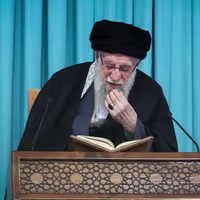
His remarks come after Iran’s Supreme Leader Ali Khamenei rejected calls by Tehran moderates for direct negotiations with the United States, insisting that Washington’s hostility cannot be resolved through talks.
“Those who say, ‘Why don’t you negotiate directly with the United States and solve the issues,’ are superficial; because the reality is different," Khamenei said during a meeting with his supporters in Tehran.
"Given America’s true objective in its hostility toward Iran, these issues are unsolvable."
Iran and the United States concluded five rounds of mostly indirect talks in May this year.
A sixth round was scheduled to take place on June 15 in Oman. However, it was suspended after Israeli airstrikes on Iran’s nuclear facilities on June 13, prompting Tehran to declare the talks "meaningless" and cancel the session.
On June 22, the US carried out airstrikes on Iran’s key nuclear sites at Fordow, Natanz, and Isfahan. A US-brokered ceasefire came into effect on June 24, which ended the 12-day air war.
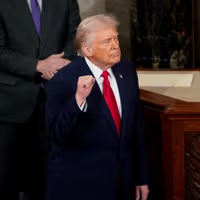
President Trump told reporters in mid-July that the urgency to engage with Iran had vanished after US strikes.
Earlier, Iran International reported that Washington ignored at least 15 messages from Iran seeking renewed negotiations.
The United States will ensure that foreign visitors pose no threat to its national security, the State Department told Iran International when asked whether the Iranian delegation would be issued visas to attend this year's UN General Assembly in New York.
While the United States is generally obligated under the UN Headquarters Agreement to issue visas to representatives of member states, the Trump administration "will not waver in upholding American law and the highest standards of national security and public safety in the conduct of our visa process," a State Department spokesman said.
"Ensuring that foreign visitors to the United States do not pose a threat to US national security or public safety remains a paramount priority of the US government," the spokesperson added in response to Iran International's inquiry.
The State Department said it does not comment or speculate on individual cases due to visa confidentiality, leaving it unclear whether Iranian officials will be allowed to travel to New York this year.
The comments come as the United Nations prepares to host its annual General Assembly session next month, when world leaders gather in New York for high-level meetings.
Secretary of State Marco Rubio rescinded the visas of Palestinian President Mahmoud Abbas and 80 other officials ahead of the UN General Assembly, the State Department said on Friday, though Palestinian representatives assigned to the UN mission were granted exceptions.
Visa for Iranian officials
Last year, the United States faced criticism from members of the Iranian diaspora and activists over its decision to issue visas to President Masoud Pezeshkian and his delegation to attend the UNGA.
The question of visas for Iranian delegations to the UN has been a recurring point of friction between Washington and Tehran, particularly during President Donald Trump’s previous term.
In 2019, Foreign Minister Mohammad Javad Zarif was granted a visa to attend the UNGA in New York, but his movements were tightly restricted to a few blocks around UN headquarters.
The US also has a history of denying visas to officials of the Islamic Republic. In 2014, the White House refused to issue a visa to Iran’s nominee for UN ambassador, Hamid Aboutalebi, due to his involvement in the 1979 seizure of the US embassy in Tehran.
President Donald Trump ordered airstrikes on Iran’s nuclear sites in June without alerting US diplomats, leaving them unable to answer questions from foreign governments, the Wall Street Journal reported on Sunday.
Officials from Middle East countries pressed for answers after the strikes, but US embassies could only point to Trump’s public remarks, the Journal said, citing people involved in the talks.
The report said Trump has sidelined the National Security Council, slashed staff to under 150, and merged key roles. Secretary of State Marco Rubio now also serves as national security adviser.
“It is a top-down approach,” White House press secretary Karoline Leavitt told the Journal. “We don’t really care if your feelings are hurt. We just need to get a job done.”
“In many respects, the national security process has ceased to exist,” said David Rothkopf, a historian of the NSC. Trump, he added, effectively is the national-security system—“the State Department and the Joint Chiefs and the NSC all rolled into one.”
Some aides say the system cuts leaks and speeds decisions. Others warn it leads to confusion and leaves officials guessing what Trump wants.
'Every bomb hit its target'
The US struck nuclear sites at Fordow, Natanz and Isfahan using B-2 bombers and submarine-launched missiles. Trump later confirmed the use of 30,000-pound bunker-busting bombs that entered Iran’s underground facilities through ventilation shafts.
The operation, called Operation Midnight Hammer, was carried out with long-range aircraft and 52 aerial refueling tankers. General Dan Caine, chairman of the Joint Chiefs of Staff, said 14 Massive Ordnance Penetrators were used against Fordow and Natanz.
Iran tried to restart talks, got no answer
In the weeks after the strikes, Iranian officials said Tehran sent at least 15 messages to the US through various channels seeking to resume talks but received no reply, Iran International reported, citing senior diplomats.
European powers triggered the UN’s snapback sanctions process, citing Iran’s nuclear activity, and said US-Iran dialogue was key to delaying new penalties.
Trump told reporters in July he was in “no rush” to talk. “They would like to talk. I’m in no rush because we obliterated their site,” he said.
Iran’s top leaders remain opposed to direct talks. “Given America’s true objective in its hostility toward Iran, these issues are unsolvable,” Supreme Leader Ali Khamenei said this month.