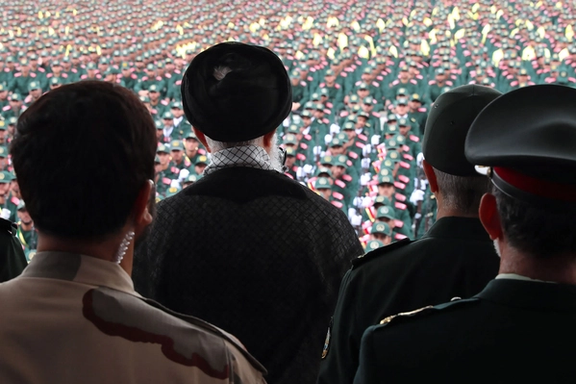
Iran's supreme leader Ali Khamenei preside over a military parade in Tehran
Facing a grinding crisis and mounting calls at home to change course before disaster strikes, Iran’s rulers still speak in a language that suggests they prefer the risks of war to the uncertainties of reform.
Supreme Leader Ali Khamenei on Sunday warned of an enemy plot to impose a harmful “no war, no peace” stalemate on Iran.
He alluded to the widespread fears of renewed conflict but stopped short of addressing them directly.
The “dangerous” limbo—as he called it—will be broken either by peace or by war. Yet peace would require a dramatic shift he has rejected in both word and deed, leaving only one option, even if not stated openly.
Why war seems manageable
For Tehran, war offers a chance to present itself as a power “standing firm against the enemy.”
That narrative rests on two premises: exaggerating the damage inflicted on Israel while recasting Iran’s own losses as “sacrifice” and “resilience.” This ability to redefine reality makes war appear containable, even when the battlefield balance tilts against Iran.
Conflict also strengthens institutions like the Revolutionary Guards and Basij, which dominate not only security but much of Iran’s economy and politics.
External crises bring them bigger budgets, wider powers, and a firmer grip on the state. Sustained tension, even without outright war, keeps them central to decision-making.
Bureaucratically, war simplifies governance.
An external threat sidelines factional disputes, concentrates power in one command center, and allows sensitive decisions to be postponed. In such conditions, obedience to central authority becomes the overriding principle.
Why change is riskier
Unlike war, which has a clear adversary and defined parameters, internal change is unpredictable.
The leadership knows genuine reform could set off a chain of fresh demands that quickly spiral out of control—especially when combined with external pressure. For a system built on concentrated power and tight social control, this is far riskier than conflict it believes it can at least spin through propaganda.
History reinforces this fear.
The Soviet collapse is interpreted in Tehran as the direct result of political liberalization. At home, the reform movement of the 1990s triggered demands that Khamenei deemed intolerable, ending in repression.
These experiences mean even cautious proposals—from economists or technocrats—are viewed as existential threats.
The IRGC and other power centers oppose change not only for security reasons but because their vast economic interests are at stake. Reform would mean redistribution of both power and wealth, making them natural adversaries of any shift.
A managed crisis—or a trap?
From Tehran’s perspective, war is “manageable”: it mobilizes security and propaganda, strengthens key institutions, and produces a narrative of defiance. Change, by contrast, has no clear enemy, no obvious tools of control, and no reliable endpoint.
Yet relying on crisis as a survival strategy carries its own risks.
Each confrontation further depletes Iran’s economic and social capacity. Emigration, a shrinking middle class, and crumbling infrastructure all show that the politics of permanent crisis may deliver short-term cohesion but erodes long-term survival.
The essential question is how long a state can balance on the edge of crisis before that very crisis slips out of control.
The answer is uncertain. What is clear is that the Islamic Republic still believes change, not war, is the greater danger to its survival.
Iran on Tuesday condemned an Israeli attack on Hamas leaders in the Qatari capital Doha, calling the bombing of the Tehran-backed group's negotiating team a dangerous escalation to simmering Middle East tensions.
The Israeli military had earlier taken responsibility for the attack, saying it targeted what it called the "senior leadership of the Hamas terrorist organization" and that steps were taken to reduce civilian harm.
Iran's President Masoud Pezeshkian strongly condemned the attack as an "illegal, inhumane, and anti-peace action", saying it shows Israel "recognizes no limits to crime and terror, and destroys every attempt at diplomacy."
He called on the United Nations, the Organization of Islamic Cooperation, and other international bodies to respond to what he called a blatant aggression with immediate, decisive, and practical action.
"Attacking an independent country is a clear violation of national sovereignty and the UN Charter," Pezeshkian said, more than two months after Iran attacked a US base in Qatar during its 12-day war with Israel.
Iranian foreign ministry spokesman Esmaeil Baqaei also said "this action by the Israeli regime is a continuation of the crimes it has committed by violating all norms and international rules."
"This action is extremely dangerous and criminal; a blatant violation of all international laws and regulations, an infringement of Qatar’s national sovereignty and territorial integrity, and an attack on Palestinian negotiators."
Hamas has long based its political leadership in the gas-rich Persian Gulf state, which has traditionally served as a mediator in regional conflicts.
Khaled Qaddoumi, the Hamas representative in Iran, said the attack it described as an assassination attempt had failed and showed US perfidy.
“As always, the US government does not honor its commitments and consistently paves the way for the Israeli regime’s terrorist actions by creating the illusion of negotiations and offering superficial proposals," Qaddoumi was quoted as saying by Iranian state media.
"This time too, while the leadership of the movement was reviewing what was called the American plan in Doha, the occupying forces attacked the movement’s headquarters in a country that is one of the most important mediators, with US coordination.”
Hamas's ceasefire negotiation delegation survived Israeli attack, Reuters reported citing sources. There were no specific official comments on any casualties by Qatar or Hamas.
Negotiations to end the nearly two-year-old war in Gaza had been entering a critical new stage, with US President Donald Trump urging Israel and Hamas to agree to a prisoner exchange and ceasefire.
'Chieftains'
Speaking on X after the Doha attack, Israeli Prime Minister Benjamin Netanyahu appeared to stress there was no involvement by the United States, whose Mideast military hub is in Qatar.
"Today's action against the top terrorist chieftains of Hamas was a wholly independent Israeli operation," he said. "Israel initiated it, Israel conducted it, and Israel takes full responsibility."
Netanyahu on Monday visited the site of a deadly shooting by Palestinian gunmen on a bus in Jerusalem in which six people were killed, vowing to crush the Jewish state's enemies.
Iran and its regional affiliates have suffered multiple blows at the hands of its arch-foe in the regional conflagration which erupted since Hamas's October 7, 2023 attack on Israel.
A 12-day surprise Israeli campaign against Iran in June battered the Islamic Republic's military and nuclear infrastructure and killed hundreds of civilians and military personnel along with several top nuclear scientists.
32 Israelis were killed in Iranian counterattacks.
US attacks on three key Iranian nuclear sites capped off the war, and a retaliatory missile salvo caused damage deep inside a US airbase in Qatar, destroying a cutting-edge communications hub.
Iranian Supreme Leader Ali Khamenei this month sought Qatari mediation in talks with the West, multiple sources told Iran International, as Tehran signals rare flexibility on its enriched uranium as part of efforts to avert looming UN sanctions.
Iran’s government said on Tuesday it does not currently have access to its stockpiles of enriched uranium following June’s 12-day war that devastated the country’s nuclear facilities, as its foreign minister traveled to Egypt for talks with the UN nuclear watchdog.
Iran’s government said on Tuesday it does not currently have access to its stockpiles of enriched uranium following June’s 12-day war that devastated the country’s nuclear facilities, as its foreign minister traveled to Egypt for talks with the UN nuclear watchdog.
“In regard to uranium, we do not have access to it. It is in a location where access does not exist,” government spokeswoman Fatemeh Mohajerani told reporters at her weekly press briefing, without giving details of where the material is being held.
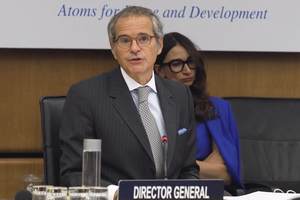
Her remarks came as Foreign Minister Abbas Araghchi arrived in Cairo for meetings with Egyptian officials and IAEA Director General Rafael Grossi. The talks are expected to focus on a new framework for nuclear inspections after Iran suspended cooperation with the agency in July.
Foreign ministry spokesman Esmail Baghaei confirmed late on Monday that “negotiations on the new protocol for Iran’s safeguards obligations will be finalized” during the Cairo meeting.
He said three rounds of technical talks had already produced a draft text that is now in its final stage.
Tasnim, citing an informed source on Tuesday, reported: “Today’s meeting between Abbas Araghchi and Rafael Grossi, the IAEA director general, is significant and will be held in Egypt within hours.”
The unnamed source added: “Although nothing has been finalized yet, a potential agreement between Iran and the Agency is possible.”
Voicing skepticism over progress in the Cairo talks, Laurence Norman, a correspondent for the Wall Street Journal, reported on Tuesday that he had learned “there is no agreement in place between Tehran and the agency, and the situation remains unclear.”
Mohajerani also referred to Iran’s complaint that IAEA inspectors had removed confidential documents from the Fordow enrichment site earlier this year.
“In early May, two documents accessed by inspectors were transferred to Vienna. After Iran submitted a written protest, the authorization of those two inspectors was revoked and their cooperation with Iran ended,” she said.
The government spokeswoman added that Iran’s future cooperation with the IAEA will be shaped by a law passed by parliament in June curbing the agency’s access, but stressed that any decision on leaving the Nuclear Non-Proliferation Treaty (NPT) “will ultimately be made by the system as a whole.”
On Monday, the watchdog's chief dismissed allegations that IAEA data had been misused to enable attacks on facilities, calling the allegation “an absurd narrative.” The agency, he said, had never shared confidential inspection information and was discussing additional measures to reassure Iran that safeguards data remained secure.
Rafael Grossi also told governors that Iran’s suspension of cooperation under a new domestic law cannot override its binding international commitments.
Several Iranian sources told Iran International that Supreme Leader Ali Khamenei instructed President Masoud Pezeshkian to seek mediation through the emir of Qatar to ease tensions with the West.
The diplomatic push comes as Britain, France, and Germany triggered the so-called “snapback” mechanism at the United Nations aimed at restoring all sanctions on Iran, citing Tehran’s refusal to meet Western demands over its nuclear and missile programs.
Nearly 22,000 Iranian gas centrifuges at Fordow, Natanz and Isfahan were knocked out in June strikes, leaving “no identifiable route” to weapon-grade output at those plants, the Institute for Science and International Security said citing the UN nuclear watchdog’s latest reports.
In a paper assessing the International Atomic Energy Agency’s (IAEA) September quarterly reports, ISIS said the attacks “destroyed or made inoperative all of Iran’s installed centrifuges… at Iran’s three enrichment sites,” and severely damaged Iran’s ability to manufacture centrifuges and uranium hexafluoride feedstock.
The group, led by nuclear expert David Albright, added that Fordow, Natanz and Esfahan held enriched uranium stocks before the strikes, but the IAEA has lost on-site visibility since inspectors withdrew for safety reasons in late June and Iran later suspended cooperation.
The IAEA’s reporting showed Iran’s stock of uranium enriched up to 60% U-235 reached 440.9 kg (uranium mass) on the eve of the June 13 bombardment, with additional inventories of 20%, 5% and up to 2% material also on hand.
The agency said the 60% stockpile -- considered highly enriched uranium -- requires verification every 30 days under standard safeguards practice and that “its verification… is overdue” because inspectors have not had access for more than two and a half months.
IAEA Director General Rafael Grossi told the Agency’s Board of Governors on Monday that Iran’s new domestic law curbing access “may create obligations domestically,” but “it cannot do so for the IAEA.”
He added that Iran’s NPT safeguards agreement remains in force and that inspection work must fully resume without delay. He said technical talks in Tehran and Vienna had made headway toward a practical arrangement, adding: “It is my sincere hope that within the next few days, it will be possible to come to a successful conclusion.”
ISIS said the IAEA reported Iran was in the process of declaring a new Isfahan Fuel Enrichment Plant (IFEP) at the Nuclear Reactors Fuel Company site before the war.
The think tank assessed the IFEP to be inside Esfahan’s mountain tunnel complex and said US strikes destroyed tunnel entrances and ventilation systems; while Iran has restored limited access to at least one portal, the plant “does not appear to be ready for operations.”
The IAEA planned a design-information visit on June 13 but canceled it as the attacks began.
Before the strikes, the IAEA counted “125 full-sized cascades” at the three declared enrichment plants, totaling more than 20,000 IR-1, IR-2m, IR-4 and IR-6 machines. ISIS estimated the installed total was closer to 22,000, including about 14,700 advanced centrifuges.
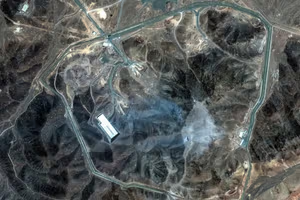
Based on satellite imagery cited by the IAEA, Fordow “suffered very significant damage,” Natanz’s underground halls were “extensively damaged,” and the above-ground pilot plant at Natanz was destroyed early in the conflict, ISIS said.
Since June 13, the IAEA said it has received no nuclear-material accountancy reports, no updated design information questionnaires, and has had no access to safeguarded sites other than the Bushehr nuclear power plant.
It reported a “loss of continuity of knowledge” over inventories of enriched uranium, as well as over centrifuge and heavy-water production since Iran halted JCPOA-related monitoring in 2021.
Grossi said only standard measures under Iran’s Comprehensive Safeguards Agreement were under discussion, because Tehran is not applying the Additional Protocol.
He also rejected claims that IAEA data had enabled attacks on Iranian facilities, calling such allegations an “absurd narrative,” and reiterated that the agency does not share confidential inspection information with any state.
European powers have moved to reimpose UN sanctions via the “snapback” mechanism, while Tehran has demanded international condemnation of the strikes on its nuclear sites.
Hamzeh Safavi, son of Yahya Rahim-Safavi, a senior military adviser to Supreme Leader Ali Khamenei, said Iran must be prepared for the possibility that Israel could attempt to assassinate the country’s top leader.
In a video interview, Safavi, a political science professor at Tehran University, repeatedly referred to the possibility of Khamenei’s killing, describing such scenarios as “disruptive and hostile acts” that Israel might pursue independently of US approval.
“If the issue of access to the number one or number two person in the country arises, they will carry it out at any cost, even at the risk of war,” Safavi said. “If Israel does this without America’s permission, the US will face a fait accompli, and Iran will be forced to think through its response.”
Former Israeli defense minister Yoav Gallant said last week that eliminating Khamenei should be part of Israel’s plan in any future conflict. Israeli officials, including Defense Minister Israel Katz, have also issued warnings aimed at the Supreme Leader, amid heightened rhetoric between Tehran and Tel Aviv following their 12-day war in June.
Safavi said US President Donald Trump had once claimed he stopped Israeli plans to target Khamenei during the June conflict. Trump later boasted he had “saved” the Iranian leader from what he called a “very disgraceful and humiliating death.”
While Safavi said war with Israel remained possible, he warned of what he called a more dangerous scenario of “gradual humiliation and erosion” if Iran did not respond to escalating threats.
“The worst scenario is not war. The worst scenario is being worn down,” he said.
Safavi also voiced rare criticism of Khamenei’s long-held stance on Washington, urging Iran to pursue what he called “comprehensive negotiations” with the United States that go beyond uranium enrichment.
“The nuclear deal was a single-issue agreement, and that is why it failed,” he said. “We need comprehensive talks with America.”
Rahim-Safavi, his father and Khamenei’s longtime military adviser, has himself said another war with Israel may be inevitable, but could be the last. “We soldiers always plan for the worst-case scenario,” he said in August.
South Korea, the rotating president of the United Nations Security Council this month, has finalized a draft resolution that would permanently lift international sanctions on Iran but is unlikely to be adopted, Reuters reported on Monday citing diplomats.
South Korea’s draft is not an initiative of its own, but a legal requirement under Resolution 2231 which endorsed the 2015 nuclear deal with Iran and is due to expire on October 18.
According to Resolution 2231, sanctions will automatically return unless the Council votes to keep them lifted. That is why the Council president must first table a resolution to “permanently lift” sanctions as its failure is what triggers the re-imposition.
The procedural step comes as part of the so-called “snapback” mechanism triggered by Britain, France, and Germany late last month, after they accused Tehran of violating its commitments under the deal.
The Security Council must vote by late September on whether to make sanctions relief permanent. For the resolution to pass, it would need at least nine votes in favor and no vetoes from the five permanent members: the United States, Britain, France, Russia, and China.
The adoption of the South Korean resolution is regarded as highly unlikely, as Washington and its European allies remain adamant that Tehran has failed to live up to its obligations, Reuters reported.
As no member tabled a resolution within ten days of the process being launched, it fell to South Korea, as Council president for September, to do so. Seoul’s move on Monday fulfills that requirement, though a date for the vote has not yet been set.
Britain, France, and Germany are still pressing Iran to meet three conditions before the end of the month, which could allow for a temporary delay in sanctions snapback and create space for new negotiations.
Moscow and Beijing have taken a different approach. Late last month, they finalized their own draft resolution calling for a six-month extension of the nuclear deal, urging all parties to return to negotiations.
The resolution of extension of sanctions is expected to be put to vote once Tehran and European powers reach an agreement.
Should Russia and China move first, their text would almost certainly face a veto from the United States, France, or Britain.