Hamas and Hezbollah rebuild during truce, Israeli officials say - JPost
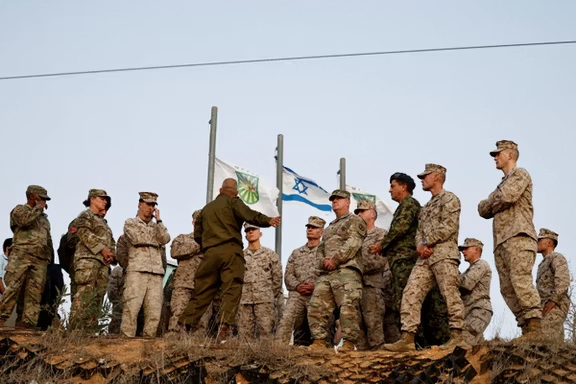
Senior military commanders and officers from around the world observe Gaza from Israel as part of an international seminar hosted by the Israeli military to share lessons from the last two years of its war, in Sderot, Israel, November 18, 2025.
Hamas and Hezbollah are quietly rebuilding their military capabilities amid a tense ceasefire with Israel, the Jerusalem Post cited Israeli defense officials as saying on Thursday.
According to the officials, Hamas’s military wing “has been rebuilding its force since the ceasefire took hold, gathering intelligence, recruiting and training operatives, and preparing for escalation,” the paper said.
The assessment followed an air strike the Israeli military said killed a Hamas battalion commander in Gaza and recent air strikes in Lebanon, one of which killed 13 people in a Palestinian refugee camp this week.
The officials said US pressure is “for now, restraining a sharper Israeli response” to Hezbollah’s ceasefire violations.
Southern Command sources said Hamas is seeking “operational opportunities to launch a surprise, limited attack against IDF units inside Palestinian territory, in violation of the deal.”
Military sources told the paper that Hezbollah is acting “in clear violation of the ceasefire understandings” and is moving “in the opposite direction of demilitarizing southern Lebanon and disarming.”
They said weapons were being moved into southern Lebanon and the Bekaa Valley as part of efforts to restore infrastructure with Iranian support.
Hezbollah’s quiet revival
Western and regional intelligence reports say Iran’s Quds Force helped Hezbollah rebuild its command structure after the killing of leader Hassan Nasrallah last year.
According to Le Figaro, Iranian operatives led by Quds Force commander Esmail Ghaani reorganized the group’s military wing within days, introducing younger commanders and tighter secrecy.
Hezbollah has agreed to withdraw its forces from the southern front but continues to store weapons north of the Litani River and in the Bekaa Valley, the report said.
Iran’s strategy, it added, aims to preserve Hezbollah’s deterrent power while avoiding direct confrontation with Israel.
Beirut challenges Tehran’s reach
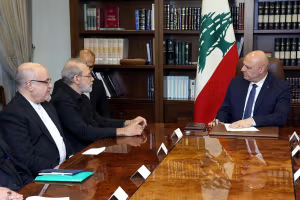
Lebanese President Joseph Aoun reportedly confronted Iran’s role in the country, breaking precedent by calling for Hezbollah’s disarmament. In a since-withdrawn interview, Aoun said he told Iran’s security chief Ali Larijani that “the Shi'ites of Lebanon are my responsibility, not yours.”
Aoun said Hezbollah’s military wing was “finished” and that he was seeking “an honorable end” to its armed role.
His comments followed a cabinet decision approving a US-backed roadmap to dismantle Hezbollah’s arsenal by the end of the year. Tehran has rejected the plan, accusing the West of trying to weaken Lebanon’s defenses.
Tension spills into Syria
Israel’s security leadership fears the growing coordination between Hamas, Hezbollah, and Tehran could extend into Syria.
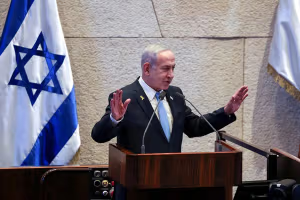
Prime Minister Benjamin Netanyahu’s visit to the country's south this week, with top defense and intelligence officials, signaled Israel’s determination to maintain its security buffer on the Golan Heights.
The visit came after Syrian President Ahmed al-Sharaa said he would normalize relations with Israel if the IDF withdrew from the Syrian Golan.
Security officials said they were not impressed by the rapprochement between the White House and Damascus and argued that al-Sharaa’s “jihadist past cannot be erased so quickly,” adding that he “does not necessarily control his own country.”
Hamas and Hezbollah rebuild during truce, Israeli officials say - JPost | Iran International
More eyewitness students have reached out to Iran International with testimonies detailing a series of aggressive acts at a Tehran school on Tuesday, leaving three girls hospitalized.
In a series of video, audio, and text messages, the students at the school recalled the events and how it started due to very aggressive body and backpack searches at the school.
“A significant number of students' mobile phones were thrown to the ground, and some were broken. A photography camera belonging to the photographic arts department was also destroyed,” an eyewitness said.
“Items such as perfume, body splash, and other personal belongings that are not legally prohibited were confiscated,” said another.
'Verbal threat'
One of the eyewitnesses said the whole ordeal had been “physically violent” and with some extreme “threatening tone.”
“They pushed students, shouted at them, and used physical force, causing intense fear and emotional distress,” one student said. “The principal even told one student: ‘We'll hang you so the others could see.’”
Another eyewitness said the aggressive behavior of the principal was not limited to the students but was directed at vice-principals and other staff at the school.
“The principal behaved inappropriately, insultingly, and aggressively toward vice principals and teachers, further escalating tension and disorder in the school.”
'Help needed'
At that point, chaos erupted and some of the girls at the school reacted differently to the chain of events.
“Several students fainted, experienced shortness of breath, heart problems, severe trembling, anxiety, and critical conditions,” one student said. “The school environment became completely chaotic, with widespread screaming, crying, and panic among the students.”
One eyewitness said that while some students were becoming unwell and fainting, crying, suffering panic attacks, loss of consciousness, and breathing difficulties—the principal refused to allow calls to parents, claiming the students were "putting on an act."
Then the students managed to call for urgent care themselves, but the school blocked entry and stopped anyone from coming in.
“When emergency services, education department representatives, and police arrived, the principal refused to open the gate, attempting to alter the situation inside the school and make the scene appear normal before allowing entry,” one student said.
There has been no official reaction to the incident that happened at “Mojtaheda Amin” girls' technical school in Shahr-e Rey, south of Tehran on Tuesday. At least three girls aged 15 -17 were hospitalized with severe injuries.
Videos shared by eyewitnesses show some angry students at the principal’s door, calling her to come out and face the students, but no one came out of the office.
The case follows earlier incidents this year, including the suicide of a 12-year-old student in Shiraz in October and the death of a 14-year-old in Zanjan in August after punishment at school, which have intensified concern about violence and a lack of accountability in Iran’s education system.
Iranian singer and songwriter Shervin Hajipour said he is facing new restrictions, including being barred from entering a gym and attending concerts.
In an Instagram video story, he said that when he asked a club security guard why he was denied entry, the guard replied: “Because you are Shervin.”
Iran's clerical rulers have eased enforcement of Islamic veiling laws, paused a draconian new hijab law and looked the other way as once-banned outdoor concerts proliferate.
But crackdowns on dissidents and political speech have sharply mounted since the conflict, according to rights groups.
Hajipour is the creator of the protest song Baraye (“For…”), which became a global anthem for Iran’s nationwide Woman, Life, Freedom movement following the 2022 death of a young woman, Mahsa Amini, in morality police custody.
He was briefly arrested in September 2022 shortly after the song went viral.
In 2023, Hajipour won the inaugural Grammy Award for Best Song for Social Change for the son.
The next year, a court sentenced him to three years and eight months in prison on charges including propaganda against the Islamic Republic and inciting and encouraging people to commit acts of violence and disturbance with the intention of harming national security.
He was also banned from leaving the country for two years.
The court ordered him to produce monthly one-page works on “the crimes of America against humanity” and compose a musical piece about “America’s crimes and its violations of human rights,” according to a copy of the verdict he shared in an Instagram post.
It also directed him to summarize books by Morteza Motahhari, a leading ideologue of the Islamic Republic whose writings on women morality and politics remain central to state doctrine, and to compile cultural and scientific “achievements of the Islamic Republic” and present them in digital form.
In September 2024, his case was dismissed under a clemency order issued by Iran’s Supreme Leader, effectively granting him a pardon.
Hajipour said in his new video that despite the restrictions, he intends to continue living in Iran.
“I did not stay in this country to sit in a corner of my house or be humiliated or be unable to work or exercise,” he said.
The Institute for Science and International Security (ISIS) citing satellite imagery reported apparent construction at Taleghan 2, a former nuclear weapons development facility within Iran's Parchin military complex.
“The imagery, captured between September and November 2025, shows a large cylindrical vessel - approximately 36 meters long and 12 meters in diameter—housed inside a new domed building,” the report said on Tuesday.
"What exactly the object is cannot be completely determined from the satellite imagery alone, however, its shape and metal structure are consistent with previous high-explosive test chambers Iran has built," the report added. "The facility is likely entering an advanced stage of construction."
Taleghan 2 is located near Taleghan 1; both are part of the Parchin military complex, about 20 miles southeast of Tehran.
“Reconstruction began as early as May 2025 and has progressed quickly despite the prior damage,” the report said.
The institute said both Taleghan sites were part of Iran’s AMAD Plan, an alleged covert project aimed at developing nuclear weapons.
The AMAD Plan ran from the late 1990s until 2003, according to the International Atomic Energy Agency (IAEA).
Iran denies the existence of the AMAD Plan, insisting its nuclear program is purely peaceful and that nuclear weapons are forbidden by a religious decree from Supreme Leader Ali Khamenei.
The institute which monitors sites activity satellite imagery, reported last month on Iran’s renewed activity in Taleghan 2 site.
“By June 12, groundwork and foundations had been laid, and by late August, a new arch-roofed structure about 45 by 17 meters was under construction over the temporary cover, with two smaller buildings nearby,” the institute added.
The UN nuclear watchdog said on Wednesday it needs more Iranian cooperation to restore full inspections at sites hit in June’s strikes, warning that verification of enriched uranium stocks is “long overdue.”
Three students were taken to a hospital after officials at a girls’ technical school in Shahr-e Rey south of Tehran allegedly assaulted pupils during searches for mobile phones, according to videos and eyewitness accounts sent to Iran International.
Tehran Province’s education chief Yousef Baharloo said tensions at the school erupted on Wednesday after staff confiscated several students’ phones, adding that he had received no reports of physical injury to the students.
But eyewitnesses drew a different picture.
“They grabbed us by the collars in groups when we entered the school and dragged us inside. They forced us to kneel and threw our belongings on the ground. They touched our private parts and checked our bodies completely,” one student said.
“On the pretext of taking mobile phones and picking on us for our hijabs, they went after the students. They even sent the Special Unit and closed the school gate,” another eye witness said, referring to security forces.
Videos and images shared with Iran International appeared to show emergency personnel and ambulances at the school following the altercation.
The incident, which occurred on Tuesday, raised fresh concerns about student safety and oversight by Iran’s Education Ministry.
Families gathered outside the school on Wednesday in protest, but the principal was not present. Security forces were later deployed around the site.
"The school principal even criticized the students' hairstyles and appearance, and during inspections, he treated them with very vulgar language and violent behavior,” a third eyewitness said, describing the original altercation.
"The principal would beat the students and throw their phones at them," the eyewitness added. "He even smashed the camera of one of the students, whose major was photography, against the wall."
The case follows earlier incidents this year, including the suicide of a 12-year-old student in Shiraz in October and the death of a 14-year-old in Zanjan in August after punishment at school, which have intensified concern about violence and a lack of accountability in Iran’s education system.
US President Donald Trump said on Wednesday that its Mideast arch-foe Iran was seeking to reach a deal and that his administration would "probably" achieve one.
In his address to a US-Saudi business forum in Washington DC with visiting Saudi Crown Prince Mohammed bin Salman in attendance, Trump said US strikes on Iranian nuclear sites in June had protected Riyadh.
"We took the Dark Cloud away from your country, it was called Iran and its nuclear capability, and we obliterated that very quickly and strongly and powerfully. But that was a real cloud over the whole Middle East," he said.
"Now they want to make a deal. They want to make a deal. They want to see if they can work out a deal with us, and we'll be doing that probably. But that was a terrible cloud that you had to live with for a long time."
At a joint appearance in the White House on Tuesday, Trump said the United States was talking to Tehran, which he said "very badly” wanted a deal with Washington.
Tehran flatly denied any such talks were underway earlier on Wednesday.
“There is no process of negotiation between Iran and the United States,” Foreign Ministry spokesman Esmail Baghaei told reporters in Tehran.
“Talking to a side that does not believe in mutual respect and takes pride in military aggression against Iran has no logical justification.”
Iran has denied seeking a nuclear weapon and has rejected US demands that it end domestic enrichment, rein in its missile program and cut off help for its armed Mideast allies.
The impasse over the disputed program festers despite Trump's assertion that the US attacks had "obliterated" it.