Trump strategy plays down Iran threat, vows to keep Strait of Hormuz open
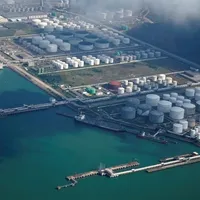
An aerial view of the Straits of Hormuz
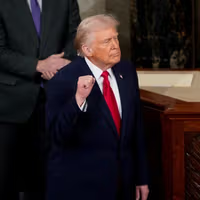
Washington remains committed to keeping the Strait of Hormuz open and preventing “outright enemies” from dominating the Persian Gulf and its energy supplies, US President Trump said in his 2025 National Security Strategy.
The document, published late Thursday, appears to downplay the scale of the threat from Iran and offers only cursory references to Tehran.
“Iran — the region’s chief destabilizing force — has been greatly weakened by Israeli actions since October 7, 2023, and President Trump’s June 2025 Operation Midnight Hammer, which significantly degraded Iran’s nuclear program,” the document reads.
“America will always have core interests in ensuring that Gulf energy supplies do not fall into the hands of an outright enemy, and that the Strait of Hormuz remain open,” it adds.
Iran’s military chiefs have floated the threat of closing the Strait of Hormuz during past standoffs with the West—with the Army and the Revolutionary Guards conducting regular drills in the Persian Gulf.
The NSS 2025 provides almost no detail on Iran’s capabilities or intentions, or what the commitment to keep open the waterway, through which much of the world's energy export flows, would entail.
Mideast peace
The broader chapter recasts the Middle East as a region the United States no longer needs to organise its foreign policy around, arguing that two pillars of past engagement—energy dependence and superpower rivalry—have faded.
The text insists “there is today less to this problem than headlines might lead one to believe,” asserting that Iran’s weakening has reduced regional instability.
Perhaps its sharpest ideological marker is a rejection of US pressure on authoritarian partners.
Earlier efforts challenging the Arab monarchies, NSS argues, were “misguided experiment with hectoring these nations,” adding that the Trump administration will “accept the region, its leaders, and its nations as they are while working together on areas of common interest.”
The text concludes that the Middle East “is no longer the constant irritant, and potential source of imminent catastrophe, that it once was,” crediting Trump for his ability “to unite the Arab world” and allowing the United States to “finally prioritize American interests.”
Iran’s national team coach Ardeshir Amir Ghalenoei has arrived in Washington with part of the country’s football delegation ahead of Friday’s World Cup draw, FIFA said.
In a response to Iran International, FIFA said it “welcomed the arrival of the Islamic Republic of Iran Football Federation delegation to Washington, DC, including head coach Ardeshir Ghalenoei,” adding that it would continue working with Iran and US authorities to prepare for next summer’s 2026 World Cup, hosted by the United States, Canada and Mexico.
Iran had initially threatened to boycott the ceremony over visa difficulties.
The Islamic Republic of Iran Football Federation applied for nine visas, but a federation spokesman said the United States granted four, including one for Ghalenoei. Federation president Mehdi Taj was among those denied entry.
Iran qualified earlier this year through the Asian tournament and will learn their group-stage opponents at the draw later on Friday at the John F. Kennedy Center for the Performing Arts.
The team has now reached its seventh World Cup and its fourth in a row. Their arrival in the US comes against the backdrop of longstanding entry restrictions that continue to shape travel rules for Iranian nationals.
White House: team allowed, fans likely not
The White House on Wednesday said Iran’s national team will be permitted to enter the United States for the World Cup, but suggested Iranian fans will remain barred under existing travel restrictions.
“The President has, in his executive order, certainly named Iran as one of the countries whose teams will be exempt to come here,” said Andrew Giuliani, head of the White House task force on the World Cup.
Pressed on whether US immigration authorities might conduct raids at matches, Giuliani added that “the President does not rule out anything that will help make American citizens safer.”
US travel rules in the spotlight
The US has kept tight visa controls on Iranians for decades, and in June President Donald Trump signed an executive order barring entry for citizens of 12 countries, including Iran, citing security concerns. The measure is meant to exempt athletes and coaching staff attending the World Cup and the 2028 Olympics, though the visa process has remained restrictive.
The administration has also announced a separate review of green cards issued to immigrants from 19 countries, including Iran.
The review followed an incident in Washington DC in which an Afghan national — who had arrived under a special immigration program after the US withdrawal from Afghanistan — shot two National Guard troops, killing one and leaving the other gravely injured.
Iran’s Revolutionary Guards began the second phase of a naval drill with volleys of ballistic and cruise missiles aimed at targets in the Oman Sea, state media reported on Friday.
Qadr 110, Qadr 380 and Qadir cruise missiles, along with the 303 ballistic missile, were fired from locations inside Iran and struck preselected targets at sea, according to the state media. Drone units also carried out attacks on simulated enemy bases, and naval air defense systems practiced responses to aerial threats against fast boats and coastal positions.
The exercise is taking place in the Persian Gulf, the Strait of Hormuz and around Iran’s southern islands, waters where Iranian officials have at times said traffic could be restricted during periods of tension.
The IRGC Navy has said the drill is named after Mohammad Nazeri, a commander and founder of the force’s special operations unit who was killed in 2016. Earlier this week, the navy announced the exercise would run for two days and extend across the Persian Gulf, the Strait of Hormuz, the Oman Sea and nearby islands.
Officials say the drill includes testing combat systems, electronic warfare defenses and operations in simulated wartime conditions.
The naval drill follows Sahand 2025, a five day counter terrorism exercise led by IRGC Ground Forces in East Azarbaijan province under the Shanghai Cooperation Organization framework. That drill was designed with support from Iran’s foreign ministry and the SCO’s Regional Anti Terrorist Structure and focuses on what the bloc calls terrorism, separatism and extremism.
Iranian lawmaker Fada-Hossein Maleki said on Friday that the United States has sent messages indicating interest in negotiations, but Tehran has no plans to engage.
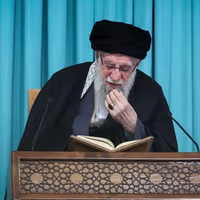
He told the outlet Didban Iran that “the remarks of the Supreme Leader about negotiations with the US are the final word,” adding that “we tried every path, but in the end it led to war and the wall of distrust only grew higher.”
Maleki said messages had arrived “through different channels,” but insisted Iran does not view Washington as a reliable counterpart. “The Americans want to dictate their positions. We want negotiations that secure our rights, not talks that follow their script,” he said.
Preconditions at the heart of the standoff
Maleki said one key reason for Iran’s rejection of talks is Washington’s insistence on sweeping concessions, including halting uranium enrichment. “Zero enrichment is something Iran will never accept,” he said, describing the demand as outside international norms. He added that “no IAEA member state accepts such limits on its own soil.”
Iran International reported last month that President Donald Trump reiterated three preconditions for talks via Saudi Crown Prince Mohammed bin Salman: an end to enrichment, curbs on Iran’s missile program, and halting support for armed allies in the region. Tehran rejects all three as non-starters.
Supreme Leader Ali Khamenei last week denied that Iran had asked Saudi Arabia to mediate, calling reports of outreach “pure lies.” Maleki said lawmakers and Foreign Minister Abbas Araghchi have agreed that Iran should stay aligned with Khamenei’s guidance.
Araghchi had said earlier that Iran remains open to negotiation “when it is real,” but added that Washington is currently “dictating, not negotiating.”
Regional risks and warnings
Maleki said there is a possibility of US or Israeli attacks on armed groups aligned with Iran in Lebanon, Iraq and Yemen, describing Washington and Tel Aviv as increasingly isolated. “They are cornered, and they may act out of desperation,” he said.
He argued that some Arab governments no longer view US guarantees as dependable. “Many in the region see that the American rope is rotten, and those who cling to it will fall to the bottom of the well,” he said.
Maleki said Iran is ready for any escalation. “We are far more prepared than before,” he said, adding that although Iran suffered losses in the opening hours of the recent twelve-day conflict, “the enemy knows our readiness now.”
He said Tehran’s position remains unchanged: “Whenever the Americans enter real negotiations — give and take — and prove good faith, we have no problem. But imposing preconditions will never be acceptable.”
A poll by the Ronald Reagan Institute released on Thursday indicated broad public support for air strikes launched by the administration of President Donald Trump on three major Iranian nuclear sites on June 22.
“With respect to Iran, the public is not only supportive of the airstrikes conducted last summer, they are keen on several forceful responses to preventing Iran from developing a nuclear device,” the Washington DC-based organization, which is dedicated to advancing the late Republican president's ideals, said in its findings.
The Reagan National Defense Survey, conducted in the last week of October and first week of November by Beacon Research and Shaw & Company, examines American views on threats and US military posture toward allies and adversaries.
“Americans back further economic sanctions 73%, deploying US cyber capabilities 70%, renegotiating the Iranian nuclear deal 66% and even using US military force 54% in the service of thwarting Iran’s nuclear weapons program,” the findings added.
Iran denies seeking a nuclear weapon but Israel, the United States and other Western powers doubt its intentions.
China remains the top perceived US threat 29%," the poll added, "followed by Russia 21% and North Korea 9%, with Iran at 3%."
77% Republican respondents supported the June strikes compared to 39% of Democrats.
“This year’s survey underscores a clear message: Americans believe US leadership is indispensable to global security and peace,” said Roger Zakheim, Director of the Ronald Reagan Institute, said in a statement.
The United States held five rounds of negotiations with Tehran over its disputed nuclear program earlier this year after President Donald Trump set a 60-day ultimatum.
When no agreement was reached, Israel launched a surprise offensive on June 13, followed by US strikes on June 22 targeting key nuclear facilities in Isfahan, Natanz and Fordow.
Israel's quarrel with Iran will end either with a full scale war including a ground invasion or through talks, ex-air force chief Major General Eitan Ben Eliyahu said in an interview with the 103fm radio station on Thursday.
A 12-day Israeli military campaign in June which was capped off with US strikes on Iranian nuclear facilities, he said, had damaged but not finished off Iran's capabilities.
"Perhaps if there is a certain weakness in our attack, it is that we did not eliminate the nuclear program, but we did delay it for many years to come," he said.
"Now either you decide on a total war with Iran, including a ground invasion," he added, "or you go for economic pressure alongside attempts to return to negotiations."
Ben Eliyahu did not specify if he meant Israel or the United States.
Iran and the United States held five rounds of indirect talks in April and May. A sixth was tentatively scheduled for the beginning of June but never occurred as Israel launched its surprise campaign beginning on June 13.
The strikes killed senior nuclear scientists along with hundreds of military personnel and civilians. Iranian counterattacks killed 32 Israeli civilians and an off-duty soldier.
Joining the conflict, the United States attacked three Iranian nuclear sites and Iran responded with missile attacks on a US airbase in Qatar before US President Donald Trump enforced a ceasefire.
Downside of US strikes
Tehran, Ben Eliyahu added, had drawn insight on Israel's defenses in the war and might position itself to wreak greater damage in another conflict.
"At the time, we taught the Iranians what they needed to improve for next time: the number of missiles, the accuracy of the missiles, moving the entire array further east and south, the surprise of these weapons, the depth of dispersion," he said.
Ben Eliyahu lamented that the US strikes, while advancing Israeli war aims, may have deprived Washington of its credibility as a mediator to solve the standoff peacefully.
"The Americans participated in the attack in the 12-Day War. Their participation was essential and effective, but there was also a negative side to it."
"As soon as the Americans participated in the attack, they lost their strength and status as those responsible for the negotiations on the political side, as such a mediator and coordinator. They lost legitimacy, this is a very important thing."
US President Donald Trump and Israeli Prime Minister Benjamin Netanyahu discussed regional issues including Iran on Monday, according to a CNN report, as Israeli defense officials warned that a renewed conflict was possible.