Iranian rights lawyer found dead, sparking allegations of state involvement
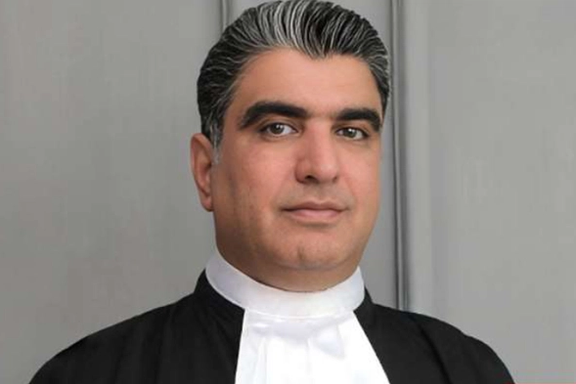
Iranian lawyer and former political prisoner Khosrow Alikordi
Khosrow Alikordi, a 46-year-old prominent lawyer for jailed protesters and a former political prisoner, was found dead under unclear circumstances, prompting some attorneys and activists to suggest possible Islamic Republic involvement.
Alikordi died of cardiac arrest on Friday night in his office in Mashhad, northeastern Iran, according to a report on Saturday by Iranian lawyers news agency (Vokala Press).
His body was transferred to the forensic institute for determination of “the main cause of cardiac arrest,” while police restricted entry to and from the office, according to media reports.
However, fellow lawyer Marzieh Mohebbi wrote on X that Alikordi died from “a blow to the head”, according to what she called "trusted contacts".
Security officers, she said, removed cameras from the area and that access to his family had become impossible.
Mohebbi said the body was discovered inside his office, adding that security forces had taken over the site.
The US-based civil-society group Tavaana relayed a similar account, quoting a witness who said blood was flowing from his mouth when he was found. Another source cited by the group said his skull appeared fractured.
Human rights activist Javad Tavaf also described blood coming from the lawyer’s mouth and nose, saying he had suffered a severe head injury.
Longstanding pressure on a prominent defender
Alikordi, originally from Sabzevar and living in Mashhad, had represented political detainee Fatemeh Sepehri, several people arrested during the 2022 Woman, Life, Freedom protests, and bereaved families including that of Abolfazl Adinezadeh, a teenager killed during protests.
“We find his death highly suspicious and do not believe he died of a heart attack," Abolfazl's sister Marziyeh said in an Instagram post about their lawyer's death.
Some colleagues said he had recently warned clients of new “case building” against him and other activists, and that the intelligence ministry “intended physical elimination.”
Lawyer Babak Paknia posted an image of a conversation with Alikordi in which he said a new case had been filed against him and that authorities “did not leave him alone until the very last moment.”
According to that exchange, Alikordi had been sentenced by the Revolutionary Court to one year in prison, a two-year ban from practicing law and two years of internal exile for joining the “No to Executions Tuesdays” campaign, on charges of “propaganda against the state.”
He had faced previous arrests and in early 2024 received another set of sentences including prison time, exile, travel bans and a prohibition on legal practice.
Tributes evoke a pattern of pressure
Former political prisoner Hossein Ronaghi said the lawyer resisted “countless pressures and threats,” adding that many deaths labeled “natural” in recent years were in fact the result of sustained coercion.
“Recent suspicious deaths testify to the disorder governing our country,” he wrote.
Dozens of users on social media went further, directly attributing the death to the Islamic Republic and calling it a “state killing.”
The circumstances remain under official investigation, though the accounts circulating among lawyers and activists have intensified scrutiny of his death and revived warnings over the risks faced by attorneys defending political cases.
Gulf Cooperation Council Secretary-General Jasem Mohamed Albudaiwi urged Iran to take to build trust with its neighbors and stop policies that undermine stability in the Middle East.
“Nobody in the GCC wants Iran to go down the drain,” Albudaiwi said at a panel titled Iran and the Changing Regional Security Environment during the Doha Forum 2025.
“We are here to talk about the present and the future – how to make our region as peaceful, as stable, as prosperous as possible along with our brothers and sisters in Iran.”
He said the GCC seeks a cooperative relationship with Iran based on dialogue, respect for the UN Charter, and non-interference in regional affairs. “We need to take the right steps towards trust-building measures,” he said.
“But there are really serious measures that we would like our brothers in Iran to take. The policies that Iran sometimes take really shake the stability of the region.”
Albudaiwi cited Iran’s support for Yemen’s Houthi group as an example of destabilizing activity and said Arab states astride the Persian Gulf had already taken steps toward de-escalation, including Saudi Arabia’s 2023 normalization agreement with Tehran and mediation efforts by Oman.
“We have put the right steps toward Iran,” he said. “What the GCC wants from Iran is simple and basic – like any normal neighborhood.”
He described Iran as part of the region’s shared culture and history but said progress required concrete change. “Iran is our neighbor, our history, our culture,” Albudaiwi said. “We have so much to share with Iran. It’s the present and the future that we should concentrate on.”
Meanwhile former Iranian foreign minister Mohammad Javad Zarif said Iran remains resilient despite recent challenges, stressing that the country has endured hardship throughout its history.
“We’ve had our ups, and certainly today is not one of our ups,” Zarif said at the Doha Forum. “Iran has gone through storms for almost seven millennia – we’ve been invaded, we’ve been occupied, but we never went down the drain. We are still standing up and we will continue to stand up.”
The commander of Iran’s Revolutionary Guard Navy said a new missile tested during this week’s naval exercises has a range exceeding the length of the Persian Gulf, without specifying the exact distance.
“The Persian Gulf is 1,375 kilometers long – this missile’s range is beyond that,” Rear Admiral Alireza Tangsiri said in an interview with state television. He added that the weapon, built by the IRGC Navy, is fully indigenous and “can be guided after launch.”
His remarks came as the IRGC carried out the second phase of its naval drill, which began Thursday with ballistic and cruise missile fire at targets in the Oman Sea. State media said the exercise also included drone operations and air defense maneuvers around the Strait of Hormuz and Iran’s southern islands.
Tangsiri said all weapons used in the drill were domestically made, including a new ballistic missile with “very high precision.” “Our enemies have seen its accuracy,” he said.
Iran’s missiles have a declared range of up to 2,000 kilometers, which officials say is sufficient for deterrence and covers Israel. The United States and its allies have called on Tehran to restrict missile development to under 500 kilometers, a demand Iran has repeatedly rejected.
Iran and Russia have signed a new cooperation agreement on artificial intelligence and cybersecurity, Iranian state media reported, expanding their technology partnership as both countries deepen strategic ties under Western sanctions.
The agreement was reached at the fifth meeting of the Iran–Russia Joint Working Group on Communications and Information Technology, held in Moscow, according to the Iranian broadcaster IRIB.
The document was signed by Meysam Abedi, Iran’s deputy minister of communications for technology and innovation, and Alexander Shoitov, Russia’s deputy minister of digital development, communications and mass media.
The accord covers cooperation in artificial intelligence, cybersecurity, digital economy, smart government, blockchain and fintech, as well as technology parks and private-sector partnerships.
Abedi said the signing confirmed “the determination of both governments to expand cooperation in communications and information technology.” He said joint work would continue on data transit, e-government, and developing AI tools, adding that both countries aim to use each other’s experience to deliver “better products and services” to their citizens.
The new agreement follows the ratification of a 20-year strategic partnership between Iran and Russia earlier this year. That treaty, originally signed by Presidents Masoud Pezeshkian and Vladimir Putin in January, commits the two nations to closer coordination in defense, trade, and technology.
Iran’s parliament approved the pact in May with broad support. Lawmaker Hamid Rasai said it was “vital from economic, security, geopolitical, and diplomatic perspectives,” noting that both Tehran and Moscow face heavy Western sanctions.
Iran’s soil is nearing bankruptcy, a senior agriculture official warned on Saturday, saying the country’s food production outlook will sharply deteriorate without urgent intervention.
Widespread awareness has not translated into action, Hadi Asadi-Rahmani, head of the Soil and Water Research Institute of Iran said at the World Soil Day conference in Ghazvin.
“We all know Iran’s soil is growing poorer, and without urgent action, the future of food production will face serious risk,” Asadi-Rahmani added.
Iran has 165 million hectares of land, of which only 24 million are arable. Half of national crop output, Asadi-Rahmani said, now comes from class-three and class-four lands.
He warned that continuous extraction, insufficient fertilizer inputs and erosion are pushing the country toward a structural crisis. “Seventy-five percent of Iran’s soils have less than one percent organic carbon,” he noted. “This shows how exhausted our soils have become.”
Roughly 30,000 hectares of land, according to him, degrade each year, reflecting patterns similar to the country’s water crisis.
Water authorities warn of parallel emergency
Iran is in its sixth consecutive year of drought, Arash Kordi, deputy minister of energy, also said on Saturday.
“Even with normal rainfall, current extraction patterns have no compatibility with Iran’s climate,” Kordi added.
“Delaying reforms directly threatens people’s livelihoods and the foundations of the country.”
Specialists warn of shrinking reserves
Dry conditions have pushed reservoirs in several provinces to record lows. Officials in the religious city of Mashhad have moved to full rationing, and parts of Kerman in the south report farmland abandonment linked to groundwater loss. Nationwide rainfall has dropped to about 18 percent of typical levels.
The twin crises of soil depletion and water scarcity, officials said, now reinforce one another. Asadi-Rahmani warned that postponing decisions would make damages irreversible.
Experts blame decades of over-extraction, unchecked urban growth and placing water-hungry industries in the desert – alongside drier weather – for pushing groundwater sources and lakes to the brink.
The editor-in-chief of Iran’s hardline daily Kayhan, overseen by Supreme Leader Ali Khamenei, said Bahrain’s “main demand” is reunification with Iran, stepping up Tehran’s response to a recent GCC statement on the three disputed Persian Gulf islands.
Hossein Shariatmadari wrote that Bahrainis seek a “return to the main and mother homeland,” going beyond Iran’s usual rejection of GCC references to Abu Musa and the Greater and Lesser Tunbs.
“This undeniable right of Iran and the people of its separated province cannot and should not be ignored,” he said.
His remarks followed a GCC communiqué issued Wednesday that reaffirmed support for Emirati claims over the islands and called for negotiations or referral to the International Court of Justice. Such statements often prompt formal Iranian protests or diplomatic summonses.
Kayhan links GCC stance to foreign alignment
Shariatmadari accused Persian Gulf states of acting under Western pressure and cited 19th-century British maps to argue Iran’s continuous sovereignty over the islands. He described Bahrain’s separation as a result of foreign intervention and said consultations with tribal leaders did not amount to a true referendum.
His remarks ventured beyond standard Iranian diplomatic messaging, which generally restricts itself to sovereignty claims dating to 1971 and rejects third-party arbitration. By reviving the Bahrain question – largely absent from formal diplomacy for decades – the column broadened the dispute at a moment when GCC statements increasingly pair the islands with Saudi-Kuwaiti positions on the offshore Arash/Durra gas field.
GCC communiqués regularly reprise both issues, while Iran emphasizes territorial “red lines” and warns neighbors against what Tehran describes as misreading its posture in the Persian Gulf.