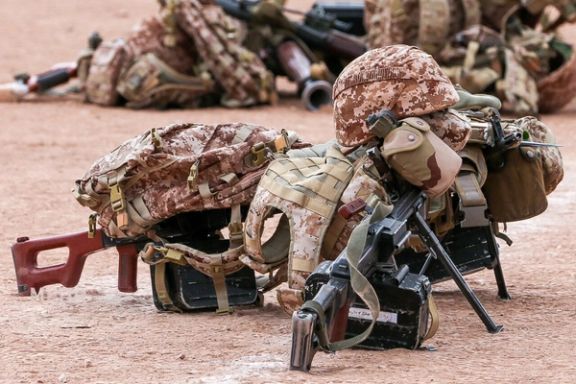
Armed group claims deadly attack on Guards members in southeast Iran
A Baluch armed group said it carried out an attack on Iran's Revolutionary Guards personnel near Zahedan, a day after Iranian state media reported that several members had been killed during a border security mission in the restive southeast.
Haalvsh, a rights group that documents abuses and unrest in Sistan-Baluchestan, said the Jebhe-ye Mobaarezin-e Mardomi (People’s Fighters Front) claimed responsibility in a statement posted overnight. The group said it targeted a convoy of the IRGC’s Imam Hossein battalion, part of the Salman Brigade, in the Lar district on Wednesday.
A spokesman for the group said the attack was meant as retaliation for what it described as the role of security forces in suppressing residents in Sistan-Baluchestan. He said a vehicle carrying the unit’s commander was struck and that four members were killed and several others wounded.
State-linked media initially reported three dead and three wounded but later said the death toll had risen to four. Haalvsh cited local sources as saying the gunfire occurred as several IRGC vehicles were heading toward their base in the Lar area.
Iran’s southeast, bordering Pakistan and Afghanistan, has long experienced armed attacks on security forces and government sites. The region has seen repeated incidents this year, including a major assault on a courthouse in Zahedan earlier in which nine people were killed. A separate Baluch Sunni militant group, Jaish al-Adl, claimed responsibility for that attack.
Authorities said pursuit operations were underway following Wednesday’s shooting, but have released few details so far.
Three Iranian satellites will be launched aboard a Russian Soyuz rocket from the Vostochny Cosmodrome on December 28, Iran’s Nour news agency reported, marking another step in Tehran’s expanding space program.
Nour News, linked to Iran's security establishment, said the satellites will support agriculture, natural resources management and environmental monitoring. Russia last carried an Iranian-made telecommunications satellite into orbit in July.
The announcement follows comments last month by Hassan Salarieh, head of the Iranian Space Agency, who said Iran is preparing to launch three Earth-observation satellites — Zafar-2, Paya and a new batch of Kosar imaging satellites — and conduct its first test launch from the new Chabahar Space Center.
Salarieh said Iran had advanced to developing satellites with imaging resolutions of one meter and below, and described Chabahar, a coastal site in the southeast, as an emerging launch hub able to support heavier liquid-fuel rockets.
He said the center would eventually serve as Iran’s main space gateway, with a position suited for placing satellites into sun-synchronous and geostationary orbits. Iran has also signed private-sector contracts for satellite constellations and highlighted recent launches aboard Russian rockets.
Iran says its space program is civilian and scientific, though Western governments argue that technologies used for satellite launches can support long-range missile development. President Masoud Pezeshkian has said Iran’s missile and space capabilities bolster national deterrence.
US Senator John Fetterman advocated attacking Iran again if it resumes uranium enrichment, aligning himself with President Donald Trump and cementing his status as a leading foreign policy hawk among Democrats.
Speaking at The Jerusalem Post Conference in Washington DC on Wednesday, Fetterman questioned Iran’s official line that its nuclear program is entirely peaceful.
“There is no peaceful purpose for ninety percent enriched uranium,” he said. “If Iran continues, I will consistently support attacking and destroying those facilities.”
The UN nuclear watchdog has not reported such levels of enrichment, though its experts warned this year that Iran’s stockpile of 60 percent material can be further purified to weapons grade with relative ease.
Fetterman’s remarks come months after surprise US strikes on three Iranian nuclear sites on June 22, which Trump says “obliterated” its enrichment capability. Trump has vowed to attack Iran again should it revive nuclear activity.
Iranian officials have also confirmed damage to the facilities but the extent of damage has not been independently assessed and some Democratic members of Congress have challenged Trump’s assertion.
Fetterman described the strikes as necessary deterrence against the United States’ arch-foe in the region.
“I was the only Democrat calling to bomb the nuclear facilities as well,” he added.
‘All in’
Elsewhere in his interview, Fetterman reiterated his unyielding support for Israel, especially after the October 7, 2023 Hamas-led attack which he called a defining moment.
“If the shit hits the fan,” he said, “I would go all in with Israel. And I meant it.”
The Pennsylvania senator, who was honored this year by the World Jewish Congress for his support of Israel, has often faced criticism from within the Democratic Party which has been divided over policy on Israel.
He hit back at colleagues who refused to attend Prime Minister Benjamin Netanyahu’s speech to Congress earlier this year.
“When the prime minister spoke to Congress and people turned their backs on him, that was astonishing,” he said. “That was outlandish.”
The head of Iran's state broadcaster conceded the network hurt its credibility with a false report on the downing of an Israeli F-35 fighter jet which cited an official source during a June war.
“In the F-35 fighter jet crash case, an official informed us it had happened, and we reported it exactly as given,” Peyman Jebeli, head of the Islamic Republic of Iran Broadcasting (IRIB), said in a speech at Shahid Beheshti University in Tehran on Tuesday.
“Were we in the sky to know an F-35 had crashed? Were we behind the air defenses to know we hit an F-35? An official military authority informed us that it had happened, and we reflected it exactly as given. Later, for some reasons, they realized the information was not reliable,” he added.
Peyman Jebeli, head of the Islamic Republic of Iran Broadcasting (IRIB), File photo.
On June 13, news spread in Iranian media that Iran had targeted an Israeli F-35 fighter jet and captured the Israeli female pilot. Locations such as Varamin, Tabriz and Kermanshah were cited as crash sites. Israel swiftly denied the reports.
“Yes, the media should not tie its credibility to other institutions, but when vital information is held by them, we have no choice but to operate within that framework,” Jebeli said.
On June 14, state TV aired the news, saying, “The Air Defense Force successfully struck and destroyed two F-35 fighter jets of the Zionist regime.” More than four days later, IRIB confirmed the report was not correct, offering no further explanation.
Asked about official polls on alleging the buoyant popularity of state TV inside Iran, Jebeli said that no polls had been fabricated but viewership is steadily declining.
“We never claimed our audience surged. The downward trend in viewership has continued since the early 2010s, though its slope has slowed,” he added.
Attorney General Pam Bondi announced on Wednesday that US forces had seized a tanker for shipping oil from Venezuela and Iran, publishing footage of troops rappelling onto the vessel by helicopter.
"Today, the Federal Bureau of Investigation, Homeland Security Investigations, and the United States Coast Guard, with support from the Department of War, executed a seizure warrant for a crude oil tanker used to transport sanctioned oil from Venezuela and Iran," Bondi posted on X.
"For multiple years, the oil tanker has been sanctioned by the United States due to its involvement in an illicit oil shipping network supporting foreign terrorist organizations, she added.
The vessel, is called Skipper but had previously gone by the name Adisa, British maritime risk management group Vanguard reported.
"This seizure, completed off the coast of Venezuela, was conducted safely and securely—and our investigation alongside the Department of Homeland Security to prevent the transport of sanctioned oil continues," Bondi said.
A 2022 US Treasury sanctions notice said a Gulf-based businessman, Viktor Artemov along with other individuals were involved in a network "to illegally transport Iranian oil abroad and procure funds on behalf of Hizballah and the IRGC-QF," referring to the Islamic Revolutionary Guards and its external branch, the Quds Force.
The Adisa was listed among the vessels controlled by Artemov under a front company in which the Treasury said he had a 50% stake, Petro Naviero.
"Artemov used his companies to buy and sell oil tankers that were then used to transport blended Iranian oil on behalf of the oil smuggling network," the Treasury said.
The United States has ramped up a military deployment in the Caribbean as part of a pressure campaign on Venezuela and its leader Nicolas Maduro. US attacks on alleged drug boats there and in the Pacific have killed at least 87 people, in attacks which Democratic opponents and rights groups say violate the laws of war.
US Secretary of State Marco Rubio last week cast Venezuela as a regional platform for Iranian influence, describing Maduro’s government as a narcotics transit hub that hosts Iran’s Revolutionary Guards and its Lebanese ally Hezbollah.
Maduro has rejected US accusations that he runs a narco-terrorist cartel and dismisses the largest American military buildup in the region in decades as an attempt to impose Washington's will on his oil-rich country.
A senior Islamic Revolutionary Guard Corps (IRGC) commander said on Wednesday that US President Donald Trump and Israeli Prime Minister Benjamin Netanyahu blessed an elaborate plot to overthrow the Islamic Republic during a June war.
"On June 14, a meeting was held in one of the European countries—I won’t name it. The meeting lasted 12 hours. All anti-revolutionary elements, agents of American and Israeli services and leaders of the opposition—including separatists, monarchists, and even Islamic State leaders—were present," Major General Ebrahim Jabari, an adviser to the IRGC Commander-in-Chief, told a Tehran conference on Tuesday.
"Under the guidance of Trump and Netanyahu, they planned that if an attack began, these elements would enter our country from various points along the borders," he added, saying the gathering aimed to form "a government-in-exile."
The United States held five rounds of negotiations with Tehran over its disputed nuclear program earlier this year, for which President Donald Trump set a 60-day ultimatum.
When no agreement was reached by the 61st day, Israel launched a surprise military offensive on June 13, followed by US strikes on June 22 targeting key nuclear facilities in Isfahan, Natanz and Fordow.
'Monarchists arrested'
Jabari referred to cases of military defections and said those involved in “running and operating” the plot had been detained.
“Iranian intelligence arrested around 123 ringleaders of a monarchist group called the ‘Javidan Guard' (Immortal Guard). Authorities also detained Christian convert leaders previously recruited by foreign services,” Jabari said.
The Javidan Guard was one of the most elite military units of the ousted Pahlavi dynasty responsible for protecting the Shah, the royal family and major palaces, particularly the Niavaran Palace complex.
Its name was inspired by the Achaemenid-era Immortals, a military grouping which ancient chronicles credit with strength and courage on the battlefield.
In the final months of the monarchy, the Javidan Guard was deployed against protesters amid escalating revolutionary unrest but ultimately was unable to prevent the collapse in 1979 and the victory of the Islamic Revolution.
“The plot is part of a long-term plan by the US and Israel. Preparations began 22 years ago and intensified eight years ago through recruitment of domestic rabble,” Jabari said.
Videos circulating last month on social media showed a man introducing himself as Colonel Ebrahim Aghaei Kamazani, delivering a speech to the people of Iran and calling on them to overthrow their leaders.
“We too are playing a role in the country's destruction through our indifference. Rise up on November 25. People, hear your son's voice. Long live the Shah; long live Iran,” he said. It was not clear if the appeal was new or he was a genuine military officer.
‘Recruiting thugs’
Jabari said agents were recruited inside Iran after training abroad before returning as operational agents.
“These individuals were taken to Turkey, Dubai, Qatar and other countries for political courses and training costing up to $25,000 per person, with corruption and immorality used as bait,” he asserted.
“Israel previously assassinated Iranian nuclear scientists directly but now uses Iranian ‘thugs’ trained abroad.”
Since at least 2010, Israel has allegedly conducted dozens of attacks inside Iran, targeting sensitive nuclear and military installations and carrying out assassinations of individuals deemed a threat.
These attacks intensified after July 2020, when an explosion at the Natanz uranium enrichment site destroyed a building.
In November that year, Mohsen Fakhrizadeh, a key figure in Iran’s nuclear program, was assassinated in a roadside attack near Tehran.
Western and Israeli intelligence had long suspected Fakhrizadeh of being the architect of Iran’s covert nuclear weapons program.
Israeli attacks in June killed over 20 senior commanders, including Mohammad Bagheri, Chief of Staff of Iran's Armed Forces; Hossein Salami, Islamic Revolutionary Guards Corps (IRGC) Commander-in-chief; and Gholamali Rashid, Head of Khatam al-Anbiya Central Headquarters.
Along with hundreds of military personnel killed, the Israeli strikes killed hundreds of civilians. Iranian counterattacks killed 32 Israeli civilians and an off-duty soldier.