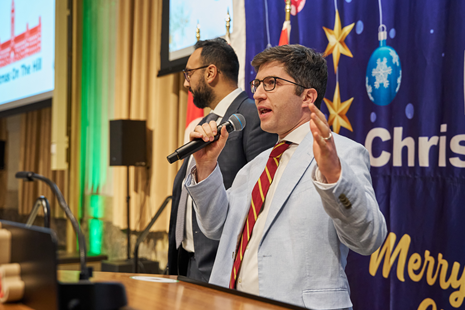
Canadian conservative MP Garnett Genuis gestures in this image from his official social media handle published December 12, 2025
Member of the Canadian Parliament Garnett Genuis told Iran International the government failed to protect people forced into conscription by Iran’s Islamic Revolutionary Guard Corps (IRGC) when it listed the group a terrorist organization last year.
Genuis, who has advocated for proscription of the IRGC since 2018, said the Liberal government "was dragged kicking and screaming" to the decision and then failed to safeguard those ensnared by Iran’s mandatory conscription laws.
“We shouldn’t be punishing victims of forced conscription,” Genuis said. “We should target those who voluntarily joined or stayed, and those who committed atrocities.”
Canada told Iran International in November it does not automatically reject Iranian men’s permanent residency applications solely for compulsory IRGC service, after a conscript said he was ruled inadmissible for his involuntary service.
Genuis highlighted a bill he backed proposing to amend Canada’s Immigration and Refugee Protection Act (IRPA) to exempt individuals required to serve in a terrorist organization if they met three criteria of completing only the mandatory period, not remaining voluntarily and not participating in terrorist acts or atrocities.
The bill, he said, addressed concerns the Liberals had raised for years yet the government did not adopt it after the IRGC listing.
Last month a Federal Court dismissed an appeal by 40-year-old Iranian asylum seeker Mohammadreza Vadiati’s against the denial of permanent residency despite completing only mandatory IRGC service from 2006 to 2008 in non-combat roles.
‘Required’ not ‘forced’
Genuis criticized Canadian authorities for narrowly interpreting “forced conscription,” often requiring proof of imminent danger to life or health, while his bill deliberately used “required” instead of “forced.”
“If the law says you must do something, that is a requirement, consequences of refusal in Iran — including imprisonment — should be contextualized,” he added.
In a written response to Iran International, Immigration, Refugees and Citizenship Canada (IRCC) said conscription alone does not automatically render someone inadmissible. However, critics say guidance remains vague, allowing excessive officer discretion.
“In the absence of clarity in the law, there is a real risk of wildly inconsistent decisions,” Genuis said, warning similarly situated applicants could face vastly different outcomes.
Under Canada’s anti-terrorism laws, membership in or support for a listed terrorist entity can result in inadmissibility, asset freezes, and criminal penalties.
“The government could easily adopt the exemption via its own legislation — the simplest and fastest solution,” he said. “The Conservatives put forward the solution, the government should implement it.”
The listing of the IRGC – which Canada blames for human rights abuses and the 2020 downing of a civilian airliner PS752 in 2020 – has broad implications for thousands of Iranian nationals who performed compulsory service.
Genuis said listing the IRGC was necessary but innocent people must be spared.
“The IRGC needed to be listed and needs to remain listed,” he said. “But it was never a choice between doing it badly or not doing it at all. We showed how to do it right.”
Genuis also criticized the Liberal government’s record on foreign interference and transnational repression, warning Iranian government-linked threats remain active in Canada.
New Google algorithms for YouTube are more accurately detecting virtual private networks which mask user locations and are reclassifying most traffic as originating from Iran where ad rates are minimal.
Prominent creators have reported revenue drops of as much as 90% in December.
Previously, RPM (revenue per 1,000 views) for Iranian content creators averaged $3-11 but has now fallen to between 20 cents and $1 for many channels, Shargh Daily reported on Tuesday.
Gaming YouTuber Aria Keoxer reported earning just $400 from a video with 400,000 views, down from thousands previously, the report said.
The changes stem from improved detection of VPN-spoofed locations, treating most views as originating from Iran, whose market advertisers rarely seek out due to stiff Western sanctions.
Users in Iran also use VPNs to sidestep broad official censorship of the internet.
While not all channels are equally affected - some report only 20% declines - the shift threatens the viability of Iranian content production, pushing creators toward sponsorships or alternative platforms.
“The income of Persian YouTube channels has practically dropped to zero," one account said on X. "Since last week, YouTube in its new update doesn't even show ads to those who connect from inside Iran using a VPN, and this means that the previous method of making money through monetization no longer works.”
“The result is that Persian channels without sponsors have practically reached the end of the line, continuing has become very difficult for them, and for some of them, continuing activities are no longer worthwhile!" it added.
An official YouTube statement on the changes in December did not mention Iran.
The country's digital marketing sector has grown modestly despite sanctions. E-commerce revenue stood at $15-16 billion in 2025 and had grown up to 12% annually, analysis site Statista reported.
Social media advertising in Iran has hit about $430 million each year driven by local platforms like Instagram and Telegram as well as apps like retail hub Digikala and ride-hailing platform Snapp.
Iran's President Masoud Pezeshkian has repeatedly promised to lift government censorship over the internet, a key pledge of his 2024 presidential campaign, but has made little headway.
Public anger intensified after revelations of so-called white SIM cards providing unfettered access to privileged insiders, which critics say contradicts government rhetoric about digital equality.
The digital and e-commerce economy in Iran faced a huge blow during a 12-day war in June with Israel, when Tehran briefly shuttered the internet entirely in what authorities called an effort to foil Israeli espionage but dissidents said aimed at free expression.
A lawsuit filed in a Texas state court accuses top American chip-making companies of failing to stop their technology from being diverted into Iranian and Russian weapons used in attacks on Ukrainian civilians.
The lawsuit names Texas Instruments, AMD and Intel, accusing the companies of allowing tiny computer chips they produced to reach - what the plaintiffs refer to as - hostile countries through weak oversight of global supply chains.
The companies did not immediately respond to an Iran International request for comment.
Filed by Watts Law Firm LLP and BakerHostetler LLP, the case represents Ukrainian civilians and families who say they lost loved ones or suffered serious injuries during drone and missile attacks. The plaintiffs are seeking damages for wrongful death, physical injury and psychological trauma.
The chips, they added, were later found in drones and missiles used by Russia and Iran in strikes that killed and injured civilians in Ukraine.
Iran has supplied drones and other military support to Russia since Moscow’s full-scale invasion of Ukraine. Tehran and Moscow are both heavily sanctioned by the United States, in curbs aimed at sapping their ability to project military power.
The complaint alleges the companies failed to take reasonable steps to prevent their products from reaching sanctioned actors, despite years of public warnings from governments, journalists and international watchdogs.
US export control laws are designed to stop sensitive technology from being diverted into foreign weapons programs and the lawsuit claims those safeguards were ignored.
According to the filing, American-made chips were identified in Iranian-manufactured Shahed drones and in Russian missiles used to strike residential areas and civilian infrastructure in Ukraine.
The Shahed has helped define the Ukrainian battlespace and the United States announced this month it had copied elements of the kamikaze drone and deployed it to the Middle East, in a move which drew pride and mockery in Tehran.
Plaintiffs argue the companies continued selling chips through distributors and online channels they knew were vulnerable to diversion. The complaint says sales continued even after reports showed US technology repeatedly appearing in Iranian and Russian weapons systems.
The companies named in the lawsuit have previously said they comply with US export controls and sanctions and do not sell products directly to Iran or Russia. The defendants have not yet responded publicly to the specific allegations in the new lawsuit and its merits have not yet been tested in court.
The lawsuit does not allege the companies intentionally supplied weapons programs but argues they knowingly failed to prevent foreseeable harm caused by the misuse of their technology.
Citing Texas tort law covering negligence, gross negligence and wrongful death, the lawsuit also argues that violations of US export control and sanctions laws automatically constitute negligence under state law.
The filing cites multiple reports documenting how American electronics ended up in Iranian and Russian weapons. Investigations by US and international research organizations have previously found that a large share of components recovered from Iranian drones used in Ukraine originated from US companies.
The complaint also points to internal warnings.
In the case of Texas Instruments, shareholders reportedly raised concerns about chips appearing in sanctioned markets but the company maintained that full traceability of its products was not achievable. Plaintiffs argue that response showed a failure to strengthen safeguards despite known risks.
David Albright, a prominent physicist and nuclear proliferation expert, posted to X that "Texas instruments has sold its goods to China and it knows they end up in Russian Shahed drones and other military systems."
Iran’s central bank said on Tuesday it had blocked bank the accounts of over 250 people suspected of money laundering a sum amounting to $1.6 billion, as the country attempts to consolidate its financial system amid harsh sanctions.
Central bank spokesperson Mohammad Shirijian said the individuals, using around 6,000 bank accounts, recorded a combined turnover of about 2,100 trillion rials ($1.6 billion).
Shirijian said about 130 trillion rials, or around $100 million, of the total was linked to the bank accounts of a 24-year-old whom he accused of involvement in “disrupting the foreign exchange market.”
He added that the cases of 13 people suspected of "disrupting the banking system and the foreign exchange market" had been referred to the judiciary.
Separately, Revolutionary Guards-affiliated Tasnim News Agency, citing the central bank’s public relations director Mostafa Ghamari Vafa, reported that authorities had identified and blocked the accounts of three individuals, aged 24, 28 and 33, whose transactions totaled about 262 trillion rials ($201 million).
Tasnim said authorities had identified the trail of currency traders linked to the accounts and that the case remains under close surveillance.
Iran’s central bank issued a new directive in late September requiring banks to set annual transaction limits for customers based on their level of financial activity.
Under the directive, the annual transaction cap is set at 200 billion rials ($154,000) for salaried individuals, 50 billion rials ($38,400) for individuals without employment and five billion rials ($3,840) for inactive legal entities.
Shirijian's remarks come as Iran’s currency hit a fresh low on Monday of 1.312 million rials to the US dollar on the open market according to currency-tracking websites, reflecting deep economic woes in the country.
Tehran has sought to boost financial regulation and gain entry into anti-money laundering bodies in a bid to gain greater access to the global banking system as renewed international sanctions have dented its already creaky economy.
But in October the Financial Action Task Force (FATF) rejected Iran's accession, saying Tehran would remain on its list of high-risk countries for failing to fully accept the body's rules on terror financing.
US President Donald Trump’s new National Security Strategy (NSS) signals a more hands-off approach toward Iran and marks a departure from the outlook of his first term, according to veteran Iran-watcher and analyst Behnam Ben Taleblu.
The 2025 National Security Strategy reflects a narrowing of what Washington now defines as its core national interests, Taleblu said, with Iran mentioned just three times despite being labeled a central threat in Trump’s 2017 strategy.
“There’s a focus on the homeland, the Western Hemisphere, strategic competition with China and getting Europe to do more,” said Taleblu, an analyst for the Foundation for Defense of Democracies think tank in Washington DC, adding that Iran is absent from the list of top-tier threats outlined in the document.
The strategy released this month emphasizes reducing US involvement in the Middle East in favor of focusing on great power competition with China, threats in the Western Hemisphere and urging Europe to shoulder more security responsibility.
Iran appears to have slipped down Washington’s priority list following last year’s 12-day war between Israel and Iran, which the United States briefly joined.
“It seems like, at least for the Trump administration, they’re content to take that victory lap,” Taleblu said on Eye for Iran, saying the White House is attempting to declare success and move on following US strikes on Iran’s nuclear facilities.
The NSS suggests Washington is ready to “turn the page” on a region that has dominated US foreign policy for decades, he added, and it credits Trump’s energy policies, regional diplomacy and limited use of force for creating political space to step back from the Middle East.
US strikes on Iran included the use of 30,000-pound bunker-buster bombs carried by B-2 stealth bombers.
While President Trump has said Iran’s major nuclear sites were “obliterated,” US intelligence assessments indicate the program was set back but not completely destroyed, according to officials cited in US media reports.
Iran is believed to possess more than 400 kilograms of highly enriched uranium whose whereabouts remain unknown, and Iranian officials have said they rebuilt its missile capacity and would respond forcefully to any future attack.
“Iran may be weakened, but it is down and not out,” Taleblu added.
The strategy document implies that major regional crises — including the Gaza war, the Israel-Hezbollah conflict in Lebanon, Houthi attacks from Yemen and instability in post-Assad Syria — are either resolved or on track toward resolution.
The document does not appear to assess that Iran could strongly reverse recent setbacks to its nuclear program and its so-called Axis of Resistance coalition.
While Taleblu credited the Trump administration for reviving elements of its maximum pressure campaign of sanctions, he criticized what he called gaps. Iranian oil exports have reached record highs, and the administration has not issued a single new human rights designation related to Iran in 2025.
“While the regime is threatening the life of this very president and the first family, it is beyond me to be thinking about peace and prosperity without a clear strategy to contain Iran further,” Taleblu said, “There is a lot of room for improvement when I look at both this document and the administration’s track record this year.”
A bus crash on the Esfahan-Natanz highway killed 13 people after an intercity coach allegedly veered into the opposite lane and slammed into a taxi on Tuesday, with Iran’s road police blaming suspected driver fatigue for the accident.
Emergency services said two passengers in the taxi and nine bus passengers died shortly after the accident. The crash also injured at least 11 others with multiple traumas, all of whom are currently in urgent care.
The Scania intercity bus, operated by the Royal Safar Isfahan company and travelling from Esfahan toward Tehran, overturned around 22:10 local time near kilometer 80 of the Esfahan–Natanz route, then collided with a passenger car, official media cited local police and provincial officials as saying.
The Iranian Red Crescent said the remaining occupants suffered injuries of varying severity and were taken to hospitals in Natanz, Shahinshahr and Isfahan.
Police account
A senior traffic police official told state media that the preliminary hypothesis is that the driver’s drowsiness and loss of control caused the bus to veer into the opposite lane, overturn and strike the car, but added that the final conclusion will depend on full technical and safety assessments.
Authorities said the scene has been cleared and traffic restored, while forensic and road-safety teams continue to inspect the vehicle, road conditions and possible mechanical factors.
Officials have said that if any negligence by the bus company, driver or other parties is confirmed, the case will be pursued through legal channels.
Iran’s Vice President on Tuesday in Tehran recalled a similar deadly accident in October in northern Iran, rejecting the driver fatigue theory.
“Is the driver to blame, when it’s apparently noted that this accident occurred about 20 minutes after he passed the police station? That would mean drowsiness, which is being raised as the issue, was not involved,” Mohammad Reza Aref said in a speech.
“A few months ago in Semnan we had a similar case, when they were going from the dormitory to class and the same thing happened and students were killed,” he added.
At least 26 students have died in 13 accidents involving university buses across Iran over the past decade, the daily Ham-Mihan reported earlier this year, reviving concerns about road safety and vehicle standards.