Majid Mohammadi
Contributor
Majid Mohammadi is an Iranian-American sociologist and political analyst, who contributes opinion and analysis to Persian, Arabic, and English news outlets. He has published dozens of books.
The prospect of an Israeli attack on Iran has sparked new tensions within Iran’s opposition. Over 360 leftists, woke activists, and former Islamist/religious-nationalist figures have issued a statement titled "No to war, no to the Islamic Republic."

Following Israel's October 4, 2024, strike on Beirut, which targeted Hashem Safiuddin, a potential successor to Hezbollah leader Hassan Nasrallah, speculation has also arisen regarding the status of Ismail Qa’ani, the chief commander of the Quds Force.
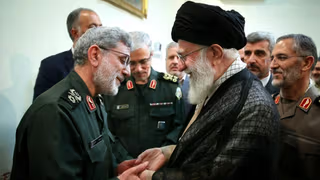
After two months of warnings, Iran’s Islamist government attacked Israel on October 1, 2024, with 200 ballistic missiles. Iranians and Israelis watched as missiles flew over cities, debris falling from the sky after being intercepted.
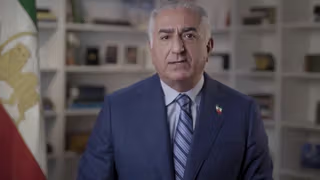
Last week, exiled Iranian Crown Prince Reza Pahlavi outlined his vision for a prosperous Iran post-revolution, but it requires further refinement and expansion to address key aspects of the country's political economy.
Despite Iran’s new president, Masoud Pezeshkian, pledging to end harassment by the notorious 'morality police' over violent hijab enforcement, the parliament has moved forward with passing a new restrictive law.

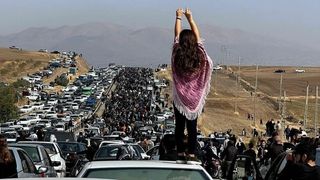
Iran’s Mahsa movement (2022-2023) was a non-violent uprising aimed at overthrowing the Islamic rule established in 1979. The government’s sole response was to suppress the protestors because of the movement’s objective.
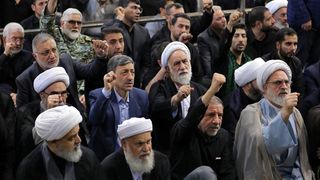
Foreigners are often baffled by the vague, poetic, and indirect way Iranian officials speak, while Iranians, though more accustomed to this style of communication, often find it frustrating as well.
This week, Iran's new president, Masoud Pezeshkian, pledged an "economic surgery" to address the nation’s worsening crisis. With millions of impoverished citizens expecting relief, he faces mounting pressure to deliver reforms.
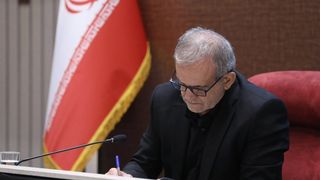
As newly elected President Masoud Pezeshkian formed his cabinet, the country’s Supreme Leader—widely recognized as the ultimate authority in Iran—made a vain effort to appear detached from the selection process.
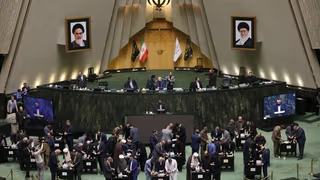
As the Iranian Parliament conducts hearings for President Masoud Pezeshkian’s proposed cabinet, a new wave of strikes has swept across the country, as economic hardship continues for the sixth consecutive year.