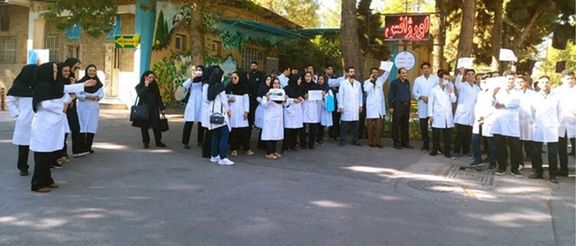
File photo of a demonstration by Iranian medical staff
As the Iranian Parliament conducts hearings for President Masoud Pezeshkian’s proposed cabinet, a new wave of strikes has swept across the country, as economic hardship continues for the sixth consecutive year.
Why aren’t strikes and labor protests in Iran uniting? | Iran International
Nurses in 50 hospitals are leading the charge in terms of the number of strikes, followed by telecom retirees in five provinces, retirees from the banking and social security sectors, and workers from the oil and gas industries. Additionally, farmers in Isfahan have staged a sit-in. The nurses have garnered support from retirees, teachers, and the truckers' union, further amplifying their cause.
When examining the recent history of trade union and non-union protests, a stark contrast emerges between the periods before and after 2017. Since December 2017, labor protests in Iran have evolved from spontaneous, uncoordinated street demonstrations into continuous, well-organized movements characterized by networked communication among similar professions. While various factors—economic, political, social, environmental, and legal—have influenced these protests, economic hardship has played the most significant role.
Amid these street protests, certain recurring slogans resonate: "Our problem is here, yet they blame America," "Retirees, shout for your rights!" "Only in the streets can we claim our rights," "We’ve seen no justice, only lies," and "When it’s our turn, the treasury runs dry."
This piece zeroes in on a single aspect of Iran's socio-economic landscape: why don’t these expressions of discontent coalesce into larger waves of protest against the government, thereby lowering the cost of dissent? The backdrop to this question is the harsh living conditions in Iran, particularly for those dependent on monthly salaries. While annual salary increases hover around 10-20%, inflation rates soar above 40 percent.
Three key factors contribute to this situation: 1) the ongoing cat-and-mouse game between the government and protesters, 2) the lack of strong, comprehensive trade unions and the severe political repercussions for activism—including the threat of imprisonment and even execution—faced by union and labor leaders, and 3) the government’s monopoly over the labor market, which drastically limits opportunities for re-employment.
Unions long disbanded
After shutting down all labor unions in the 1980s, the Islamic government introduced state-funded Islamic labor councils. However, these councils did little for workers, given their reliance on the state. As a result, in the 1990s, some workers and employees began establishing their own unofficial unions. During the last three decades, the government has arrested and imprisoned thousands of union activists for their participation in the establishment of trade unions and even issued a death sentence for some of them, such as the recent death sentence for Sharifeh Mohammadi. The most famous and powerful of these unions are the Drivers' Union of the Tehran Public Transportation, Haft Tappeh Sugar Cane Mill Labor Syndicate, and the Teachers' Union Council.
For this reason, organizing a strike and holding a protest rally in Iran is very difficult and risky. However, between 2020 and 2021, more than 2,500 gatherings (mostly held without permit) were held throughout the country. According to a former Ministry of Interior's spokesperson, during the first term of the Rouhani administration (2013-2017), people in different cities of Iran held about 43 thousand gatherings "with or without permission" to pursue their demands in various fields. Even if this number seems unreal, Iranians’ grievances are limitless.
Livelihood issues are deteriorating the quality of life and placing such unbearable pressure on wage earners that workers and employees are willing to endure the risks of repression to take to the streets in protest.
Carrot and stick
One of the Islamic Republic's common tactics for dealing with union and profession-based protests when they spill into the streets involves a combination of harsh threats, such as dismissal and imprisonment, alongside small concessions to placate some protesters. For instance, during the pensioners' protests coinciding with the presidential election, the government paid 3 million tomans ($50) into their accounts—far short of the additional salary they legally demanded. This tactic appeased a portion of the protesters, causing the movement to lose momentum. The widespread teachers' protests in recent months were handled similarly, with mass arrests and the payment of one month’s extra salary to retiring teachers and assistant teachers, which helped to quell the unrest.
Risk of permanent unemployment
The government in Iran is the largest employer, with about eighty percent of the economy controlled by three powerful economic entities under the supervision of the Leader’s office, the IRGC, and state-owned companies. Beyond these, public resources are managed by the government, and most public services are state-owned. In this environment, anyone dismissed for organizing or participating in a trade union must effectively say goodbye to the public sector—and likely to stable employment as well. The government and these economic empires act like a giant gatekeeper, monopolizing the job market, enforcing ideological hiring practices, and making intimidation easy.
The pressing issue of the energy crisis, which has reached a tipping point, took center stage in the Wednesday parliamentary hearings for President Masoud Pezeshkian's cabinet approval.
Lawmaker Hamidreza Goudarzi described the ongoing energy shortfall and frequent water and electricity outages as a "critical crisis for the Islamic Republic." He warned that this issue is on the verge of inflicting serious damage on the industrial sector and further fueling public discontent.
Mansour Alimardani, the representative from Abhar, referred to the frequent power outages in industrial zones, "The power cuts have devastated many industrialists."
The main reason for lack of power in a country that has the second largest natural gas reserves in the world is lack of investments and inefficiency in management. Iran is deprived of foreign investments due to its confrontational foreign policy and a nuclear program deemed dangerous by many countries. The government also fails to invest in infrastructure, prioritizing the military and foreign adventures.
MP Mohsen Biglari observed, "Throughout this sweltering summer, we have endured consistent household power outages, with agricultural electricity being disrupted for five to six hours daily. Given these circumstances, can we genuinely expect a surge in agricultural production? Furthermore, 40% of our villages lack access to household water supply networks; even among those connected, more than half rely on severely outdated plumbing systems."
Abbas Aliabadi, the proposed Minister of Energy, also identified electricity and water shortages as a fundamental governance issue, asserting that it transcends the mere effects of seasonal heat. He projected that, based on current estimates, the annual shortfall in electricity could surpass 18,000 megawatts.
Aliabadi also highlighted that the National Development Fund has deprioritized investments in the electricity sector, noting that the Ministry of Energy's accumulated obligations have led to significant losses for previous investors, deterring new investments.
The ministerial nominee opposed the "burdensome government bureaucracy," underscoring that "the government should not, and cannot, serve as the primary executor."
On the issue of water, Aliabadi pointed out that the current negative water balance stands at six billion cubic meters annually. He issued a stern warning: "The water situation is critical. We are at a tipping point, and continuing this trajectory is untenable."
Despite the discussions, no substantive solutions were proposed. The only measure presented as a remedy was Aliabadi’s pledge to "empower citizens to sell their electricity quotas in a competitive market." He explained that individuals would have the option to either consume their electricity or sell it at premium international or industrial rates, thereby realizing the true value of their assets. However, this presupposes a reliable supply of electricity—a currently unmet condition.
In recent years, the Islamic government has consistently struggled to meet the nation's electricity demands, with recurrent failures plunging hundreds of cities and villages into darkness each summer. This year, however, the situation has reached a critical inflection point, as the frequency and duration of blackouts have escalated, reflecting an increasingly stark disparity between supply and demand.
On Tuesday, an Iranian lawmaker, defending the proposed minister of science, stated that the nominee is 'fervently loyal' to the core principles of the establishment and fully aligned with Supreme Leader's directives.
This mode of defense has become central to the parliamentary hearings, where legislators are tasked with ratifying the ministerial appointments made by the newly elected president, Masoud Pezeshkian.
In theory, the president and his cabinet are required to present a comprehensive governance agenda. In practice, however, the discourse has largely bypassed substantive policy discussions, focusing instead on the ministers' loyalty and compliance, especially their willingness to align with Ali Khamenei's directives.
Contrary to parliamentary expectations, Pezeshkian has not presented a detailed road map for his administration. Instead, he has merely cited the Seventh Development Plan—a continuation of the framework approved during Ebrahim Raisi's tenure in November 2023—and reiterated his commitment to the policies endorsed by Khamenei. Critics say that the Seventh Plan itself is an unrealistic document, full of economic wishes that simply cannot be realized. It is the continuation of the previous failed plan.
Iran's Sixth Five-Year National Development Plan, originally slated to conclude in 2021, was extended to mid-2024 due to its failure to achieve its intended economic objectives. According to an analysis by the Parliament Research Center, only 30% of the plan was partially implemented, 40% remained unaddressed, and the remaining 30% could not be accurately assessed. Despite its formal approval, the parliament has deemed the latest plan deficient.
Pezeshkian's strategy appears to be a mere perpetuation of this existing plan, coupled with a vague adherence to Khamenei’s orders, devoid of any substantive detail. MPs defending the proposed ministers similarly lean on this rationale, equating loyalty to the establishment with a sound governance strategy, effectively rebranding familiar rhetoric as policy.
While the overwhelming majority of the proposed ministers are expected to receive parliament’s endorsement—dominated as it is by hardline factions—there have nonetheless been murmurs of discontent within the legislative body.
In their addresses, a few dissenting MPs expressed concerns that Pezeshkian has failed to present an independent policy framework separate from the Seventh Development Plan, limiting the scope for meaningful debate or opposition.
Alireza Salimi, a Tehran representative, took issue with Pezeshkian's approach, noting that he has merely reiterated the Seventh Development Plan as his own rather than offering a novel or detailed strategy. Salimi emphasized, "The Guardian Council has already approved the Seventh Development Plan. Thus, debating support or opposition to it is a futile exercise."
Another parliamentarian, Mehdi Kouchakzadeh, raised a procedural objection, underscoring that the primary objective of the session was to "examine the government’s program." Addressing Mohammad Bagher Ghalibaf, the Speaker of the Parliament, the lawmaker, inquired, "Has Pezeshkian’s plan been submitted to you for dissemination among us?"
He further highlighted that Pezeshkian has claimed his agenda is grounded in the Nahj al-Balagha—a centuries-old compilation of sermons, letters, and sayings attributed to the first Shia Imam, Ali, which Pezeshkian often recites in Arabic—and the vision of the Supreme Leader. Kouchakzadeh then provocatively questioned, "Are the dissenting MPs opposing the Nahj al-Balagha and the Seventh Development Plan?"
An expert from an institute affiliated with Iran's Ministry of Oil has raised concerns about the country's oil dealings with China, revealing that these transactions bring minimal financial returns for Iran.
"Today, we are selling oil under deplorable conditions—at low prices with steep discounts—and in return, we are importing substandard Chinese goods at best," Morteza Behrouzifar from the Institute of International Energy Studies remarked in a candid discussion with a local website about the ongoing challenges facing Iran’s oil industry.
In an interview with ILNA, Behrouzifar further highlighted that Iran's current situation leaves it heavily reliant on China, which poses significant risks to the nation's economic sovereignty. This starkly contrasts with official claims that Iran sells crude oil to 17 nations, including some in Europe.
The expert also criticized the broader strategic missteps within the oil sector, describing them as rooted in "showmanship" rather than substantive achievements.
Over the past three years, he said there have been claims of massive foreign economic contracts—exceeding $100 billion—but these were often mere memorandums of understanding presented as binding agreements.
He argued that this has led to the depletion of national resources, including the National Development Fund (NDF), without any significant return on investment. "We did not achieve any results proportionate to the money invested," he noted, underscoring the inefficacy of these deals.
NDF, Iran's national wealth fund, is intended to reserve around 30% of oil profits for future generations. However, due to international sanctions and an inefficient economy that have perpetually strained the government's budget, the majority of the over $100 billion in savings has already been depleted.
The most recent instance that could be inferred from his remarks is the May agreement, in which Tehran Municipality discreetly finalized a two-billion-euro contract with a Chinese firm for the import of transport and traffic surveillance equipment, including electric buses. This clandestine deal sparked significant backlash, even among members of the city council.
"The president of the 14th government [Masoud Pezeshkian] must understand that if these conditions continue, the oil industry will not be able to survive," Behrouzifar warned.
Despite US sanctions reinstated in 2018 over Iran's nuclear program, China has continued to purchase Iranian oil, but under conditions that are far from favorable to Iran.
Last July, The Wall Street Journal reported that Iran's crude oil exports had surged to their highest levels in five years, albeit at steep discounts of up to $30 per barrel. The report corroborated estimates indicating that Iran exported 1.6 million barrels per day in May and June, a significant increase from the 250,000 barrels per day recorded in 2019 and 2020, shortly after the US reimposed comprehensive sanctions.
In addition to discounts, China apparently does not pay in cash for most of the oil, because Iran is also under US banking sanctions. Although on paper Iran annual oil revenues reach $35 billion, it is not clear how much hard currency Tehran receives.
China imports Iranian oil through tankers, which avoid detection by operating without transponders. Known as "ghost ships" or "dark fleets," these vessels employ sophisticated methods to conceal their ownership and movements, enabling them to circumvent international sanctions. They partake in high-risk operations such as ship-to-ship transfers in open waters and deactivate Automatic Identification System (AIS) transponders to mask their identities and evade detection.
Once they reach Chinese shores, the oil is rebranded as Malaysian or Middle Eastern crude. It is primarily bought by "teapots," small independent refineries that have absorbed the bulk of Iran's oil exports since larger state-owned refineries withdrew due to sanction fears.
As the Atlantic Council reports, China’s payments to Iran are made in renminbi through smaller, US-sanctioned financial institutions like the Bank of Kunlun. This minimizes exposure for China’s larger banks but leaves Iran with limited options for using the currency.
Ali-Mohammad Naini, the spokesperson for the IRGC, tempered Iran’s rhetoric on Tuesday, adopting a more measured tone regarding sharp revenge for the killing of Ismail Haniyeh.
Israel has neither confirmed nor denied involvement in Haniyeh's assassination in the Iranian capital on July 31, which further escalating the already tense relations between Tehran and Tel Aviv.
Naini remarked, "Time is on our side, and the waiting period for this response may be prolonged." This shift suggests a strategic withdrawal from Tehran’s earlier threats of immediate and severe retaliation against Israel, as Tehran reportedly delays its strike to avoid disrupting ongoing ceasefire talks aimed at ending the Gaza conflict.
Despite the apparent de-escalation, Naini insisted that "the enemy should expect calculated and precise strikes at the right time," and added that Iran's response might not mirror its past operations.
Naini further claimed that Israel failed to achieve its objectives with the assassination of Haniyeh, arguing that the "Resistance Front" has only grown stronger. He emphasized Iran's resolve to respond to what he described as “the Zionist regime's aggressions,” warning that “those in the occupied territories” are now suffering the consequences of Netanyahu's actions.
Jason Brodsky, the policy director for United Against Nuclear Iran (UANI), noted that Naini's remarks about "a long wait" for Israel are rooted in his role as one of the IRGC's top "experts" in psychological warfare and soft war.
He referred to an article by New Lines Magazine in which two Iran experts Saeed Golkar and Kasra Aarabi say Naini’s appointment was made by the Supreme Leader’s representative to the IRGC, Abdollah Haji Sadeghi, rather than by the commander-in-chief, Hossein Salami. The importance of this change is highlighted by the fact that Naini's predecessor, Ramazan Sharif, held the role for more than 18 years.
“An assessment of Naini’s expertise and experience in the context of the responsibilities of his role as deputy for public relations reveals a lot about the future trajectory of the IRGC. His appointment is a clear indication that the supreme leader’s office is preparing to step up the IRGC’s psychological warfare operations and intends to better coordinate control over its propaganda, communications and PR operations,” reads their article.
“The appointment of Naini reveals the direction of travel for the IRGC. The speed with which Naini asserted himself to limit the damage to the IRGC following reports that foreign infiltration was responsible for Haniyeh’s assassination gives an indication of the aggressive approach to propaganda and cognitive war the IRGC will take under his tenure.”
At the start of a weekly cabinet meeting on Sunday, Netanyahu issued a warning to Iran and Hezbollah, emphasizing Israel's preparedness to defend itself against any threats from these adversaries.
"We are determined to defend ourselves, and we are also determined to extract a very heavy price from any enemy that dares to attack us, from any theater," Netanyahu underlined.
Netanyahu also reaffirmed Israel’s commitment to its security principles, insisting they would remain non-negotiable despite the complexities of the peace talks.
Israel remains engaged in indirect negotiations with Hamas, with mediation efforts led by Qatar, the United States, and Egypt. The talks, held in Doha over the past week, aim to secure the release of Israeli hostages captured by Hamas during the October 7 attacks, which resulted in the deaths of approximately 1,100 Israelis. Despite these efforts, substantial disagreements persist between the two sides.
Even goldsmiths were taken aback as huge crowds gathered outside their shops on Sunday, eager to purchase anything from small pieces to expensive gold jewelry. The sudden 'gold rush' was not driven by changes in prices.
Photos and videos posted on social media showed big crowds outside jewelry shops in many areas of Tehran and other cities from the early business hours of Sunday.
The 'gold rush' was triggered by a religious superstition encouraged by some influencers online, who urged people to buy some gold for attracting wealth, or symbols of other big items such as cars that they wish to have.
Mohammad Kashtiaray, Deputy Chairman of Goldsmiths and Jewelers’ Union, says he had never seen such a rush to buy gold in his 64 years of trade. According to Kashtiaray, the rush to buy gold pushed up the prices of gold and gold coins although international prices had remained the same.
He also said most people had purchased very tiny items weighing one gram or less and pointed out the role of social media in forming people’s beliefs and behavior.
There is still no information on the amount of gold sold on Sunday, but prices on Monday were somehow higher than in the past few days.
In a post on X, a gold shop in an arcade in northwest Tehran said they had to stop selling gold coins, which many Iranians buy as an investment, to meet the demand for the gold jewelry on display.
Many people who rushed to buy gold said this was because there was some religious wisdom about purchasing gold on this day.
Some netizens say people were also buying keychains in the hope of being able to purchase homes and cars, or dolls to have children.
“Dream sellers sold dreams to a society whose purchasing power has shrunk… Such happenings are not strange where [economic] development is lacking,” journalist Zahra Ali-Akbari contended in an article published by the moderate Khabar Online news website.
Sunday was the 13th of the Islamic month of Safar in the unofficial lunar Islamic calendar that many Iranians who keep up with religious feasts and other occasions are quite familiar with.
Netizens say the unprecedented rush to buy gold this year was spurred by social media posts claiming the sixth Shia Imam, Imam Ja’far Sadiq (702-765 CE), recommended buying gold on this day to become prosperous. The quote from the Imam, some others say, is not substantiated by any authoritative religious source.
The Instagram and Telegram posts that attributed the recommendation to the sixth Imam were posted by both gold sellers and jewelry businesses and influencers. Whether this was a coordinated campaign by goldsmiths or importers or only spurred by superstition is difficult to gauge.
“Did they really write in Instagram that buying gold on the 13th of Safar is auspicious and people went and did that? Didn’t they think why nobody had heard of this before? Didn’t they think it may have been a marketing campaign by goldsmiths to make up for the slow business in the months of Moharram and Safar?” Iranian journalist Yeganeh Khodami took to X to ask.
In Shia Iran, some businesses, including gold and jewelry shops, experience a setback in these months as many prepare to partake in religious mourning ceremonies.
Another Iranian journalist, Maryam Shokrani, also took to X to comment on the ‘gold rush’. “This degree of superstition is unbelievable!” she wrote.