• Iran Insight
  • Politics
  • Economy
  • Analysis
  • Special Report
  • Opinion
  • Podcast
All rights reserved for Volant Media UK Limited
volant media logo
  • العربية
  • فارسی
Brand
  • Iran Insight
  • Politics
  • Economy
  • Analysis
  • Special Report
  • Opinion
  • Podcast
  • Iran Insight
  • Politics
  • Economy
  • Analysis
  • Special Report
  • Opinion
  • Podcast
  • Theme
  • Language
    • العربية
    • فارسی
INSIGHT

Trump’s State of the Union may test appetite for Iran strikes

Arash Sohrabi
Arash Sohrabi

Iran International

Feb 24, 2026, 14:11 GMTUpdated: 17:20 GMT
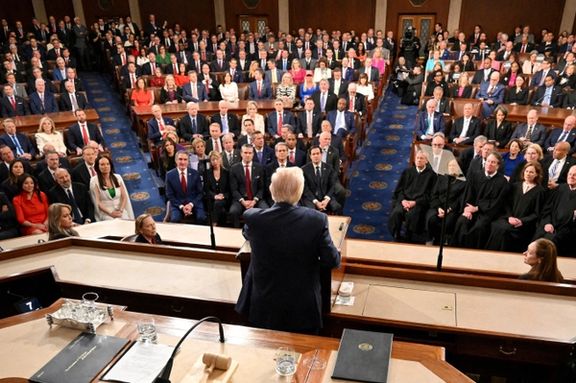
US President Donald Trump speaks during an address to a joint session of Congress at the US Capitol in Washington, DC, on March 4, 2025.

President Donald Trump will step into the House chamber on Tuesday night for a State of the Union address shadowed by the prospect of new US military action on Iran, as his administration sends envoys back to nuclear talks in Geneva and builds up forces in the region.

The prime-time speech offers Trump his most prominent platform yet to signal whether he is still betting on diplomacy in the days ahead, or preparing the public for strikes if talks fail.

While advisers have urged him to focus on affordability, immigration and the economy ahead of November’s midterm elections, the buildup toward a potential confrontation with Iran has overshadowed the run-up to the address.

Mainstream outlets have widely previewed Trump’s State of the Union address, highlighting how he might frame Iran alongside domestic political pressures.

Reuters wrote that the speech could be Trump’s best opportunity to rally skeptical voters behind his approach to Iran, including the possibility of military strikes if negotiations fail.

Trump on Monday brushed aside reports of internal dissent about military action, writing on social media: “I am the one that makes the decision… if we don’t make a deal, it will be a very bad day for that country.”

Democrats have sharply criticized his approach. Senator Tim Kaine said Trump was “bumbling his way toward war,” arguing he had scrapped a 2015 nuclear agreement that had constrained Iran’s program.

Bloomberg similarly described Iran as a major flashpoint Trump may address as he seeks to reset the political narrative after domestic setbacks.

The Associated Press said the address offers Trump a chance to make his case for possible action against Iran, citing polling that shows broad public unease with his handling of foreign affairs.

Iran in past State of the Unions

References to Iran in State of the Union speeches have typically surfaced at inflection points–the hostage crisis, regional conflict and terrorism, nuclear negotiations, or moments when presidents sought public backing for a tougher coercive strategy.

In the Cold War alliance era, Iran appeared mainly as a country whose stability and relationships mattered to Western cohesion.

President Dwight Eisenhower’s 1955 State of the Union message cited “Britain and Iran” among nations that had “resolved dangerous differences,” framing Tehran in terms of security and diplomacy rather than direct confrontation with Washington.

After the 1979 Islamic Revolution and the hostage crisis, Iran became the crisis itself.

Jimmy Carter’s 1980 address opened by saying that 50 Americans were still being held in Iran, calling the episode “terrorism and anarchy” and warning that if the hostages were harmed, “a severe price will be paid.”

After 9/11, Iran references shifted into the terror-and-WMD architecture of US strategy, placing Tehran within a broader post-attack security doctrine.

In 2002 and 2003, George W. Bush repeatedly cast Iran as a serious security threat, famously labeling it part of the “axis of evil” and describing its government as pursuing weapons of mass destruction, supporting terrorism and repressing its people, while distinguishing between the regime and Iranians who “speak out for liberty.”

President Barack Obama repeatedly used the address to press for diplomatic compromise while stressing that the United States would prevent Iran from obtaining a nuclear weapon.

In 2014, Obama said diplomacy had halted the advance of Iran’s nuclear program, warned he would veto sanctions that could derail negotiations, and argued war should be a “last resort.”

In 2015 and 2016, he defended the nuclear agreement reached with Tehran, asserting that it had helped the world avoid another war.

During his first term, Trump invoked Iran to justify withdrawing from the 2015 deal and imposing sweeping sanctions under his “maximum pressure” campaign, portraying Tehran as a central destabilizing force in the Middle East.

In 2018, he said the United States stood with “the people of Iran” against a “corrupt dictatorship” and urged Congress to address what he called “the terrible Iran nuclear deal.”

In 2019, he called Iran the “world’s leading state sponsor of terror.” In 2020, he tied Iran to counterterrorism and deterrence, citing the killing of former IRGC-Quds commander Qasem Soleimani.

The pattern is consistent: presidents have used the nationally televised address to reset Iran policy at decisive moments–to sell diplomacy, justify confrontation, or redefine strategy.

Tuesday’s speech fits that same historical frame.

Most Viewed

Trump’s State of the Union may test appetite for Iran strikes
1
INSIGHT

Trump’s State of the Union may test appetite for Iran strikes

2
INSIGHT

Khamenei ‘rat’ taunt spills from social media onto Iran’s campuses

3

CIA issues rare Persian-language appeal to Iranians for secure contact

4
ANALYSIS

Mexico cartel violence revives scrutiny of Iran-linked networks

5

Iran developing missiles that may soon reach US, Trump warns in SOTU address

Banner
Banner

Spotlight

  • Confront or concede: Iran’s brinkmanship reaches its limits
    ANALYSIS

    Confront or concede: Iran’s brinkmanship reaches its limits

  • Trump’s speech leaves Iranians guessing before Geneva talks
    INSIGHT

    Trump’s speech leaves Iranians guessing before Geneva talks

  • Hope and hedge: Tehran braces for decisive Geneva talks
    INSIGHT

    Hope and hedge: Tehran braces for decisive Geneva talks

  • China refiners turn to Russian oil as Iran faces rising uncertainty
    ANALYSIS

    China refiners turn to Russian oil as Iran faces rising uncertainty

  • Mexico cartel violence revives scrutiny of Iran-linked networks
    ANALYSIS

    Mexico cartel violence revives scrutiny of Iran-linked networks

  • Officials in Tehran claim calm, but prices tell another story
    INSIGHT

    Officials in Tehran claim calm, but prices tell another story

•
•
•

More Stories

A refuge in the dark: The Tehran home that treated protesters for 19 nights

Feb 23, 2026, 23:19 GMT
•
Reza Akvanian

From the night of January 9, a family home in western Tehran became an improvised refuge for wounded protesters, operating for 19 consecutive nights as security forces carried out a bloody crackdown that left tens of thousands dead in the streets.

The three-member household - a dentist’s daughter and her elderly parents - treated injured demonstrators with minimal equipment until the last of them was able to leave.

For those struck by live ammunition, they took the added risk of bringing a trusted doctor into their home to remove bullets and continue care.

In the final hours of January 9, wounded protesters began arriving one by one. Some had been hit by pellet or live rounds in the streets; others said they feared arrest if they sought hospital treatment.

Maryam, the daughter, who spoke to Iran International under a pseudonym, said she initially removed superficial pellets herself. But as injuries proved more severe and the number of wounded grew, it became clear that several had been shot with live ammunition and could not safely be transferred to hospital.

“We knew if they went back outside, they might not survive,” she told Iran International.

For nearly three weeks, the house functioned as a makeshift clinic. The wounded slept there, were bandaged and monitored, and underwent procedures on mattresses laid side by side.

Maryam said she saw snipers positioned on rooftops firing live rounds at unarmed protesters. She said plainclothes agents, Basij militia members and other forces affiliated with the Islamic Revolutionary Guard Corps were also shooting at close range.

Shot again in hospitals

A young doctor who assisted at the house said colleagues in several cities told him some wounded protesters were allegedly shot again in hospitals or during transfer.

“It wasn’t one or two cases,” he said. “Reports were coming from every city. People were being sprayed with bullets. Some who reached the hospital with gunshot wounds were later found dead with bullets to the head. It is clear that crimes were committed.”

As the condition of several live-fire victims worsened, those inside debated whether to risk hospital transfer — a step many believed could lead to detention or worse.

They ultimately agreed to bring the doctor to the house, where he remained for several days administering pain relief and extracting bullets with limited supplies.

Will to survive

One protester shot in the leg said he believed he would not survive. Two nights later, the bullet was removed. Before him, others had undergone similar procedures for wounds to their legs, stomachs and hands.

Some left as soon as they were able, fearing identification. Others relocated to different cities rather than return home.

Those sheltering there described nights marked by fear, grief and solidarity. They sang Kurdish, Luri and Azerbaijani songs and mourned those killed. When images of victims from Tehran and other cities appeared on television, they wept together.

The father, Khosrow, said internet and phone disruptions initially left them cut off. Only after satellite reception improved and they were able to watch Iran International did they realize the violence extended beyond their neighborhood.

The house has since returned to daily life. But the family says the memory of those 19 nights — when their home became a refuge for people who could neither remain in the streets nor safely seek hospital care — will not fade.

They insist they did only what they could under the circumstances and say they wish they had been able to save more lives.

How Tehran whitewashes its crimes abroad

Feb 23, 2026, 16:38 GMT
•
Negar Mojtahedi, Jay Solomon

As Iran’s security forces crushed protests, a parallel operation unfolded online, blaming a domestic uprising on a global conspiracy.

In late December and early January, as Iranians took to the streets to protest the country’s economic malaise, the Islamic Republic quietly began seeding onto social media its own narrative of events, in preparation for a brutal crackdown.

The uprising wasn’t organic or homegrown, according to posts by state-backed media accounts, but the shadowy work of the Central Intelligence Agency and Israel’s vaunted Mossad spy agency.

“The enemies, particularly the United States and Israeli regime, are focused on fueling insecurity in Iran by making use of the tools of soft warfare,” state-controlled Fars News Agency proclaimed on January 5, citing the chief of staff of Iran’s armed forces.

In the days that followed, particularly January 8 and 9, Iran’s security forces mowed down thousands of ordinary Iranians in an operation that is widely seen as the bloodiest in the country’s modern history.

Twinned with this crackdown has been a sophisticated, state-backed information offensive.

For the Islamic Republic to rely on claims of U.S. and Israeli involvement to justify its repression isn’t new.

The difference between this campaign and the Iranian regime’s frequent efforts to smear dissidents and protesters as foreign agents is that the push launched by the regime this time was not designed only, or even mainly, for domestic consumption.

It was directed just as much at ideological allies and supporters abroad, inserting the Islamic Republic’s propaganda into global political discussions and seeking to whitewash the massacre of Iranian protesters.

That campaign has succeeded in gaining the backing of a wide array of far-left media personalities, MAGA-aligned influencers, Russian-backed X accounts, and global bot farms. In the U.S. alone, white nationalist Nick Fuentes, The Young Turks media host Cenk Uygur, Gen Z influencer Calla Walsh, and the anti-Israel campaigner Max Blumenthal have parroted the regime’s line that the CIA and Mossad stoked the uprising.

Rutgers University’s Network Contagion Research Institute (NCRI) tracked Iran’s government narratives through over 300 X accounts, finding millions of views for posts that amplified Iranian propaganda—some from accounts that appear to be linked to state actors.

A newly released report, which NCRI researchers discussed exclusively with The Free Press, found that this social media narrative has become a key lever of foreign influence for the Islamic Republic. With signs that Iranians are ready to rise up again, and U.S. air and sea power massing outside Iran, regime opponents and human rights activists worry that the information tools that Iran has developed over the last months will be repurposed to shape the narrative of any conflict.

“This episode illustrates a broader mechanism of modern authoritarian resilience: Repression alone does not secure regime stability. Narrative control does,” Joel Finkelstein, co-founder and chief science officer at NCRI, told The Free Press.

“When state-aligned media and decentralized amplification networks converge to externalize blame, they can blunt international solidarity, fracture ideological coalitions, and recast domestic dissent as foreign aggression.

”The unrest in Iran began in late December among merchants protesting a catastrophic drop in Iran’s currency, then quickly spread to more general demonstrations, soon evolving into open calls for the end of the Islamic Republic itself. Iran’s government has officially claimed that around 3,000 Iranians died during January’s unrest. But human rights groups and the United Nations special rapporteur on Iran said the death toll could reach the tens of thousands.

Videos emerged of snipers shooting unarmed civilians from rooftops and body bags flooding local morgues.

As Ayatollah Ali Khamenei’s regime orchestrated its massacre, Tehran intensified its information war in lockstep. NCRI researchers describe a step-by-step sequence—almost a digital playbook—in which Tehran framed the protests as a CIA–Mossad operation, amplified it online, and allowed sympathetic, outside actors to legitimize the narrative in real time. 

How Islamic Republic's information war unfolded:

Iran’s information operation used X posts from a Persian-language account widely identified as affiliated with Israel’s intelligence services, Mossad, and an X post from U.S. Secretary of State and CIA Director Mike Pompeo to lend ballast to its narrative. Early in the protests, the accounts posted comments on X that appeared to lend moral support to the burgeoning Iranian uprising.

“Let’s come out to the streets together. The time has come,” the Mossad-affiliated account proclaimed on December 29.

“We are with you. Not just from afar and verbally. We are also with you on the ground.” Pompeo also posted a message of support on January 2, which included a quip implying that Iran was filled with Mossad agents.

As the Iranian regime intensified its crackdown on dissent, screenshots of the posts circulated rapidly across Persian-language Telegram channels and X, and government and regime-aligned commentators presented the Mossad and Pompeo posts as proof of foreign infiltration.

Iranian Foreign Minister Abbas Araghchi took to X on January 10, just a day after the regime inflicted its worst violence on protestors, and wrote: “According to the US Government, Iran is ‘delusional’ for assessing that Israel and the US are fueling violent riots in our country.”

The diplomat attached a screenshot of Pompeo’s January 2 post. In a sign of the importance that Iran’s regime attached to influencing, Araghchi appeared on Fox News to advance the Mossad conspiracy narrative, and pushed it again in a post-crackdown op-ed in The Wall Street Journal.

NCRI researchers documented a surge in online traffic promoting the regime’s CIA-Mossad narrative—from January 6 through January 16—at a time when most of the country remained in a communications blackout.

NCRI found that most of this online engagement didn’t originate from Iranian state media itself, but from independent influencer accounts that carried the narrative into Western political ecosystems. 

Central to this were two large accounts–@AdameMedia (with over 500,000 followers) and @Megatron_ron (nearly 600,000 followers)–which NCRI believes are likely fronts for foreign governments, potentially Russia. Much of this traffic appeared to utilize bot networks to amplify their messages.

On January 12, the @AdameMedia account described Iranian protesters as “Mossad backed rioters” and circulated footage that the account claimed showed opposition activists burning mosques, declaring: “These scum are the face of the movement.”Those claims were picked up by American social media influencers, both from the far left and MAGA right.

The MAGA-aligned influencer and media personality Nick Fuentes, who has 1.2 million followers on X, posted on January 11: “The chaos in Iran is totally astroturfed by Israel and the US for regime change. . . . Why do you think Iran wanted nuclear weapons? To prevent this exact scenario.”

The same day, far-left Israel critic Max Blumenthal, who has over 800,000 followers on X, claimed: “Mossad rent-a-rioters in Iran throw molotov cocktails at apartments and into a mosque filled with children. Supporters of these nihilistic regime change rampages are openly celebrating the violence.”

U.S. government and independent analysts who study Iran’s information networks told The Free Press that the regime has spent decades developing propaganda networks in the West specifically for times of crisis.

Much of this has been focused on finding ideologically aligned academics, journalists, and politicians, but also, increasingly, social media influencers. Blumenthal visited Iran last May as part of a regime-backed media trip. 

“They have a very sophisticated network and they operate both in a coordinated manner and in a diffused manner,” Stanford University’s Abbas Milani, an Iranian-American scholar and historian, told The Free Press.

“Somebody sheds doubt about the number killed, somebody sheds doubt about who was doing the killing. . . . The goal is to dishearten the opposition.”

The Free Press and Iran International jointly published an investigation in 2023 that documented how Iran’s Foreign Ministry created a network of overseas academic and media influencers to promote its positions on the nuclear negotiations with the Barack Obama administration in 2014 and 2015.

Tehran called the network the Iran Experts Initiative. Now the kind of influence that was achieved piecemeal with individual outreach can be done at scale through social media. NCRI’s researchers said this stealth migration of regime talking points is how modern information warfare succeeds.

State narratives enter polarized digital ecosystems, then are reframed and repeated until the message no longer appears to originate from the state that benefits from it. NCRI and other activists are increasingly concerned that Tehran may be successful in muddying the reality of the January massacres.

The approach also hints at how Iran will likely seek to influence international opinion in any further conflict with the United States.

"The idea that this is somehow an operation from Mossad or the CIA is really an odd assertion given that the people doing the killing, as we see on video, are part of the regime,” said Gissou Nia, a human rights lawyer at the Atlantic Council. Nia and other activists have been stunned by the tepid international response to the massacre.

It took until January 23 for the United Nations Human Rights Council to formally condemn Iran’s crackdown. And leaders across the Arab world and West continue to engage with Iran’s leadership at the highest levels. So far, no state has formally called for an investigation by the International Criminal Court into the nationwide massacre.

Lawdan Bazargan, a human rights activist and former political prisoner in Iran, added: “More than 30,000 people are dead. . . . Not a single foreign agent was found among the victims.”

Capital flees Tehran stocks as geopolitical tensions deepen

Feb 23, 2026, 10:32 GMT

More than 107.8 trillion rials ($66.5 million) in retail money has flowed out of the Tehran Stock Exchange over the past 24 trading sessions, marking what analysts describe as a new phase of liquidity depletion driven by political uncertainty and fears of military escalation.

Habib Arian, a financial markets researcher, told ISNA that the turning point came on January 10, when the market recorded a one-day outflow of 9.4 trillion rials ($5.8 million), at the time the largest daily withdrawal of individual investor funds.

“That figure showed that trust, which is the main asset of the capital market, had been severely damaged,” Arian said. “From that date onward, the Tehran bourse was unable to return to an upward trajectory, and any positive fluctuation was treated as an opportunity to exit.”

Outflows accelerated as regional tensions intensified and speculation grew about possible confrontation between Iran and the United States. Investors shifted from equities toward hard assets, pushing the dollar above 1,650,000 rials and lifting domestic gold prices sharply.

Between January 8 and February 21, the benchmark index fell 15% while 18-karat gold posted a 33% gain over the same period. Gold-backed funds rose 20%, emerging as a primary destination for funds exiting equities.

“The 48-percentage-point gap between gold and stocks explains why liquidity has fled the equity market at this speed,” Arian said.

  • Money is leaving Iran faster as oil income falls and uncertainty mounts

    Money is leaving Iran faster as oil income falls and uncertainty mounts

  • Why Iran cannot stop its currency collapse

    Why Iran cannot stop its currency collapse

On Sunday alone, the main index shed another 103,000 points as retail investors pulled out a record 41 trillion rials ($25.3 million) in a single session, according to market data cited by Arian.

He said the stock market was now driven less by economic fundamentals than by political risk. “The market today is more hostage to political tensions and the shadow of war than to economic variables,” he said. “As long as geopolitical risks do not subside, the capital market will continue to act as a liquidity provider for parallel markets.”

The exodus from stocks comes against a backdrop of broader capital flight and currency weakness.

The rial has traded around 1,630,000 per dollar in recent weeks, reflecting deep structural imbalances, falling oil income and persistent uncertainty surrounding nuclear negotiations and sanctions.

Analysts say the combination of record outflows from equities, a weakening currency and rising demand for gold shows the erosion of investor confidence, with households and businesses seeking safety in assets perceived as more resilient to inflation and political shocks.

“In this environment, investors prefer the security of gold and dollar-linked assets to the ambiguity of shares,” Arian said.

Iran rules out interim deal in US talks, keeps military on alert during diplomacy

Feb 23, 2026, 09:23 GMT

Iran said on Monday it does not support an interim agreement in talks with the United States and is seeking a swift, result-oriented deal focused on lifting sanctions and addressing nuclear issues, as the two sides prepare for another round of negotiations within days.

Foreign Ministry spokesperson Esmail Baghaei said speculation about a temporary arrangement had no basis, adding that details of any agreement would be decided only at the negotiating table.

“A temporary agreement has no basis,” he told a weekly news conference in Tehran. “The drafting of any negotiating text is a joint effort.”

Baghaei said Iran was currently formulating its positions and hoped to hold another round of talks within days. “We are now in the stage of drafting viewpoints and we hope to have another round within the next two or three days."

He said Iran’s positions on ending sanctions and on nuclear matters were clear, and that Tehran was fully aware of the US position.

“Iran does not benefit from protracted negotiations,” he said. “Negotiations are useful for us when they lead to a result. Reason dictates that we act as soon as possible to remove sanctions.”

Baghaei rejected accusations that Tehran was deliberately dragging out the process.

“This has no basis,” he said. “We have repeatedly said we are ready to continue negotiations for weeks without interruption in order to reach a result.”

He said any talks aimed at forcing Iran into one-sided concessions would fail.

“No negotiation whose goal is to compel one side to accept unilateral demands will succeed,” he said. “Iran is serious and determined in pursuing the diplomatic path, and we will continue this process as long as we feel it leads to a result.”

Military ready to respond

Baghaei said US threats against Iran during the talks would not alter Tehran’s approach, adding that Iran’s armed forces remain on heightened alert while diplomacy continues.

“If it leads to war, our fighters will respond,” he said. “Our forces, with eyes wide open, are ready 24 hours a day to defend Iran’s sovereignty.”

On nuclear oversight, Baghaei said Iran had no preconditions for visits by the International Atomic Energy Agency, though he distinguished between general cooperation and inspections of damaged facilities, which he said required specific procedures.

"The issue of inspecting damaged facilities is different because there is no established method for such inspections.”

He said Iran had previously implemented the Additional Protocol to its safeguards agreement on a voluntary basis during the 2015 nuclear deal and could consider similar steps again in exchange for sanctions relief.

“Such a voluntary decision depends on reciprocal steps in the area of sanctions relief.”

Baghaei also addressed US sanctions, saying “In recent years they (Americans) have explicitly said that the goal is to pressure Iranian citizens so that they feel the pressure and protest against the government,” he said.

He added decisions on the nuclear file were taken within Iran’s Supreme National Security Council, with all relevant institutions participating, dismissing reports about any rift between the Foreign Ministry and the council over the conduct of negotiations, and saying the ministry acts in line with decisions adopted by the council.

Iran agrees €500 mln arms deal with Russia to rebuild air defenses - FT

Feb 22, 2026, 16:33 GMT

Iran has agreed a secret €500 million arms deal with Russia to acquire thousands of advanced shoulder-fired missiles in a major effort to rebuild air defenses damaged during last year’s war with Israel, the Financial Times reported on Sunday.

The agreement, signed in Moscow in December, commits Russia to deliver 500 man-portable Verba launch units and 2,500 9M336 missiles over three years, the FT reported, citing leaked Russian documents and several people familiar with the deal.

The Verba is described as one of Russia’s most modern shoulder-fired, infrared-guided air defense systems, capable of targeting cruise missiles, low-flying aircraft, and drones. Operated by small mobile teams, it allows forces to create dispersed defenses without relying on fixed radar installations, which are more vulnerable to strikes, the report said.

Under the €495 million contract, deliveries are scheduled in three tranches from 2027 through 2029, the FT said, adding that one person familiar with the transaction suggested a smaller number of systems could have been delivered earlier.

Tehran formally requested the systems last July, days after the end of a 12-day conflict in which the US briefly joined Israel in strikes on Iran’s three key nuclear facilities, according to a contract seen by the newspaper.

A former senior US official told the FT that Moscow likely viewed the agreement as a way to repair ties with Tehran after failing to come to its ally’s aid during the June conflict.

The deal was negotiated between Rosoboronexport, Russia’s state arms export agency, and the Moscow representative of Iran’s Ministry of Defense and Armed Forces Logistics (MODAFL), FT’s report said.

The contract was arranged by Ruhollah Katebi, a Moscow-based MODAFL official who previously helped broker Iran’s sale of hundreds of Fath-360 close-range ballistic missiles for use in Russia’s invasion of Ukraine.

One Russian Ilyushin Il-76TD cargo plane has made at least three runs from Mineralnye Vody in Russia’s northern Caucasus to the Iranian city of Karaj in the past eight days, FT’s report said. At least one more Il-76 flew the same route in late December.

Iran reportedly received up to six Russian Mi-28 attack helicopters in January and operated one of them in Tehran this month.

According to documents seen by the newspaper, Rosoboronexport is selling the 9M336 missiles at €170,000 per unit and the launch systems at €40,000 each.

The deal also includes 500 “Mowgli-2” night-vision sights designed to track aircraft and other targets in darkness, the report added.

Unlike larger Russian strategic air defense systems such as the S-300 and S-400, the Verba systems do not require extensive training or integration and can be deployed more quickly, FT’s report said.

The report added that Verbas have not played a significant role in Russia’s defenses against Ukrainian drone attacks, which could make Moscow more willing to part with them than other air defense systems.