Families Of Victims Say Iran's Top Officials Responsible For Ukraine Airliner Crash
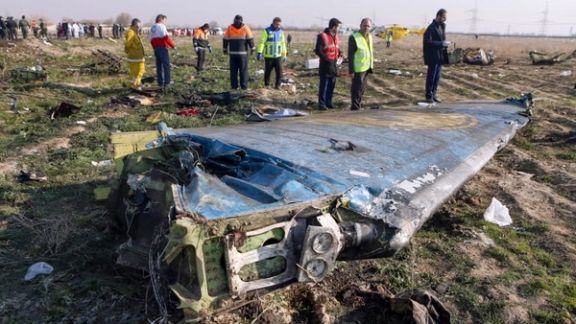
Debris of a Ukrainian airliner shot down over Iran. January 8, 2019
The 2020 downing of a Ukrainian jetliner by Iran was the responsibility of high-level Iranian officials, not an accident as Tehran claimed, families of victims said in a report on Wednesday.
The report by an association composed of mostly Canadian families of Flight PS752 victims challenges Iran's official findings that blamed a misaligned radar and an error by the air defense operator for downing the plane shortly after it took off from Tehran's Airport in early morning on January 8 2020. All 176 people aboard were killed.
Iran for three days denied that the airliner was shot down and claimed it was an accident. After it acknowledged that two missiles fired 30 seconds apart had brought the plane down, it refused an independent investigation and tried to withhold information from Ukraine and Canada.
Iran's civil aviation body, which had responsibility for investigating the crash, said the operator mistook the jet for a missile at a time when tensions were high between Tehran and the United States. Hours earlier, Iran had fired ballistic missile at US bases in Iraq and was probably expecting a response.
A Canadian investigation in June which condemned "those responsible" but found no evidence that the tragedy was premeditated, but critics say that the country’s top leadership decided to leave the civilian airspace open at a time of high military tension on that day..
"It is the belief of the association that high-ranking officials of Iran are responsible for the downing of Flight PS752 and not just a handful of low ranking...members as per the claims of the government of Iran," the association report said.
"At the highest levels of military alertness, the government of Iran used passenger flights as human shield against possible American attacks, by deliberately not closing the airspace to civilian flights," it said.
Association president Hamed Esmaeilion told a virtual news conference: "We think that the downing of PS752 was a deliberate act."
The Iranian foreign ministry was not immediately available to comment.
The association said it based its report on public information and recordings of "high-ranking Iranian officials" among its sources and was prepared with assistance from aviation and legal experts.
It is not an official air crash accident report, which is designed to focus not on liability but how safety can be improved in the future.
The report said the missile system operator was experienced and should have been able to distinguish the jetliner from a cruise missile.
The trial of ten lower-level military personnel opened in Tehran on Monday. Many families in Iran refused to recognize the trial and protested outside the courtroom.
A Canadian government spokeswoman said the country is analyzing the report, which calls for an international investigation. Many of the victims killed in the crash were Canadian citizens or permanent residents.
Canadian Foreign Affairs Minister Melanie Joly tweeted on Tuesday that the country "stands with Ukraine" in its decision to not take part in PS752 hearings at a military court in Iran, calling for "transparency in the criminal proceedings."
Farmers protesting in Esfahan for water say that after midnight on Thursday security agents attacked their camp, set fire to their tents and bulldozed the scene.
Protesters, many of whom have refused to leave their tents for over two weeks, said on social media the attack occurred at 3:00 AM while many other farmers and their supporters were gone. According to these reports, security forces then broke the metal frame of the tents anddrove a loader over the site to remove the remains. During the attack, protesters say, security forces shot blanks and tear gasto disperse them.
One of the protesters posted a video report that has been widely circulated on social media and shows a large groups of riot police advancing towards the camp in the dry bed of Zayandeh Roud river. The citizen-journalist speaking in the video says protesters have been ordered to leave and alleges that security forces set fire to the protesters' tents. "We only came here for water," he says.
In the video, a member of security forces is heard speaking into a loudspeaker who repeatedly asks protesters to evacuate the site "now that there are good agreements reached [regarding the water problem] and all [authorities] have offered you support".
State-run broadcaster (IRIB), however, in a report Thursday morning alleged that "opportunists" some of whom were arrested by security forces were responsible for burning the tents. The report claimed that the "opportunists" had prevented farmers from dismantling their tents after a statement issued by the farmers union which announced the end of their protest.
"They set fire to our tents," a protester says in a second video that shows smoke rising from burning tents in a distance. "They are Kuffar… they stole our water, now these [security forces] have come to their aid".
A protester is heard in the video comparing the security forces to Shimr, the villain in the Battle of Karbala between the grandson of the Prophet Muhammad, Imam Husayn, and Yazid I in 680 AD. The Imam, his men, and his family were killed in the battle near the river Euphrates from which they were not allowed to get water and their tents were set on fire. The story of Karbala is an important foundation for the Shiites who mark the occasion every year as a great injustice toward ‘true’ Muslims.
"What are they going to do about Friday," he says.
Authorities who blame this year's drought for the exacerbation of water shortage have kept promising to take action to resolve the long-standing shortage and to compensate farmers who have not been able to sow autumn crops.
Promises of water for Esfahan have fueled protests in Shahr-e Kord, the capital of the neighboring Chahar Mahal and Bakhtiari Province, where people have been also protesting the mismanagement of water in the past four days.
The recent water protests took place as many Iranians marked the second anniversary of the bloody November 2019 unrest. In 2019 protests that quickly spread across the country were heavy-handedly suppressed by the security forces who killed hundreds of unarmed people. After two years, no one has been accountable, and the protesters have been accused of serving foreign interests and destroying property.
Recent days have seen several reports of cyberattacks in Iran, including possible hacking of the computer network for the country’s dams.
The newspaper of the state broadcaster quoted “an informed source” saying a cyber intrusion had disrupted the monitoring of water levels and general conditions in dams over the past two weeks.
The source said that employees exchanging data about dams had lost Internet-based communication, including applications like WhatsApp. The source dismissed denials issued by information network officials.
A security official at Iran’s ministry of energy also denied the claim, telling the Iranian Students News Agency (ISNA) that authorities had restricted certain employees’ access to the information system.
Iran has been the target of many cyberattacks and other sabotage since mid-2020, frequently attributed to Israel. Nuclear, military and industrial targets have all been hit with disruption, including explosions and fires.
In October motorists faced disruption at gas stations across the country when the payment system for cheaper, rationed gasoline broke down. It took nearly a week to fully restore the service. Iran’s railroad network was hacked in July, apparently as part of a wider strategy to target infrastructure.
Some cyberattacks have been claimed by unknown dissident groups, including the hacking and release in July of troves of security-camera footage and documents from Tehran’s Evin prison, including guards beating prisoners and confidential letters from and to the prison. The chief of Iran’s prisons was replaced in November, in a decision at least partly related to the hacking.
On Wednesday, the website of Ayatollah Ahmad Alamolhoda, Friday prayer leader in Mashhad and father-in-law of President Ebrahim Raisi (Raeesi), was hacked, according to the cleric’s communications chief. Alamolhoda is Supreme Leader Ali Khamenei’s representative in Khorasan-Razavi, one of Iran’s largest and most important provinces.
Shargh newspaper in Tehran reported that the websites of the Assembly of Experts, a constitutional body tasked with choosing the Supreme Leader, was disrupted Wednesday by a cyberattack. The reformist newspaper also reported that the website of Tehran province courts had been disrupted, although it was not clear this was due to a cyberattack.
Iran's top nuclear negotiator Ali Bagheri Kani met with senior Emirati officials on Wednesday during a visit to the United Arab Emirates, state news agency WAM reported.
The rare visit comes as Abu Dhabi moves to reduce tensions with rival Tehran.
WAM said Bagheri Kani met with the diplomatic adviser to the UAE president, Anwar Gargash, and Emirati minister of state for foreign affairs Khalifa Shaheen Almarar.
The discussions stressed the importance of strengthening relations "on the basis of good neighborliness and mutual respect", working for greater regional stability and prosperity and developing bilateral economic and commercial ties, WAM said.
The visit comes ahead of the expected resumption of talks between global powers and Iran in Vienna on Monday to try to revive a 2015 nuclear pact, which Gulf states have criticized for not addressing Tehran's ballistic missile program and regional proxies.
Gargash earlier this month said that the UAE was taking steps to de-escalate tensions with Iran.
Senior Iranian and Gulf officials told Reuters last week that a top UAE delegation would visit Tehran soon.
Gulf states, uncertain of the Biden administration's role in the region and seeking to avoid a return to heightened tensions of 2019 that saw attacks on tankers in Gulf waters and Saudi energy infrastructure, have moved to engage with Iran.
Sunni Muslim power Saudi Arabia also launched direct talks with Iran in April. Riyadh has described the talks as "cordial" but said they remained largely exploratory.
Protests against water scarcity and government distribution policies continued for a fourth successive day in Shahr-e Kord, 100km west of Esfahan.
Shahr-e Kord is provincial capital of Chaharmahal-Bakhtiari, a traditionally water-rich region in the Zagros mountains, has seen its water resources decline in recent years due to both drought and projects that shift water to arid regions.
Protests began November 20, following demonstrations against lack of water in the city of Esfahan, where thousands of residents demanded water be supplied to the Zayandeh Roud river, which has been dry for most of the last ten years.
As the government promised solutions to people in Esfahan, residents in neighboring Chaharmahal-Bakhtiari took to the streets in fear their water would be diverted. Drought across the Middle East in recent years has encouraged conflict and tension between nations and between communities over access to water.
The Iranian government has encouraged water-intensive industries to be built in Yazd, east of Esfahan, diverting Zayandeh-Roud water, leaving tens of thousands of farmers with inadequate irrigation.
Days ago, the government appointed a Revolutionary Guards general as governor of Chaharmahal-Bakhtiari, following similar appointments in recent weeks elsewhere. Some protesters Wednesday attacked the new provincial governor as a servant of central authorities.
Iran’s currency Wednesday fell to its lowest point in a year as US sanctions continued and prospects for reaching a deal in nuclear talks with the West deemed.
The currency, rial, dropped to 290,000 against the US dollar in Tehran’s exchange market, raising fears of more inflation in the near future. Iran already suffers from more than 60 percent rise in food prices in the past one year, as a cash-strapped government prints money, inflating liquidity.
The rial has dropped more than ninefold since early 2018, when former US president Donald Trump signaled his intention to withdraw from the 2015 nuclear agreement with Iran, known as JCPOA. Trump carried out his threat in May 2018 and imposed crippling sanctions on Tehran’s oil exports and international banking.
Indirect nuclear talks with the United States are scheduled to resume next week in Vienna, but a tougher position adopted by the new hardline government in Tehran has led to pessimism over chances of a successful outcome.
In the past four years, the deepening economic crisis has led to large protests in which security forces killed hundreds of protesters. With a parallel water shortage and pollution, rising prices pose a serious risk of renewed unrest against the government.