Two Europeans Arrested in Iran Identified As Members Of French Teachers' Union
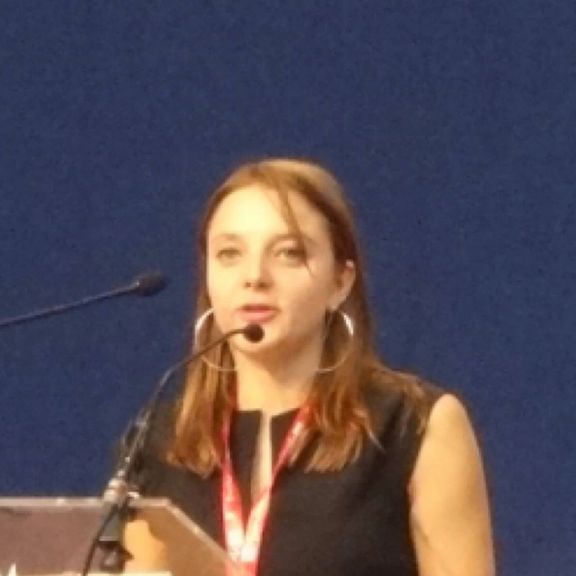
Cécile Kohler, the head of France’s National Federation of Education, Culture and Vocational Training
The two European nationals arrested in Iran were identified as Cécile Kohler, the head of the biggest federations of teachers' unions in France and her husband, Iran International has learned.
Kohler is the head of the National Federation of Education, Culture and Vocational Training – known by their French abbreviation FNEC FP-FO – that is a trade union representing education and related staff in France.
According to information received by Iran International, Kohler and her husband, who is also a member of the FNEC FP-FO, traveled to Iran as tourists and not on behalf of the organization.
They arrived in Tehran's Imam Khomeini Airport on April 29 and stayed in Tehran for two days, and then went to Kashan and Esfahan. The couple were returning to Paris on May 8 when they were arrested.
Considering the activities of the FNEC FP-FO, the couple fits the bill for the scenarios Islamic Republic uses as pretext to arrest foreign nationals.
The Iranian Intelligence Ministry alleged in its statement on Wednesday that the two met with members of the Coordination Council of Iranian Teachers’ Trade Associations, which has been the organizer of several rounds of nationwide protests since last year.
European Union’s coordinator in Iran nuclear talks met with Tehran’s chief negotiator on Wednesday, as Iran said it arrested two European citizens.
Enrique Mora who arrived in Tehran on Tuesday met with Ali Bagheri-Kani and photos published showed a somewhat somber-faced Mora shaking hands with the smiling Iranian diplomat, but with no news about the results of the meeting until late evening in Iran.
In a tweet before the meeting, Iran’s foreign ministry emphasized both circumventing United States’ sanctions and removing them through an agreement. But it warned that Tehran’s “red lines” must be respected in any “lasting and good agreement.”
Fars news website, affiliated with the Revolutionary Guard, in a long article Wednesday morning, listed all the “violations” and “lack of commitment” by Europeans to the 2015 nuclear agreement, JCPOA, when they failed to honor its economic benefits for Iran.
The article coincided with the announcement that Iran’s intelligence ministry has arrested to “European nationals” for visiting the country to foment unrest, especially among disgruntled teachers. Hardline news websites publishing the news provided no details.
Mora, before departing for Tehran on Tuesday, tweeted that he would be discussing both the revival of the nuclear talks and “other issues”. Iran has been threatening Sweden for the long trial of a former judicial official who was arrested in Stockholm for his alleged role in the killing of thousands of political prisoners in Iran in 1988. A verdict is expected in the case in July and Swedish prosecutors have demanded the maximum sentence of life imprisonment.
There is also the case of a former Iranian diplomat who is serving a 20-year prison term in Belgium for organizing a plot to bomb an opposition rally in France. Iran also demands his release.
On Tuesday Tehran ruled out any prisoner exchange with Europe as it says it will execute Hamidreza Djalali, a Swedish Iranian dual citizen, who was arrested in 2016 on a visit to an Iranian university and convicted on alleged “espionage for Israel.”
Therefore, Mora’s visit to Tehran could be as much about prisoners as to find a common ground to jump start the JCPOA talks stalled since mid-March.
However, Iran is facing a worsening economic crisis, as food price inflation accelerated this month and market chaos threatens political instability. To what extent Tehran is willing to risk survival with US sanctions in the absence of a nuclear agreement, is not clear.
Meanwhile, Fars published another article arguing that three foreign visits, starting with the trip of the Polish foreign minister Zbigniew Rau last Saturday, Mora’s visit on Wednesday and the upcoming visit of Qatar’s Emir Sheikh Tamim bin Hamad al-Thani, all had a common thread.
Fars argued that Europe needs natural gas in the wake of the Russian invasion of Ukraine and the main purpose of these dignitaries is to find ways for Iran to export gas to Europe. The theory however has one problem. Iran does not have enough natural gas for its own domestic consumption, and it would take years to inject capital and technology to tap into its vast reserves and achieve a significant volume of exports.
Iran's Revolutionary Guard (IRGC) has launched artillery attacks against Erbil, the capital of Iraqi Kurdistan, claiming it targeted “the strongholds of terrorist groups”.
Tasnim news agency, affiliated to the IRGC, reported the attack on Wednesday, saying no details are available so far about possible fatalities and damages in the strike.
According to local Kurdistan officials, the artillery attack hit Barbazin heights, while four suicide drones also targeted Similan heights this morning.
In March, Iran fired missiles at Erbil. No one was killed but missiles did damage to some residential buildings. Iran claimed it used 12 ballistic missiles in that attack and targeted an Israeli intelligence center. At the time it was seen as a response to an Israeli airstrike in Syria that had killed two IRGC officers or to an suspected Israeli attack in February on a drone base at an airfield in western Iran.
The attacks on Erbil have taken place at a time when Tehran is demanding the removal of the iRGC from a US list of terrorist organizations amid stalled nuclear talks.
An exclusive Reuters Report said days later that the purpose of the missile strike might have been meant to derail a gas pipeline project to pump Kurdish gas to Turkey and Europe. A claim that was denied by Nour News, which is close to the secretary of Iran's Supreme National Security Council (SNSC), Ali Shamkhani.
Iran’s Ministry of Intelligence has announced the arrest of two European individuals for promoting unrest and instigating chaos in the Islamic Republic.
The public relations office of the ministry said in a statement on Wednesday that the two Europeans, who had entered the country with the aim of provoking public outrage through changing the direction of normal popular demands into chaos, social disorder and destabilization of society, were identified and arrested by the intelligence forces.
The statement by the ministry did not provide any details about their nationality or how and when they were arrested, but apparently, they came from the same country.
It added that the two main elements of the mission -- organized by intelligence agencies -- were experts in the field of riot and instability and have experience in training their local agents in several countries over the years.
The statement also mentioned the Coordination Council of Iranian Teachers’ Trade Associations as one of the circles with whom the two had held meetings. The council has been the organizer of several rounds of nationwide protests since last year, prompting speculations that the announcement can be a measure to link teachers’ protests to foreign intelligence agencies to justify the heavy-handed crackdown.
The timing of the announcement also suggests that it can also be an attempt to exert pressure on European countries over the case of a former officials who is facing a court verduct in Sweden.
On Tuesday, a Belgian court also dismissed appeals by three accomplices of an Iranian diplomat who was convicted of plotting to bomb an opposition rally in France in 2018.
A Belgian court has dismissed appeals by three accomplices of an Iranian diplomat who was convicted of plotting to bomb an opposition rally in France in 2018.
Amir Saadouni (41), Nasimeh Naami (37), and Mehrdad Arefani (58) were arrested in Brussels in June 2018 for involvement in a bombing plot masterminded by Asadollah Assadi (50), the third secretary of the Iranian embassy in Austria.
Saadouni and Naami, a Belgian couple of Iranian origin, were carrying 500 grams of the explosive triacetone triperoxide (TATP) and a detonator in a toiletry bag in their car at the time of their arrest.
The bomb was intended to be used at a gathering of members and supporters of the exiled Iranian opposition group Mujahedin-e Khalq Organization (MEK) in Villepinte near Paris on June 30, 2018.
Arefani, a former supporter of the MEK, was arrested simultaneously at Villepinte, France.
The three have accepted their involvement in the plot but claim they were coerced by Assadi, their handler, and the Iranian intelligence to participate in it. Assadi has always maintained that he did not know the other three defendants.
Iran's foreign ministry spokesman Saeed Khatibzadeh late Tuesday condemned media coverage of the court's decision as an "orchestrated attempt" against Assadi and condemned his arrest and trial as a violation of diplomatic immunity.
The Antwerp appeals court has upheld Naami and Arefani's sentence of 18 and 17 years in prison but increased Saadouni’s sentence from 15 to 18 years. “The court finds the allegation by Saadouni and Naami that they assumed that the explosives would only cause noise and fireworks to be implausible,” the judgment handed down on Tuesday said according to De Morgen, a Dutch Flemish newspaper.
“Everything was meticulously prepared beforehand and the modus operandi to be used was also discussed in detail,” the court said while declaring that there is no doubt that Assadi and the three others worked for the Iranian intelligence ministry.
Assadi, the mastermind of the operation, was arrested in Bavaria, Germany, where he did not enjoy diplomatic immunity, while he was on holiday. German authorities later extradited Assadi to Belgium. He has not appealed his twenty-year sentence.
He is the first Iranian diplomat ever brought to trial in Europe for direct involvement in terrorism. The MEK in a statement in July 2020 alleged that Assadi was a senior official of the Iranian intelligence ministry and the station chief in Austria.
Iranian officials say there are no plans to trade EU citizens held in Iran including Ahmadreza Djlali (Jalali), a Swedish-Iranian doctor that Iran says it will execute soon on charges of spying for Israel, with Iranians held in EU countries such as Assadi in Belgium or Hamid Nouri in Sweden. Swedish prosecutors have requested life imprisonment for Nouri over his alleged role in a wave of prison executions in 1988.
The trials of the four suspects and the allegation that Iranian intelligence was behind the bombing plot continues to strain Iran's relations with European countries. Tehran has always dismissed the allegations against its diplomat and in July 2018 summoned the French and Belgian ambassadors and Germany's chargé d'affaires in protest to his arrest.
Tehran accuses European countries of sheltering the MEK which it has for decades persecuted as a terrorist group. MEK which carried out many terrorist attacks of its own in Iran, particularly in the 1980s, was designated as a terrorist organization by the US State Department in 1997 but was delisted in 2012 when it renounced violence.
Iran must import at least seven million tons of wheat to meet its domestic needs until March 2023, the chairman of Iran's Grain Union said on Tuesday, amid rising bread prices.
Iran imported a record eight million tons of wheat in the previous year to March 2022 due to the drought that had a huge toll on domestic production, Kaveh Zargaran said in a conference.
He added that the projected imports would be part of a total of 25 million tons of grains, soybean meal and oilseeds.
The forecast seems plausible as it is close to figures announced by other officials in the sector, such as the head of the Flour Producers Association who said earlier this month that the country needs to import at least 20 million tons of grain this year, including six to seven million tons of wheat. Mohammad-Reza Mortazavi admitted that the country has never been so dependent on imports.
Iran, which has in some years been self-sufficient in the production of the staple cereal, is among countries in the Middle East whose production is heavily dependent on the amount of rainfall and has been suffering from a dry spell as authorities have predicted even less precipitation this year.
The importers are now facing extra difficulties as Russia's invasion of Ukraine has disrupted Black Sea grain shipments, increasing the global prices.
In March, reports revealed that Iran has signed a deal with Russiato import 20 million tons of basic goods, including vegetable oil, wheat, barley and corn.