Rents In Tehran Rose 300% In Three Years - Real Estate Official
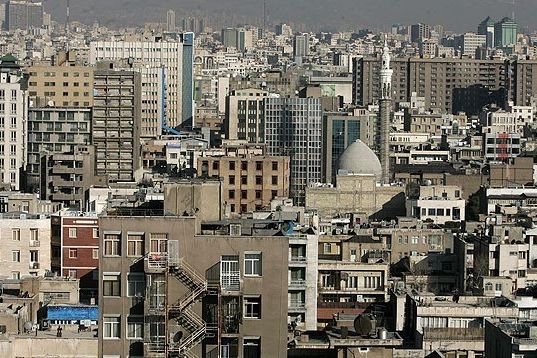
An ordinary neighborhood in Tehran
A board member of the Tehran Real Estate Consultants Union says rents have risen 300 percent in the last three years in the capital, with the bulk of this occurring in the last few months.
Abdollah Otadi told ILNA news website on Monday that rents have risen "terribly" in the last few months, forcing many tenants to sell their car or other properties to afford accommodation even in the cheaper parts of the city.
The rent increases are much higher than the 25 percent rate set by the government, he noted, adding that “we are witnessing the relocation of many tenants to the outskirts of Tehran.”
Surveys by the Central Bank of Iran published in January indicated that rents in the capital Tehran have increased by more than 50 percent in one year as annual inflation is hovering over 40 percent.
Home prices rose in local currency because real estate is a major asset protecting savings in a country like Iran where the national currency has lost value almost tenfold since 2017. In countries without an internationally accepted currency, wealth can disappear with devaluation and people rush to protect their capital.
The drop comes as the last rays of hope for reviving the 2015 nuclear deal between Tehran and world powers are fading away, with multilateral talks in Vienna paused since March.
Saudi Arabia has refused to accept 6,500 Iranian Hajj pilgrims who had been vaccinated against coronavirus with Iranian-made Barekat vaccines.
According to Iranian state-owned paper JameJam, they all had to be vaccinated once again with one of the vaccines approved by Riyadh.
After two years of pared-down pilgrimage due to Covid-19 pandemic restrictions, this year Saudi authorities will permit one million Muslims from inside and outside the country to participate. About 40,000 Iranians are set to attend.
Iraq, with a population of over 40 million, vaccinated 18 percent of its population, short of a 40 percent target set last year by the World Health Organization for January 2022, but has reported about 25,000 deaths. Iran has vaccinated 70 percent and has reported about 141,000 deaths.
Iran has approved at least six homegrown vaccines for production, although some have not completed trials. Most of the 147 million doses administered in Iran are Sinopharm Chinese vaccines, recognized by the World Health Organization.
In January 2021, Iran’s Supreme Leader Ali Khamenei banned the purchase of American and British vaccines, and the state began pushing for homegrown variants.
In September 2021, more controversy ensued when a former member of parliament alleged that Barakat, the most well-connected vaccine developer received one billion dollars from the state in advance and delivered only a fraction of the quantity promised.
Iraqi Foreign Minister Fuad Hussein has criticized the Islamic Republic of Iran's interference in Iraq's internal affairs, saying Baghdad's tone has changed vis-à-vis Tehran.
In an interview with the Egyptian Alghad TV channelaired on Sunday, he said that Tehran has begun to hear a new language from Baghdad, which did not exist before, noting that Iranian interference in Iraq is “unacceptable."
“These problems regarding Iranian interference whether political or otherwise, we have started talking with the Iranian side differently,” he added.
The Iraqi diplomat said Baghdad’s ties with Iran have passed a level of silence and reached a level of frankness.
“We have told our Iranian brothers that we are geographical neighbors and that will stay...therefore we need cooperation, we do not need interference from Iran. Interference in Iraqi affairs cannot be accepted from any state,” Hussein said.
Lawmakers from the Sadrist bloc in Iraq's parliament resigned on Sunday after their leader, powerful Shiite Muslim cleric Moqtada al-Sadr, asked them to step down amid a prolonged stalemate over forming a government without former Prime Minister Nouri al-Maliki and his Iran-aligned coalition.
On Saturday, Hussein said that Iraq had submitted a formal complaint to Iran for its aggressive behaviors toward Iraq and the Kurdistan Autonomous Region, and denied Iran's allegations that the Israeli Mossad is present in Erbil, stressing that Iran must refrain from attacks on the capital of Iraqi Kurdistan.
“We find it strange that Iran chose the Kurdistan region to respond to Israel,” he said.
In March, Iran fired missiles at Erbil. No one was killed but missiles did damage to some residential buildings. Iran claimed it used 12 ballistic missiles in that attack and targeted an Israeli intelligence center.
Iran’s foreign ministry spokesman on Monday dismissed a critical resolution passed last week by the UN nuclear watchdog, the IAEA, criticizing Iran for its lack of cooperation.
Defending the government’s decision to reduce cooperation with the UN nuclear watchdog as a reaction to the resolution critical of Iran, he said, “We could not leave the IAEA’s political and non-technical action unanswered. Our response was decisive and appropriate.”
The resolution called on Iran to engage with the IAEA without delay and expressed “profound concern” at Iran’s failure to satisfy the agency over traces of uranium found at three undeclared sites and highlighted earlier in June in a report from by Grossi.
"The abrupt change in the IAEA chief’s tone, his manner of negotiations, and his discourse when he addressed the European Parliament [earlier in May] clearly shows that he was acting on the orders of an outside player," Khatibzadeh said.
Relations between Iran and the Agency continue within the technical framework, he added, saying that if Grossi wants to come to Iran within the framework of agency, he should have an agenda by the agency, but he can come as a tourist.
Saying that Grossi made a trip to the wrong place and at the wrong time and “met with wrong people, he added, “It is unfortunate that the director general of the International Atomic Energy Agency has granted the unlawful regime of Israel permission to make a mockery of the international organization through its agents, and erode its credibility.”
Reiterating that the move seriously harmed the credibility of the UN nuclear watchdog, Khatibzadeh said that “These actions have discredited the achievements of international organizations. Under the Statute of the IAEA, its chief is obligated to ensure the independence and impartiality of the organization.”
Iran told the IAEA it plans to remove more monitoring equipment after the 35-member IAEA board Wednesday passed the resolution. Tehran says it intends to maintain a basic level of monitoring and inspectors’ access as required under the Nuclear Non-Proliferation Treaty (NPT).
Khatibzadeh also touched on the Vienna talks, saying an agreement is within reach if the United States abandons delusions and fulfills its commitments.
“If the agreement is finalized in Vienna tomorrow, all the measures carried out by Iran are technically reversible,” he said.
Israel has warned Iran not to harm its citizens who are in Turkey, after a travel advisory for Israelis to avoid visiting the country where Iranian agents are known to operate.
Israel urged its citizens Monday to avoid Istanbul or to return home because of what it said was a threat of Iranian attempts to kill or abduct vacationing Israelis.
Foreign Minister Yair Lapid said a "huge effort" by Israel's security forces had saved "Israeli lives in recent weeks" and thanked the Turkish government for its contribution.
He did not give further details. An Israeli security official told Reuters Turkey had arrested several suspected "operatives" of Iran's Revolutionary Guards.
"We are calling on Israelis not to fly to Istanbul - and if you don't have a vital reason, don't fly to Turkey. If you are already in Istanbul, return to Israel as soon as possible," Lapid said in a televised statement.
"These terrorist threats are aimed at vacationing Israelis. They are selecting, in a random but deliberate manner, Israeli citizens with a view to kidnapping or murdering them," he said.
"I want, from here, to relay a message to the Iranians as well. Whoever harms Israelis will not get away with it. Israel's long arm will get them, no matter where they are."
Tehran has vowed to retaliate against Israel, which it blames for the May 22 killing of Hassan Sayyad-Khodaei, an Iranian Revolutionary Guards Corps colonel who was shot dead at the wheel of his car by two people on a motorcycle.
Israel neither confirmed nor denied responsibility, its standard policy over accusations of assassinations. It accused Khodaei of having plotted attacks against its citizens worldwide.
Iran has denied that a Boeing 747 impounded in Argentina over links with the Revolutionary Guard belongs to any Iranian aviation company.
Iranian Foreign Ministry spokesman Saeed Khatibzadeh said at a weekly press conference on Monday that the grounded plane operating for the cargo division of Venezuelan national carrier Conviasa does not belong to Iran’s Mahan Airlines. The United States sanctioned the airline in 2008 for its links to Tehran’s extraterritorial intelligence and secret ops outfit, the Quds (Qods) Force.
Khatibzadeh, however, confirmed that some of the crew on the plane – which was seized upon arrival in Buenos Aires on June 6 -- were Iranians, noting that "The plane has been sold to Venezuelan airlines for more than a year and its crew is not entirely Iranian."
Iran’s aviation chief Mohammad Mohammadi Bakhsh said on Sunday that the Iranian crew on the plane were instructors working as part of an aviation deal between Iran and Venezuela, and that the seized aircraft has not been on Mahan Air’s register.
Argentine lower-house lawmaker and member of the country's Congressional Intelligence Commission Gerardo Milman, who has raised attention to the case in recent days, presented a complaint to a judge asking to fingerprint the crew and share the information with the Federal Intelligence Agency, saying that "Our information is that this is a plane that has come to conduct intelligence in Argentina."
Among the Iranians on board, is Gholamreza Ghasemi, who is a member of the IRGC and a former board member of Fars Air Qeshm, the Iranian airline that is accused of transporting weapons for Hezbollah covering up as civilian jets. He is reportedly a relative of current Interior Minister Ahmad Vahidi, whose assignment by President Ebrahim Raisi triggered condemnation from Argentina given his suspected role in the 1994 AMIA bombing that killed 85 people and injured over 300.