Iran-Backed Parties Gain Power In Iraq’s Parliament After Sadrists Quit
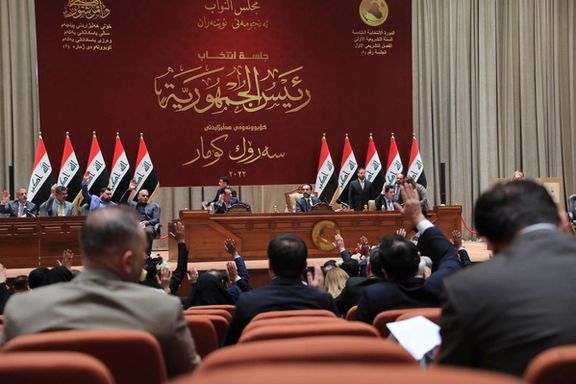
Iraqi lawmakers during a parliament session in Baghdad
About two weeks after the mass resignation of the Sadrist bloc, Iraq's parliament swore in dozens of new lawmakers on Thursday, giving majority to Iran-backed politicians in the assembly.
A group of 73 parliamentarians loyal to the powerful Shiite cleric Moqtada al-Sadr resigned on June 12 upon his order after eight months of stalemate over forming a new government. Addition of the 64 new representatives means the influence of the parties supported by the Islamic Republic of Iran in the Iraqi parliament increased and they once again became the main force in the 329-seat parliament. Nine newly elected representatives were absent for unknown reasons.
"Following the Sadr lawmakers' resignation, we can confirm that we are the largest bloc in parliament with around 130 seats after the swearing in of the new lawmakers," Shiite lawmaker Ahmed Rubaie told reporters.
Sadr's party was the biggest winner in an October general election, and its success had raised the possibility that he could sideline his Iranian-backed rivals who had dominated politics in Iraq for years, but political disagreement among parties hindered parliament from electing a president and forming a government.
Sadr said on Wednesday that his decision to withdraw from Iraqi politics was prompted by pressure exerted by Iranian proxies on non-Shia members of his parliamentary coalition and on the Iraqi judiciary, but dismissed rumors that Iran itself had pressured him directly. “Iran this time did not exert any pressure on any Shiite party.”
Hosting Russian counterpart Sergei Lavrov, Foreign Minister Hossein Amir-Abdollahian reiterated Thursday Iran’s support for a diplomatic end to the Ukraine war.
Amir-Abdollahian was speaking at a press conference alongside Lavrov, who arrived in Iran Wednesday on a two-day visit that appears to bring Moscow and Tehran closer. Talks have reportedly covered the 2015 Iran nuclear deal and boosting bilateral trade as the fall-out from Ukraine continues.
“We believe that American actions done through NATO are part of the crisis' causes,” Amir-Abdollahian said. “However, the Islamic Republic does not see war as a solution and welcomes political talks…”
Lavrov stressed the importance of adding “depth” to the “height” of existing Iran-Russia relations, and suggested “experts” should work on “ways to substantiate” the 20-year cooperation agreement in principle reached February, which some Iranian analysts argue has yielded few benefits. The Russian foreign minister also made an oblique remark on extending “the protection of intelligence,” probably referring to enhanced security cooperation.
‘Correct understanding’
The Russian foreign minister said he agreed with sentiments over Ukraine expressed Wednesday by President Ebrahim Raisi, who had warned of the necessity of being “active in the face of attempts to expand NATO’s influence in any part of the world, including in West Asia, the Caucasus and Central Asia.” Lavrov thanked Iran “for his correct understanding of the roots of this problem.”
While Russia, alongside China, voted against the June 8 resolution critical of Iran raised by the United States and three European states at the International Atomic Energy Agency (IAEA), Moscow’s efforts to discount exports – especially oil and steel– can have adverse consequences for Iran, including cutting its competitiveness in supplying China.
But any new pattern is unclear. According to Petro-Logistics, the oil trade analysts, Iran’s oil exports jumped from an average 461,000 barrels per day in May to 961,000between June 1 and June 19. China has been easily Iran’s main crude market since the US in 2018 imposed ‘maximum pressure’ sanctions, threatening punitive action against third parties, when Washington left the 2015 nuclear deal, the Joint Comprehensive Plan of Action (JCPOA).
Prior to receiving Lavrov in Tehran, Amir-Abdollahian June 8-10 visited India, which has not only resisted US and European calls to boycott Russian oil exports but increased its purchases to the extent Moscow became last month its second largest crude supplier, after Iraq.
Some analysts in India have welcomed the ‘independent’ approach of Prime Minister Narendra Modi, comparing it favorably with New Delhi’s decision in 2007 under US pressurenot to go ahead with a gas pipeline from Iran, a move that followed India voting at the IAEA in 2005 to refer Iran to the United Nations Security Council. India abstained on the June 8 vote censuring Iran at the IAEA governing board.
During Abdollahian’s visit, India’s Prime Minister Narenda Modi tweeted June 8, the day of the IAEA censure resolution: “Our relations [with Iran] have mutually benefited both the countries and have promoted regional security and prosperity.”
Turkey said Thursday it thwarted a planned attack against Israeli tourists in Istanbul, and detained eight suspects allegedly working for an Iranian intelligence cell.
Turkey's National Intelligence Organization (MIT) revealed the operation on Thursday just before the arrival of Israel’s Foreign Minister Yair Lapid to Turkey, adding that the eight, who were not all Iranian nationals, were arrested in a raid in three houses in Istanbul’s Beyoglu district last week.
According to reports, Iranians planned to kidnap Israeli diplomats and tourists in Istanbul, including the former Israeli ambassador and his wife who were staying at a hotel in the city.
The agents were disguised as students, while members of Iran's Revolutionary Guards were undercover as businessmen and tourists, according to Hurriyet Daily News.
Turkish news agency İhlas Haber Ajansı said, "The hitmen in the assassination team, who settled in two separate rooms on the second and fourth floors of a hotel in Beyoglu, were (detained) with a large number of weapons and ammunition."
Israel's intelligence agency, Mossad, had already evacuated the targeted Israelis from their addresses to Tel Aviv on a private plane.
Israeli officials and media began issuing warnings to citizens against traveling to Turkey in the end of May, citing suspected killing or abduction plots by Iran, which has vowed to avenge the May 22 assassination of a Revolutionary Guards colonel in Tehran that it blamed on Israeli agents.
Chinese Foreign Minister Wang Yi says his country has urged the US to respond positively to Iran's "reasonable" concerns in the year-long nuclear talks.
Iran’s ambassador to China, Mohammad Keshavarzzadeh, said on Thursday that Wang made the remarks in a phone talk with Iranian Foreign Minister Hossein Amir-Abdollahian.
While China supports pushing forward the Vienna negotiations to restore the 2015 nuclear deal, Beijing has kept close communication with Tehran since the talks stalled in March, reportedly because of Iran’s insistence for the removal of its Revolutionary Guard (IRGC) from the US list of Foreign Terrorist Organization (FTO).
Earlier in the week, Tehran again blamed Washington for lack of progress in talks, saying it is ready to resume negotiations to achieve a “good deal”. But a good deal for Iran means something very different from what the US says is possible.
The Biden Administration that came to office with a promise to restore the Obama-era Joint Comprehensive Plan of Action or JCPOA, says that it is ready to lift nuclear-related sanctions imposed by its predecessor but does not want to discuss “extraneous issues,” meaning sanctions imposed by the Trump administration over support for terrorism or other violations by Iran and Iranian entities.
IRGC-linked news agencies have reported that the Guards' counter-intelligence chief Mohammad Kazemi has replaced Hossein Taeb as the IRGC's intelligence chief.
Tasnim quoted IRGC's Public Relations spokesman Ramazan Sharif as saying that IRGC Commander Hossein Salami has appointed Kazemi as the IRGC's new intelligence chief on Thursday, June 23.
Sharif told Tasnim that Hossein Taeb has been appointed as an "adviser" to the IRGC commander, a clear sign that the former intelligence chief has been demoted. Meanwhile, the fact that Taeb's removal and Kazemi's appointment is announced by a low-key IRGC officer rather than Supreme Leader Ali Khamenei who directly oversees the IRGC Intelligence is another indication that Taeb has been dismissed from his job.
Tasnim placed the news about Taeb under its top story which is about Lavrov's visit in an elaborate attempt to downplay the development. The report's headline is also about Kazemi's appointment rather than Taeb's removal.
In recent weeks there were multiple mysterious incidents in which IRGC officers and operatives were killed or died in unexplained circumstances. Iran blamed Israel for some of the incidents.
According to Sharif, Kazermi has been the IRGC Intelligence Organization's counter-intelligence chief for many years and is highly experienced in intelligence and security matters. Kazemi is a brigadier general while Taeb was a cleric with some military experience that dated back to the 1980s war with Iraq.
According to political analyst Morteza Kazemian, Taeb, one of the most feared men in Iran's security system, was the second strongest man in the country's intelligence system only after Khamenei. Kazemian added that Taeb maintained good relations with Khamenei's son Mojtaba, a former comrade during the war.
Meanwhile, Kazemian suggested that Russian Foreign Minister Sergey Lavrov visiting Tehran on Thursday, possibly carried a message that revealed flaws in Taeb's performance. In a press conference in Tehran Lavrov Thuesday did refer to an "intelligence protection agreement|" with Tehran, wihtout elaboration.
Taeb was recently harshly criticized by social media activists and some politicians for failing to detect and prevent Israel's destructive operations in Iran.
Social media activists also said that the change on top of the IRGC Intelligence Organization revealed a divide in the organization that was already noticed after several leaks. On the other hand, the fact that an Israeli news outlet, Kaan News reported Taeb's removal from his post several days before its confirmation by Iranian officials, was another indication that Israel had access to insider information from the IRGC Intelligence Organization.
Furthermore, the choice of the new chief from the counter-intelligence unit, points out the fact that the reason for the change was something happening within the organization where Kazemi was in a better position to detect the leaks.
The spokesman for Iran's Reform Front, Ali Shakouri Rad also saidin a tweet on the same date that: Taeb's removal is a very important development which requires to be elaborated as the organization has a major role in elections and the running of the affairs of the state in Iran."
Prime Minister Naftali Bennett says the Islamic Republic will pay the price of targeting and threatening Israel on its own territory, implicitly confirming Israel’s role in the assassinations of IRGC officers.
Describing what he calls his “Octopus doctrine,” he said Israel hits Tehran at the head of the octopus rather than its tentacles that have spread across the region.
Bennett added, “It turns out these guys are more vulnerable than they seem. The Iranian regime is rotten, corrupt — and incompetent.”
Bennet accused Tehran of “violating fundamental requirements” of the Nuclear Nonproliferation Treaty and seeking to strike Israel directly using unmanned aerial vehicle.