Iran Calls For Release Of Diplomats Detained In Europe
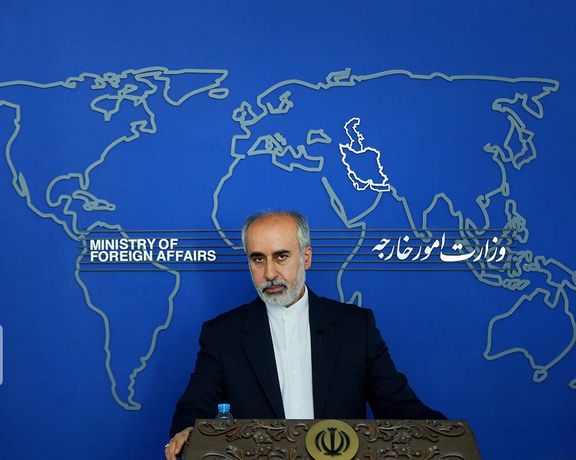
Iran's foreign ministry’s new spokesperson Naser Kanani
Iran repeated calls for release of Assadollah Assadi, serving a 20-year sentence in Belgium over a terror attack in Paris, and former jailor Hamid Nouri, on trial in Sweden for his role in 1988 prison purges.
Iran repeated calls for release of Assadollah Assadi, serving a 20-year sentence in Belgium over a terror attack in Paris, and former jailor Hamid Nouri, on trial in Sweden for his role in 1988 prison purges.
Foreign ministry’s new spokesperson Naser Kanani told reporters on Wednesday that Tehran is following up the cases to free former officials as soon as possible. Their cases were a priority for the foreign ministry since their arrest, he added.
“Assadi’s unconditional release is Iran's request, and talks are ongoing with the Belgian government, and we hope that with the efforts we have made, we will see the release of this diplomat in the near future,” he said.
Kanani also said the Iranian Embassy in Sweden and the foreign ministry have seriously put consular support for Nouri’s release on their agenda. “We believe that the arrest of this Iranian citizen does not have a proper judicial basis and unfortunately, the political atmosphere of a hostile and terrorist movement has provided the ground for his illegal arrest.”
Iran says Nouri’s detention is driven by “false allegations” made by the Albania-based opposition group Mujahedin-e-Khalq Organization (MEK).
Government and military officials in Iran have warned the population over disobeying hijab rules, one day after many women took off their headscarves in public.
The interior minister, Ahmad Vahidi, warned women that the government’s fearsome Special Unit will deal with those “breaking rules” and will not allow people to “intentionally cooperate with the enemy.”
The act of civil disobedience on July 12 was called by women’s rights and civic activists as authorities in recent weeks increased harassment of women in the streets for “improper hijab”. Patrols and check points by the so called ‘morality police’ were highly visible in large cities. Government agents in charge of “vice and virtue” stopped women and detained them in special police vans for questioning, warnings and even detention.
But on Tuesday large numbers of Iranian women defied forced hijab rules and came out without headscarves and in some cases dressed in attire common in most countries, such as trendy jeans and T-shirts forbidden by the Islamic Republic.
No major incidents were reported as women defied the rules, probably because the government did not want to create further tensions on that particular day, which would project the picture of a successful act of civil disobedience. But official threats rang out before the day was over and on Wednesday.
The representative of Supreme Leader Ali Khamenei in the religious city of Qom demanded decisive action against opponents of hijab. The army’s ideological-political commissar said, “Hijab is our first line of defense. If it falls, all other bulwarks will fall.”
This remark will perhaps stay as an iconic quote for a long time to come. Observers, analysts and critics have long said that the Islamic Republic uses hijab and other social restrictions, such as bans on female singers, dancing and alcoholic drinks as ways of imposing control over society.
The spokesman of the armed forces, that encompasses both the traditional army and the Revolutionary Guard, called those who do not follow hijab rules “Satan’s troops”. Speaking at a ceremony on Tuesday Abolfazl Shekarchi said these individuals are in fact engaged in ‘Moharebeh’, a serious crime according to Sharia. Moharebeh in Iran’s Islamic law means the act of taking up arms against the people, which is identical to fighting God. Being convicted of the offense could carry the death penalty.
The interior minister who had traveled to the shores of the Caspian Sea in the north also spoke about plans to segregate beaches and said the government should set up public awareness mechanisms to teach 20 million annual visitors to the resort areas about proper Islamic behavior. Almost all tourists who visit the Caspian shore are Iranians.
When the Islamic Republic imposed hijab in early 1980s, Iran had a population of around 30 million, which has grown to 80 million. The vast majority never saw the pre-1979 era when Iran had social freedoms. They only see photos or films showing women walking around in Western attire. They also have the Internet and can see the lifestyle in other countries. Many also travel abroad, or at least to neighboring countries such as Turkey, Azerbaijan and the United Arab Emirates, where they see Muslims can choose what to wear.
More than 10 human rights and activist groups urged Belgian lawmakers Tuesday to reject a prisoner swap deal with Iran that could result in the release of a convicted terrorist.
In a statement, the signatories said approving such a treaty condones hostage-taking policy by the Islamic Republic and undermines accountability for Iranian officials convicted for acts of terrorism abroad.
“We warn against a political deal that would legitimize Iran’s hostage-taking and swap deals as an acceptable state’s foreign policy,” they said, adding, “Belgium must call out Iran’s shameless instrumentalization of human lives to impose its political agenda upon the international community, not facilitate it.”
They called on the Belgian Parliament to say no to a treaty “which may result in impunity for human rights violators, and put lives of Europeans and dual nationals in danger,” noting that the international community should “step up its efforts to hold Iran accountable for its human rights violations and for its shameless instrumentalization of human lives. Impunity should never be an option.”
A draft law could lead to the release of Assadollah Assadi, an Iranian diplomat serving a 20-year prison sentence in Belgium for planning a terror attack in Paris four years ago.
An official of Ukrainian President Volodymyr Zelenskyy’s political party says news of Tehran planning to arm Russia with drones has shocked Ukrainian officials.
Yevheniia Kravchuk who is also a member of the Ukrainian parliament told Iran International Tuesday that Tehran’s decision would lead to the death of more Ukrainian civilians.
US National Security Adviser Jake Sullivan Monday said that Russia wants to obtain hundreds of drones from Iran, both for surveillance and attack, to use in its war in Ukraine.
“Our information indicates that the Iranian government is preparing to provide Russia with up to several hundred UAVs, including weapons-capable UAVs on an expedited timeline,” he told reporters Monday, adding that Washington’s information further indicates that Iran is “preparing to train Russian forces to use these UAVswith initial training sessions slated to begin as soon as early July.”
The Iranian foreign ministry gave an evasive answer to a reporter who asked about Sullivan’s statement. “The Islamic Republic’s cooperation with the Russian Federation in some new technologies predates the war in Ukraine and lately there have been no particular new developments,” the ministry spokesman Naser Kanani said.
"The position of the Islamic Republic of Iran regarding the war in Ukraine is quite clear and has been officially announced many times," he added, but did not clearly deny the news about delivering drones.
The Russian President Vladimir Putin is to visit Tehran next week.
Tehran has not officially taken side with Russia on Ukraine and says the conflict should be resolved through dialogue but many officials, including President Ebrahim Raisi, have implicitly pointed a finger at Ukraine and accused the country of instigating Russia to attack by seeking to join NATO.
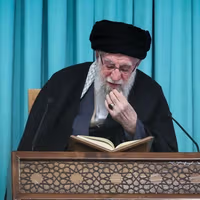
In a televised speech in early March Iran’s Supreme Leader Ali Khamenei said Iran was against war in Ukraine but held the US responsible for disrupting stability and "creating a colored coup". Reiterating that the US and Western countries cannot be trusted, Khamenei said Ukraine has fallen victim to US policies and the crises created by Washington without mentioning Russia's invasion in his speech.
Tehran has very close political and military ties with Moscow, whereas its relations with Ukraine have been quite sour since January 2020 when the IRGC shut down a Ukrainian commercial flight near Tehran killing all 176 passengers onboard.
Military analyst Samuel Bendett of the CNA think tank told Associated Press that Russia’s choice of Iran as a source for drones is logical because “for the last 20 years or more Iran has been refining its drone combat force. Their drones have been in more combat than the Russians’.”
Bendett said the Iranian drones could be very effective at striking Ukrainian power stations, refineries and other critical infrastructure. Bendett added that before the Ukraine war, Russia had licensed drone technology for its Forpost UAV from Israel which is no longer supplying them to maintain neutrality.
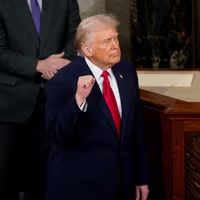
US President Joe Biden and Israeli Prime Minister Yair Lapid will sign the Jerusalem Declaration this week, which also pledges a joint stance against a nuclear Iran.
The declaration that outlines US-Israeli strategic partnership will include a mutual commitment against Iran’s nuclear program and regional aggression, with both countries pledging they will use “all elements of national power” to ensure Iran never builds a nuclear weapon.
President Biden will be in Israel on Thursday during a regional trip, with the highlight of a long-expected visit to Saudi Arabia.
During Biden’s visit Iran will be a focal point of discussions, with attempts to launch a regional air defense system including Israel and US Arab allies. It could also culminate in steps to bring Saudi Arabia closer to normalizing relations with Israel.
President Biden is also expected to reaffirm US commitment to Israel’s security with annual assistance and a pledge to uphold its military edge, which is becoming more important with the advance of Iran’s missile program.
The Jerusalem Post quoted an unnamed official as saying that Iran will be at the top of the bilateral agenda, with talks to restore the 2015 nuclear deal stalled and Iran boosting uranium enrichment. He added that Iran is playing for time, calculating that the longer the current situation lasts the more advantage it will gain.
Iran says its oil production in June increased by 31,000 barrels a day, rejecting reports that Russia has taken market share, shipping more oil to China.
The government’s office news website IRNA said Tuesday that the latest OPEC monthly report shows that Iran produced 2,574,000 barrels per day in June, slightly higher than in May.
Kpler, a market intelligence firm reported in June that Iran’s oil shipments had halved in May due to Russian competition after many countries boycotted imports from Moscow after the invasion of Ukraine. Other reports said that more than 30 million barrels of Iranian oil remained unsold in Asia.
IRNA highlighting the small increase in production has rejected these reports saying that despite US sanctions on Iran’s oil exports sales continue.
However, the impact of Iran’s illicit oil exports is not felt in Tehran’s financial markets where the currency, rial is close to its all-time lows and the government this week failed to pay monthly cash handouts to fixed-income Iranians.
Amid its economic crisis the hardliner government of President Ebrahim Raisi tries to present the overall situation in a positive light as it refuses to make a deal with the United States over limiting its nuclear program in return for the lifting of sanctions.
OPEC overall increased oil production by 234,000 barrels per day in June.