Ten Years Jail For Iranians Sending Videos To Women’s Rights Activist
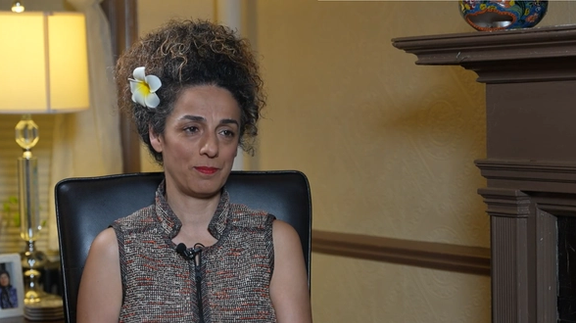
Anti-hijab activist Masih Alinejad
After dozens of Iranian women unveiled in public and sent their videos to anti-hijab activist Masih Alinejad in New York, Iran says sending her footage can lead to up to 10 years in jail.
Ali Khan-Mohammadi, the spokesperson of Iran’s Headquarters For Enjoining Right And Forbidding Evil, tasked with promoting the Islamic Republic’s interpretation of Islamic laws, said on Saturday that any cooperation and sending videos to Alinejad will be considered a violation of Article 508 of the Islamic Republic’s Penal Code, and can result in one to ten years imprisonment.
He noted that the ban is not limited to sending photos and videos of protests against the compulsory Islamic dress code – or hijab, adding that any material that is deemed against the Islamic Republic will be punishable. According to Article 508, any collaboration with “enemies and hostile media networks” is a serious violation and lead to imprisonment.
Accusing Alinejad of being a CIA and UK foreign intelligence service MI6 agnet, Khan-Mohammadi said she is a “sworn enemy of the nation” who seeks to undermine the territorial integrity of the country and create division and polarization among the people.
Iranian authorities have transferred female prisoners from two penitentiaries with harsh living conditions to the main Evin prison in Tehran, where they can be under better surveillance.
A few days after female political prisoners were transferred from Qarchak to Evin, the political prisoners of the Fashafouyeh prisonwere also transferred to Evin on Sunday.
The transfers from Qarchak, also known as Rey or Shahr-e Rey Women Prison on July 20, and Fashafouyeh, aka the Greater Tehran Central Penitentiary, to Evin both were carried out abruptly and without any explanation by the authorities.
However, former political prisoner and civil rights activist Arash Sadeghi wrote on social media that the transfers were done with the aim of imposing restrictions and having more control on political prisoners rather than separating them based on crimes.
He added that for example there is limitations in access to telephones in Evin's women’s ward and the Ward Six of Evin – where the political prisoners of Fashafouyeh are held – is close to Ward 209 that belongs to the Intelligence Ministry, making it easier to put pressure and restrictions on the prisoners of conscience.
Moreover, considering the disastrous situations of the Qarchak and Fashafouyeh detention centers, which were being leaked out by the political prisoners, the Islamic Republic preferred to transfer them to Evin instead of closing or changing the conditions of these two prisons, he said, noting that in this way no more news from these two prisons will go out.
Iran’s revenues from oil and other exports have increased but so has the rate of capital flight, figures from the Central Bank of Iran (CBI) indicate.
The CBI report published last week indicates that in the fiscal year ending March 20, 2022, the country's revenues from exporting oil, gas, as well as oil and gas products and by-products, amounted to nearly $39 billion, $17 billion more than the previous fiscal year when oil prices were much lower.
The 84% increase in oil export revenues, however, was accompanied by a nearly 50% increase in capital flight in comparison with the previous fiscal year (ended March 20, 2021) as trust in the local economy and the political future of the country appeared to have diminished.
According to the latest OPEC figures, Iran earned more than $25 billion from selling crude oil in 2021. There have been numerous reports since late 2020 that Iran has been selling more oil, clandestinely, despite US sanction. Iranian shipments increased from as low as 200,000 barrels per day in 2019 to as high as more than one million barrels in January 2022. In 2020 Iran earned only around $8 billion due to enforcement of US sanctions.
The precise amount of capital leaving Iran is very difficult to calculate but it can be deducted from the official data on net capital account deficit. According to the CBI’s latest report, the net capital account deficit stood at $9.3 billion during the fiscal year ending March 20, 2022.
The hard currency outflow from the country is invested in various ways including in real estate, stocks, bonds, cryptocurrencies, or establishing of companies abroad. Investment in neighboring countries is particularly popular. The high rate of inflation and the huge drop in the value of the national currency have also hugely contributed to the urge to invest in such markets instead of domestic production and services.
One of the indications of capital flight from Iran is the popularity of property acquisition in neighboring countries such as Turkey, the United Arab Emirates, and Georgia which often goes hand in hand with business investments.
According to a report by the state broadcaster’s Young Journalists Club (YJC) in April, the value of assets held by Iranians abroad was estimated at between 3 to 4 trillion dollars in 2015, about 10 times the country’s gross domestic production.
Experts say CBI figures indicate that Iranians are fearful about the safety of their investments despite promises of government officials last year that the 2015 nuclear deal, Joint Comprehensive Plan of Action (JCPOA) would be restored.
They argued that the administration of President Ebrahim Raisi does not tie the economy to the outcome of the nuclear talks and restoration of the JCPOA and therefore, the economy would not be damaged even if the talks to restore the deal failed and US sanctions continued.
Iran has also struggled to attract foreign investment since the United States withdrew from the 2015 nuclear deal and slapped sanctions on oil exports, international banking, and officials of the Islamic Republic. Any entity worldwide supplying dollars to Iran is vulnerable to punitive US action.
According to official figures, Iran's net capital account balance was positive from 2001 to 2005 when there was foreign investment. But in the following years, except in 2014, the balance has been in the negative.
Israel has called on the international community to "stop" the nuclear program of the Islamic Republic before it is "too late".
In a tweet on Sunday, the Israeli Foreign Ministry said that “a nuclear Iran is not a threat only to Israel, but to the entire region and the world.”
Echoing remarks by the head of the UN nuclear watchdog, the International Atomic Energy Agency (IAEA), Rafael Grossi, the ministry said, "Today what we have is a nuclear program that has grown enormously....” and a country that does not seek nuclear weapons would not enrich uranium to 60 percent.
On July 22, Grossi told Spain's El Pais newspaper that the Islamic Republic’s nuclear program is "galloping ahead" and the IAEA has very limited visibility on what is happening.
In 2019, Iran began breaching restrictions on its nuclear program following the 2018's pullout of the United States from the 2015 deal, the JCPOA, or the Joint Comprehensive Plan of Action. The process accelerated after President Joe Biden’s administration signaled it was ready to return to the JCPOA.
“If there is an agreement, it is going to be very difficult for me to reconstruct the puzzle of this whole period of forced blindness,” Grossi said. “It is not impossible, but it is going to require a very complex task and perhaps some specific agreements.”
Iran would like to see a nuclear agreement taking shape soon, but it will not act with emotion and haste, Iran’s foreign ministry spokesman Naser Kanaani said Monday.
The Islamic Republic appointed Sunday Saeed Iravani, a former deputy of the country’s top security official Ali Shamkhani, as Iran’s new ambassador to the United Nations.
Iravani, who will replace Majid Takht-Ravanchi, served as a deputy of Shamkhani, the secretary of Iran's Supreme National Security Council (SNSC), for nine years. Majid Takht-Ravanchi was among the last officials appointed by former foreign minister Mohammad Javad Zarif, who led the Iranian negotiations with P5+1 countries which produced the 2015 nuclear deal – or the Joint Comprehensive Plan of Action.
Iravani also served as Iran’s chargé d'affaires in Iraq and secretary of Iran’s Strategic Council on Foreign Relations. He has career overlaps with current lead nuclear negotiator Ali Bagheri-Kani – as both served as SNSC deputies. He is the first Iranian ambassador to the UN with extensive SNSC experience. Iravani's diplomatic assignments -- spearheading the Saudi-Iranian dialogue in Baghdad and his experience as chargé d'affaires -- have been more regionally focused than his predecessors to date.
President Ebrahim Raisi also appointed new ambassadors to six countries – Georgia, India, Lebanon, Czech Republic, Poland, and Sierra Leone -- on Sunday, practically cleansing the diplomatic roster of appointees from the administration of former president Hassan Rouhani. A cleric, Khalil Sadati Amiri, was named as Iran's ambassador to Sierra Leone.
Moreover, Raisi appointed Ali Bahraini as Tehran’s permanent representative to the UN Office and other international organizations in Geneva.
Although Iran had declared a pro-East policy in 2018, its reliance, particularly on Russia became more evident during a visit by Vladimir Putin on July 20.
Nonetheless, Supreme Leader Ali Khamenei’s supporters have exhibited endless fascination with Russia and Putin's charm offensive during his latest visit.
The Supreme Leader's senior international affairs adviser Ali Akbar Velayati, who was dozing off while Khamenei and Putin were talking through interpreters, has said: "What do reason and wisdom tell us? Should we go toward the West that has always been our enemy? Or should we go toward the East that has always helped us as much as it could?"
Velayati claimed elsewhere: "Putin believes in spirituality. Previous Kremlin leaders were Godless, but now from Putin to lower officials are either Christian or Muslim."
As if this was not enough, Assembly of Expert member Ahmad Hossini Khorasani said: "Putin's modest gestures in front of Khamenei was like a pupil's sitting in front of his teacher, and that is an honor for Islamic Iran."
International relations expert Ali Bigdeli, however, told Arman Emrooz that that Iran's reliance on the East is a strategic mistake and certainly against Iran's national interests. However, he noted that anti-Americanism has always been part of Tehran's policy since the 1979 revolution, but the government of President Ebrahim Raisi has escalated the anti-US policy.
Referring to Russia's track record of broken promises and hypocrisy in its relations with Iran before and after the 1917 Russian revolution, Bigdeli said that Iran should have taken a lesson from Russia's invasion of Ukraine.
Meanwhile, Bigdeli warned that Russia is not capable of meeting Iran's economic needs and noted that Moscow has already failed to fulfil its commitments in nuclear, air defense projects and other projects. Bigdlei said that the latest visit by Putin simply showed that he was isolated in the world following the invasion of Ukraine and was pretending that he has found a major ally in Tehran.
He warned that Iran should not land in Russia's lap as a result of its enmity with the West. He noted that Iran currently needs $200 billion to reconstruct its oil industry but Russia and even China are incapable of providing funding for that project.
International relations expert Hassan Hanizadeh told the daily that "Iran's ‘Looking East’ policy was a choice between bad and worse." However, he justified the move as "an outcome of broken promises on the part of the United States" and said that "Iran started to seriously align its policy with those of Moscow only after former US President Donald Trump pulled the United States out of the nuclear deal with Iran in 2018."
"As the Vienna talks ended in a deadlock, the current government of Iran is now keener to follow the Looking East policy as US sanctions badly affect the country's economy, and the West's broken promises have pushed Iran to get closer to Russia and China," Hanizadeh said.
Ultraconservative analyst Foad Izadi on the other hand argued that getting close to Russia can serve Iran's major national interests. He said pro-Western analysts describe the current situation as Iran's reliance on Russia and China, but he claimed Iran is simply maintaining relations with them and is not building reliance.
However, Izadi warned that Iran should not get itself entangled in dichotomies such as choosing between reviving the JCPOA or relying on Russia.