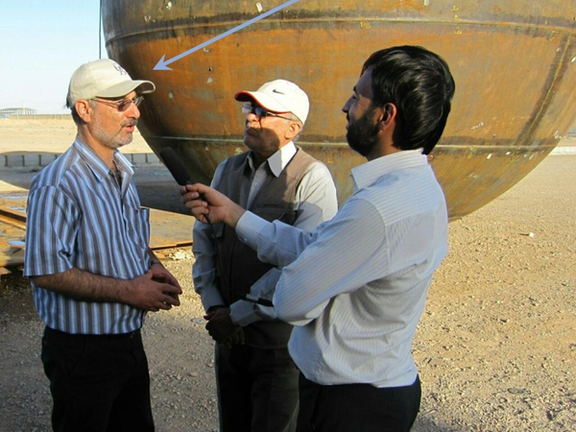
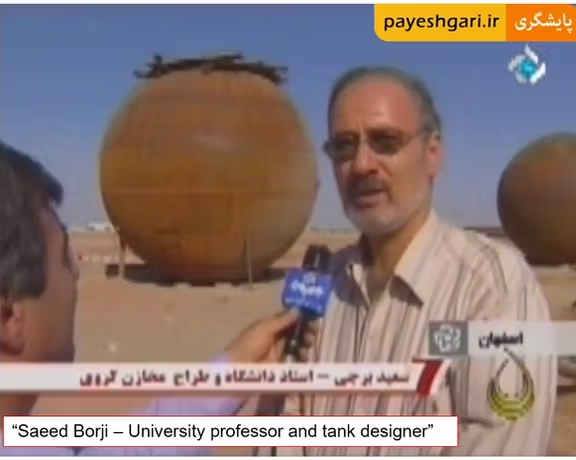
Iranian explosives and metals expert Saeed Borji (left)
An Iranian specialist of nuclear detonators, who was previously working at a secret nuclear weapons development test site in Iran, is said to be still working for the defense ministry on nuclear weapons.
According to information obtained by Iran International, Saeed Borji is working to develop nuclear detonators for the ministry’s Organization of Defensive Innovation and Research -- or SPND.
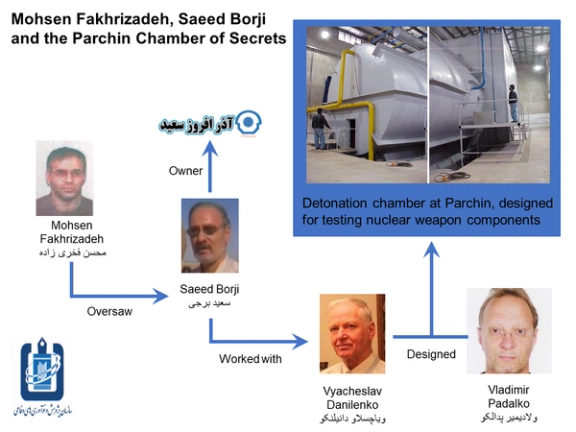
A protege of the once-top Iranian nuclear weapons scientist and a senior member of Iran's Revolutionary Guard, Mohsen Fakhrizadeh -- who was assassinated in November 2020 – Borji runs a front company named Azar Afrouz Saeed Engineering Company, specializing in explosives. The company is a subsidiary of SPND.
The explosives and metals expert for Shahid Karimi Group, also a subsidiary of SPND, has been associated with "possible military dimensions of the Iranian nuclear program," according to the International Atomic Energy Agency (IAEA), and has assisted SPND’s efforts to procure equipment used for containing explosions.
Borji, who has a PhD in chemical engineering from Malek Ashtar University of Technology, has previously worked in Parchin military complex with Russian-born former Soviet scientist Vyacheslav Danilenko – with an extensive expertise in the development of nuclear detonators – and Vladimir Padalko on projects about explosive chambers for nuclear weapons.
The Abadeh site is an important site for conducting large-scale high explosive tests for developing nuclear weapons under the Amad Plan, which was Iran’s project during the early 2000s to build five nuclear weapons and later was reoriented to a smaller, better camouflaged nuclear weapons program. Abadeh was first identified as a weapons site in October 2019 by Israeli Prime Minister Benjamin Netanyahu. The site was built in the mid-1990s by companies controlled by the Islamic Revolutionary Guard Corps
The Abadeh site also called Marivan site in the southwestern Fars province, is one of the places that the IAEA found traces of undeclared uranium and demanded explanation from the Islamic Republic. Iran said the origin of the particles is "unknown" and insisted the site was used for "the exploitation of fireclay through a contract with a foreign company decades ago."
Borji was sanction by the United States on March 22, 2019 as a Specially Designated National (SDN) by the US Department of the Treasury's Office of Foreign Assets Control (OFAC) pursuant to Executive Order 13382, which targets proliferators of weapons of mass destruction and their delivery system.
Late in July, two Telegram channels with links to IRGC suggested that Iran may build nuclear warheads “in the shortest possible time” if attacked by the US or Israel, which has repeatedly threatened in recent months to use all means at its disposal to prevent Iran from becoming a nuclear threat, and has said its armed forces are preparing for action if necessary.
“The nuclear facilities of Fordow have been built deep under mountains of Iran and are protected against trench-busting bombs and even nuclear explosion… all infrastructures required for nuclear breakout have been prepared in it,” the video by Bisimchi Media (Radioman Media) Telegram channel said while adding that the facilities at Natanz may be highly vulnerable to a possible attack by Western powers and Israel but Fordow will immediately assume war footing and begin the nuclear breakout project within a short time if Natanz comes under missile attack.
EMAD, another form of an earlier weapons program, AMAD, refers to Iran’s purported secret nuclear effort, which started in 1989 under the leadership of Fakhrizadeh and according to the UN nuclear watchdog IAEA, stopped in 2003. According to a IAEA director general’s report in 2015, Iran specifically denied the existence of the AMAD Plan and the ‘Orchid Office’ as elements of such a program.
Iran has now enough uranium enriched to 60 percent purity and if further enriched to 90 percent, the fissile material will be sufficient for a nuclear bomb within a few weeks.
Eight US Republican Senators have written to President Joe Biden asking him to deny a visa to Iran’s President Ebrahim Raisi who plans to travel to the UN in New York in September.
Earlier this week, an Iranian spokesman said that Raisi (Raeesi) is preparing to attend the United Nations General Assembly in New York for the first time. Last year after he toook office he did not travel to New York and send a video address to the General Assembly.
Senators Tom Cotton, March Rubio, Joni Ernst and Ted Cruz are among the eight Senators who told Biden, “Raisi’s involvement in mass murder and the Iranian regime’s campaign to assassinate U.S. officials on American soil make allowing Raisi and his henchmen to enter our country an inexcusable threat to national security.”
Raisi is accused of being a member of a death commission that ordered the summary execution of thousands of political prisoner sin Iran in 1988.
Moreover, US law enforcement arrested a man armed with an AK-47 assault rifle in Brooklyn last week near the house of a well-known Iranian journalist and women’s rights defender Masih Alinejad, believed to be a target of the Iranian regime. Last year, the US uncovered a plot by Iranian intelligence to kidnap the activist.
The Senators in their letter cited precedence of US denying visas to Iranian and other leaders and diplomats for visiting the UN, urging President Biden to also deny entry to Raisi and his aides.
A US-based think tank says al-Qaeda terrorist group’s second in command, who is set to become its new leader following the death of Ayman al-Zawahiri, is in Iran.
Senior researcher of the Foundation for Defense of Democracies Behnam Ben Taleblu told Sky News on Tuesday that following the death of al-Zawahiri, “All eyes are on Iran’s eastern border.” “With the killing of al-Zawahiri, the next up – believed to be number two of al-Qaeda – is assumed to be in Iran.”
“So that may mean that the Iranian government – if that individual is still there – will have to decide what to do; to expel this person or to allegedly promote them or to basically facilitate the rise of Al-Qaeda’s next leader.
According to the 2019 US State Department’s terrorism report, Tehran allowed al-Qaeda to transfer money via Iran, as well as to transit personnel and resources across conflict zones such as Afghanistan and Syria.
In the past years, several US officials, including ex-CIA director Mike Pompeo, accused the Islamic Republic of having links with al-Qaeda, citing documents that were declassified.
Senior al-Qaeda facilitator and financier Ezedin Abdel Aziz Khalil, also known as Yasin al-Suri, is also allegedly based in Iran.
United States and Iranian officials played down prospects as they headed to Vienna for the resumption of nuclear talks on Thursday.
“Our expectations are in check, but the United States welcomes EU [European Union] efforts and is prepared for a good faith attempt to reach a deal,” Rob Malley, the US special envoy for Iranand lead nuclear negotiator, wrote on Twitter. “It will shortly be clear if Iran is prepared for the same.”
“[Iranian negotiator Ali] Bagheri Kani will leave Tehran in a few hours,” said Iran’s foreign ministry spokesman Nasser Kanaani in Tehran. “In this round of talks, which will be held as usual with the co-ordination of the European Union, ideas presented by different sides will be discussed.”
The talks are expected to focus on a written text submitted July 20 by Joseph Borrell, the EU foreign policy chief. The resumption of talks aimed at restoring the 2015 Iran nuclear deal, the JCPOA (Joint Comprehensive Plan of Action) was announced earlier Wednesday by Enrique Mora, the senior EU official who coordinated year-long Vienna meetings between Iran and six world powers, which paused in March.
‘Ominous legacy’
“Heading to Vienna to advance the negotiations,” Bagheri Kani tweeted. “The onus is on those who breached the deal & have failed to distance from ominous legacy…The US must seize the opportunity offered by the JCPOA partners’ generosity; ball is in their court to show maturity & act responsibly.”
But on August 1 Iran said it started feeding fuel into “hundreds” more IR-1 & IR-6 centrifuges – devices used to enrich uranium – as part of a plan for a capacity of at least 190,000 SWU (separative work units), a measurement of efficiency in enrichment. Under the JCPOA Iran was allowed only 6,104 of the less advanced 6,104 and no IR-6s.
It is as unclear whether the resumed talks will resume the Vienna set-up – with formal, direct talks involving Iran, China, France, Germany, Russia and the United Kingdom; and with the US participating indirectly.
Reuters quoted one un-named Iranian official that the talks would be “in the format of the Doha meeting,” referring to June’s two-day indirect bilateral US-Iran talks in the Qatari capital, when the US and Iran conferred through EU mediator. Tehran has ruled out face-to-face meetings.
Russia ‘ready for talks’
Mikhail Ulyanov, Russia’s envoy to the Vienna-based International Atomic Energy Agency (IAEA), suggested in a tweet that the talks were restoring the Vienna process “after a break” of five months with Russian negotiators were “ready for constructive talks in order to finalise [sic] the agreement.”
Both the Vienna talks and the Doha round failed to bridge gaps between the US and Iran over which American sanctions violate the JCPOA and should be lifted for Iran to downsize its nuclear program to JCPOA limits. The US left the JCPOA in 2018, imposing ‘maximum pressure’ sanctions and prompting Iran by 2019 to begin expanding its atomic work and to reduce IAEA monitoring to that is required under the Nuclear Non-Proliferation Treaty.
With the US and Iran blaming each other for lack of agreement over renewing the JCPOA, Iran’s nuclear chief Mohammad Eslami said Wednesday that Tehran saw no reason to accept any of the deal’s limits. The US Treasury has also in recent days announced further action, under ‘maximum pressure’ powers introduced by President Donald Trump, to sanction companies from China, the Emirates and Singapore it said were involved in exporting Iranian petrochemicals.
Iran exported 366,000 tons of gasoline from March 21-July 20, and earned $133 million, spokesman of the country’s customs organization told local media on Wednesday.
Ruhollah Latifi said that the biggest destination for Iran’s gasoline shipments was the United Arab Emirates that purchased 269,000 tons, followed by Afghanistan 59,000 and Iraq with 34,000 tons.
Despite cheap prices Iran is offering the exports seem quite modest due to sanctions by the United States, which create risk of secondary sanctions on buyers and payment difficulties. Iran’s refining capacity is also limited, and its extremely low domestic prices keep consumption high. Lately there has been talk in local media of Iran being forced to import gasoline.
Latifi said that Iran’s shipments were sold between 35-38 US cents per liter (around 94 cents per gallon), while bulk gasoline prices in the Persian Gulf are more than 70 cents per liter. Some observers in Iran have said that in fact gasoline is exported for 27 cents a liter, but Latifi disputed the claim.
Latifi also said that the price does not include shipment cost and is a spot price as shipments leave customs. There is also gasoline smuggling from Iran due to low domestic prices but it is hard to quantify it.
An Iranian war veteran injured during the eight-year conflict with Iraq has died after setting himself on fire due to financial harship in the Kurdish-majority city of Sonqor in Western Iran.
The US-based Human Rights Activists News Agency (HRANA) said that the war veteran, identified as Khosro Yavari, committed suicide on Tuesday and succumbed to his burns after he was transferred to hospital. According to reports, it was the ninth case of self-immolation due to livelihood problems and vocational issues in the past 70 days.
The most recent cases happened in the northern city of Lahijan and western city of Ilam due to financial hardships the victims faced.
The prosecutor of Lahijan, Ebrahim Ansari, said on Sunday that one of the workers of the city’s water and wastewater management company set himself on fire in protest to his suspension by the contracting company. Hengaw Organization for Human Rights also reported that a 30-year-old man, identified as Jamil Valibaygi, set himself on fire because of financial pressures.
In June, two workers in Bandar-e Mahshahr in the southwestern province of Khuzestan also set themselves on fire in protest to their dismissal. They survived thanks to prompt intervention by their coworkers. Earlier, a worker in the city of Yasuj, the capital of Kohgiluyeh and Boyer-Ahmad province, set himself on fire over his inability to pay a debt of about 10 million tomans, or $300.