EU Sanctions 11 People, 4 Entities Over Iran’s Protest Crackdown
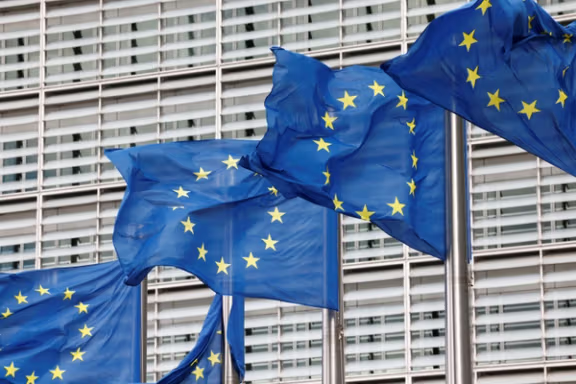
The Council of the European Union has imposed sanctions against 11 Iranian individuals and four entities for their role in the death of Mahsa Amini and the crackdown on the ongoing protests.
The European Council, the institution that defines the general political direction and priorities of the European Union, added on Monday 11 individuals and four entities to the EU list of those subjected to restrictive measures in the context of the existing Iran human rights sanctions regime,. The EU list now comprises a total of 97 individuals and eight Iranian entities.
"The EU and its member states condemn the widespread and disproportionate use of force against peaceful protestors. This is unjustifiable and unacceptable. People in Iran, as anywhere else, have the right to peacefully protest and this right must be ensured in all circumstances," the statement read.
The latest measures consist of a travel ban and an asset freeze, in addition to prohibiting EU citizens and companies from making funds available to the listed individuals and entities.
The sanctions also include a ban on exports to Iran of equipment which might be used for the repression of protests and of equipment for monitoring telecommunications and surveillance.
"The EU expects Iran to immediately stop the violent crackdown against peaceful protesters, to free those detained, and to ensure the free flow of information, including internet access. Furthermore, the EU expects Iran to clarify the number of deaths and arrested," the EU said.
The new designations include Iran’s so-called ‘Morality Police’ and two of its key figures, Mohammad Rostami and Haj-Ahmad Mirzaei. In addition, the EU has designated Iran's police, known as the Law Enforcement Forces, as well as several of its local chiefs for their role in the crackdown on the protests.
The EU has also sanctioned the minister of information and communications technology, Issa Zarepour, for shutting down the internet to restrict access to information on the protests and impede communication among protesters.
Announcing “unanimous” decision to take action against those “responsible for the death of Mahsa Amini and violent repression of peaceful protests” in a tweet Monday, the EU Foreign Policy Chief Josep Borrell stressed that the EU will always act against serious human rights violations.
Borrel also said on Monday that he currently did not expect progress in negotiations over reviving the 2015 nuclear deal with Iran. "I don't expect any move, that's a pity because we were very, very close," he said.
Iran-European Union relations have soured with claims Tehran has supplied Russia with armed drones used in Ukraine, although the EU is not yet expected to agree new sanctions.
Arriving in Luxemburg Monday for a meeting of EU foreign ministers, Josep Borrell, the EU foreign policy chief, said Europe would look for “concrete evidence” over reports that Russia had used Shahed-136 drones in recent weeks. The Washington Post backed up Ukrainian claims Sunday citing US and “allied” officials speaking anonymously.
The Washington Post cited “an intelligence assessment shared in recent days with Ukrainian and US officials [that] contends Iran’s armaments industry is preparing a first shipment of [surface-to-surface] Fateh-110 and Zolfagher missiles…” Reuters reported Monday its reporter had seen pieces of a drone bearing the words ‘For Belgorod,’ presumably referring to Saturday’s gunning down of 11 Russian trainee soldiers 40km north of the Ukraine border.
There have been differences within the 27-member EU over the Russia-Ukraine conflict over the extent of sanctions against Moscow, which continues to supply gas and oil to many European states. Denmark’s Foreign Minister, the Social Democrat Jeppe Kofod, called Monday for the EU to take “concrete steps” in response to Russian attacks on Kyiv Monday morning, with Reuters reporting at least three deaths. “Iranian drones are used apparently to attack in the middle of Kyiv, this is an atrocity,” Kofod said.
France has argued that Iran supplying drones to Russia would violate United Nations Security Council Resolution 2231, which endorsed the 2015 Iran nuclear agreement. Paris bases its case on the non-binding, informal Missile Technology Control Regime (MTCR) agreed by 35 states including Russia.
As signatories to the JCPOA, both France and Germany have been involved in the talks aimed at reviving the agreement, which the US left in 2018 prompting Iran to expand its nuclear program beyond JCPOA limits. The leeway for new European sanctions has been reduced by decline of Europe-Iran trade given European companies’ fear of US action against them under the ‘maximum pressure’ sanctions Washington introduced on leaving the JCPOA. Nonetheless, Luxembourg’s Foreign Minister Jean Asselborn Monday it was “no longer” enough just to extended the existing list of sanctioned Iranian individuals.
Iran denies supplying weapons to Russia. Foreign Minister Hossein Amir-Abdollahian said Saturday – in comments made by telephone to Portuguese foreign minister Joao Gomes Cravinho – that Tehran believed “the arming of each side of the crisis will prolong the war.” The US has sent Ukraine $16.8 billion in aid, mainly in weapons, and the EU $2.5 billion, although Washington is denying Ukraine more advanced weapons so as to avoid escalation. Washington has said it wants to degrade Russian capacity as its stocks of Cruise and other missiles diminish.
‘Inconsistent behavior’
Comments made Monday by Iran’s Foreign Ministry spokesman Nasser Kanaani reflected a deteriorating tone in EU-Iran relations. Kanaani highlighted what he said was “inconsistent behavior” by the French in suggesting there was “good and bad terrorism” and in condemning “disturbances” and “labor strikes” in France but welcoming them in Iran.
Kanaani portrayed Iran as an “anchor of stability” in a region where many countries – he cited Afghanistan, Iraq and Syria – “fell into chaos and were exposed to terrorism and foreign attacks.” The spokesman said that an arson attack on an Iranian school in Hamburg Thursday showed a failure to provide security for “Iranian diplomatic places.” He said there was a “bitter irony that the countries that export millions of dollars of arms to one side of the war [had] started a propaganda war against Iran.”
Kanaani stressed that while new EU sanctions would lead to “reciprocal reactions” from Iran, “the path of negotiations” was separate. The EU has coordinated efforts to revive the 2015 agreement, both in meetings April 2021-March 2022 in Vienna of all JCPAO signatories (China, France, Germany, Iran, Russia, the United Kingdom, with the United States taking part indirectly) and in subsequent bilateral contacts between Iran and the US. Kanaani also said Monday a prisoner exchange with the US was being held up by Washington’s insistence that the 2015 agreement be revived first.
Sadegh Zibakalam, a former revolutionary who has become an outspoken citric of hardliners in Iran, has said the ongoing protests have startled the Islamic Republic's authorities.
Zibakalam, who has been recently banned from teaching at University of Tehran for his frequent berating remarks against the government, said in an interview on Sunday that the sheer volume of the protests has surprised everyone, including the statesmen and those who are serving in the government, parliament and the judiciary.
The ‘reformist’ analyst said that the officials are not sure how to react to such a huge uprising and are confused due to a lack of appropriate responses.
The political science university professor added that he himself is surprised by the big role of universities in the protests, noting that even students andprofessors ofnumerous branches of Azad University – who usually do not participate in antigovernment rallies – have beentaking part in the nationwide demonstrations.
Stressing that he does not want to "ignore the economic problems," he said the main cause of the current wave of protests is the hatred against the so-called ‘morality’ police or hijab enforcement patrols. "The fuel and ammunition of these protests is social discontent," he added, noting that women and Generation Z are the two main groups of protesters.
The uprising was ignited over the death in custody of 22-year-old Mahsa Amini and protest rallies first erupted in her hometown Saqqez and capital Tehran and soon spread to all over the country, garnering support from Iranian expatriate communities around the world as well as foreign governments and officials.
The Iranian Judiciary's news agency says the number of deaths from the fire which broke out at Tehran’s Evin prison on Saturday evening has now risen to eight.
According to the Judiciary, four more prisoners, who were in critical condition in hospital, succumbed to their injuries to bring the death toll to eight.
The Monday report has not mentioned the cause of the new deaths while on Sunday it said the first four lost their lives due to inhaling smoke.
The identities of the deceased have not been revealed yet, but the hard-liner Judiciary says they were theft-related convicts.
There is no chance in Iran for any independent investigation as to how the blaze started and exactly how many prisoners were killed. The Judiciary is a political institution fully at the service of the ruling elite, directly under Supreme Leader Ali Khamenei's control.
The large fire at the notorious prison began on Saturday evening, leaving tens of prisoners wounded while gunshots and blasts were also reported.
The prison fire infuriated the anti-government protesters once more with university students chanting slogans saying Evin had turned into a slaughterhouse.
The Evin fire caused global reactions soon after. EU foreign policy chief Josep Borrell said on Sunday that Iranian authorities are responsible for lives of all detainees, including human rights defenders and EU nationals.
Meanwhile, the number of signatures in an online campaign aimed at the leaders of the seven industrialized countries of the world, G7, has reached the 200 thousand mark. The petition calls on these countries to recall their ambassadors from Iran and expel diplomats and officials of the Islamic Republic.
Initiated by Kaveh Shahrouz, a lawyer and human rights activist living in Canada, on October 13, the campaign also demands the release of inmates from Iranian prisons.
However, reports from Iran show that the regime is still getting prepared to crack down on the protests and strikes. Following a strike and call for protests by the workers of Haft-Tappeh sugar factory in the southern oil-rich Khuzestan province, it was reported that the employer's agents are attempting to create division among the workers to prevent any gatherings.
However, the workers’ unofficial union social media channel has called on members to be alert and participate in a protest on Tuesday morning.
Iran’s oil workers last week joined the anti-regime protests. Workers of refineriesin southern oil-rich provinces of Bushehr, Khuzestan and Hormozgan such as Abadan Refinery and the petrochemical facilities in Asalouyeh, off the coast of the Persian Gulf, have been on strikes since last Monday.
This comes as the uprising of Iranians against the clerical regime draws more support from the diaspora and the international community.
In one of the latest reactions, the famous American pop star Britney Spears has expressed support for the protests. “Me & my husband stand with the people of Iran fighting for freedom,” Spears wrote on her Twitter account on Sunday.
The pop star's tweet came after her Iranian-American husband Sam Asghari, condemned the Iranian regime as "terrorists" last month.
An Iranian historian says the Islamic Republic may survive if it gives concessions to the people while it is still maintaining some measure of authority and power.
Speaking on Iran's state television in a debate with Lawmaker Abolfazl Amoui on Saturday, October 15, Majid Tafreshi, a London based researcher, claimed that Shah Mohammad Reza Pahlavi's regime did not survive because it offered its concessions to the people too late when his power had waned after months of protests.
Tafreshi’s appearance on Iran’s tightly controlled state TV is part of a recent attempt by the government to showcase some public debates to attract viewers as the large government broadcaster, with 40,000 employees has lost its audience in recent years.
Tafreshi held government posts when he lived in Iran and although he has published critical articles, he is not part of the opposition and hence his appearance on state TV.
Britain-based Iranian researcher Majid Tafreshi
As part of the discussion about the media in the program, Nour News quoted lawmaker Amoui as saying that social media platforms and foreign media outlets do not reflect a true image of Iran. Tafreshi responded that "We cannot ignore foreign-based Persian speaking media's errors, but at the same time, we cannot blame them for the problems that exist in Iran."
While Amoui complained about Iran's isolation in the international community, Tafreshi said: "When you do not communicate with the international community, do not accept the terms of the Financial Action Task Force (FATF) and want to create a new South Korea with North Korea's policies, of course you will be isolated."
Chalak said: "A national research conducted between 2015 and 2021 showed that the government's legitimacy has been on decline." He added that "coupled with the government's chronic inefficiency in meeting the people's demands will lead to more violent protests even if this round of uprising in Iran recedes."
Sunday protests across Iran were mainly focused on reactions to the mysterious fire at Tehran’s notorious Evin prison and the death of a schoolgirl in the northwestern city of Ardabil.
"Another Cinema Rex Fire Happening. Enough Is Enough, People, Join Us," Tehran University students were heard chanting, referring to the deadly 1978 fire at Cinema Rex of Abadan in southern Iran which killed some 400 people and intensified the 1979 Revolution.
Students at Azad University of Karaj were chanting, "Neither Gaza nor Lebanon, I Sacrifice My Life for Iran" during their rallies at the campus, in defiance of the authorities who have threatened students with expulsion if they continue their protests.
EU foreign policy chief Josep Borrell said on Sunday that he is following evolving reports on the situation in Evin prison, noting that Iranian authorities are responsible for lives of all detainees, including human rights defenders and EU nationals.
Borrell said that he expressed his “most serious concern” to Iranian Foreign Minister Hossein Amir-Abdollahian, saying that the EU “expects maximum transparency on the situation.”
Echoing the sentiments, German Foreign Minister Annalena Baerbock said, “The government of Iran bears responsibility for all those imprisoned in Tehran's Evin Prison, including many political prisoners and demonstrators.”
Protests were also reported at universities in the northeastern city of Bojnourd, the northern city of Babol, and several cities in the southwestern provinces of Khuzestan and Lorestan. Some clashes were also reported in the central city of Yazd, with a population known to be sympathetic to the Islamic Republic.
Outraged by the death of a schoolgirl, citizens of the city of Ardabil also held protest rallies, which broke into clashes in some areas.
School officials in Ardabil tried to force the students to sing the propaganda song “Hello Commander” in praise of Iran’s ruler Ali Khamenei Wednesday, but when some students refused, government agents showed up, beating and assaulting the girls. One student, identified as Asra Panahi, reportedly died of her injuries at the hospital while another one is in critical condition.
Tehran was also the scene of sporadic clashes and demonstrations, with teargas and gunshots used to disperse the protests.
According to videos on social media, a group of residents in Tehran's Ekbatan township held a protest march in the evening, with slogans likening Iran’s Revolutionary Guards to ISIS terrorists, while people residing in the Nazi Abad neighborhood clashed with security forces who tried to disperse their demonstration.