Hamas Says Report Alleging Khamenei’s Rebuke To Haniyeh A Lie
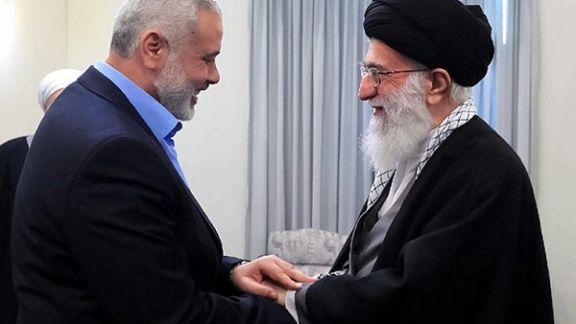
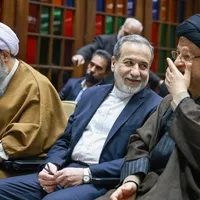
ran's Supreme Leader Ayatollah Ali Khamenei and Palestinian group Hamas' top leader, Ismail Haniyeh, in Tehran
Hamas' has called a Reuters report on the details of a meeting between its leader Ismail Haniyeh and Iran's ruler Ali Khamenei "pure slander and a lie”, according to the Iranian state news agency IRNA.
Reuters reported on Wednesday that the Iranian regime was unaware of Hamas' October 7 terror attack against Israel. The report quoted three anonymous senior officials as stating that in a recent meeting in Tehran, Khamenei told Haniyeh: “You gave us no warning of your Oct. 7 attack on Israel and we will not enter the war on your behalf.”
In an interview with IRNA, published on Thursday, Osama Hamdan, a member of Hamas' political office, denied the claim saying: “Such news is intended to destroy the image of Hamas and the Axis of Resistance in the region.”
The so-called Axis of Resistance refers to a coalition of military forces in the region backed by Iran, including militias in Iraq, Syria, Yemen and Lebanon. For years, Tehran has provided Hamas with military, technical, and operational support.
The Iranian government has not officially commented on the Reuters report, but publication of the interview with Hamdan on IRNA can be interpreted as an indirect response.
The Hamas official added: “Ayatollah Khamenei's meeting with Haniyeh was consistent with Iranian and Hamas' ongoing constructive ties”.
Reuters has updated its report since publication and said Hamas has denied the validity of the report on Telegram, calling it "baseless”.
At least 1,200 people, mostly civilians, were killed and 240 more were taken hostage by Hamas after its surprise attack on Israel on October 7. This has led to the most deadly conflict between the two sides since Hamas took power in 2007.
Calls to designate Iran's Islamic Revolutionary Guard Corps (IRGC) arose once again in the British Parliament this week, led by the former defense minister.
Liam Fox hosted a session on the security threats posed by the group at Parliament this week just weeks after Ken McCallum, the Director-General of MI5, referred to "hostile activity by the Islamic Republic in the UK," emphasizing that countering threats from Tehran remains a top priority. "Iran has been a rising source of concern and a rising source of task for MI5 over the last 18 months or so in particular," he said last month.
The British newspaper, The Times, also reported that Iranian regime agents were stirring up unrest in the UK through pro-Gaza protests in the wake of the Iran-backed proxy Hamas' invasion of Israel on October 7.
The session on Tuesday was organized by the International Organization to Preserve Human Rights (IOPHR) and featured lawmakers such as former Leader of the Conservative Party Sir Iain Duncan Smith.
Jason Brodsky, policy director at United Against A Nuclear Iran, and Vahid Beheshti, British-Iranian journalist and anti-regime activist were among the panelists.
For months, Beheshti held a hunger strike for 73 days outside the UK Foreign Office in protest of the atrocities committed by the regime in the wake of the Women, Life, Freedom movement protests. Following the latest calls for designation, he told Iran International he is optimistic after earlier this week, more than 60 lawmakers urged the British Prime Ministerto ban the IRGC, designated by the US in 2019.
A UN General Assembly committee has slammed Iran for discriminating against and harassing women and girls, in addition to a host of other human rights violations.
The Third Committee of the 78th General Assembly approved a resolution entitled “Situation of human rights in the Islamic Republic of Iran” by a vote of 80 in favor to 29 against.
Another 65 countries, including many with a track record of human rights abuses such as Saudi Arabia, Egypt, and South Africa, abstained. A bevy of dictatorships voted against, including Iranian ally Russia, Belarus, Syria and North Korea.
The resolution, whose draft was introduced by Canada, condemned the misogynistic policies and practices of the Iranian regime, calling on Tehran to put an end to its discrimination against women.
The regime continues to introduce yet stricter legislation to crack down on hijab and ‘chastity’ laws as more women across Iran reject the mandatory headscarf and curbs on their behavior. Surveillance has been stepped up and like Mahsa Amini, the symbol of the Women, Life, Freedom uprising which began after her death in morality police custody last year, a 16-year-old girl, Armita Geravand, also died in their hands in recent weeks.
Citing “the Iranian authorities’ flagrant disregard for human rights, life and dignity”, the resolution condemned “the intensified, targeted repression of women and girls by Iran, both online and offline”. Women are arbitrarily arrested on the street for hijab refusal and refused entry to public spaces including universities, hospitals and public spaces.
Iran’s #MeToo movement has also chronicled systemic sexual abuse in the country’s legal system, women under constant threat of sexual violence on the streets and in prison.
The resolution cited “mass arrests and arbitrary detention, disproportionate use of force, including force leading to the death of peaceful protesters, and imposition and carrying out of the death penalty against those connected to the protests.”.
More than 500 demonstrators were killed by security forces in the protests following Mahsa's death, after they were given free rein by the regime’s top officials in an attempt to quell the uprising.
The resolution also called on Iran to end its harassment and persecution of political opponents and human rights defenders, especially those belonging to minority groups, a phenomenon which has worsened since the uprising.
The people of Sistan-Baluchestan have been holding weekly protests after security forces opened fire at peaceful protesters, killing nearly 100 on September 30, 2022, a day known as the Bloody Friday of Zahedan. Zahedan is one of the few Sunni-majority cities in predominantly Shiite Iran.
“The authorities are ramping up their brutality to stop Baluchi protesters from gathering each week in Zahedan,” warned Diana Eltahawy, Amnesty International’s Deputy Regional Director for the Middle East and North Africa.
The resolution of the General Assembly’s Third Committee, which addresses social, humanitarian and cultural issues, also urged Tehran to cooperate with international human rights mechanisms, especially with the UN special rapporteur on human rights in Iran, Javaid Rehman.
Earlier this month, Rehman warned that the Israel-Hamas war bolsters repression inside Iran by deflecting attention from internal criticism of the regime to regional issues as the conflict instigated by Iran’s biggest Palestinian proxy against Israel, rages on.
In a post on X, Abram Paley, the US State Department's deputy special envoy for Iran, hailed the passing of the resolution. “We stand with the people of Iran as they continue their fight against oppression and violence and for a free and democratic future,” he said.
The resolution comes a week after United Nations reiterated concerns regarding the human rights situation in Iran, urging the release of detained protestors and an immediate end to executions which have also escalated since the uprising began in September last year.
The committee noted “the alarming increase of the use of the death penalty”. According to a UN report, at least 419 people were reportedly executed, including 409 men and 10 women, between January 1, 2023, and July 31, 2023, marking a 30 percent increase compared to the same period last year.
The committee also approved six resolutions including on the human rights situations in Ukraine, Syria, Iran, Myanmar and the Democratic People’s Republic of Korea.
Iran’s representative at the session, Zahra Ershadi, rejected the resolution branding it “biased and politically motivated”. Falling back on regime rhetoric to attack the West, she blamed it on “Canada, the United Kingdom, France, Germany, the United States, and the occupying and apartheid Israeli regime — the classic cast of characters and the usual suspects.”
German authorities have executed raids on 54 locations connected to the Islamic Center of Hamburg (IZH), suspected of supporting the militant group Hezbollah.
Iran-backed Hezbollah, its biggest regional proxy based in Lebanon, is designated in several countries including the US and UK, and was designated by Germany in 2020. However, the IZH still has a deep influence on the likes of schools and mosques in Germany, believed to be an extension of the regime.
German Interior Minister Nancy Faeser highlighted that the IZH has been under continuous surveillance by German intelligence services, being categorized as "Islamist."
"We have the Islamist scene in our sights," she said following the Thursday raids. "Especially now, at a time when many Jews feel particularly threatened, it's important to state: we do not tolerate Islamist propaganda or anti-Semitic and anti-Israel agitation."
Cities across the world have seen a massive rise of antisemitism since the war began on October 7 when Iran-backed Hamas militia invaded Israel, killing at least 1,200 mostly civilians and taking around 240 more hostage. Israel's response has been the most deadly since Hamas took control of the strip in 2007.
According to DW, SPD politician Andy Grote, the interior senator for the city-state of Hamburg, called the raids a "hard blow" against the IZH whose time, he said, "has run out." "The sooner the IZH disappears from Hamburg entirely, the better," he said. "Today, we've come a great deal closer to that."
"I'm pleased that the federal interior ministry is pushing strongly for a ban. I am confident that this process will be concluded thoroughly and that the IZH will soon be closed," Grote said.
Russian companies will participate in the development of seven oil fields in Iran, the managing director of the National Iranian Oil Company (NIOC) has announced.
The maximum capacities of the Iranian companies will also be employed in the development of these fields, in southern and northwestern Iran, Mohsen Khojastehpour added.
Over the past two years, Iranian officials have time and again made optimistic statements about widening energy cooperation with Russia, but so far, there is no concrete evidence of any substantial contributions by Russia.
Last year, Ahmad Asadzadeh, the Deputy Minister of International Affairs and Trading at Iran’s Oil Ministry, expressed hope that the comprehensive plan of Iran’s cooperation with Russia’s Gazprom regarding the development of six oil fields and two gas fields would be finalized in a few months.
About a decade ago, Iran also signed dozens of oil and gas MoUs with various Russian companies, none of which were executed.
IRNA, the Iranian state news agency, also reported last month that the country’s Oil Minister Javad Owji visited Moscow to hold talks with Russian officials about turning MoUs into contracts. He claimed that Tehran and Moscow can employ their joint capabilities to neutralize sanctions against both countries.
Despite Tehran’s call on Moscow to help develop its energy fields, Russia itself has been facing technical challenges since several western companies pulled out of joint energy projects due to the sanctions slapped on Moscow over the Ukraine war.
Iran’s Minister of Interior has slammed the previous government, hailing the current hardliner administration as "impossible to isolate” from the international community.
Ahmad Vahidi, a former IRGC officer, asserted that “Despite some claims about Iran suffering global isolation under this government, it is impossible to isolate it as long as it adheres to its values.”
Iranian hardliners were persistently attacking President Hassan Rouhani’s government for nuclear talks and the JCPOA agreement with world powers between 2013-2021. These attacks have continued in the past two years to justify the serious economic failures of President Ebrahim Raisi’s team and the parliament dominated by ultra-conservatives.
But the hardliners failed to reach a new nuclear deal with the United States after two years of negotiations with the Biden administration, leaving crippling sanctions in place and deepening Iran’s economic crisis.
While defending the performance of the current administration by saying that they have been in power for “just” two years, he criticized Hassan Rouhani's government by stating that “there is no win-win situation in dealing with Satan without giving ground,” referring to the United States.
Iran's former foreign minister Mohammad-Javad Zarif (right) and former president Hassan Rouhani
“In the previous government, they said that we were advancing our goals in a win-win game, but what does that mean? Thinking of the enemy as a friend is a very dangerous attitude. That's also why it's taking so long to resolve the Palestine issue."
Vahidi even tried to blame foreigners for the apparent apathy of Iranians toward the regime’s highly engineered parliamentary elections. Concerned about the elections, the interior minister stated: “The enemy is doing everything in its power to deter people from voting, but our people will defeat the enemy once again with their enthusiastic participation.”
Meanwhile, Javad Zarif, Rouhani’s Foreign Minister was recently quoted as saying: "If Iran is dragged into the Israel-Gaza war, nothing is going to happen to any of Iran's state officials! The bombs are going to fall on the people."
Rouhani himself has also warned against Iran becoming involved in the Israel-Hamas conflict, pointing out that by inflaming the conflict, the regime is putting the country at risk. In his remarks, he emphasized the potential consequences of direct involvement or indirect involvement through proxies, asserting that "a mistake, a wrong decision, or an imprecise action could drag the flames of war towards us".
In particular, the government's actions and stance regarding the Gaza war seem to be exposing the cracks in the regime.
In a recent summit of Islamic and Arab states in Riyadh, Iran accepted the two-state solution, which is contrary to its central ideology of opposing the existence of the Jewish state. Palestine would be an independent state alongside Israel as part of the two-state solution to the Israeli-Palestinian conflict.
Although the current administration is attempting to appeal to hardliners by claiming that they are not isolated, but rather the “isolated nation is the United States”, the facts show a different picture.
With the election of Ebrahim Raisi in 2021, the regime has only increased its isolation from the international community and exacerbated internal tensions.
In the latest instance, Iranian punitive economic and political measures against Israel were rejected by Muslim leaders at the Arab summit and excluded from the final resolution.
The move to support Russia's invasion of Ukraine and speed up the nuclear program, led Western countries to condemn the Islamic Republic and impose more sanctions on its officials and entities. Iran has reportedly supplied Russia with hundreds of suicide drones for use against Ukraine’s civilian infrastructure and cities since mid-2022.
Also, attempts by the regime to substitute relationships with other countries - more specifically China- failed after Beijing backed the UAE in the Abu Musa and Tunbs island dispute.