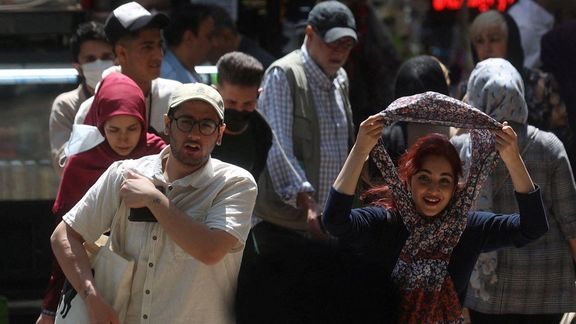
Amnesty Urges Iranian Women To Share Stories Of Hijab Persecution
Amnesty International has issued a call to Iranian women who have faced persecution due to Iran's mandatory hijab laws, urging them to share their accounts with the rights group.
The call, published on on Monday, highlights the systemic harassment and persecution experienced by women in Iran, with particular emphasis on the issuance and execution of flogging and imprisonment sentences.
the organization's Telegram channel in Farsi
"The real dimensions of the organized assault on women's rights, particularly the issuance and execution of flogging and imprisonment sentences against them, remain hidden," added the announcement by Amnesty.
The Iranian government's continued enforcement of mandatory hijab laws, despite nationwide protests triggered by the killing of Mahsa Amini in the custody of morality-police, has drawn international condemnation. The methods employed, including seizing cars and imposing widespread social deprivation, underscore the severity of the situation.
Amnesty's call emphasizes the importance of shedding light on such issues by requesting affected women, along with their relatives, lawyers, and other witnesses to share relevant documents such as court rulings and evidence of administrative actions by February 27.
Narges Mohammadi, a prominent human rights activist imprisoned in Iran and recipient of the 2023 Nobel Peace Prize, last month called upon the United Nations Secretary-General to recognize sexual and gender apartheid as a crime against humanity. Mohammadi's plea, articulated in a letter from Evin Prison published on January 26, drew parallels between this form of oppression and racial apartheid, urging international action.
Meanwhile, the Iranian government's efforts to reinforce hijab enforcement include attempts to pass a law entitled "Chastity and Hijab,"which imposes severe punishments on women who resist compliance. Mohammad Bagher Ghalibaf, the Speaker of the Parliament, has announced that the bill's amendments are in their final stages, indicating imminent communication to the government following approval by the Guardian Council.
The Tehran Revolutionary Court has handed down death sentences to four Baluchis on charges of armed rebellion as crackdowns of dissidents in Iran continues.
The men are currently imprisoned in Ghezel Hesar Prison in Karaj according to rights group Hengaw.
In addition to the cases, reports from human rights sources indicate that Pakhshan Azizi, a former Kurdish journalist and political prisoner, faces similar charges by the Iranian judiciary.
Furthermore, the Iranian Free Workers Union recently reported that Shahab Naderi, a political prisoner, has also been sentenced to execution by the Tehran Revolutionary Court on similar grounds.
Earlier reports from the Human Rights Activists News Agency (HRANA) revealed that in 2023, Iran witnessed the execution of at least 791 citizens, including 25 women and two child offenders, marking a significant increase of over 33% compared to the previous year.
Furthermore, UN experts disclosed in a separate report that Iran executed at least 834 people in the same year, with eight individuals linked to nationwide protests that commenced in 2022, triggered by the death of Mahsa Amini in morality-police custody for not wearing her hijab properly.
Hacktivist group Uprising till Overthrow has taken responsibility for the recent cyberattack on the Khaneh Mellat News Agency, the media arm of the Iranian Parliament.
In a statement released by the group, closely affiliated with the Albania-based opposition Mujahideen-e Khalq (MEK) organization, it was disclosed that the attack reached 600 of the the main servers of the parliament, commission servers, main chamber servers, parliament assistant servers, parliament bank server, and other servers related to administrative functions.
The timing of the cyberattack is notable as it coincides with the upcoming parliamentary elections, scheduled for March 1st, which have been marred by extensive disqualifications of candidates, raising concerns about the integrity of the electoral process.
This isn't the first time Uprising till Overthrow has targeted Iranian government agencies. In June, the group exposed documents from the Iranian presidential system, shedding light on activities of the Revolutionary Guards in suppressing protests.
In addition to Uprising till Overthrow, other hacking groups have also conducted successful cyber operations against Iran's infrastructure and government servers. Gonjeshk-e-Darande or Predatory Sparrow, for instance, disrupted gas station activities across Iranian cities in December through a cyberattack on fuel systems. Another group, Edalat-e Ali (Ali's Justice), hacked CCTV cameras in Evin Prison and targeted the Islamic Republic of Iran Broadcasting (IRIB) and the Judiciary in recent years.
Iran’s hardliners are incensed by the failure to prosecute Ali Daei's teenage daughter for appearing without a hijab on an online football show where she surprised her father for his birthday.
In a scathing critique published on Friday, Raja News, a website associated with the ultra-hardliner Paydari Party, expressed public outrage, questioning whether ordinary individuals would have faced legal repercussions for similar actions. The absence of judicial action against Noura Daei, the footballer's teenage daughter, was labeled as "judicial discrimination" by Raja News, warning of its potentially detrimental impact on public morality and religious devotion—a sentiment echoed by hardliners across social media platforms.
The incident occurred during an episode of the internet show "Football 360," hosted by Adel Ferdosipour, where the thirteen-year-old daughter of the former German Bundesliga striker made a surprise appearance to celebrate her father's birthday.
Ali Daei’s daughter Noura entering the studio to surprise her father.
Noura Daei entered the studio dressed simply in a black hoodie, sweatpants and trainers, but despite Iran's mandatory hijab rules, which requires girls to cover their hair from the age of nine, her dark hair was cascading on her shoulders.
Noura Daei hugged her father and when she became emotional, Ferdosipour, his father’s old friend, caressed her head for a second. This, too, has angered hardliners who have also criticized him for touching a girl he is not related to by blood, and Daei, for allowing him to do so.
“Last week, scorning the law and Sharia, Adel Ferdosipour sat Ali Daei’s daughter with uncovered head in his program. None of the authorities dared to prosecute them for this. Is the prosecutor, as the public’s representative, in winter hibernation?” a hardliner tweeted.
Daei and Ferdosipour have made no comments about hardliners’ criticisms and their demand for the punishment of Daei’s young daughter for not wearing the hijab.
Many social media users, however, have defended them and pointed out that the same hardliners have been silent about women not wearing the hijab in the state-sponsored February 11 anniversary of the Islamic Revolution march or the recent visit of a pro-Palestinian American adult movie actress Whitney Wright to Iran.
A woman with uncovered hair at state-sponsored anniversary of Revolution march.
“They see the hair of Ali Daei’s 13-year-old daughter and protest that it is defiance of hijab. But they even encourage it when a 40-year-old woman shows her hair [in the march] because it is propaganda for the regime,” one of the tweets on the subject said.
Daei, a former soccer star and captain of the national team, has garnered even greater popularity among Iranians for his vocal support of anti-government protesters. With 12.4 million followers on his Instagram page, he has refrained from commenting on the hardliners' attacks against him and their demand for his daughter's punishment.
Both Daei and Ferdosipour, a renowned soccer commentator, are considered "undesirables" by the regime due to their outspoken support for Iranian protesters on numerous occasions, resulting in their exclusion from official events and programs in recent years.
“What have you done to this country? My daughter is asking me what has happened [to Mahsa Amini]. What can I tell her? For what sin [was she killed?” he wrote on Instagram on September 16, 2022, when the 22-year-old Mahsa Amini died in hospital after a head injury she sustained in the custody of morality police.
Daei's philanthropic efforts faced government interference in 2017 when he and fellow footballer Karim Bagheri attempted to raise funds to aid the earthquake-stricken people of Kermanshah. Authorities froze their accounts, obstructing their charity drives.
The pressure on Daei and his family escalated further after his Instagram post during the Woman, Life, Freedom protest. In December 2022, security forces diverted a Dubai-bound Mahan Airlines plane to Kish Island to prevent Daei's wife and daughter from leaving the country. Furthermore, in early December of the same year, security forces sealed two of his businesses, a jewelry shop, and his restaurant, following his participation in a day of strikes called by protesters.
Ferdosipour, known for his immensely popular show "90" aired weekly on the state broadcaster IRIB, was banned from all IRIB sports programs in 2018. With an audience sometimes surpassing 30 million, he was once listed among Iran's top 20 most influential figures by Newsweek magazine in 2009.
In early 2022, Ferdosipour launched "Football 360," a weekly YouTube talk show also available as a podcast and mobile application. With over a million installations by Iranians on their phones, the show has gained significant traction.
Four journalists from the Fardaye Eghtesad media outlet have been missing since February 5 amid tightening crackdowns on dissent under a weakening regime.
The US-based Human Rights Activists News Agency (HRANA) revealed on Sunday that three video-journalists, Mehrdad Asgari, Nikan Khabazi, Ali Tasnimi and the deputy editor-in-chief of the liberal-leaning newspaper, Behzad Bahmannejad, were taken to an unknown location on Friday after being detained in the editorial office for four days.
Maryam Shokrani, an economic reporter, said the journalists have had no communication with their families, raising concerns about their whereabouts.
On Monday afternoon, approximately 30 journalists were arbitrarily detained at the offices by security forces without any explanation. Some managed to inform their families that their mobile phones and computers were confiscated during the detention.
Although some were released from the office on Tuesday morning, five others remained.
The judiciary claims the raid was unrelated to journalistic activities and that separate allegations were under investigation.
The International Federation of Journalists reported in July that following the killing of Mahsa Amini, at least 100 journalists in Iran have been detained, with more than 21 of them sentenced to a combined total of 77 years in prison.
Iranians in many European and North American cities took to the streets to protest against human rights abuses in Iran, and against the Islamic Republic on the anniversary of the 1979 Revolution.
Demonstrations took place in Belgium, Sweden, Australia, Germany, France, the United States, Britain, and Denmark.
In Belgium, a group of Iranians gathered in Antwerp, chanting slogans demanding justice. Similar rallies took place in Copenhagen, Denmark, and in front of Iran's embassy in Brussels. Protesters in Brussels displayed banners featuring images of Toomaj Salehi, a jailed dissident rapper.
Meanwhile, Iranians and Israelis in Sydney called for designating the Islamic Revolutionary Guard Corps as a terrorist organization by Australia. Iranians in Cyprus also held a demonstration in front of Iran's embassy in Nicosia. In Bern, Switzerland, protesters gathered in front of the Iranian embassy to denounce human rights violations.
In the United States, a rally was held in Washington DC, on Saturday, protesting against the anniversary of the revolution. In Paris, France, Iranians marched towards Iran's embassy, demanding justice for Mahsa Amini and chanting slogans for women's rights and freedom.
Reports from Iran indicated limited participation in government-organized rallies on February 11, despite relaxing enforcement of compulsory hijab and providing recreational activities on the streets.