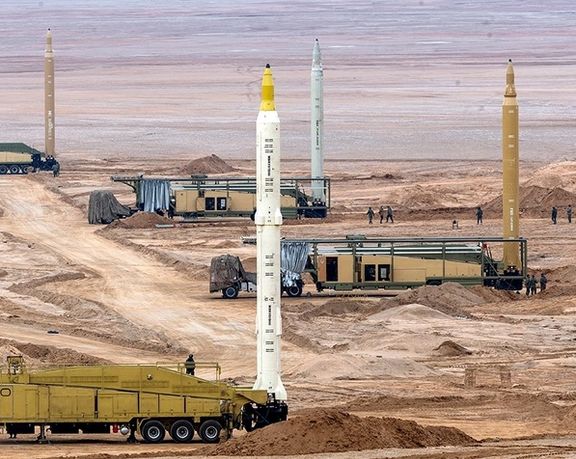
Unnamed American and Israeli officials have said that a major missile or drone attack by Iran or its proxies on Israel seems imminent in the coming days, Bloomberg reported on Wednesday.
“The potential assault, possibly using high-precision missiles, may happen in the coming days, the people said, requesting anonymity to discuss confidential matters, Bloomberg reported. It added that the United States is “helping Israel on planning and sharing intelligence assessments,” sources said.
Since the precision missile strike by Israel on April 1 that killed two top IRGC generals and five other officers in Iran’s embassy compound in Damascus, Tehran has been threatening retaliation.
Supreme Leader Ali Khamenei on Wednesday said that Israel made a mistake and “will be punished.” Observers have been speculating in the past ten days whether Iran is willing to risk a widening of the conflict with Israel, or if it decides to retaliate, what kind of response it will unleash.
In an apparent response to Khamenei, Israeli Foreign Minister Israel Katz said on Wednesdaythat Israel will respond if Iran attacks Israel from its own soil.
"If Iran attacks from its own territory, Israel will respond and attack in Iran," Katz said in post on the social media platform X.
US President Joe Biden says his country's commitment to Israel's security in the face of Iran's threats to launch an attack against Israel is "ironclad".
German airlines Lufthansa suspended flights to and from Tehran for 24 hours amid concerns of a potential military escalation.
The Iran-backed Islamic Resistance in Iraq (IRI) is awaiting a decision from Iranian authorities regarding a “calculated response” in the Golan Heights region for the Israeli airstrike on Iran’s Syrian consulate.
On Monday, a CNN report, citing sources familiar with US intelligence, suggested that Iran's retaliation against Israel is likely to be carried out by proxy militia groups rather than directly by Iran itself.
Iran’s supreme leader has led calls for retaliation, echoed by military and political leaders in Iran.
However, while Israel awaits Iran’s response, sources speaking to Asharq Al-Awsat emphasized that the pro-Iranian factions have no intention of reigniting confrontation with American forces which it had begun in the wake of the Gaza war.
Following US support for Israel’s right to defend itself in the wake of the Iran-backed Hamas invasion of October 7, the IRI -- an umbrella group representing several Iran-backed factions -- conducted dozens of attacks on US facilities.
Since February 6, when a US drone strike killed senior Kataib Hezbollah commander Abu Baqir al-Saadi, calm has been observed between Iraqi armed factions and US forces.
Kataib Hezbollah, established in the aftermath of the 2003 US-led invasion of Iraq, stands as one of the primary Iraqi armed factions with close ties to Iran. It remains the most influential faction within the IRI, a coalition of hardline Shiite groups responsible for over 150 attacks on US forces since the onset of the Gaza conflict on October 7.
Three sons and three grandchildren of Hamas leader Ismail Haniyeh were killed in an Israeli airstrike in Gaza on Wednesday, the Islamist group and family said.
The three sons - Hazem, Amir and Mohammad - were killed after the car they were driving in was bombed in Gaza's Al-Shati camp, Hamas said.
"Our demands are clear and specific, and we will not make concessions on them. The enemy will be delusional if it thinks that targeting my sons, at the climax of the negotiations and before the movement sends its response, will push Hamas to change its position," Haniyeh told pan-Arab Al Jazeera TV.
The Israeli military confirmed carrying out the strike, saying in a statement that Haniyeh’s sons were all operatives of Hamas’ armed wing.
Officials and government media in Iran did not immediately react to the news, except Fars News, affiliated with the IRGC that reported on the incident.
"The blood of my sons is not dearer than the blood of our people," said Haniyeh, who is based abroad in the Gulf Arab state of Qatar.
Haniyeh, based abroad in Qatar, has been the tough-talking face of Hamas' international diplomacy as war with Israel has raged on in Gaza, where his family home was destroyed in an Israeli airstrike back in November.
In the seventh month of the Gaza war Hamas wants an end to Israeli military operations and a withdrawal from the enclave, and permission for displaced Palestinians to return home.
Haniyeh's eldest son confirmed in a Facebook post that his three brothers were killed. "Thanks to God who honored us by the martyrdom of my brothers, Hazem, Amir and Mohammad and their children," wrote Abdel-Salam Haniyeh.
Appointed to the militant group's top job in 2017, Haniyeh has moved between Turkey and Qatar's capital Doha, avoiding Israeli-imposed travel restrictions in blockaded Gaza, and enabling him to act as a negotiator in the latest ceasefire negotiations, or communicate with Hamas' main ally Iran.
Israel regards the entire Hamas leadership as terrorists, accusing Haniyeh and other leaders of continuing to "pull the strings of the Hamas terror organization".
The body of Mohammad Sarur, a Lebanese financier for Iran, sanctioned by the US for involvement in sending funds from Iran to its terror proxies, was discovered on Tuesday in a suspected assassination.
Lebanese citizen Sarur was found at home in possession of an undisclosed sum of money left untouched by the assassin.
Sarur has known affiliations with financial institutions linked to terror group Hezbollah, backed by Iran. In August 2019, the US Treasury imposed sanctions on Sarur and others, accusing them of transferring "tens of millions of dollars" from the foreign operations arm of Iran’s Revolutionary Guards through Hezbollah in Lebanon “to Hamas for terrorist attacks originating from the Gaza Strip.”
The Treasury revealed Sarur's role as a “middleman” between Iran's Revolutionary Guards' Quds Force and Hezbollah, collaborating with operatives to also facilitate funds for Hamas's armed wing, the Izz-a-Din al-Qassam Brigades in Gaza.
“As of 2014, Sarur was identified as in charge of all money transfers” between the Quds Force and the Qassam Brigades, the Treasury added.
According to the Treasury, Sarur also has an extensive history working at Hezbollah's sanctioned bank, Bayt al-Mal. Washington blacklisted Bayt al-Mal in 2006.
Since October 7’s Hamas invasion of Israel, alongside the subsequent war in Gaza, Lebanese Hezbollah has been engaged in daily clashes with the Israeli military. Proxies in Syria and Yemen have also joined the offensive in solidarity with Hamas in Gaza.
October 7’s attacks saw 1,200 mostly civilians murdered and 250 or more hostages taken to Gaza. Israel’s retaliatory offensive in a bid to rescue the hostages and eliminate Hamas has led to over 32,000 deaths according to Hamas. Israel claims around 13,000 terrorists have been killed since the war began.
Eighty-two Iranian and international human rights groups are urging the UN agency on drugs and crime to suspend its cooperation with the regime in Iran, until it halts drug-related executions.
Mahmood Amiry-Moghaddam, one of the organizers of the call who heads Iran Human Rights, says the UN Office on Drug and Crime has remained silent about the sharp hike in drug-related executions in the country – while it cooperates with Tehran on combating drug trafficking.
“In addition to legitimizing the state’s use of the death penalty, this cooperation also leads to more executions through financial aid and equipment. A UN entity must not be complicit in drug executions in Iran,” Amiry-Moghaddam said.
“This joint action is to raise awareness and sensitise the international community and public about drug-related executions in Iran and increase the political cost of these executions for the authorities. The execution of more than one person per day under the pretext of drug offences should become intolerable for the people and the international community.”
Amnesty International’s latest report this month says at least 481 executions – more than half of the total 853 executions recorded in 2023 – were carried out for drug-related offenses.
“The number of executions in 2023 is the highest recorded since 2015 and marks a 48% increase from 2022 and a 172% increase from 2021. Iran’s killing spree is continuing into 2024, with at least 95 recorded executions by 20 March,” the Amnesty report read.
“Aimed at instilling fear and preventing more protests, the Islamic Republic executed at least 471 people for drug-charged in 2023, without any political cost and consequences,” Amiry-Moghaddam highlighted.
Execution numbers recorded by human rights groups are often the minimum figures and organizations like Amnesty International have often said that it believes the real number is higher.
“We are concerned that hundreds more will be executed in the coming months if we do not increase the political cost of these executions for the Islamic Republic. We call on all human rights organizations and activists to take part in a special global campaign to stop drug-related executions in Iran,” the statement read.
The signatories noted that the international community's muted response and limited media coverage for drug-related executions have led to these daily executions to take place with minimal public scrutiny. "On the other hand, the United Nations Office on Drug and Crime (UNODC) which cooperates with Iran in combating drug trafficking, has not only remained silent about the sharp hike in drug executions, but signed a new agreement with the Islamic Republic in May 2023."
Iran's top Sunni cleric Mowlavi Abdolhamid said in October that a lot of people are hanged In Iran for petty crimes involving only a few dollars. Abdolhamid told his congregation in Zahedan, capital of southeastern Sistan-Baluchestan Province, that lack of jobs in his province and some other impoverished areas is the prime reason people are driven to smuggling fuel, minor drug-related offences, or drug trafficking. "Many of these individuals end up in prison or are even executed for committing crimes that involve profiting as little as 5 million rials ($10)."
While on the surface, Iran has some of the world’s harshest drug laws – many of the regime’s own members are known to run parts of the drug business inside the country, including officials and high-ranking members of Iran’s Supreme National Security Council, managers from Tehran’s Municipality and members of parliament.
The Secretary of Iran’s National Saffron Council has revealed that Afghanistan purchased 40 tons of saffron from Iran last year, then proceeded to sell it in Iran’s target markets.
Farshid Manuchehri said, "Afghanistan buys our saffron and exports it as an Afghan-produced product to the destination markets and target markets of our country, and at a higher price”.
Afghanistan’s own production is now also soaring, becoming a possible contender with the world’s largest producer of the spice.
Gholam Reza Miri, chairman of the Iranian Saffron Exporters and Sellers Union, said in January that most of Iran's saffron is smuggled to Afghanistan and packed in Spain.
Miri said that high customs duties and embargoes are among the factors for trafficking with almost half of the value of Iran's annual saffron production ending up in the pockets of smugglers.
He said that last year, 90 tons of saffron, accounting for 40% of Iran's total production of 225 tons, were subject to smuggling with Afghanistan and Spain holding 21% and 16% of the global saffron markets, respectively.
Extreme weather has also halved production of the world’s most expensive spice in Iran, with areas once dependent on what is also known as desert gold, decimated by climate change.
Iran produces nine tenths of the world’s supply but climate change has meant devastation for farmers.
As Iran battles a cost of living crisis, the mainstay of Iranian cuisine has become less consumed than ever before in the country as economics make the spice prohibitive as prices continue to rise. It has been pushed up by high demand from major markets such as China, which accounts for almost half of Iran’s exports.