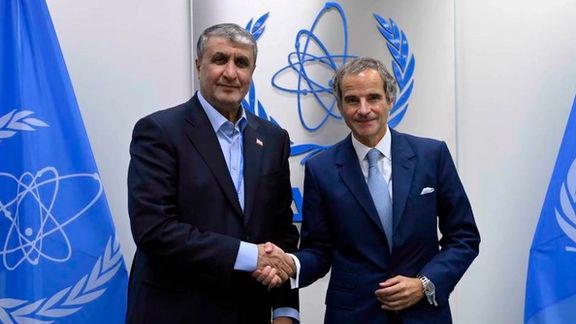
Head of the Atomic Energy Organization of Iran Mohammad Eslami (left) and the International Atomic Energy Agency Director General Rafael Mariano Grossi in Vienna on September 25, 2023
The head of Iran's Atomic Energy Organization, Mohammad Eslami, said on Wednesday that the International Atomic Energy Agency monitoring is in place and UN nuclear chief Rafael Grossi will soon visit Iran.
Mohammed Eslami did not specify a date for Grossi's visit in his comments. However, based on his previous remarks, the date might be as soon as early May. In February, Eslami announced that Grossi would attend the first international nuclear energy conference in Isfahan, coinciding with the 50th anniversary of establishing the Atomic Energy Organization of Iran.
However, Iran’s nuclear chief did not mention the closure of the nuclear facilities for 24 hours on Sunday in the wake of Iran's aerial bombardment which saw 350 plus missiles and drones launched towards Israel.
The IAEA director said on Monday that Iran closed its nuclear facilities on Sunday due to threats of an Israeli attack, fearing retaliation to the bombardment which saw forces from the UK, US, Jordan and France work to intercept the majority of the projectiles before they reached Israeli territory. While they reopened on Monday, Grossi said he would keep IAEA inspectors away until the situation calmed down.
As Israel considers whether to launch a counterattack, there has been speculation that some nuclear-related sites may be targeted. In response to a question regarding the possibility of Israel striking Iran's nuclear sites, Grossi replied on Monday, “We are always concerned about this possibility.”
Eslami also downplayed the tension by claiming that cameras are installed and "constantly monitor" the nuclear facilities and that inspectors also visit them regularly.
Iran said the attack on Saturday was an action of self-defense in retaliation for an alleged Israeli strike on its consulate in Damascus on April 1. It was the first direct action initiated inside Iran against Israel and began a new chapter in the conflict between the two countries previously engaged in a years-long shadow war.
Iranian President Ebrahim Raisi warned on Wednesday that any "tiniest invasion" by Israel would face "massive and harsh" response from Iran as the two archenemies sit on the verge of war.
His threats came during an annual army parade which had been moved from its usual venue, a highway in southern Tehran, to a barracks north of the capital. Iranian officials gave no reasons for the venue change, and unlike in past years, the event was not live on state television.
Speaking about the weekend air attack in which 350 plus drones and missiles were fired towards Israel a "limited action" and warned that in case of a more expansive assault "nothing will be left from the Zionist regime."
With the help from allies including the United States, the United Kingdom and Jordan, most of the deadly bombardment was intercepted.
The Saturday aerial assault was, Iran claims, in retaliation to an Israeli airstrike on April 1 that targeted the consulate of Iran in Syria, killing several of its staff from the Revolutionary Guards, including two generals.
Israel has not detailed its response to the Iranian attack immediately but has vowed action will be taken. Its allies called for restraint from all sides to avoid further escalation.
Several Republican and Democratic lawmakers have endorsed a potential Israeli retaliatory attack against Iran, branding the Biden administration too soft on its archenemy.
The congressmen told Iran International that they viewed Iran's attack over the weekend as a failure but believed Israel's response was "necessary".
“If they [Iran] intended to create a lot of chaos and cause damage in Israel they weren't successful,” but the Iranian regime “crossed the red line,” Republican Representative Lance Gooden (R-TX) told Iran International.
Representative Steve Cohen (D-TN) believed the escalation did not start with Israel killing IRGC commanders in Iran’s consulate in Syria earlier this month, which Tehran claims was the trigger for the aerial bombardment this weekend, as the regime was involved in Hamas’ October 7th attack against Israel.
“This has been going on for a while as Iran trained some of the leaders of October 7 in the country,” he explained. Iran-backed Hamas invaded Israel on October 7, killing 1,200 mostly civilians and taking over 250 more hostage.
Earlier this month, an alleged Israeli air strike hit the Iranian consulate in Damascus, killing a senior Quds Force commander and several other IRGC personnel. Tehran claims the weekend's bombardment of over 350 missiles and drones was an act of self defence in response to the strike.
Democrat Cohen said the operation was done with the intent to “kill people”. He added, “Israel will respond. And I support Israel.” The majority of the projectiles were intercepted on Saturday night by Israel and its allies including the UK, US, Jordan and France in one of the most complex aerial missions in modern warfare.
Biden has stated the US will not take part in any Israeli attack against Iran, though says it will support the Jewish state in the face of attack. Since the Biden presidency began, Tehran has become ever more emboldened, including accelerating its nuclear program.
The Republican Party has long criticized the policies enacted by the Biden Administration regarding Iran. Biden has come under fire for releasing $6 billion of Iranian oil revenues in September as part of a prisoner exchange agreement and also for granting Iraq a new four-month waiver that enabled the release of billions of dollars to Iran after the October 7 terrorist attacks.
Despite the humanitarian guise, Republicans and Democrats challenged these decisions, arguing that money's fungibility would enable the Tehran regime to divert these funds towards arming its proxies.
Republican Representative Don Bacon (R-NE) stated that “there's a greater risk by being weak in our response to Iran,” as it would lead to a more aggressive response on the part of the regime.
"The Islamic Republic wants to be a caliphate. They want to control the Mideast, have a Shia empire there," he said, adding that "Iran wants to be the regional superpower, and that would be bad for America and bad for our allies."
Republican congressman Randy Weber (R-TX) told Iran International that times must change and a new approach taken with Iran which has been emboldened under Biden. “He's [Biden] giving Iran billions of dollars when we should have had sanctions. They should have been tight. The sanctions should not have been lessened,” he said.
While the White House announced on Tuesday that fresh sanctions would be imposed on Iran, analysts believe that the US will not initiate drastic sanctions on Iran because it is worried about increasing oil prices and angering its top customer, China.
Former president Donald Trump, who Biden is running against in the upcoming presidential elections, has already blamed the ageing president for the Iranian attack on Israel. “It [the aerial bombardment] would not have happened if we were in office,” Trump said in the wake of the bombardment on Sunday.
Under Trump, policies to Iran took a much tougher stance. He pulled out of the JCPOA nuclear agreement and in 2020, the commander of Iran's Quds Force, Qassem Soleimani, was assassinated in an airstrike in Iraq.
The Raisi administration has allocated millions of dollars to advance Iran's national internet infrastructure in an attempt to tighten control over information flow and curb the influence of external media.
The new budget is part of a broader allocation for the Ministry of Communications and Information Technology, which has seen a 25% increase from the previous year, totaling over 195,830 billion rials (approximately $300 million USD).
The government's financial strategy also includes over 150,000 billion rials (over $220 million USD) designated in miscellaneous credits, with a substantial portion aimed at broadening the scope of the national information network. The move underscores a continued push towards a more isolated and state-controlled digital environment, despite mounting domestic and international criticism.
Platforms such as Instagram, X, Facebook, Telegram are not accessible in Iran as a result of the government’s filtering policy, leaving millions unable to work, many small businesses dependent on social networks, especially in remote rural areas and women-run enterprises.
Documents from the Information Technology Organization reveal that the ministry is intensifying efforts to segregate and minimize the national information network’s dependency on the global internet to toughen crackdowns. The shift comes at a time when Cloudflare, a major cloud services provider, has noted a consistent decrease in internet traffic from Iran over the past two years, suggesting increased network isolation.
Compounding the situation are widespread internet disruptions that have plagued consumers and businesses alike, sparking discontent across the country. The Tehran Chamber of Commerce recently called on the government to reassess its approach to internet policy, emphasizing the negative impact of current practices on the business community and the broader economy.
Iran seems to have started a new round of crackdown on journalists and media outlets critical of the government following the strike on Israel during the weekend.
IRGC-linked Tasnim News Agency published a statement on Twitter (X) earlier this week that said the Guards were about to start "to deal with Israel's supporters on social media." The statement called on citizens to turn in those who support Israel on social media.
It was obvious that knowing the repressive nature of the Islamic Republic, no one would "support Israel" particularly after Iran launched a massive missile and drone attack on the country. For those in the know, it meant that the regime was not going to tolerate any narrative about the strikes which would be different in any way from the official state rhetoric.
Journalists living in Iran approached the news about the attack on Israel very cautiously or avoided it all together. However, two of the outspoken media activists, reformist commentator Abbas Abdi and moderate conservative journalist and documentary filmmaker Hossein Dehbashi behaved differently.
Abdi wrote in an article in Etemad that "a military reaction to Israel's strike on the Islamic Republic's Consulate in Damascus on April 1 was not necessary," noting beforehand that he was aware that "writing about certain issues might lead to "unforeseen situations." He also noted that "Perhaps it was not right to write about an ongoing war."
Abdi also noted that "It is not right for the Islamic Republic to attack a country it does not officially recognize," and says it does not exist. He pointed out that Iran was not able to file a complaint against Israel at a recent UN Security Council meeting simply because it does not recognize Israel."
Dehbashi's comments about Iran's attack on Israel were more straightforward and down to the point. He wrote in a tweet on the morning after the attack: "Let us be fair. It is the responsibility of any government in Iran to protect Iranian places and citizens and deter attacks against them." He also noted that the change in Iran's approach from watching and tolerating Israel's attacks, to immediate retaliation is a legitimate and important development."
However, Dehbashi added that "Last night's attack was an insufficient and unsuccessful show," adding that the attack is likely to "raise concerns about the country's real defensive capabilities."
This was a fact, as many Iranians on social media and through phone-ins to media outlets such as Iran International TV asked why Israel killed seven Iranian officers with one missile and Iran was unable to hurt any Israeli military personnel using more than 300 missiles and drones?"
On April 15, when the Iranian Judiciary's news agency Mizan reported that Dehbashi was summoned to the Prosecutor's office to respond to the charges of "disrupting the society's psychological security," Dehbashi sarcastically and defiantly replied under the post with a Persian expression that could be loosely translated as "OK. Big job!"
Abdi wrote in a new tweet on April 15: "These indictments will nullify and devaluate articles others write in defense of the attack on Israel. Independent writers are likely to avoid writing about the issue. This is how the society's psychological security will be undermined.
Alongside Abdi and Dehbashi, the Prosecutor's Office also indicted the dailies Etemad (for publishing Abdi's article) and Jahan-e Sanat for publishing a report about the rising exchange rates as a result of escalating tensions.
The crackdown on the press, is part of a bigger crackdown that targets women who defy compulsory hijab rules and restrict civil liberties in general.
Hamid Vahedi, the commander of Iran’s Army Air Force, says forces are ready to execute orders, using the Soviet-era Sukhoi Su-24 bombers against Israel.
"We are ready to strike our targets with Sukhoi 24," Vahedi declared, the Sukhoi Su-24 first entering service in 1974. It remains a component of Iran's limited fleet of strike aircraft, which includes several aging models from both the US and Russia.
Vahedi's comments follow Iran's air strike against Israel over the weekend when over 350 missiles and drones were fired towards Israel, most of which were intercepted by Israel and its allies.
Tehran says its attack was in response to an earlier incident on April 1, where Iran’s consulate in Syria was attacked by an alleged Israeli air strike, killing a senior Quds Force commander and several IRGC personnel.
Despite the tone of Vahedi’s warnings, his remarks have sparked a flurry of jokes, with many commenting on the antiquated nature of the Su-24 bombers still in service.
Currently, the Islamic Republic of Iran Air Force operates around 30 Su-24MKs, a fleet acquired from Iraq during the 1991 Gulf War and potentially other post-Soviet states.