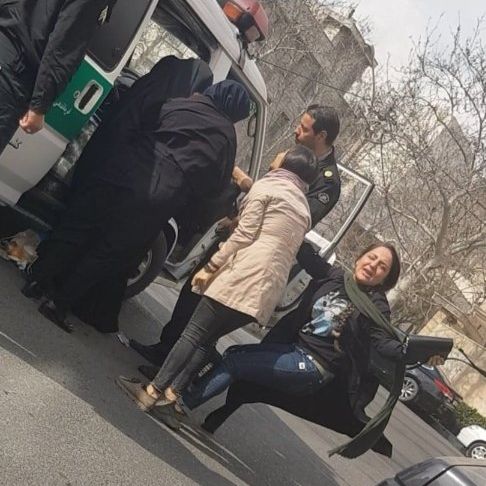
A woman being dragged into a ‘morality police’ patrol van (April 2024)
Multiple women arrested by the morality police in the latest crackdown since the weekend have informed Iran International about severe violence including severe physical assault as well as sexual verbal abuse.
A 17-year-old girl said that when she was arrested in Tehran’s Daneshjoo Park, the officers treated her violently, pulling her hair and beating her right arm and thighs with a baton, in addition to making sexual insults.
Male officers in the morality police van that transported the arrested women to a detention center beat the women who refused to submit to arrest.
The young woman told Iran International that at the detention center, the officers made women unlock their mobile phones and to reveal their picture galleries and social media accounts to the brutal state security. She saw more than fifty women in custody, most of whom were in their early 20s or teens.
A 19-year-old girl told Iran International that she refused to unlock her phone for the plainclothes officers at the detention center, so they hit her stomach and genitals with an electric shocker, addressed her with sexual profanity and sexually insulted her family. She was forced to cooperate to avoid being taken to the security agencies.
Several hours after their arrest, both of these girls were released from the detention center after providing their details, home addresses, telephone numbers, and fingerprints and signatures on sheets that were written "did not respect the hijab."
Reports given to Iran International indicate that hundreds of women have been arrested throughout the country, including Tehran and Karaj, for disobeying the mandatory hijab since Saturday when a new policy called project Noor, came into place, allowing further oppression for women and girls amid nationwide hijab refusal.
An Iranian journalist and post-graduate student of political science, Dina Ghalibaf, 24, was arrested at her home in Tehran on Tuesday after describing in a tweet her recent encounter with the police.
On Monday, she sent out a series of tweets in which she described how police used a shocker and handcuffed her at the Sadeghieh metro station for not wearing the mandatory veil.
Shahed Alavi, an editor of the Iran International Newsdesk, states that the regime is concerned people may expand their power and overthrow the government should the country be vulnerable to an attack by Israel amid the two countries' shadow war which came to the fore on Saturday night when Iran launched a massive aerial bombardment towards the Jewish state.
“This is not the Iranian people’s war. The state does not have the nation on its side, yet the regime is trying to force legitimacy by instilling fear and inflicting violence,” he added.
“The government wishes to demonstrate that while they are weak in foreign policy, they still possess power in the domestic arena,” Alavi said.
Aida Shakarami, the older sister of the slain 16-year-old Iranian protester Nika Shakarmi, was arrested in Tehran yesterday by the Islamic Republic's guidance patrol for not wearing the hijab.
"Yesterday, my daughter Aida was arrested by Tehran's moral security police for not wearing the mandatory hijab and is still in custody," the siblings’ mother Nasrin Shakarami wrote in an Instagram post.
Iranian authorities have recently escalated their violent crackdown on women for defying the country’s mandatory Islamic hijab laws, with reports of mass arrests across the country.
Some human rights activists argue that the regime is using the crisis and ‘state of war’ with Israel to suppress dissent – and that the country’s Supreme Leader, Ali Khamenei, enacted controversial measures during this time to avoid public backlash.
Nika was kidnapped and murdered by state security forces during unprecedented nationwide protests in Iran in September 2022, following the killing of 22-year-old Mahsa Jina Amini in custody of the so-called “morality police” in Tehran.
Just four days after Amini was killed, videos showed Nika setting fire to her hijab at a protest in Tehran. When Nika suddenly went missing, authorities refused to give the family any answers. After 10 days, authorities informed the family that Nika’s body had been found.
The authorities claimed that Nika had committed suicide. The teenager’s family has repeatedly denied these claims and stated that she was killed as a result of repeated blows to her head.
Subsequent reports indicated that Nika was raped by state security forces before they killed her. Since her murder, the Shakarami family has persistently been targeted with threats from authorities, and several members of the family were detained.
Last October, Aida Shakarami revealed that unidentified individuals had threatened her family while they visited Nika’s grave – telling them that Nasrin, the siblings’ mother, would face arrest.
Nika’s story and death at the hands of the regime turned her into one of the beloved icons of the movement for many Iranians.
Last year, Amnesty International reported that Iranian authorities are “waging a ruthless campaign of harassment and intimidation against the families of protesters and bystanders unlawfully killed by security forces during the “Woman Life Freedom” uprising to force them into staying silent…”.
The commander of the Aerospace Force of the IRGC has claimed the aerial attack on Israel was carried out with old weapons and minimal military strength amid backlash over the operation’s ineffectiveness.
Amir Ali Hajizadeh stated on Thursday that IRGC’s limited resources exceeded "the maximum capacity of both Hebrew and Western powers with minimal strength,” Tasnim, a news outlet affiliated with the IRGC, reported.
While Iran launched an unprecedented drone and missile barrage against Israel over the weekend, the effectiveness of the attack has been criticized and ridiculed online.
The attack, which was in retaliation for Israel's April 1 air strike on the Iranian consulate in Damascus, was almost entirely intercepted by the Israeli Defense Forces and its allies.
The Iranian authorities attempted to silence all criticism, including that of journalists and citizens inside the country, within hours of the attack.
Several news outlets and journalists who were critical of the regime's portrayal of a powerful attack were arrested and prosecuted. The IRGC's Intelligence Unit and judiciary have also threatened to prosecute anyone who ridicules or criticizes the military establishment.
In spite of attempts by the regime to save face, researchers interviewed by the Washington Post about Iran's arsenal claim Iran "threw everything it had that could reach Israeli territory."
n his Thursday remarks, Hajizadeh named a few "powerful" missiles to boast that they were not used, like Sejjil-1. However, experts say they may no longer be produced as they are too costly. Additionally, Hajiazdeh claims that the Kheibar Shekan missile was not used, a claim the Washington Post analysts refute.
The Iranian Revolutionary Guard Corps (IRGC) summoned the Swiss ambassador during the attack on Israel, a New York Times report on Wednesday confirmed.
Mojtaba Abtahi, an adviser to the Iranian Interior Minister, previously claimed that the Swiss Ambassador was summoned to the IRGC instead of the Foreign Ministry at 3 a.m. during Iran's first ever direct attack on Israel.
Tehran launched 350 or more missiles and combat drones on Saturday night in retaliation for Israel's April 1 air strike on the Iranian consulate in Damascus, killing a senior IRGC-Quds Force commander and several IRGC personnel.
Israeli forces, backed by the US and other allies, stated that approximately 99% of the incoming threats were destroyed, while the few that survived caused only minor damage. As tensions in the region mount, Iran is preparing for possible retaliatory attacks either on its territories or its proxies.
Speaking to Swiss Ambassador Nadine Lozano, the IRGC apparently broke protocol and warned her that "The IRGC would destroy the entire region if the US took even the slightest action", showing the true political force of the IRGC in Tehran.
Since 1980 following the attack on the US embassy in Iran, Switzerland has played a crucial role in representing US interests in Iran. It serves as a go-between for US interests in Iran during escalating tensions. However, summoning an ambassador to a military base, a clear violation of diplomatic protocols, is a highly unusual event. As of now, Switzerland and the US have yet to respond to this breach of diplomatic norms.
Mojtaba Abtahi, who also holds the title of Secretary-General of the International Conference on Supporting Palestine Intifada, referred to the action of IRGC as simply "military diplomacy."
In recent years, the IRGC has developed a more significant influence within the Iranian government and has broadened its influence outside the military to include other fields, such as economics.
Heavy rainfalls and flooding of local rivers have so far claimed the lives of at least eight people in Sistan-Baluchestan, dealing a heavy blow to the infrastructure of the southeastern Iranian province.
According to the Iranian Red Crescent Society, the flooding resulted in the collapse of a loader and the deaths of three employees of Iran’s Railway company in Khash to Iranshahr road.
Meanwhile, Majid Mohebbi, the director general of Sistan-Baluchestan’s Crisis Management Department, said that heavy rains and flooding caused the closure of 45 rural roads, 12 sub-roads and one main road in the south of the province.
We have reports of the disconnection of telecommunications in 60 villages of Zarabad, Konarak and Chabahar towns due to a problem in their optical fiber, Mohebbi said, further adding that the amount of rainfall in the last two days in the province has “exceeded the forecast.”
A 5-year-old Baloch girl in the village of Kach, Dashtiari district, lost her life after falling into a water hole created due to recent rains and floods.
According to the Iranian media, the relief forces managed to rescue 70 passengers of three buses which were caught in flood on Nikshahr-Chabahar route.
Local officials have urged people to take precautions and avoid unnecessary travels in the province.
Issa Ghazi, agricultural director of Konarak, said that according to the preliminary estimates, the heavy rains over the past two days inflicted more than 5,000 billion rials ($8 million) of damage to the facilities and infrastructure of the agricultural sector, including poultry houses, orchards and farms.
In Nikshahr, 12 villages have lost power as a result of heavy rainfalls and storms.
In a statement issued on Thursday, Sistan and Baluchestan’s Department of Environment warned of the detrimental impacts of the recent flooding on the wildlife.
“Following recent rains, flooding of all rivers and collapse of most dams in the province, it is not unexpected to witness stress and tension in wildlife, especially among native crocodiles. There is a possibility that the crocodiles will leave their primary habitat pond,” the statement added.
Mugger crocodiles, also known as “gando” in the local Baluchi dialect, are medium-sized broad-snouted crocodiles native to southeastern Iran and the Indian subcontinent.
State-sponsored Borna news agency wrote that despite its damages, the heavy rainfalls “revived hopes for an end to the drought” in the province.
In February, the torrential rains in southern Sistan-Baluchestan triggered extensive flooding, particularly in the Dashtyari region, leading to submerged residential areas and the closure of numerous roads. Hundreds of households also incurred damage due to the floods.
Furthermore, monsoon rains in the province in July 2023 led to the flooding of local rivers, closure of at least 42 roads and damage to hundreds of hectares of palm groves – an important source of income in the impoverished and arid region.
Experts attribute the recent flooding in Sistan-Baluchestan, a heavily drought-stricken region, to the consequences of global warming and climate change.
In an interview with Etemad daily Mehdi Zare, a geologist, remarked that “global warming tends to increase the intensity of extreme rainfall events,” further adding heavy rainfall is a telling aspect of the water cycle.
Sistan-Baluchistan is an economically challenged province in southeastern Iran adjacent to Afghanistan and Pakistan and home to a substantial Sunni community, which has been largely oppressed by the Iranian regime over the past decades.
Activist and Islamic scholar Sedigheh Vasmaghi, imprisoned for her opposition to the mandatory hijab in Iran, was sent to hospital from Tehran's notorious Evin prison on Monday without a headscarf.
It is an unprecedented move from Iran's authorities who refuse treatment to prisoners unless they comply with compulsory hijab regulations. High profile cases such as Nobel Laureate Narges Mohammadi have been the face of the regime's brutality for prisoners compelled to wear hijab in exchange for medical treatment. Mohammadi was the sole activist reportedly granted hospital visits without hijab on three separate occasions.
Vasmaghi's Instagram account reported on Wednesday that she was taken to the hospital for eye tests with three male and female agents while refusing to wear a headscarf. It is unclear how the regulations were waived when so many cases have been denied treatment.
The outspoken activist was arrested in early March for her criticism of the compulsory hijab law and for describing Supreme Leader Ali Khamenei as a “dictator” and the regime in power as “oppressive.”
Over 300 political and civil activists in Iran have campaigned for her release in the past week and expressed concern for her health. They expressed their dismay that Vasmaghi had been imprisoned despite her severe visual impairment.
Prior to this, Vasmaghi was denied access to adequate medical care. Iran International had learned from a family source that her health deteriorated on Monday morning, with her heart rate exceeding 120 and her blood pressure exceeding 160.
Narges Mohammadi, a Nobel laureate and jailed Iranian human rights activist, also expressed concern about Vasmaghi’s well-being and wrote on her Instagram account on April 2: "I protest against the government's terrible and deadly repression against Iranian women."
Nevertheless, Vasmaghi, the former professor at Tehran's university, has been vocal in her protests while in prison. Against the backdrop of Iran's recent crackdown on women for hijab rules, in a message from April 2024, Vasmaghi condemned the government's actions as "antipatriotic and contrary to national interests."