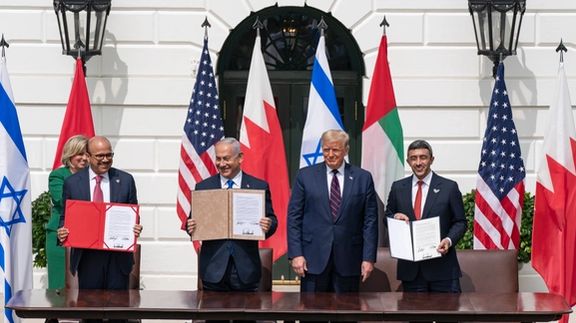
Bahraini Foreign Minister Abdullatif bin Rashid Al-ZayaniIsraeli, Israeli Prime Minister Benjamin Netanyahu, US President Donald J. Trump, Emirati Foreign Minister Abdullah bin Zayed Al-Nahyan after signing the Abraham Accords, September 15, 2020, on the South Lawn of the White House
April 13, 2024, Iran’s attempted retaliation against Israel marks a watershed moment in the history of contemporary Middle East that might bring Arab monarchies and Israel ever closer than before.
Indeed, major Arab conservative monarchies seem to have entered an unwritten Entente with Israel against the Islamic Republic of Iran. Despite all their condemnations of Israel’s operation in Gaza and its tragic humanitarian consequences, the escalation of conflict between Israel and the Iranian regime may convince the major Arab monarchies in the Middle East that they would rather rise to stop the assault on Israel by Iran and its proxies than sit idly by. Instead of submitting to a balance of terror by Iran and its proxies, they may very well choose to strike a balance of containment and stability. Understandably, such an argument runs counter to a somewhat prevailing view of Hamas’ 7 October attack on Israel convinced must have stalled any normalization between the Arab monarchies in the region and Israel for a long time to come.
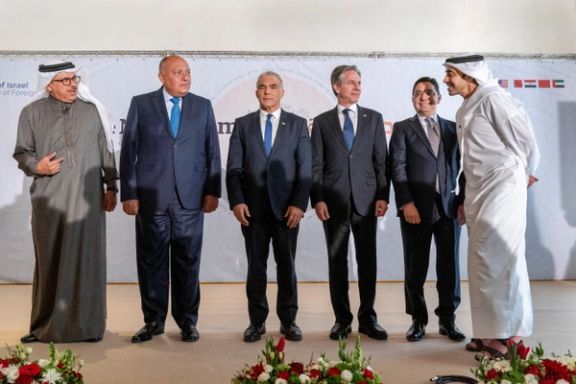
Secretary of State Antony Blinken with Arab and Israeli officials in a conference in Israel. March 2022
Yet, on April 13, 2024, after signaling its intention to direct a retaliatory strike from the Iranian soil against Israel, the Iranian regime launched a rather long-winded mixture of kamikaze drones, cruise, and ballistic missiles towards Israel. In coordination with their patron, the Iranian allied regional proxies at once launched projectiles of all types towards Israel. Israel by the afternoon of the same day declared that over 99 percent of the devices had been intercepted and destroyed. Many of them had in fact been eliminated even before they reached the Israeli air space.
In addition to the US, France, and UK that engaged their air defences and air forces in defence of Israel, several Arab countries did at once engage their air defences against such projectiles as they were discovered to be using these countries’ air space. However, with the exception of Jordan, all these Arab countries have been silent about their true role in thwarting the swarm that Iran and its proxies unleashed towards Israel. Even the Jordanian King Abdullah cited the principle of “raison d’état” to justify his country’s intervention: “Jordan won't be an arena for a regional war”. Saudi Arabia’s silence about its possible action against the Yemeni projectiles that flew through its air space to reach Israel is all too conspicuous. It is highly likely that the Kingdom did engage its air defence to shoot down some of the Houthi’s projectiles. Despite such news, many of the Abraham Accords skeptics continue to insist that the Arab countries may distance themselves from US and Israel ever further to shield themselves from the vengeance of Iran and its proxies.
All in all, the Iranian “attempted retaliation” has provided a litmus test for the rigour of the Abraham Accords like no other. And irrespective of Biden’s administration attempts to de-escalate tensions with Iran and prevent an all-out regional war between Iran and Israel, the Arab monarchies that endured a bloody war with the Yemeni Houthis are justified to be wary of the Iranian drone and missile technology in the aftermath of its attempted retaliation against Israel. In a decade or so, memoirs or archival documents may reveal that Saudi Arabia, UAE and Bahrain indeed actively shot down many of the projectiles that were launched towards Israel by Iran and its proxies. Their silence as to their instrumentality in thwarting the Iranian attack is all too comprehensible. They do not wish to come across to the Arab Public Opinion as the defenders of the Israeli state that they have been collectively condemning for the commission of crimes against humanity in Gaza since October 2023.
As actions speak louder than words, the likelihood of the Arab states’ participation in thwarting the Iranian retaliation speaks volumes about which “entity” they perceive to pose the greatest threat to the peace and security of the region: Iran’s Shia imperium and its armed proxies. In the meantime, pundits who have hitherto written off both the Abrham Accords and the Saudi Israeli rapprochement may wish to reconsider their previous “analyses.” Confirmation bias is an odd beast in international relations that preys on those who constantly seek to adjust “facts” to “confirm” the constant relevance of frameworks that have long been rendered obsolete. Recent events establish that Israel and the Arab states of the Middle East are members of a security military Entente against Iran’s Shia Imperium for all intents and purposes. Whether or not this Entente will ever be formalized is just a matter of time.
US forces in Iraq and Syria faced two separate rocket and explosive drone attacks in less than 24 hours, Iraqi security sources and US officials told Reuters on Monday, the first reported after a near three-month pause.
At least one armed drone was launched at the Ain al-Asad air base that hosts US troops in the western Iraqi province of Anbar, a US official said.
That followed five rockets fired from northern Iraq towards US forces at a base in Rumalyn in remote northeastern Syria, on Sunday, according to US and Iraqi officials.
There were no reports of casualties or significant damage from the drone attacks.
On Saturday, a massive explosion at a military base in Iraq killed a member of the pro-Iran Hashd al-Shaabi armed militia group. The force commander said it was an attack while the army said it was investigating and that there were no warplanes in the sky at the time. The US military denied involvement.
Near-daily rocket and drone strikes on US forces began in mid-October and were claimed by a group of Iran-backed Shiite Muslim armed groups known as the Islamic Resistance in Iraq, who cited US backing for Israel's war in Gaza.
The attacks stopped in late January under pressure from Iraqi authorities and Iran, following deadly US retaliatory airstrikes in Iraq, after three US soldiers were killed in a drone strike on a small base on the Iraqi-Jordanian border.
Iraqi Prime Minister Mohammed Shia al-Sudani returned at the weekend from a week-long visit to the United States where he met President Joe Biden in an effort to turn a new page in US-Iraqi relations despite soaring regional tensions.
The US invaded Iraq in 2003 and toppled strongman leader Saddam Hussein, withdrawing in 2011 before returning in 2014 at the head of an international military coalition at the Baghdad government's request to help fight Islamic State insurgents.
The US has some 2,500 troops in Iraq and 900 in eastern Syria on an advise-and-assist mission.
He is an attention seeker, always trying to grab attention, sometimes by making too much noise and at other times by keeping silent. Former populist Iranian President Mahmoud Ahmadinejad is currently in the latter mode.
Even when he is silent, his political rivals want to make him say something, hoping that he might shoot himself in the foot by making an odd or controversial comment that would put an end to his turbulent political career.
Conservative journalist Afifeh Abedi in an April 17 tweet quoted Ahmadinejad as having said on social media that "Any country which illegally attacks another should be responded to. That is a right for the country whose territory has been violated." This was clearly a reference to Iran’s April 13 massive missile and drone attack on Israel in response to an airstrike earlier in the month that destroyed a building within the compound of Tehran’s embassy in Damascus.
Abedi charged that "Ahmadinejad's remark reflected his ambitions in Iran's domestic politics rather than being aimed at foreign audiences." Nonetheless, Abdi criticized Ahmadinejad for acknowledging that Israel is a state.
This is one of those controversial comments that everyone in Iran can interpret to serve their political interests. Some, like Ms. Abedi, might believe Ahmadinejad was referring to Iran's unlawful attack on Israel, while others might take it as support for Iran after Israel attacked the Iranian Consulate in Damascus on April 1, and Iran's attack was a retaliation for that.
Some hardliner social media users lashed out at the former President for failing to condemn Israel for attacking Iran's Consulate in Damascus in the first place and charged that Ahmadinejad had created big problems for Iranians for denying the holocaust during his presidency.
However, some foreign-based media quoted Ahmadinejad as having said in his Telegram channel that "attacking Israel was a right for Iran," possibly to avoid Khamenei’s wrath.
In a tweet on April 16 reformist cleric Rahmatollah Bigdeli called for Ahmadinejad's dismissal from the Expediency Council, a sort of higher parliamentary chamber with members appointed by the Supreme Leader, who intervene in Iran's domestic political and economic issues where the parliament and the government cannot reach a final agreement on an issue.
Bigdeli wrote: "It is essential to remove Ahmadinejad from the Expediency Council as there is an open case against him at the court about oil swap with other countries," that allegedly happened during his presidency. Bigdeli further questioned the way he was elected President in 2005 and 2009 and charged that his slogan about wiping Israel off the map created too many problems for Iran.
Bigdeli further charged that Ahmadinejad has not condemned the Israeli attack on the Iranian Consulate that killed seven top IRGC officers, and has refused to support Iran's attack on Israel. "How can such a creature be a member of the Expediency Council?" Bigdeli asked. He also called on Judiciary Chief Gholamhossein Mohseni Ejei to start Ahmadinejad's trial as he has repeatedly promised in the past.
Many other Iranian politicians have been calling for Ahmadinejad’s trial and his removal from the Expediency Council after he openly criticized Khamenei in 2018. Nonetheless, he somehow managed to keep his seat at the influential council.
Conflicting reports from sources affiliated with Iran and its proxies have raised questions about their intentions, as a US base in Syria was targeted on Sunday for the first time in more than two months.
On January 30, following several months of sustained attacks against American troops in Iraq and Syria, the Shiite militia group Kataeb Hezbollah announced they would halt their strikes to “prevent embarrassment of the Iraqi government.” That announcement came after large US retaliatory air strikes targeting Iranian proxy forces in the region.
Sunday's attack was reportedly followed by at least one armed drone launched at the Ain al-Asad air base that hosting US troops in the western Iraqi province of Anbar, a US official told Reuters on Monday.
That January statement about halting attacks had withstood the test of time until Sunday night when five rockets were launched from Iraq's town of Zummar towards a US military base in northeastern Syria.
Shortly after the attack, a post appeared on the Telegram group affiliated with Kataeb Hezbollah, seemingly alluding to Sunday night’s rocket attacks, and stating that the armed groups’ in Iraq had decided to resume attacks because they felt the Iraqi government had failed to deliver a deal to end the US military presence in the country.
“Iraqi resistance gave Iraq’s prime minister three months to negotiate with the American forces to come up with a specific timetable for their removal from Iraq,” the post on the Kataeb-affiliated Telegram channel. “But now… It’s become clear that some political parties were lying: there is no foreign intention to leave Iraq.” Hence the decision “to resume military action.”
The “military action” (and the Telegram statement) came only one day after Iraq’s prime minister Mohammad Shia al-Sudani returned from Washington, where he had met President Joe Biden and other US officials to advance the plans for the Americans’ withdrawal from Iraq.
Not long after, Sabereen News, another popular Telegram group affiliated by Iran and its proxies, issued a statement denying that Kataeb Hezbollah had released a statement. Another Iran-affiliated outlet, Al Mayadeen, seconded the denial.
“The news attributed to the Islamic Resistance in Iraq regarding the resumption of its operations against US forces is false,” Al Mayadeen quoted its Baghdad correspondent. ”Iraqi Kataib Hezbollah Brigades has not issued any statement regarding this matter.” In another statement issued on the Telegram messaging app, the group said the resumption of attacks is "fabricated news".
It’s hard to tell with certainty which statement is true. Perhaps both. The difference could be intentional to create confusion, or it could be a sign of real clash within the groups’ rank and file.
Iran may also have a hand in all this: nudging its proxies to resume attacks on American forces in Iraq and Syria in order to pressure President Biden to dissuade the Israeli government from targeting Iran-backed militias in Syria and Iraq.
On Saturday –less than a day after the Israeli airstrike against Iran’s S-300 defense system near Isfahan– another round of airstrikes hit the headquarters and a major base of Iran-backed militias Hashd al-Shaabi (Popular Mobilization Forces) in Babylon, south of Baghdad.
No one claimed responsibility for the overnight attack on Hashd al-Shaabi US military rejected claims that it had a part in the operation. Citing an unnamed Israeli official, CNN reported that Israel also denied involvement in the incident.
Not enough is known about the incident to help draw definite conclusions about its source. One thing can be said with a reasonable degree of certainty, however: that “a vast network of hybrid warfare is currently underway between Israel and Iran and its proxies in the region,” according to UAE-based analyst Masoud Aflak.
Iranian President Ebrahim Raisi arrived in Islamabad on Monday on a three-day official visit, his first after unprecedented tit-for-tat military strikes this year.
The visit comes as the two Muslim neighbors seek to mend ties about three months after Pakistan launched airstrikes against several locations in southeastern Iran following Iran’s Revolutionary Guards hitting targets inside the Pakistani territory.
Both sides emphasized that the attacks were meant to target “terrorist hideouts” and not the civilians. Several children and women were killed in both attacks. Iran’s IRGC claimed their missiles and suicide drones targeted two bases of the Sunni militant group Jaish al-Adl while Pakistan claimed the operation was against “Sarmachar,” a term that means insurgents or rebels in general. Iranian officials have rejected Islamabad’s allegations about the presence of Pakistani terrorists in the city where the attack took place.
The cross-border attacks have escalated tensions between Iran and Pakistan although both countries insist that Baloch separatist factions were the main target of the strikes. Earlier in April, the insurgent Sunni Baluch group launched simultaneous attacks against military posts in southeastern Iran, which left at least 11 security forces dead.
"The Iranian president is accompanied by his spouse and a high-level delegation," Pakistan's foreign ministry said in a statement, adding that the group also included the foreign minister, other cabinet members and senior officials.
Raisi is scheduled to hold meetings with Prime Minister Shehbaz Sharif and several other officials, besides visiting the eastern city of Lahore and southern port city of Karachi, it added.
Major highways in Islamabad were blocked as part of the security measures for Raisi's arrival, while the government declared a public holiday in Karachi.
Pakistan's Prime Minister Shehbaz Sharif greets Iranian President Ebrahim Raisi on his three-day official visit in Islamabad, Pakistan April 22, 2024.
Raisi's visit is a key step towards normalizing ties with Islamabad, but Iran's supreme Leader Ali Khamenei, not the president, has the last say on state matters, such as nuclear policy.
Tension is also high in the Middle East after Iran launched an unprecedented attack on Israel a week ago, saying the attack was in retaliation to an airstrike on its consulate in Damascus. Several IRGC men, including a high-ranking general was killed. A few days after Iran’s attack against Israel, central Iran in turn suffered what sources said was an Israeli attack on Friday. Radar systems and S300 defense missile systems were targeted at a military base near Isfahan (Esfahan).
Pakistan and Iran have had a history of rocky relations despite a number of commercial pacts, with Islamabad being historically closer to Saudi Arabia and the United States.
Their highest profile agreement is a stalled gas supply deal signed in 2010 to build a pipeline from Iran's South Fars gas field to Pakistan's southern provinces of Balochistan and Sindh.
Despite Pakistan's dire need of gas, Islamabad has yet to begin construction of its part of the pipeline, citing fears over US sanctions.
Pakistan said it would seek waivers from the US, but Washington has said it does not support the project and warned of the risk of sanctions in doing business with Tehran.
Faced with the possibility of contract breach penalties running into the billions of dollars, Islamabad recently gave the go-ahead for construction of an 80-km (50-mile) stretch of the pipeline.
Iran is grappling with soaring food prices amidst economic turmoil and the devaluation of the rial compounded by Iran-Israel tensions.
According to reports from Iran's state-run Khorasan newspaper, the cost of essential food items has skyrocketed since the beginning of the Iranian New Year in March 2024, coinciding with the month of Ramadan. Beans have seen a staggering 30% increase in price, while red meat prices have surged by 25%. Additionally, summer foods have seen a remarkable 50% hike, with rice and several other items following suit with increases ranging from 10% to 15%.
Earlier in April, in an interview with so-called reformist news site Entekhab, Reza Kangari, the head of the Tehran Provincial Union of Food Banks, also highlighted the recent significant rise in food prices. Kangari stated that “some food items have seen a 30% rise" and attributed the rise to the depreciation of the rial, supply shortages, and subsequent price gouging.
The root cause of this alarming price surge lies in Iran's faltering economy, exacerbated by the continuous devaluation of the Iranian rial. The rial has continuously fallen since the inception of the Islamic Republic in 1979, but it turned into a steep fall in 2018 when the United States withdrew from the JCPOA nuclear deal, demanding its revision. Oil export sanctions and international banking restrictions imposed by the Trump administration badly hurt Iran’s oil-dependent economy.
The Iranian rial has witnessed a sharp decline, losing over 30% of its value against major currencies since the onset of January this year. Additionally, following Iran's military and drone attack on Israel on April 13, the rial experienced an unprecedented downfall, with the dollar surpassing the 700,000-rial threshold.
Furthermore, Iran's economy has been besieged by a prolonged period of high inflation, with rates surpassing 40% for the past five years. Additionally, Iran's substantial state debt and liquidity challenges contributed to the devaluation of the rial. This devaluation has had a cascading effect on the prices of essential food items. Since President Ebrahim Raisi assumed office in August 2021, Iran's liquidity has almost doubled, fueling rampant inflation that surged to 47% in the last fiscal year.
Despite the government's recent announcement of being committed to addressing the issue of food security, the relentless upward trajectory of food prices has only served to compound the economic woes faced by ordinary Iranians, pushing many further into financial precarity.
In the lead-up to Norouz, Iranian New Year on 20 March, according to messages received by Iran International Iranians lamented a sharp decline in their purchasing power, with essentials like rice, red meat, and dairy vanishing from household budgets.
While external factors such as US sanctions undoubtedly play a significant role in Iran's economic challenges, domestic policies and priorities also come under scrutiny.
For instance, sanctions resulted in a significant decrease in Iran-India trade, plummeting by as much as a third. Rice, which constitutes the primary export from India to Iran, saw a sharp decline of 34%, falling from $2 billion in 2022 to $723 million in 2023.
The consistent reluctance of Iran's leadership, Supreme Leader Ayatollah Ali Khamenei, to address fundamental problems such as the nuclear issue has exacerbated the country's economic isolation and hindered efforts to alleviate the plight of its citizens.
As economic woes deepen with soaring food prices, Iranian citizens face dwindling options and rising prices, painting a bleak picture ahead.