Iran Says Wall On Afghan Border Can Thwart Terror Amid Rising Threats
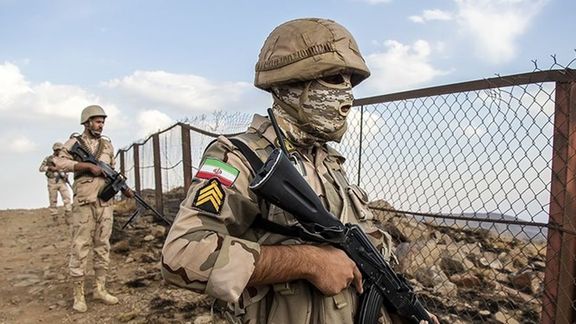
Iranian border guards
Iran's Deputy Police Chief, Qasem Rezaei, has claimed that the construction of a border wall with Afghanistan will help prevent drug trafficking, the movement of outlaws, and terrorist infiltrations.
The border fortification plan, which was revealed last month, entails building a four-meter concrete wall, along with barbed wire, fencing, and proper roads along the northwestern and eastern borders, all scheduled for completion within the next three years.
Rezaei highlighted, "This initiative specifically targets areas known for frequent illegal activities, including drug trafficking and the movement of outlaws, as well as potential terrorist threats."
Iran's Deputy Interior Minister, Majid Mirahmadi, announced last week an investment of three billion euros to "quickly start sealing the borders," amidst ongoing clashes with Taliban forces.
"This comprehensive effort includes the installation of fences, walls, and intelligent border control systems, ensuring a robust defense of our national borders," Mirahmadi added.
Tensions along Iran's borders have been highlighted by multiple incidents, including the capture and subsequent release of five Iranian border guards by Taliban forces on April 25 as tensions escalated in recent months.
The eastern borders of Iran have also been troubled by the intensified activities of the insurgent Sunni Baluch group, Jaish al-Adl (Army of Justice), which advocates for enhanced rights and improved living conditions for the Baluch ethnic minority.
The group has been a consistent source of tension with Iran. In response to attacks attributed to Jaish al-Adl, the Islamic Revolutionary Guard Corps (IRGC) has conducted cross-border operations into Pakistan, which have led to retaliatory attacks.
Jaish al-Adl was responsible for multiple attacks in the Sistan-Baluchistan province in recent months, which resulted in the deaths of Iranian law enforcement officers.
Iran continues to solidify its position as one of the most oppressive regimes for press freedom, with recent reports shedding light on the increasing challenges faced by the media in the country.
A report published Friday by the Organization for the Defense of Free Flow of Information (DeFFI) highlights a surge in repression against journalists during April 2024. Documenting 44 new cases filed against journalists by Iranian state authorities, with updates on 49 existing cases, the report underscores a systematic effort by the authorities to silence dissenting voices. This surge in repression coincides with recent events including tensions with Israel and heightened enforcement of hijab regulations on women.
Earlier Friday, Reporters Without Borders (RSF) placed Iran at 176th rank out of the 180 countries assessed, in its 2024 World Press Freedom Index, placing the country below China and just ahead of North Korea.
Speaking on the matter at the Nobel Peace Center's event on World Press Freedom Day Friday, Nahid Persson Sarvestani, Swedish-Iranian filmmaker, likened Iran to "a big prison for everybody, especially for journalists," additionally emphasizing the challenges faced by citizen journalists like Ghazaleh Chalabi, who was shot and killed by state security forces while filming protests in 2022. She added that the risks extend beyond Iran's borders, as exemplified by the case of Pouria Zeraati who was stabbed outside his London home recently.
In another report from the Midpoint School of Journalism, extensive repression against Iranian journalists over the past year is detailed. Documenting over 226 cases, the report highlights various forms of persecution, including arbitrary summons, arrests, physical assaults, and security threats. These incidents often targeted journalists covering contentious issues such as women's rights, economic struggles, and significant security incidents.
The involvement of security institutions, government agencies, and the judiciary in pressuring and threatening journalists is evident. Instances of pressure extend beyond Iran's borders, with allegations of targeting journalists abroad, including assassination plots.
Overall, these reports paint a grim picture of the challenges faced by journalists in Iran and the lengths to which authorities go to suppress dissent and control information.
Amidst the release of these reports coincided with World Press Freedom Day, US Department of State’s official Persian language X page paid tribute to Iranian journalists in Iran facing governmental pressures including Nilufar Hamedi, Elaheh Mohammadi, and Nazila Maroufian, applauding them for their bravery in reporting under difficult circumstances.
Paradoxically, the Spanish, Romanian, and Slovenian embassies in Iran, shared a message on their X pages for World Press Freedom Day, claiming to “honor journalists and media workers who report the truth, often at their own risk". Notably absent from their message were references to the arrests, bans, media outlet closures, and other forms of persecution faced by journalists in Iran.
Iran has decided to prohibit women from attending football matches involving FC Nassaji Mazandaran against popular teams such as Persepolis FC and Esteghlal FC.
The ban extends similar restrictions previously placed in cities like Arak and Tabriz and was reportedly influenced by an incident in Arak where a female fan without mandatory hijab, referred to as a 'jimmy jump', embraced Esteghlal FC's goalkeeper Hossein Hosseini at the end of a match.
Additionally, recent tensions escalated during a match between Persepolis and Sepahan FC, where verbal altercations between female fans of Persepolis and male fans of Sepahan further complicated the situation.
The newspaper Etemad highlighted what it describes as a "strange project" to re-ban women from stadiums, suggesting that each minor incident is being used as a pretext to justify broader restrictions.
"This time, a general directive to ban women's entry to stadiums will not be issued. Instead, any small or significant incident in any stadium will be used as a pretext to ban women's entry to that particular stadium. Later, it will probably be told to FIFA that women's entry to stadiums is not banned, but in a specific stadium, it has been temporarily suspended until the infrastructure is improved in the near future," wrote Etemad.
Conversely, the conservative Kayhan daily, which has ties to Supreme Leader Ali Khamenei, supports the exclusion of women from stadiums. It argues that the environment at football matches makes the spaces unsuitable for families and women.
The ongoing debate over women's presence in stadiums has been a contentious issue in Iran, with FIFA pushing for inclusivity for several years. Despite occasional relaxations allowing limited female attendance, persistent barriers continue to restrict their full participation, often under the guise of protecting cultural values or awaiting infrastructural upgrades.
Traders in Bandar Abbas gathered in front of the General Department of Taxation of Hormozgan Province to protest against 10 percent hikes in the value-added tax (VAT) rate amid the country's economic disaster.
According to one merchant interviewed by Sobh-e Sahel, the increase compounds the already significant strain on the country's production and industrial sectors due to ongoing inflation and international sanctions.
The assembled crowd chanted slogans like "We object" and demanded the revocation of the new tax directives.
The protest comes on the heels of similar actions earlier in the week when gold retailers in cities such as Tehran, and Tabriz either shut down or scaled back operations to voice their discontent with the government’s tax policies and legislative attempts to impose higher taxes.
A local retailer told Sobh-e Sahel that in addition to a base 20 percent tax on goods, merchants are compelled to add another 10 percent in VAT, a policy that significantly diminishes the purchasing power of consumers.
The broader economic context in Iran remains grim, with numerous reports over the years highlighting a sharp increase in poverty and the deteriorating financial conditions faced by its citizens.
As the government prepares to implement new tax regulations across several sectors such as gold, currency, housing, and automobiles, discontent continues to rise.
On April 22, the Etemad newspaper criticized the newly imposed taxes as exacerbating the issues, suggesting that such fiscal policies could deepen poverty and expand the impoverished demographic within the country.
Late on Saturday, Miri Regev, a member of Israel's security cabinet and Minister of Transportation, officially confirmed that Israel had launched a strike on an Iranian air base in Isfahan.
The action was in direct retaliation to Iran's unprecedented missile and drone strike on Israeli territory last month. Regev's statement marked the first time an Israeli official publicly acknowledged responsibility for the attack in April.
"We responded with a message which was received by Iran and the world which observed that Israel is no sucker," Regev stated in an interview with the right wing Channel 14.
Following Iran's first-ever direct assault on Israel, which involved over 350 cruise missiles, ballistic missiles, and drones, mostly intercepted by Israel and a US-led coalition of allies, Israel's counter strike aimed to recalibrate the balance without escalating to full-blown conflict.
The destruction of a key component of the S-300 air defense system at the Isfahan base, revealed through satellite imagery analysis, illustrates the precise nature of Israel's military response.
Iran, likely seeking to avoid a broader regional war, downplayed the damage to its airbase and stated it would not retaliate further despite having the capacity to do so. Tehran has also lessened its verbal aggression towards Israel recently.
Iran's air offensive was triggered by an Israeli air strike on Iran's Damascus consulate compound last month, in which at least one senior Quds Force commander was assassinated and several senior IRGC figures killed in the blast.
As the Gaza war rages on, sparked by Iran-backed Hamas's invasion of Israel on October 7, negotiations are underway regarding a potential ceasefire. Talks began on Saturday, aiming to secure the return of some hostages of the remaining 133 hostages held by Hamas.
The CIA director was in Cairo for the talks but Israeli officials continued to reiterate that Israel's war aims remained in place - the release of the hostages and the elimination of Hamas, with no permanent ceasefire option available.
Washington, along with other Western powers and Israel, which label Hamas as a terrorist organization, has encouraged the group to agree to a deal. Progress on this front has faltered due to Hamas' persistent demand for a commitment to cease the offensive. Israel, on the other hand, maintains that it would resume military operations aimed at disarming and dismantling Hamas after any temporary truce.
On Friday, Hamas expressed a willingness to approach talks in Cairo with a "positive spirit," having reviewed the latest proposal, details of which remain largely undisclosed.
Since Hamas's initial cross-border invasion on October 7, which killed 1,200 people and resulted in 252 hostages as per Israeli tallies, the violence has escalated. Gaza's health ministry reports that over 34,600 Palestinians have been killed.
The dynamics are further complicated by Iran's historical support of Hamas. According to an exclusive report by The Times, secret documents discovered during the Gaza war reveal that the Iranian government provided significant financial support to the Palestinian Islamist group Hamas, totaling at least $222 million from 2014 to 2020.
Previously, Tehran has admitted to financing and training Hamas, and while it has applauded attacks on Israel, it denies direct involvement in specific attacks, though celebrations were held across Iran just hours after the October 7 invasion and Hamas leaders continue to meet with Tehran's leadership amid the war.
The President of the Kurdistan region visited Tehran in a bid to calm tensions between the government and the flashpoint area.
The relationship between Kurdistan and Tehran has been marked by conflict sparked by Iran's military actions against Kurdish exile groups and accusations of Kurds harboring Israeli Mossad agents.
An escalation occurred in January when Iran’s Islamic Revolutionary Guard Corps (IRGC) targeted a location in Kurdistan, alleging it was a Mossad base.
The IRGC missiles hit a civilian house in Erbil belonging to Peshraw Dizayee, killing him and 4 members of his family. Dizayee was a business mogul and head of Falcon Investment Group. Following the raid, IRNA, the Iranian state news agency, released a report that accused Dizayee of collaborating with Israel.
The president of the region, Nechirvan Barzani, arrived in Tehran on Sunday. Accompanied by a delegation of senior officials, including Interior Minister Reber Ahmed, President Barzani is scheduled to meet with Iran's leaders including President Ebrahim Raisi, and Parliamentary Speaker Mohammad Bagher Ghalibaf.
The trip marks Barzani's first visit to Iran since attending President Raisi’s inauguration ceremony in 2021.