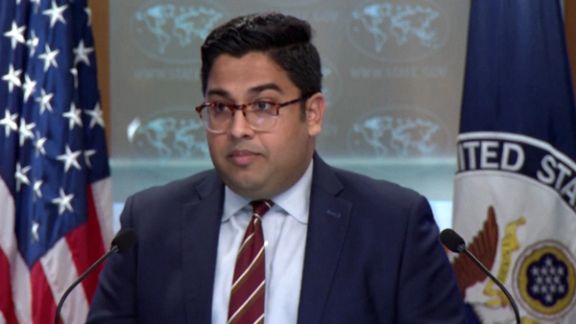
US State Department's Deputy Spokesperson Vedant Patel in a press briefing on May 13, 2024
The US will not allow Iran to build a nuclear bomb, the State Department said on Monday, one day after a senior Iranian official said Tehran would have no option but to change its nuclear doctrine in the face of Israel's threats.
“[President] Biden and [US Secretary of State Antony] Blinken will not allow Iran to have a nuclear weapon,” State Department deputy spokesperson Vedant Patel said in a press briefing.
He made the remarks in reaction to Sunday comments by Kamal Kharrazi, a senior advisor to Iran’s ruler Ali Khamenei, that the Islamic Republic would be left with no option but to alter its nuclear doctrine if Israel threatened its nuclear facilities or its existence.
“We continue to assess, though, that Iran is not taking any key activities that would be necessary to produce a testable nuclear device,” Patel told Iran International correspondent Samira Gharaei.
Kharazi said on Sunday that Iran does "not possess nuclear weapons, and there is a fatwa from the leader regarding this matter. But what should you do if the enemy threatens you? You will inevitably have to make changes to your doctrine."
Asked if these comments were a concern for the United States, Patel said, “We don't believe that the Supreme Leader has yet made a decision to resume the (nuclear) weaponization program that we judge Iran suspended or stopped at the end of 2003.”
When asked about the Biden administration's strategy toward a "nuclear threshold state" like Iran in the absence of ongoing negotiations, Patel told Iran International, "We have ways of communicating with Iran when it's in our interest, I'm not going to comment on that."
In a Monday press conference in Tehran, Iran's foreign ministry spokesman suggested that Kharrazi's remarks were not the official position of the Islamic Republic, and that Tehran's nuclear doctrine has not changed.
"Iran's official position on Weapons of Mass Destruction has been repeatedly declared by high-ranking Iranian officials, and there has been no change in Iran's nuclear doctrine," Nasser Kanaani told reporters in a briefing held on the sidelines of Tehran International Book Fair, citing a fatwa by Ali Khamenei on the prohibition of the production and use of nuclear weapons as the basis for Iran's position.
However, the fatwa Iranian officials refer to is not an irrevocable principle. Islamic fatwas can change or be reversed at a moment’s notice, experts have pointed out. Also, the alleged Khamenei fatwa is not actually a religious order, it is part of a statement he submitted to an international conference more than a decade ago.
Khamenei may invoke the principle of expediency to overrule his “anti-Nuclear” fatwa. The principle of expediency, as decreed by the founder of the Islamic Republic Ayatollah Khomeini in January 1988, stipulates that the Supreme Leader may even violate the fundamental tenets of the Islamic faith in order to preserve “the Islamic Regime” as the preservation of the Islamic Regime supersedes all else.
Kharrazi on Sunday also raised the issue of Israel’s alleged nuclear arsenal and called for the Jewish state’s nuclear disarmament. “If Israel threatens other counties, they cannot remain silent,” he retorted.
Last week, Kharrazi had stated, “If they dare to strike Iran's nuclear facilities, our level of deterrence will change. We have experienced deterrence at the conventional level so far. If they intend to strike Iran's nuclear capabilities, naturally, it could lead to a change in Iran's nuclear doctrine.”
In recent weeks, Iran has evoked the option of using the nuclear option as a deterrent against the possibility of an Israeli strike against its atomic facilities, amid a new reality in the Middle East after the October 7 Hamas attack.
On Friday, Iranian lawmaker Ahmad Bakhshayesh Ardestani claimed Iran might already possess a nuclear weapon.
He conveyed to the Rouydad 24 website his belief that Iran's decision to risk attacking Israel in April stemmed from its possession of nuclear weapons.
Ali-Akbar Salehi, who was foreign minister more than a decade ago and is still a key foreign policy voice in the Iranian government, also said last month that Iran has everything it needed to build a nuclear bomb, as tensions rose with Israel amid the Gaza war.
In a televised interview in April, Salehi, was asked if Iran has achieved the capability of developing a nuclear bomb. Avoiding a direct answer he stated, "We have [crossed] all the thresholds of nuclear science and technology.”
Salehi’s statement was preceded by a declaration from a Revolutionary Guard general. In the midst of tensions between the Islamic Republic and Israel, Ahmad Haghtalab, the IRGC commander of the Guard for the Protection and Security of Nuclear Facilities, announced on April 19 that if Israel intends to "use the threat of attacking our nuclear facilities as a tool to pressure Iran, a revision of the nuclear doctrine and policies of the Islamic Republic of Iran and a shift from previously stated considerations is conceivable and likely."
Since early 2021, when the Biden administration opted for negotiations to restore the Obama-era JCPOA agreement, Iran has vastly expanded its uranium enrichment efforts and is now believed to have amassed enough fissile material for 3-5 nuclear warheads.
In Iran, there have been more than 2,000 work-related deaths recorded in the last year, more than five per day, up by over 11 percent.
According to Ali Ziyai, head of the crime scene investigation unit at the Iranian Legal Medicine Organization, a total of 2,115 workers lost their lives, while an additional 27,000 sustained injuries as a result of work-related accidents during the last Iranian calendar year, spanning from March 2023 to March 2024.
Criticizing the Ministry of Labor for "statistical cover-up" on Monday state-affiliated ILNA news agency highlighted that this figure translates to an average of 5.79 worker fatalities per day throughout the year.
Ziyai told INLA that work-related fatalities "have increased by 11.3% compared to the previous year", adding that falling from heights consistently constitutes the largest portion of work accident fatalities.
He said, "Last year, 983 individuals lost their lives in workplace accidents due to falls from a height, comprising 46% of the total casualties.”
However, the numbers are likely far higher than reported by government affiliated sources. On International Labor Day last month, the HRANA Human Rights Organizationreported that at least 9,879 workers lost their lives or sustained injuries over the past year in Iran from 1 May 2023 to 27 April.
According to HRANA, a minimum of 1,680 workers died due to work-related accidents. Out of these fatalities, 10 official sources documented 1,514 deaths, while independent organizations reported the remaining 166 fatalities.
India and Iran have inked a deal allowing India Ports Global (IPGL) company to develop and control the management of an Iranian port for 10 years.
According to the deal, signed on Monday, IPGL is allowed to manage the transit operation of Indian goods to Afghanistan and Central Asia at the port in Chabahar, on Iran's southeastern coast along the Gulf of Oman.
Sarbananda Sonowal, India's Minister of Ports and Shipping, visited Iran today to participate in the ceremony and discuss boosting relations.
Since 2016, IPGL has invested $85 million in Chabahar to develop the Iranian port, aiming to create a rival to the Chinese-funded Pakistani Gwadar and Karachi ports – and to expand trade with Central Asia and Afghanistan.
The Indian company was supposed to have invested $250 million in Chabahar by now, but the investment has been delayed due to financial obstacles and Iran's procrastination in developing the Chabahar-Zahedan railway.
This railway is crucial for connecting the port to the national railway network and facilitating the transit of Indian goods to target markets.
Under the new agreement, the investment value is expected to reach $370 million. This project obtained a US sanctions waiver in 2018.
"As and when a long-term arrangement is concluded, it will clear the pathway for bigger investments to be made in the port," Indian Foreign Minister Subrahmanyam Jaishankar told reporters in Mumbai.
The Strategic Significance of Chabahar Port
Indian trade with Central Asia and Afghanistan remained unchanged at $2 billion during last year due to its dependence on Chinese and Pakistani territory to connect the target markets.
For comparison, Indian trade rival China had $90 billion trade turnover with Central Asian states, including Kazakhstan, Uzbekistan, Kyrgyzstan, Turkmenistan and Tajikistan in 2023 – which increased by 27% year-on-year, China Customs statistics indicate.
China also had $1.33 billion trade with Afghanistan last year, 40% more than India’s.
According to the International Monetary Fund, Central Asian states had $143 billion export and $95 billion import with foreign countries.
The Indian Commerce Ministry’s statistics show the mentioned states share only 0.5% of India’s total foreign trade.
India, Iran and Russia also signed a transit agreement in 2000, but neither India nor Russia transits good through Iranian territory due to its poor logistic infrastructures.
In terms of the logistics performance index (LPI), the World Bank has ranked Iran among the poorest countries.
Last year, the Islamic Republic ranked 123 of the 139 countries compared, marking the lowest score among all neighbors, except Afghanistan. Even Iraq outperformed Iran in terms of LPI, ranking 115 globally.
Given the current circumstances, while the transit of Indian goods through Iran to Russia seems unlikely, the Chabahar port holds significant potential for fostering trade between India and Central Asia or Afghanistan in the years ahead.
Last year, more than 4.2 million tons of goods were loaded or unloaded at Chabahar, sharing 2.2% of Iran’s total foreign trade volume. However, only 15,000 tons of goods were transit cargoes, corresponding to 0.1% of Iran’s total foreign cargo transits in 2023.
Therefore, almost all of the loaded or unloaded cargoes at Chabahar was related to Iran and India’s own trade.
India increased exports to Iran by 14% year-on-year to $1.66 billion in 2023, while its imports from Iran experienced a 45% growth to $672 million. Before US sanctions, India imported $11.1 billion and exported $2.65 billion goods to Iran in 2017.
Turkish Defense Minister Yaşar Güler voiced his frustrations regarding Tehran's lack of cooperation in combating the PKK.
Despite Ankara's efforts to engage with Iran on their mutual security threat, discrepancies in their approaches continue to pose challenges when combating the group both deem terrorist.
Güler, in an interview with Milliyet, detailed how Turkey has actively shared intelligence with Iran about the locations of PKK operatives, expecting collaborative counterterrorism measures.
"We clearly monitor and say, 'Look, these individuals (terrorists) are at this address, in this house,' but the response we typically receive from Iran is, 'No, we checked that address, and such a person does not exist.' Of course, this is unacceptable," Güler expressed.
His remarks coincide with Nechirvan Barzani, President of Iraq's Kurdistan Region, making a visittoIran last week. Given the recent IRGC missile attack on the Kurdistan Region, the timing and nature of Barzani's visit suggest they likely centered on shared security concerns.
The PKK, or Kurdistan Workers' Party, has been a longstanding insurgent force in the region, engaging in guerrilla warfare primarily in southeastern Turkey and northern Iraq since 1984. Initially fighting for an independent Kurdish state, the PKK’s focus shifted in the 1990s toward autonomy and enhanced rights for Kurds within Turkey.
The organization is designated as a terrorist group by Turkey, the United States, the EU, and others, though some continue to debate the appropriateness of the classification, suggesting that the PKK’s current activities do not systematically target civilians or constitute organized terror operations.
While both nations engage in joint efforts to address regional security challenges, including drug trafficking and terrorism, political and ideological differences frequently overshadow the collaboration. The tension is particularly palpable in conflict zones like Syria and Iraq where both countries seek to assert influence, often at odds with one another.
Following a meeting between gold retailers and government representatives, Iran International has learned that Iranian security agents arrested several gold merchants amid the ongoing strikes.
Reports indicate that a verbal altercation ensued during Sunday’s meeting following threatening statements from a representative of the Industry Ministry regarding potential legal action against protesting gold retailers.
Gold sellers in Tehran's market began their strike late April – with other retailers joining in from other cities, including Tabriz, Ardabil, Kermanshah, Hamedan, and Mashhad. The primary grievance driving the strike is the reactivation of the Comprehensive Trade System coupled with the introduction of a Capital Gains Tax.
The meeting was attended by representatives of the Ministry of Intelligence, the Ministry of Industry, the Tax Organization, members of the Tehran Gold and Jewelry Union, and several market traders.
Security agents present detained some of the gold retailers who were filming the meeting. As of the time of reporting, it remains unclear whether these individuals have been released.
The meeting reportedly ended without any resolution to the talks between the parties.
Last week, regime agents sealed a number of gold retailers' shops in Mashhad in retaliation to the merchant’s participation in the nationwide strikes.
In further response to the strikes, Iran's Chamber of Guilds has issued a formal threat of legal action against the Ardabil Gold Dealers Union in northern Iran, as revealed in a letter obtained by Iran International.
Similar protests have occurred last year in Iran, when comparable tax proposals were put forward.
Why Gold Retailers Across Iran Are Striking
The strikes commenced in Tehran's bazaar on April 28, spurred by the approval of new tax legislation by the Iranian parliament. Gold retailers shuttered their shops in protest against the Capital Gains Tax and the reinstatement of the Comprehensive Trade System.
Other gold merchants joined in quickly, expanding the strikes across Iranian cities.
Gold retailers have urged for the complete removal of the requirement to register information in the Comprehensive Trade System, which mandates that all manufacturers and sellers, both wholesale and retail, must register their transactions.
The newly introduced tax legislation requires gold retailers to pay taxes on gold assets surpassing 150 grams.
Iranian gold retailers assert that they have the "most transparent trade performance" and that they already make the "highest tax payments compared to other businesses."
"The tax burden on gold retailers in the past year [Iranian calendar year starting March 2023] averaged 96 million rials [approximately 15,000 USD], equating to only 8 million rials [approximately 129 USD] per month," Mehdi Movahedi, spokesperson of the Iranian National Tax Administration, stated in a television interview last month.
Nader Bazarafshan, the head of the Tehran Gold, Coin and Jewelry Union, stated in a media interview that "gold retailers have no issue with the tax system."
He added that their objection lies with the Comprehensive Trade System's requirement to record their capital and inventory information. Bazarafshan emphasized that gold retailers are questioning why they should register their ancestral capital in the Comprehensive Trade System.
According to the Gold Dealers Union, "two million people" are employed in this trade.
Impact on the Average Iranian
As the Iranian rial depreciates against major currencies, gold, much like real estate, automobiles, and imported goods, is seen as a crucial capital investment by Iranians to safeguard their savings.
Iranian gold retailers are opposing the regulations of the Comprehensive Trade System, particularly the requirement for them to input their customers' information.
They believe that this obligation, combined with the recently implemented Capital Gains Tax, will place an additional financial burden on ordinary Iranians who are already finding it challenging to save money to buy gold as a way of safeguarding their earnings.
Gold retailers also point out that under this Capital Gains Tax, people will be discouraged from purchasing gold.
Some experts have cautioned that this could exacerbate inflation, which has already surpassed an annual rate of 50%, according to the Central Bank of Iran.
Narges Mansouri, a 46-year-old Iranian labor activist, is in a critical condition on the twentieth day of her combined hunger and medication strike at Evin Prison in Tehran.
Medical reports have highlighted severe complications including kidney damage, neurological issues, and an elevated risk of cardiac arrest due to her ongoing strike.
A source close to Mansouri's family disclosed to Iran International that the prison's medical staff have described her condition as "dangerous".
The activist began her strike on April 23 to protest the neglect of her legal case and the financial demands made by the court which threatens to seize her mother's home unless a payment of 1.5 billion rials (about $2,500) is made. She is also demanding her own release.
On April 29, the situation became publicly known through the Instagram page of Narges Mohammadi, another imprisoned human rights activist at Evin, who highlighted the severity of Mansouri's condition and her ongoing strike.
Mansouri is renowned for her activism as part of the Syndicate of Workers of Tehran and Suburbs Bus Company. She was among 14 women who, in 2019, demanded the resignation of Ali Khamenei, leader of the Islamic Republic. The act led to her arrest, and she was sentenced to five years for "assembly and collusion against national security" and an additional year for "propaganda activities against the system."
Her defiance against the strictures of the Islamic Republic continued even after her arrest.
In recent decades, many political prisoners have suffered from various diseases and serious injuries due to their protest hunger strikes in prison, and some have also lost their lives.