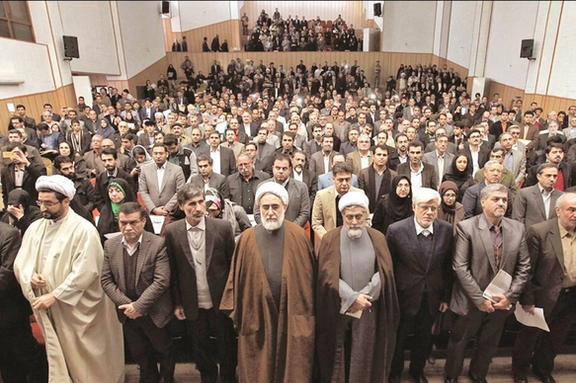
Iran's 'reformists' have indicated that they are willing to participate in the snap presidential elections of June 28, provided that the ruling establishment allows them to field their own candidates.
Azar Mansouri, the current head of the Reforms Front and secretary general of the Union of Islamic Iran People’s Party (Etehad-e Mellat-e Iran-e Eslami), indicated in a tweet on Tuesdaythat reformists are expecting clear signals from the authorities that the elections will be fair, free, competitive, meaningful, and effective. She added that is important to see if the “dominant will”, apparently referring to Supreme Leader Ali Khamenei, wishes “maximal participation” in the upcoming elections.
As Khamenei’s hardliner loyalists have barred others from competing in the last three national elections, voters have turned away from ballot boxes. Turnout has dropped to below 40 percent according to non-official estimates.
Reformists including former President Mohammad Khatami refused to vote in the March 1 elections of the Parliament and Assembly of Experts.
For the first time in his political career, Khatami not only refrained from voting in the parliament and Assembly of Experts elections, despite Supreme Leader Ali Khamenei's repeated declarations that voting is a religious duty, but also defended his decision in solidarity with the majority of Iranians who are angry with the country's governance, in a speech to his advisors on March 6.
In the past few days, however, there have been indications that reformists are seriously considering a return to the ballot boxes if given adequate guarantees that their participation will not serve the ruling establishment and “heat the election oven” to “bake someone else’s bread”.
‘Reformists’ appear determined not to support any candidate outside their own camp in this election, unlike in 2013 and 2017 when they rallied around moderate conservative Hassan Rouhani.
In an editorial in the reformist Etemad newspaper Tuesday, prominent Reformist commentator Abbas Abdi maintained that the populace may be willing to vote again, after shunning the ballot in the past three elections, provided that they are given “a certain level of meaningful choice”.
Ali Shakouri-Rad, the former secretary general of the Etehad-e Mellat Party, has also said that his party has decided to encourage people to participate in the elections provided that a candidate endorsed by the Reforms Front, the umbrella ‘reformist’ coalition, is allowed to run.
Shakouri-Rad who represents his influential party in the Reforms Front said his party has endorsed Mohammad Sadr and Mohammadreza Zafarghandi as potential candidates to the reformists decision-making body.
Sadr, 73, is a nephew of the late Iranian-Lebanese Shia politician Musa al-Sadr and a diplomat. He was appointed as a member of the Expediency Council by Khamenei in 2017 and was reinstated by him in 2022.
Sadr was one of the founding members of the Islamic Iranian Participation Party (IIPF) before 2009 and one of the most vocal critics of President Mahmoud Ahmadinejad’s foreign policy.
Sadr said Tuesday that the leader of the Reforms Front, former President Khatami, suggested to him to run but he has not yet made a decision.
Mohammadreza Zafarghandi, a former secretary-general of the non-profit Iran Medical Council, has been a vocal critic of hardliners and Ebrahim Raisi’s government. Zafarghandi is also one of the veteran members of the Islamic Association of the Iranian Medical Community. The association is part of the Reforms Front.
Since Tuesday, several figures including the ultra-hardliner Mayor of Tehran, Alireza Zakani, former President Akbar Hashemi-Rafsanjani’s son Mohsen Hashemi who is a member of the centrist Servants of Construction (Kargozaran) Party have denied an intention to run.
However, Mehrdad Bazrpash, 45, a hardliner who once served as a member of populist Mahmoud Ahmadinejad’s “young advisers” during his tenure as mayor of Tehran, was named by Meysam Nadi, head of the election headquarters of the Strategic Network of Friends of the Islamic Revolution (Sharyaan), as one of the group’s “principal options”.
Iranian media such as Borna News claimAli-Akbar Salehi, Iran's foreign minister under Mahmoud Ahmadinejad and nuclear chief under Hassan Rouhani, has also indicated his interest in running for the presidency, although he will be over the maximum age (75) allowed by law to run by two months.
Four Pakistanis were killed and two were injured late on Tuesday night, when Iranian forces opened fire in the restive southwestern province of Balochistan in Pakistan, Reuters reported.
The shooting took place near the Pakistan-Iran border, in Washuk District, confirmed Umar Jamali, additional deputy commissioner.
Naeem Umrani, deputy commissioner Washuk, said an investigation is being initiated to determine the reason for the shooting.
Former Iranian President Ebrahim Raisi visited Pakistan in April on a three-day official visit as the two Muslim neighbours seek to mend ties after unprecedented tit-for-tat military strikes this year. Raisi's visit was seen as a key step towards normalising ties with Islamabad.
Iran and Pakistan have had a history of rocky relations, but missile strikes in January were the most serious incidents in years, with Pakistan recalling its ambassador to Tehran and not allowing his counterpart to return to Islamabad, as well as cancelling all high-level diplomatic and trade engagements.
Swift efforts to lower the temperature subsequently led to assurances that they respected each other's sovereignty and territorial integrity, as well as vows to expand security cooperation and requests for envoys to return to their posts.
Islamabad said it hit bases of the separatist Baloch Liberation Front and Baloch Liberation Army, while Tehran said it struck militants from the Jaish al-Adl (JAA) group.
The militant groups operate in an area that includes Pakistan's southwestern province of Balochistan and Iran's southeastern Sistan-Baluchestan province. Both regions are restive, mineral-rich and largely underdeveloped.
As snap UK elections have been called for July, a group of over 550 politicians from across the political spectrum are making a last minute bid to proscribe Iran’s IRGC.
It comes just days after yet another Iran-backed attack on protesters in London, standing against commemorations for the late president, Ebrahim Raisi, known as the ‘Butcher of Tehran’. The incident left one man with severe spinal injuries.
MPs and peers on the British Committee for Iran Freedom are pushing once again for the designation before the country goes to the polls as the issue becomes key policy for both the Conservative and Labour parties. So far, the Foreign Commonwealth and Development Office (FCDO) has resisted calls to proscribe, even though its ally the US has led the way.
Instead, the country has issued multiple rounds of sanctions against entities and people connected with the IRGC, Iran’s military wing at home and abroad. This month, foreign secretary David Cameron said sanctions are currently enough, leaving the door open to diplomatic channels to deal with one of the world's biggest nuclear threats.
The latest initiative is led by Tory MP Bob Blackman, a long-time supporter of the National Council for Resistance of Iran (NCRI), who has worked with the NCRI and the umbrella group The British Committee for Iran Freedom, to compile the list of supporters and the accompanying statements.
Prominent MPs include Tory MPs Sir Iain Duncan Smith, Tobias Ellwood, Vicky Ford, Liam Fox, Sir John Hayes, Caroline Nokes, and Desmond Swayne, and Labour’s former shadow chancellor John McDonnell.
If the move does not pass this last round, change may be afoot if Labour wins the polls with shadow foreign secretary David Lamb suggesting that under his lead, there could be a change of policy with many of the peers behind the latest project from the Labour party.
In addition to Conservative Lord Bellingham, Labour signatories include Lord Boateng, former Archbishop of Canterbury Lord Carey, Labour’s Lord Coaker, retired general Lord Dannatt, former attorney general Lord Goldsmith, Baroness Kennedy KC, former Labour leader Lord Kinnock, Lord Pannick KC, former deputy prime minister Lord Prescott, and Labour’s Lord Whitty.
Slamming Cameron's approach, Blackman said: “We have tried the current policy of appeasement for 40 years, and it has only resulted in failure after failure, simply emboldening the regime in intensifying its nefarious conduct.
“It should be coupled with holding the regime accountable, including by designating the IRGC as a terrorist entity, a step long overdue. That would send a clear message to the ayatollahs that business as usual is over and would signal to the brave Iranians that the West has started to be on their side.”
Earlier this month, Prime Minister Rishi Sunak named Iran as one of the states posing direct threats to Britain, alongside Russia, China and North Korea.
Last year, British security services MI5 admitted that Iran was among the country’s biggest state threats after a string of attempted assassinations had been revealed on UK soil.
Blackman said proscribing the group “would have a huge impact on the regime’s schemes to skirt sanctions and finance its repressive forces at home and proxy groups all over the region.”
As more details come to light of Iran’s backing of the likes of Hamas in Gaza, which invaded Israel on October 7, sparking the current war, there are growing calls to proscribe the IRGC which is essentially a self-ruling body under the command of the Supreme Leader, Ali Khamenei.
The IRGC controls massive amounts of economic policy in Iran in order to redirect funds to military uses such as proxy activities with Iran’s militias such as the Houthis in Yemen, currently blockading the Red Sea in support of Hamas, and Hezbollah in Lebanon, also waging war on Israel’s northern front.
The IRGC has been linked to multiple high profile assassination attempts including a former Spanish MEP and vice president of the European Parliament.
If proscribed, they would be denied access to international funds and their links to Iranian government activities abroad would be severely curtailed.
Among those targeted by regime agents in the UK were members of the Iran International team. The Metropolitan Police admitted that threats had become so dangerous last year that they could no longer protect the offices in West London, forcing the team to temporarily relocate to the US while security measures were ramped up.
In March, Pouria Zeraati, the television host of the Last Word program on Iran International, was attacked by a group of what were believed to be Iran-backed agents in London.
The spokesperson for Iran’s Guardian Council declared that there is no possibility to appeal disqualifications in the presidential election as the body shores up increasing influence.
"The presidential election law does not provide for appeals against disqualifications, and the decision of the Guardian Council is final," Hadi Tahan Nazif stated Wednesday in a televised interview on the June 28 polls.
He claimed that the rule is not unique to the upcoming snap election following the sudden death of Ebrahim Raisi this month, but is the standard procedure under normal circumstances as well.
Earlier this month, former President Hassan Rouhanicriticized the Khamenei-appointed Guardian Council for undermining democracy and reducing the people's role in elections by vetoing candidates with opposing political views.
"This is not a defense of myself, but the defense of the system's republican (and Islamic) foundations, a defense of the institution of presidency which as the direct representative of all Iranians should not be weakened any more than this," Rouhani wrote in an open letter.
The former president, barred from running in the March 1 elections for the Assembly of Experts, addressed his letter to the "Iranian Nation," which was published on his personal website.
The 12-member Guardian Council, half of whom are clerics appointed by the Supreme Leader versed in Sharia law, and the other half laymen or clerics appointed by the chief justice, also a Supreme Leader appointee, has increasingly expanded its role in disqualifying election candidates.
The disqualifications routinely target not only opponents and dissidents but now also prominent insiders who fall out of favor with the hardline regime.
Former Parliament Speaker Ali Larijani was barred by the Guardian Council from running against Ebrahim Raisi in 2021, allegedly because his daughter resides in the United States. Despite Supreme Leader Khamenei calling his disqualification an "injustice" before the elections, he did not reinstate Larijani through a state edict, as many had expected.
Mystery surrounded the state-affiliated Borna news agency announcement that ex-parliament speaker Ali Larijani will run in the upcoming presidential election in spite of Larijani not confirming his intention to run.
When asked about his candidacy on Monday, the 66-year-old moderate conservative responded, "Let's see what happens." It is widely believed that Larijani is seeking assurances from Supreme Leader Ali Khamenei to avoid disqualification, a fate he faced during the 2021 elections allegedly due to his daughter's residency in the US.
The elections are slated for June 28 in the wake of the sudden death of Ebrahim Raisi who died in a helicopter crash on the Azerbaijan border this month, along with the foreign minister and other delegates.
In spite of Larijani's uncertainty, Borna claimed the former Parliament Speaker has finalized his decision and will soon register as a candidate, suggesting the tacit approval of Khamenei who is lining up a roster of allies for the upcoming polls.
Larijani, who has no political party affiliation but has been a prominent figure in the Islamist Principlist camp, has held numerous high-ranking positions appointed by Khamenei, including chief of the state broadcaster (IRIB) and secretary of the Supreme National Security Council. He also served as Iran's top nuclear negotiator from 2005 to 2007 and is currently a member of the Expediency Council and an advisor to Khamenei.
Meanwhile, former defense minister Hossein Dehghan dismissed the possibility of his presidential candidacy, stating, "Thank God, the number of people running for the presidential election is so high that it needs to decrease."
Dehghan, an Iranian military officer and former IRGC Air Force brigadier general, currently heads the Mostazafan Foundation, a “charitable” organization that claims to promote the living standards of disabled and poor individuals in Iran. The Mostazafan Foundation is closely associated with the Islamic Revolutionary Guard Corps (IRGC).
Candidate registration is scheduled from May 30 to June 3, with the Guardian Council expected to complete vetting within two weeks. Official campaigning will commence after that, leading up to the election on June 28.
Tehran representative Mahmoud Nabavian has claimed true Islam includes fighting Iran's archenemies, the US and Israel.
"The criterion for being a Muslim is, first and foremost, fighting against America and Israel," Nabavian declared. As Iran continues its decades-long proxy war against the Jewish state, he said the Iranian revolution is meaningless without opposing Israel, citing the incorporation of the principles in the Iranian Constitution and parliamentary laws.
Iran has long employed an anti-US and anti-Israel propaganda strategy as a central pillar of its ideological and foreign policy agenda. The narrative is perpetuated through state-controlled media, educational curricula, and political rhetoric, consistently framing the United States and Israel as principal adversaries.
This messaging is not only aimed at bolstering domestic support by uniting the population against external "enemies," but also at extending Tehran's influence across the Middle East, Iran having given birth to a host of militant groups across the region such as the Houthis in Yemen and Hezbollah in Lebanon, supporting others such as Hamas in Gaza.
Amid the ongoing war in Gaza, fueled by Hamas's October 7 invasion of Israel, Iran's proxies have all launched allied attacks on both US targets for having supported Israel's right to defend itself as well as Israel, from Syria, Yemen, Lebanon, Iraq and Gaza.
Last month saw the first direct attack on Israel from Iran when over 350 missiles and drones were launched towards Israel, mostly intercepted by Israel and a US-led coalition force as the tit-for-tat shadow war between the two states was drawn out into the open.