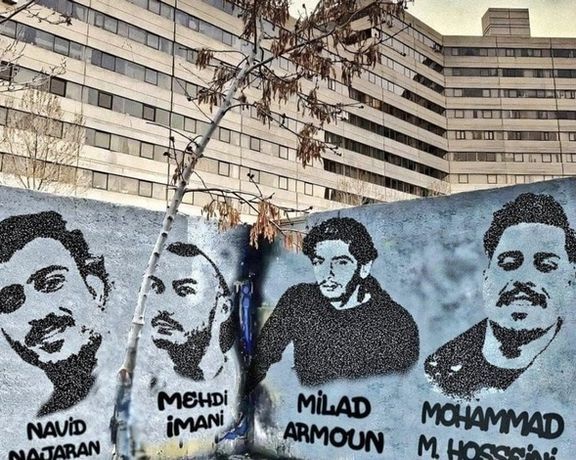
Stencil photos of imprisoned protesters Navid Najaran, Mehdi Imani, Milad Armoun, and Mohammad Mehdi Hosseini in a graffiti in Tehran’s Ekbatan neighborhood
The prolonged detention and transfer of four individuals accused in the high-profile 'Ekbatan case' to the notorious Ward 2A of Tehran’s Evin prison has sparked growing concerns amongst rights groups.
Their transfer has deepened fears about their well-being, the possibility of forced confessions through torture, potentially leading to severe sentences including the death penalty.
Milad Armoun, Navid Najaran, Mohammad Mehdi Hosseini, and Mehdi Imani, who have been imprisoned for almost two years, were transferred for re-interrogation to Ward 2A from Ghezel Hesar Prison in Tehran on April 30 as per reports by Human Rights Activists in Iran (HRA) on Friday. HRA reported these individuals have been in custody for 18 months, and only recently allowed brief phone calls with their families.
Sources close to their families have also warned of their families being threatened into silence and not speaking to the media.
Mohammad Hossein Aghasi, one of the lawyers of the detainees, had previously confirmed on X, in response to queries from activists about reports of their transfer to Ward 2-A and re-interrogation, stating that the detainees are in the “IRGC Intelligence [detention center]” in the process of completing “investigations” at the court’s request.
However, the pro-bono legal group, Dadban, reported on Sunday that they have been detained in Ward 2A for almost three months, citing irregularities in legal proceedings, and urging lawyers to not remain silent on the case proceedings.
Until recently, news of Navid Najarian being imprisoned concerning this case or even the date of his arrest was unknown.
Former political prisoner and activist, Foad Choobin who had met Najaran while he was imprisoned in Ahvaz Central Prison in Khuzestan Province wrote on X confirming Najaran’s date of arrest being December 5, 2022, and further revealed that he had been denied legal representation, subject to beatings and forced confessions in another IRGC Intelligence detention facility last year as well.
Ekbatan Case: Rights Violations, Forced Confessions and State Propaganda
The Ekbatan case traces back to November 2022 at the height of nationwide protests sparked by the death of Mahsa Amini who died in the custody of morality police.
A Basij force member, Arman Aliverdi, was allegedly murdered in Ekbatan on the evening of October 26, 2022, leading to a crackdown by security forces. Over 50 young residents were arbitrarily detained, with 14 facing charges such as Moharebeh (waging war against God), “assembly and collusion against national security”, “participation in intentional homicide”, and “disrupting of public peace and order." Of those arrested, some were released on bail. However, Armoun, Najaran, Hosseini, and Imani remain imprisoned and their transfer to Ward 2A further exacerbates their situation.
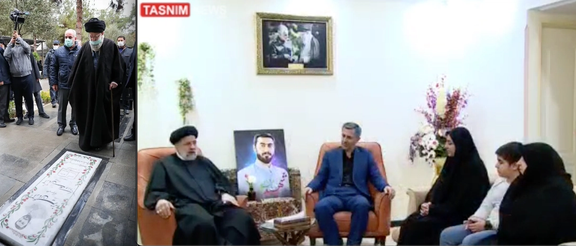
Following Aliverdi’s death, the late Iranian President Ebrahim Raisi visited the family of Aliverdi and Iran’s Supreme Leader Ali Khamenei also visited his grave.
Iran’s Supreme Leader Ali Khamenei at the grave of Basij force member, Arman Aliverdi (left) Late Iranian president Ebrahim Raisi during a visit to Aliverdi’s family
A large state-sponsored funeral was held for Aliverdi. State media highlighted his role in suppressing protests, portraying him as a hero, naming him a “martyr”, and a dedicated student Basij member.
Meanwhile, the detainees were subject to forced confessions. Armoun was shown on state media, blindfolded, and handcuffed.
The Iranian government has a history of broadcasting forced confessions from detainees, a practice widely criticized by human rights organizations. Such confessions are often used as evidence in court to convict political prisoners, a tactic that Amnesty International and other groups have consistently condemned.
However, even those appearances, Armoun publicly denied involvement in Aliverdi’s death, contradicting statements made by Tehran's police chief.
"The case has many fundamental flaws," stated Dadban, quoting Payam Derafshan, one of the defense lawyers who pointed out inconsistencies and illegal actions in the judicial process. "Milad Armoun has clearly stated that he never had any weapon in his hand."
Why Rights Groups Concerned About Transfer to Evin’s Ward 2A
Ward 2A of Evin Prison is operated illegally by the Islamic Revolutionary Guard Corps (IRGC). Even officials of Iran Prisons' Organization have no access to prisoners in this ward as per reports of multiple human rights organizations including, the New York-based Center for Human Rights in Iran (CHRI).
“Prisoners in Ward 2A are confined in either solitary or shared cells and are completely cut off from the outside world. Political prisoners and prisoners of conscience inside this ward are routinely subjected to beatings and inhumane torture for forced confessions," CHRI states.
Accounts of past political prisoners who have been kept at Ward 2A throughout the years reveal shocking accounts of torture, threats of rape, beatings and forced confessions.
“This is [Ward] 2A and god can’t hear you,” the interrogators at Ward 2A of Evin prison told Arash Sadeghi, a prominent human rights activist and former political prisoner who had been taken to this ward previously.
The IRGC's commander in Qazvin has made a bizarre claim that the United States had sent Iran a written message supporting its right to retaliate against Israel in spite of the two nations having no direct channels of communication.
Rostamali Rafiei Atani stated that Washington urged Tehran to "lower the level of revenge." The claims come in the wake of the US coming to Israel's aid after an unprecedented attack from Iran.
On April 13, Iran launched hundreds of explosive drones and missiles in retaliation for what Iran claims was an Israeli strike on its consulate in Damascus that killed seven IRGC officers. The US led a coalition of nations, including the UK, to support Israel in intercepting the majority of the 350 or more projectiles.
However, in the Sunday statement, Rafiei went on to say that "the Israelis and the British have sent messages saying they are ready to negotiate," while the British security services say Iran is one of the country's biggest foreign threats on its soil and Israel vows to do all it can to prevent Iran getting a nuclear weapon.
The Biden administration, however, rejected Rafiei's remarks on Sunday afternoon, telling the Washington Free Beacon that the remarks are "false" and such an exchange of message "did not happen."
This is not the first instance of an Iranian official making claims that cannot be independently verified. On Thursday, the IRGC-affiliated Tasnim news agency reported that Amirali Hajizadeh, a senior commander of the Revolutionary Guard, stated Israel had offered compromises in Gaza through communications mediated by Egypt's foreign minister to forestall further Iranian retaliation.
Despite the claims, the situation on the ground suggests otherwise. Israel has intensified its military operations into Rafah, the last Hamas stronghold in southern Gaza. The escalation persists even amid warnings from the International Criminal Court, as Israel continues its campaign to dismantle Hamas and secure the release of 125 hostages reportedly held in Gaza.
Nasrin Roshan, a British-Iranian citizen and political prisoner, has been detained in Iran for over 200 days and is serving a three-year prison sentence in Evin Prison.
Roshan is suffering from joint and back pain and has been denied medical attention despite swelling in her knees and ankles. Iran International has learned that she has developed knee arthritis in prison and her physical condition has deteriorated to the point where her illness has affected her appearance and gait.
She was arrested by security forces at Imam Khomeini International Airport on November 19, 2023, while attempting to legally travel from Tehran to her country of residence, the United Kingdom. Roshan was then taken to a solitary cell in the Intelligence Ministry's detention center known as Ward 209 of Evin Prison.Section 209 of Evin Prison, reportedly the most dreadful wardof the detention facility, is one of three prison sections that are controlled by Iran’s intelligence ministry.
Sara Tabrizian, a former political prisoner who died mysteriously after being released from prison, was arrested with her. She had been summoned to the Intelligence Ministry just one day before her death.
On January 1, 2024, after about a month and a half of torture and interrogation, Roshan was transferred to the women's ward of Evin Prison, where she has remained since.
Iran has been accused of wrongfully detaining at least a dozen foreign and dual nationals on trumped up charges, effectively as hostages to extract concessions from Western governments. Most of them are held on spurious spying charges.
Roshan was later tried by Judge Iman Afshari, head of Branch 26 of the Tehran Revolutionary Court, and sentenced to four years in prison on charges of "assembly and collusion" and eight months in prison on charges of "propaganda against the system."
Under Article 134 of the Islamic Penal Code, the four-year sentence was the maximum applicable punishment, which was later reduced to three years in prison.
A source familiar with her case told Iran International that her participation in anti-regime rallies following the death of Mahsa Amini at the hands of Iran’s morality police in September 2022, outside Iran was one of the grounds cited by the court in issuing her sentence.
Arash Asiabi, Roshan’s husband, in an interview with Iran International about his wife's continued imprisonment in Iran, said: "My wife has committed no crime and does not deserve to be in prison in Iran. My wife participated in protests outside Iran, just like any conscientious Iranian who cares about their country and people. Giving voice to the Iranian people is not a crime, and she should not spend a single day in prison."
It is not Roshan’s first time inside the Islamic Republic’s prisons. Roshan, born in 1963, was imprisoned in Iran from September 1981 to September 1985, between the ages of 18 and 22.
She spent the first two months of her detention in the 1980s under interrogation and torture in Evin Prison, and the rest of her sentence in Qazal Hesar Prison in Karaj.
Now, 200 days after Roshan’s arrest in Iran, she remains in the women's ward of Evin Prison, and her husband Arash Asiabi and daughter Hasti are worried about her conditions and have been calling on the international community to pressure Iran for her immediate release.
The foreboding news, “Iran is using criminal networks in Sweden,” bespoke an association between the Islamic Republic and Swedish mobsters whose targets are Jewish and Israeli.
Iran summoned Sweden's charge d'affaires in Tehran on June 1 over "baseless and biased" accusations made by a Swedish official. Sweden's security service said two days earlier that the Iranian government had been using criminal networks within Sweden to carry out violent acts against other states, groups and individuals.
Reuters has been the only leading major Western media outlet to cover this bewildering news. To hear, however, that the Iranian regime is forging bonds with Swedish gangsters is no news to those who have sounded the alarm about a pattern of behavior that in the case of the Iranian government is decades long. The Islamic Republic has had a multi-pronged affair with global gangsters using them for arms trafficking (both conventional and unconventional grade weapons) as well as money laundering.
Tehran’s favorite yardstick of governance has been mobster-like thanks to the iron fist of the praetorian IRGC in confederation with the ruling clergy. The military-industrial complex and the security-intelligence apparatus, which are pillars of its rule, operate through a complex network of religious charities and rentiering economic networks.
Thanks to JCPOA and Obama administration’s less strict approach towards Tehran, its rulers have morphologically devolved the Middle Eastinto a complex “nexus” of armed proxies that operates akin to a mafia racket. In this context, Trump’s “maximum pressure” sanctions on their own did not disrupt the Iranian regime’s “armed proxy” and “terror network” expansionism. With President Biden taking over the White House in 2021, the regime intensified its effort to consolidate its armed regional proxy network and expanded its terror network across the globe. However, since Hamas’s October 7 attack on Israel, Iran’s efforts to recruit gangsters has accelerated by leaps and bounds.
Iran and the World Crime Syndicate: A Not-So-Secret Affair
In 2015, Peruvian officials alerted US authorities about the expansion of the IRGC Quds force’s clandestine operations into Latin America, as they bonded with the region’s drug cartel to build a network across the region. By June 2022, the special commission of money laundering of the provincial government of British Columbia, the Cullen Commission, reported on the connections between Iran’s proxy, Hezbollah, the El Chapo drug cartel and their money laundering operations in British Columbia, Canada. Putting all the available reports together, it is likely that the triad of the Latin American drug cartels, the Lebanese Hezbollah, and the IRGC are working in tandem.
The advantages of such a collaboration are manifold for those involved. Such a network joins Latin America to North Africa and the Middle East, and also avails the partners in crime with the resources available through a global money laundering network powered by Crypto Currency. A further possible advantage could be to help one another eliminate competitors and/or enemies across the world.
The Iranian network with the global crime syndicates is not limited to Latin America, but stretches all the way to East Asia. In February 2024, the US indicted Takeshi Ebisawa, a Yakuza (Japanese Mafia) boss, for conspiring to transfer uranium and weapons-grade plutonium from Myanmar to Iran.
Recruiting Global Gangsters to Target Jews and Non-Jews
In view of the decade long collaboration between the Iranian authorities and the global crime syndicate, it was just a matter of time that Tehran would seek the services of domestic franchises as far as Sweden, Canada, and the United States to commit acts of terror on its behalf.
Starting from its founding in 1979, the Islamic government assassinated Iranian dissidents in Europe and North America in the 1980s and 1990s. A 2011 study by Iran Human Rights Documentation Centre detailshow the regime plotted and implemented these assassination plots. The report points out that it used a combination of hired-for-murder non-Iranian hitmen as well as Iranian agents who operated clandestinely under diplomatic cover for such missions.
After a lull in the early 2000s, Tehran renewed its overseas terror plot machinery as of 2010 with renewed vigor. In 2011, it sent two clandestine agents under cover as tourists to target Israeli diplomats in Bangkok. The Thai authorities arrested the to-be-assailants after the explosives that they had stored at their residence in Bangkok blew up the roof of the house. The Iranian agents were eventually convicted for plotting to assassinate Israeli diplomats in Thailand in 2013.
Unabated, the IRGC intelligence awakened a sleeper-cell that it had dispatched to Sweden three years earlier as refugees in the persons of an Iranian couple to implement a plot to murder Swedish Jews. However, the Swedish police arrested them in April 2021 before they could accomplish their mission.
This was followed by the shooting attack on a synagogue in Essen Germany in November 2022(18 November). The Essen shooting attack marked a departure by the Iranian security-intelligence apparatus from using Iranian nationals. In fact, the planning and implementation of the Essen Synagogue attack debuts the recruitment of local gangster franchises to implement a terror plot designed, planned, and funded by Tehran.
It was not until March 2023 that it was reported that the Iranian agents used a German citizen of Iranian descent based in Tehran to launch an attack against the synagogue in Essen. It is noteworthy that there was another attempted attack on another synagogue in Bochum on 17 November 2022. At the time, German authorities speculated that the suspect in both attacks was the same personwho had acted at the instigation of an Iran-German member of Hells Angels, Ramin Yektaparast. A former president of the Hells Angels chapter in Oberhausen, Yektaparast was the mastermind of the attacks against both synagogues in November 2022. At the time, Yektaparast had already absconded Germany for Iran a year or so earlier as he was a suspect in the “Rocker-Torso Murder”. Based on reports from Israel and Europe, Israeli intelligence finally “dispatched” Yektaparast in Iran in April 2024.
The ferocity of the Iranian plots against Jewish and Israeli citizens across the world reached such heights that by September 10, 2023 (almost a month before Hamas’ attack on Israel) David Barnea, Mossad’s Chief, publicly warned the Iranian regime that if it so persisted in planning and attempting to implement such terror plots, Israel was ready to attack Iran’s top officials in Tehran.
In late January 2024, news broke that the Iranian agents hired two members of the Canadian Hells Angels to commit assassinations inside the United States against Iranian American dissidents. After their successive failures in Europe in the previous years, the IRGC and their underworld friends were still intent upon striking terror in the heart of North America.
Damion Patrick Ryan (43), one of the two Canadian Hells Angels, as mentioned in the US indictment, however, was all too familiar for those who follow organized crime news in Canada. Originally, Ryan was a member of Vancouver biker gangs. He moved to Ottawa in 2010 where he joined the Hells Angels chapter there for a few years. He later moved to Greece and joined the Hells Angels chapter in Attica. It is not clear when and how, in Canada or Greece, he became acquainted with an Iranian international drug dealer, Naji Zindashti, that acted as middleman between him and the Iranian intelligence. The US Justice Department indictment establishes that between December 2020 and March 2021, the Canadian gangsters became part of a network run by Zindashti’s criminal drug trafficking organization at the behest of the Iranian security and intelligence apparatus.
Any astute observer would notice that the recruitment of the German and Canadian Hells Angels occurred within two years (2020-2021), indicative of a premeditated design. The latest episodes of recruiting local gangsters establish the systematic nature of such efforts. The first of such episodes was in March 2024, when Peruvian authorities arrested an alleged member of the IRGC’s Quds force, Majid Azizi, along with two Peruvian accomplices. According to the official reports, the trio intended to kill an Israeli businessman.
Though Tehran’s doctrinal shift to use gangsters as opposed to undercover agents acting as diplomats, or pretending to be refugees, seems novel, it is highly flawed. States are traditionally far more likely to extradite (with or without mutual extradition treaties) organized crime members than they would in the case of assassins that operate under diplomatic cover. Furthermore, if the number of arrests and convictions of gangsters hired by a country to act as their terror plot agents starts to surge, this could mark a new era of enforcing the counter-terrorism UN convention in an unprecedented way. The only presumable advantage for gangsters to enter such Faustian deals can be to secure themselves a safe haven from an emerging counterterrorism à la counter-organized crime regime.
Gholamhossein Karbaschi, former mayor of Tehran, likened the mass registrations for the Iranian presidential election to a "stand-up comedy."
Karbaschi, a prominent figure in the centrist, pro-reform Executives of Construction Party, said, "They [the government] have turned the country's main symbol of democracy into a stand-up comedy," amid the sham elections which will ultimately nominate someone chosen by the country's Supreme Leader.
Karbaschi, a close ally of former President Mohammad Khatami, was previously arrested and imprisoned on corruption charges in a case that the New York Times described as "widely seen among moderates as a politically motivated attack" by conservatives and hard-liners. It was perceived as an effort to suppress Khatami's reformist agenda.
Echoing Karbaschi's sentiments, Saeed Hajarian, a reformist theorist, also voiced his concerns over the superficiality of the candidate registration for the upcoming presidential election.
On X, he criticized the absence of substance behind the spectacle: "A neat suit, a few slow steps, showing the ID card, a few camera flashes... That's it! They talk neither of a coherent plan nor of the potential members of an effective cabinet."
The debacle comes in the wake of the sudden death of President Ebrahim Raisi in a helicopter crash on May 19, which precipitated the current snap election set for June 28. With registration ongoing since Thursday and ending Monday, nearly 90 percent of the candidates hail from the pro-regime camp.
Adham Naroui, a political prisoner facing the death penalty in Iran's Zahedan Prison, attempted suicide on Thursday amid fears of imminent execution.
According to Haalvash, a news outlet covering the Sistan-Baluchestan province, Naroui was rushed to a local hospital after overdosing on sedatives. He is the latest prisoner to attempt suicide amid Iran's escalating killing spree, last year alone, over 850 Iranians executed.
Naroui, arrested by security forces in June 2021 in Lashar, and later transferred to Zahedan, was charged along with Mohammad Zeinoddini in October 2020. In 2022, both were convicted of "waging war through armed action" and their death sentences were upheld by the Supreme Court in November 2023.
They were accused of murdering three members of the Revolutionary Guard during an operation, charges they have repeatedly denied, claiming they played no role in the incident.
The incident is part of abroaderpatternofneglect and abuse in Iranian prisons, which the US-based Human Rights Activists News Agency (HRANA) highlights in its annual report saying between March 2023 and March 2024, at least six prisoners died due to illness, twenty committed suicide, and eight were murdered in custody.
The report details physical torture, denial of medical services, solitary confinement, forced confessions, lack of access to chosen lawyers, and inappropriate detention conditions endured by political prisoners.
Iran has consistently failedtoacknowledgeresponsibility for the deaths and suffering of political prisoners caused by torture, lack of medical care, and other forms of systemic abuse.