Iranian Acting FM Calls Lebanese Hezbollah 'Anchor of Stability and Peace'
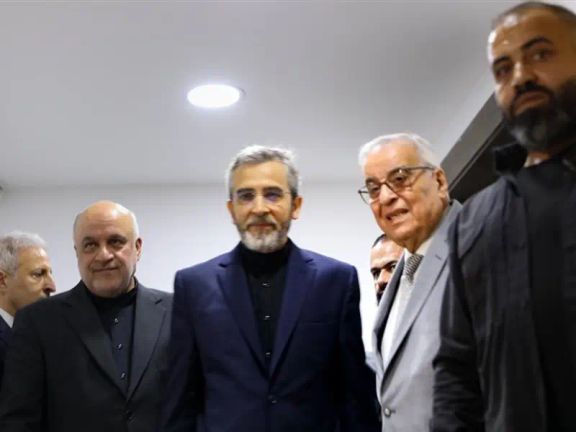
Iran's Acting Foreign Minister (C) visits Lebanon on June 3, 2024, marking his first international destination.
Iran’s acting Foreign Minister, Ali Bagheri Kani, has called Iran's proxy terror group Hezbollah in Lebanon an "anchor of stability and peace in the region" while the militia continues to bombard Israel's northern towns.
Calling the group, designated by countries including the UK and US the "Islamic Resistance", he lauded the actions which have seen well over 3,000 drones, rockets and missiles launched towards Israel since Iran-backed Hamas launched its invasion on Israel on October 7. Over 100,000 people in Israel's north have been displaced by the conflict and similar numbers from southern Lebanon.
In his first international visit following the sudden death of President Ebrahim Raisi and foreign minister Hossein Amir-Abdollahian in a helicopter crash last month, Bagheri arrived in Lebanon on Monday.
Hezbollah, Iran's biggest and most powerful proxy, funded, trained and armed by the regime, continues its daily exchanges of fire with Israeli forces amidst the ongoing Gaza war, the conflict on Israel's northern border its worst since the second Lebanon war.
Bagheri Kani’s visit marks the importance of Lebanon in Iran's 'Axis of Resistance', the collective name used to describe its proxies fighting Iran's archenemies, the US and Israel. With tens of thousands of militants and over 120,000 missiles ready to fire at Israel, Hezbollah remains Iran's greatest proxy project to date, a pet project of the Supreme Leader.
Hezbollah has supported Hamas since the invasion of October 7, along with Iran's proxies in Syria, Yemen, Iraq and Gaza, with missiles fired towards all of Israel's borders. In a single day, around 3,000 Hamas terrorists killed at least 1,200 mostly civilians and took around 250 more hostage to the strip.
Israel's relentless retaliatory attacks have seen over 36,000 killed in Gaza, according to Hamas, Israel claiming 14,000 or more terrorists have been killed in the operation.
GPS jamming has been seen across Iran as the Supreme Leader goes on tour amid increased security fears on the back of the sudden death of President Ebrahim Raisi.
Supreme Leader AliKhameneidelivered a speech at the mausoleum of Ayatollah Ruhollah Khomeini on the 35th anniversary of his death on Monday, along with other high profile figures, leading to suspicions of jammed GPS signals to protect his whereabouts.
In addition to the ongoing protests against the government, the sudden death of President Ebrahim Raisi in a helicopter crash last month has revived unease about the safety of Iran's leaders, though officially, the government says there was no foul play. Raisi died alongside the country's foreign minister Hossein Amir-Abdollahian, another key figure in the government.
The Iranian navigation app Neshan has described the incident as "the most extensive GPS disruption" recorded to date. Users in Tehran reported anomalies in their location data, with maps inaccurately showing their positions at significant distances from actual locations.
Neshan's public relations team acknowledged the disruptions but did not clarify the cause. The ongoing issues with domestic navigation services, exacerbated by the government’s ban on popular apps like Waze, have forced many to rely on local alternatives, which are now proving unreliable.
After Mahsa Amini died in a morality police detention center in mid-September 2022, sparking nationwide protests,the government responded by blockingseveral widely used internet services, including Instagram and WhatsApp in a bid to quash the uprising which has proved the greatest challenge to the government since the founding of the Islamic Republic.
Tehran's historic Azadi Square, one of the city's most cherished landmarks, is scheduled for demolition within the next month, according to documentation revealed on social media.
The news has sparked outrage among Iranians online, who suspect the project to be a decision by Tehran’s hardline Mayor, Alireza Zakani, known for his recent initiatives to construct mosques in city parks.
Social media users are rallying support, urging fellow Iranians to disseminate the information to help safeguard the national symbol from destruction.
Alireza Nadali, the spokesperson for the Tehran City Council, denied the rumors, stating, "Azadi Square is the most important symbol of freedom-seeking in our country and will not be demolished under any circumstances."
Nadali added, "In fact, we are reviewing a plan that aims to preserve Azadi Square with its current identity and appearance, and to further develop it as a cultural square with a focus on the discourse of the Islamic Revolution."
Azadi Square, historically known as Shahyad Square before the Islamic Revolution, was commissioned by Mohammad Reza Pahlavi, the last Shah of Iran, originally designed to commemorate the 2,500th anniversary of the Imperial State of Iran. One of the most beloved symbols of the city, it ranks as the third most recommended site for tourists, following museums and palaces.
Last week, Hossein Amanat, the designer and chief architect of the Azadi Tower who has projects in Iran, China, the Middle East and North America, was awarded an honorary doctorate by the University of British Columbia in Canada. Born into a Baha'i family, Amanat moved to Canada a year following the 1979 revolution.
Hassan Bagherinia, a dissident and former faculty member at Iran’s Hakim Sabzevari University, has been arrested after Iranian security forces conducted a raid on his residence, confiscating all electronic devices.
His daughters were also threatened not to speak out about the raid in which his family's devices were also confiscated.
Bagherinia, an assistant professor in the Department of Educational Sciences and Psychology, was dismissed from his university role due to his vocal opposition to the government's violent crackdown on protesters during the 2022 uprising in Iran in which over 500 Iranians were killed.
Undeterred by his dismissal, he continued to publicly criticize the authoritarian policies and the leadership of Supreme Leader Ali Khamenei.
In a video made prior to his arrest, Bagherinia criticized what he called "illegal actions" during his dismissal. He stated, "The Islamic Republic thinks it can maintain its rule by arresting and detaining people, but Mr. Khamenei... this era of yours will also pass. Long live Iran. Woman, life, freedom."
Despite the efforts to silence him, no formal charges have been brought against Bagherinia and his current whereabouts remain undisclosed.His arrest has sparked outrage among the academic community, with 100 academics from across Iran condemning his dismissal and the continued governmental policy of purging universities of critics, a practice that has intensified since the presidency of Ebrahim Raisi began.
The Human Rights Foundation (HRF) announced the winners of the Václav Havel International Prize for Creative Dissidence 2024, among whom is the imprisoned Iranian rapper facing a death sentence, Toomaj Salehi.
The winners of this year’s Havel Prize will be recognized during a ceremony this Tuesday 4 June, at the Oslo Freedom Forum (OFF) 2024 in Oslo, Norway.
Negin Niknaam, a friend and leading advocate for Salehi’s freedom and admin of Toomaj Salehi’s social media pages, will accept the award on his behalf. Speaking to Iran International English on Sunday on her way to Oslo ahead of the event, Niknam stated:
“I am attending the event with a heavy heart as Toomaj remains behind cold prison bars, but a deep sense of pride for his resilience and art. This award validates Toomaj’s fight for freedom of speech and expression, further highlighting the ongoing plight of Iranians held hostage by the Islamic Republic.”
In his music, Salehi advocates for justice and human rights in Iran in protest of the suppression of the Iranian people. At the peak of Iran’s nationwide Woman, Life, Freedom uprising sparked by the killing of Mahsa Amini in morality police’s custody, Salehi released a song in support of the Iranian people.
The song was titled “Divination” with the lyrics, “Someone has lost their young child and someone has lost their youth… Someone was dying before the execution of justice… Someone's crime was, dancing with her hair in the wind.” It reflected the brutality of Iranian authorities in their crackdown on the protests, which resulted in the killing of at least 500 protestors and over 20,000 detained including Toomaj himself.
In addition to Salehi, Uyghur poet and activist Tahir Hamut Izgil, and Venezuelan pianist and recording artist Gabriela Montero are amongst this year’s Havel Prize winners.
“Every year, the Havel Prize celebrates individuals who, with courage and creativity, unmask tyranny and embody the concept of ‘Living in Truth,’ as relevant today as when it was articulated by Václav Havel almost 45 years ago. Their work stands as a testament to extraordinary bravery and ingenuity,” HRF Founder Thor Halvorssen said in a statement.
Iran’s Supreme Leader Ali Khamenei on Monday openly endorsed the October 7 Hamas attack on Israel, saying “Our region was very much in need of this attack.”
Khamenei was speaking at a ceremony marking the 35th anniversary of Ayatollah Ruhollah Khomeini’s death, who was the founder of the Islamic Republic.
Khomeini believed that Palestinians should not rely on negotiations for compromise and must take action themselves to claim their rights and force the enemy to retreat, Khamenei said.
The Supreme Leader praised the attack “as a huge blow to Israel," signaling an escalation in rhetoric from Tehran. He also accused the United States and Israel of orchestrating a vast scheme aimed at altering regional dynamics, further intensifying the geopolitical tensions in the Middle East.
Khamenei reiterated that the October 7 attack shattered a long-term plan by the US, Israel, and some regional countries to change existing dynamics and establish ties with Jerusalem. "Given the situation over the past eight months, there is no hope for reviving such a plan."
"The Zionist regime has completely misjudged the capabilities of the resistance front," he added. "The Zionist regime is melting before the eyes of the world... They have, by their own actions, entered a dead-end corridor from which failures continue to follow one after the other, and from which they will not be able to escape."
The Islamic government in Iran has staunchly backed Palestinian and other militant groups in the region during Khamenei's 35-year authoritarian rule.
In many stances, it was Tehran’s Revolutionary Guard that created armed groups in Lebanon, Iraq, Yemen and Syria, providing both financial and military support, mainly with the aim of weakening Israel and the United States.
Khamenei on numerous occasions hailed the October 7 attack but implicitly denied Tehran’s direct involvement in the operation. He reiterates Tehran’s long-held policy of demanding a referendum to decide the fate of Palestine and Israel, but at the same time calls for the “Al-Aqsa Flood” to be repeated, which was in essence an attack on civilians and widespread and indiscriminate killings.
He harshly decries the Israeli attacks in Gaza, without mentioning that the campaign began after Hamas killed 1,200 people in Israel, mostly civilians. He insists that Israel’s military operation has been a disgrace for the United States and other Western countries that have supported it.