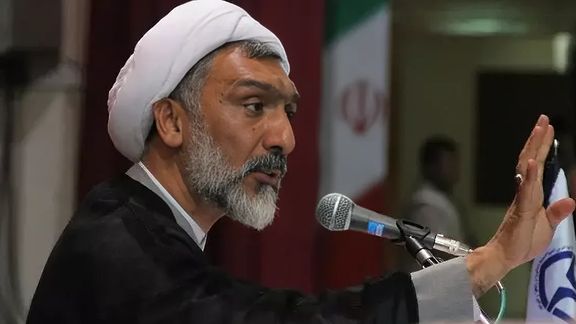
Iranian presidential candidate Mostafa Pourmohammadi has vowed to end the practice of internet bans, likening the internet to "the water for life" and acknowledging the disruption caused by current censorship.
Pourmohammadi committed to appointing a minister dedicated to "ending the VPN game and guaranteeing the security of users" after widespread bans on the likes of social media and dissident websites has cut swathes of Iran off from the digital world. Many have been forced to use virtual private networks (VPNs) to bypass the bans which have worsened in the wake of Iran's uprising since 2022.
Pourmohammadi's remarks have sparked controversy among Iranians who are skeptical of his sudden advocacy against internet censorship.
One user pointedly remarked on social media platform X, "Do you only remember filtering during election time?"
Further exacerbating concerns is the recent movement in the Iranian parliament toreintroduce a bill last monththat could further tighten internet controls, ostensibly aimed at "protecting cyberspace users" but likely to deepen social repression.
Iran's approach to internet censorship has been a contentious issue for over two decades, with routine blocking of websites and social media applications. Many Iranians bypass the restrictions using VPNs and other tools but the government's measures have grown more severe, especially following the nationwide protests triggered by the death of Mahsa Amini in morality police custody in September 2022.
In response, the government blocked major internet services like Instagram and WhatsApp which massively affected the country's SMEs where ecommerce was an essential means of survival, especially those in rural Iran.
Freedom House has ranked Iran 11/100 for internet access, calling it "not free" in its 2023 report, noting the crackdowns following 2022's uprising.
As the state-controlled presidential election gets underway, Iran’s six handpicked candidates begin a mud slinging war on televised debates with accusations from corruption to human rights abuses.
In a Wednesday interview, Tehran's mayor, Alireza Zakani, highlighted his “successful tenure” and emphasized his “relentless efforts to uncover and address pervasive corruption” among officials across various institutions, from the government to parliament.
The ultra-conservative candidate portrayed himself as a determined fighter against corruption, particularly targeting "those in power who enjoy special protection”, in spite of having been one of the main proponents for the violent crackdown on hijab violators in the capital.
"I have always said that we should start with the most powerful people with clear-cut boundaries separating them," he asserted. "Those in power should safeguard people’s lives and wealth, but this is not always the case."
Zakani pointed out that corruption is prevalent among "reformists and fundamentalists [conservatives]," though to varying degrees. He even cited an example involving someone from the Revolution's inner circle who shared the same faction as himself.
However, he alluded to corruption during the previous municipality administration and said he has “salvaged substantial funds from corruption cases,” a comment that could hint at Mohammad Bagher Ghalibaf, another presidential candidate's, 12-year tenure as Tehran's mayor.
The capital's municipality, a hotbed of corruption, was marred by significant financial mismanagement during Ghalibaf's mayoral tenure, who is now parliament speaker.
His successors revealed a staggering figure, claiming that over $5 billion was either misappropriated or wasted from 2005 to 2017. Despite numerous accusations of financial corruption against Ghalibaf, he was not investigated or accused of wrongdoing, which many attribute to his close relationship with Supreme Leader Ali Khamenei.
Meanwhile, Zakani's tenure in Tehran has also been controversial. It included a scandal involving approximately $336 million that went missing. He also faced criticism for appointing his deputy for financial affairs as the head of his campaign team, raising concerns about the misuse of municipal resources for personal political gain. The move is seen as an ethical violation, if not an infringement of campaign laws.
Zakani's remarks on corruption among powerful officials come amid warnings to presidential candidates not to tarnish the country’s image. These warnings include threats of broadcast suspension, part of a broader crackdown on media content preceding the elections.
The directive emphasizes the need for candidates to avoid defamation and behaviors detrimental to national unity and civic engagement.
In another televised interview, Ghalibaf expounded upon his prospective initiatives in the event of his electoral success, affirming his advocacy for whistleblowing, which he claimed he previously institutionalized during his parliamentary tenure. He promised incentives, including financial remuneration for those who come forward with information.
The claims come amid the arrest of Yashar Soltani and Saba Azarpeik, esteemed figures within Iranian journalism renowned for their relentless exposés on corruption
Soltani, who endured imprisonment in 2019 for his investigations into financial malfeasance within the Tehran Municipality under Ghalibaf's stewardship, now faces further legal ramifications. Also, Azarpeik's spouse intimated that Ghalibaf had instigated legal proceedings against her.
Mostafa Pourmohammadi, also vying for the presidency, voiced his commitment to “safeguarding the rights of the accused and prisoners.” in his promotional address aired on TV. However, his candidacy is overshadowed by his association with the infamous Death Commission alongside the late President Ebrahim Raisi, implicated in the authorization of the mass execution of thousands of political dissidents in 1988, a legacy that is still vivid among many Iranians.
Iran's Minister of Interior praised the brutal enforcement of the radical hijab regulation under the recent 'Noor' plan as one of the police's "greatest honors."
Ahmad Vahidi said the police actions in implementing the plan which have included violent beatings and sexual assaults, were in line with "protecting the family."
Since its initiation on April 13, the hijab crackdown has worsened under the legislation which came from a mass rejection of the Islamic dress code in the wake of the 'Women, Life, Freedom' movement sparked by the death in policy custody of Mahsa Amini in 2022.
Meanwhile, Major General Mohammad Bagheri, Chief of the General Staff of the Armed Forces, claimed that the Noor plan was implemented with "minimal controversy", in a bid to undermine the global criticism that has ensued.
The rhetoric comes as the controversial "Protection of Family Through Promotion of Hijab and Chastity Culture" bill moves closer to becoming law. Despite requiring additional reviews after being initially rejected by the Guardian Council, the ultimate legislative authority, the bill’s harsh regulations are already being enforced.
Women now face heightened risks, including arrest and travel bans for non-compliance with hijab mandates, and exclusion from public spaces and services.
The morality police have reassertedtheir presence on the streets with renewed vigor, particularly in Tehran’s central districts, following a period of reduced activity after the uprising which began in September 2022.
Critics argue that such measures represent a deeper entrenchment of authoritarianism, with the police and judiciary increasingly infringing on individual rights and freedoms.
The reformist newspaper Ham-Mihan has called out the Speaker of the Iranian Parliament for his presidential election campaign rhetoric concerning Afghan migrants.
Mohammad Bagher Ghalibaf recently promised that "provisions have been made for the complete expulsion" of illegal immigrants while numbers have continued to grow with around eight million in the country.
Ham-Mihan voiced a question: "If this issue is so important that it requires promises to win votes, then why haven’t you presented any ideas, opinions, or serious critiques about it in the past four years, and why haven’t you pursued and implemented the issue in any of the institutions where you were present? Is this way of making promises a sign of sincerity?"
The timing of Ghalibaf's statements coincides with a surge in the detention and expulsion of foreign nationals, particularly Afghan citizens, from Iran. This has sparked a complex debate among Iranian citizens and officials, balancing the perceived threats and opportunities presented by the presence of Afghan migrants.
Despite the approximate figure of 780,000 Afghans in Iran with official refugee status, the majority remain undocumented, a significant number seeking refuge from the instability in Afghanistan, particularly following the resurgence of the Taliban.
Fatemeh Sepehri, a prominent Iranian political prisoner and vocal critic of the Islamic Republic who suffers from a heart ailment, has been sentenced to an additional 18 and a half years in prison.
The harsh ruling underscores the Islamic Republic’s ongoing crackdown on dissent. Sepehri’s brothers, Mohammad-Hossein Sepehri and Hossein Sepehri, have also received severe sentences, facing 8 and 5.5 years in prison, respectively.
Sepehri, who is a widely revered figure among Iranian dissidents, apparently received the long sentence for condemning Hamas’s October 7 attack on Israel. Despite facing prison and ill health, she issued a statement supporting the Israeli people, who were massacred, tortured, sexually assaulted, and taken hostage by Hamas. This was a clear act of defiance against the Islamic regime in Iran that staunchly supports Hamas.
The sentences were handed down by Judge Hossein Yazdankhah of Branch 5 of the Mashhad Revolutionary Court following the court's second session on June 6. This information was announced by the siblings' brother, Asghar Sepehri on the social media platform X.
According to Asghar Sepehri, the charges against Fatemeh are extensive and severe. She has been sentenced to a total of 18.5 years in prison on multiple charges: 7 years for supporting Israel, another 7 years for gathering and collusion to conspire against national security, 3 years for insulting Supreme Leader Ali Khamenei, and 1 year and six months for propaganda against the Islamic Republic.
Similarly, Mohammad-Hossein Sepehri faces significant charges. He has been sentenced to a total of 8 years in prison, comprising 5 years for assembly and collusion, 2 years for insulting Khamenei, and 1 year for propaganda activity against the regime.
Hossein Sepehri has also received a harsh sentence totaling 5 years and 6 months. His charges include 3 years and 7 months for gathering and collusion, 1 year and 4 months for insulting Khamenei, and 7 months for propaganda activity against the regime.
“They have built a case against our daughter resulting in 18 and half years imprisonment for condemning Hamas,” decried Sepehri’s elderly mother in a video shared on X.
Fatemeh Sepehri was already facing a lengthy prison sentence following her arrest in September 2022 amid Iran’s nationwide Woman Life Freedom protests. According to her mother when she was first arrested she spent over 30 days in the intelligence ministry’s detention undergoing interrogations before being transferred to Vakilabad prison. Her brother also previously reportedof Sepehri being subject to “psychological torture by a judiciary psychiatrist” recently.
Despite being severely ill and having just had open heart surgery last year, she was promptly transferred back to prison following her surgery.
“After her open heart surgery, they took her from CCU to prison. In prison they closed the only window through which she could see the sky,” added Sepehri’s mother.
Her brothers, Mohammad Hossein, and Hossein were attending to their sister in hospital while she was having surgery when security forces arbitrarily arrested them.
“Hossein was in prison for 3 months and released on bail. Eight months have passed and now it is 9 months since Mohammad is in prison. Mohammad has not been able to speak a word. Hossein hasn’t released any statements, yet they filed a case against them [alleging] ‘you have spoken against us’ which they haven’t,” Sepehri’s mother stated.
Echoing his mother’s words, Asghar further added that his sister’s phone calls from prison are strictly monitored and she is being denied medical leave from prison.
“I condemn Hamas’s attack on Israel and say loudly that the Iranian nation stands by the Israeli nation. The Islamic Republic and its agents spend Iran’s wealth to buy bullets and attack Israel. We, the people of Iran neither want war nor the killing of defenseless people. I again condemn Hamas’s attack. Since the rise to power of Ali Khamenei and the founding of the Islamic Republic, the Middle East has not seen peace,” Sepehri had declared in her statement.
Iran's Acting Foreign Minister Ali Bagheri Kani claimed that Iran and Iraq are "two main pillars in the region" while Iran continues to destabilize Iraq through its Shia proxies.
During a joint press conference in Baghdad with his Iraqi counterpart Fuad Hussein on Thursday, he blamed the region’s instability on Iran’s archenemy, Israel, currently at war with Iran-backed Hamas in Gaza.
“All countries in the region are together with interaction and solidarity to build a secure and stable phase, and it is the Zionists who have shown that they are the main factor in the instability of the region, he said. Iran’s largest proxy, Hezbollah, is currently at war with Israel on its northern border with Iran’s Yemeni proxy, the Houthis, targeting the country’s south with its Red Sea region blockade and a series of missile and drone attacks.
The latest assertion from Iran’s acting foreign minister came amidst widespread accusations of the regime’s role in destabilizing Iraq by supporting militia groups that challenge the sovereignty and governance of Iraq through its backing of Shiite armed groups.
Bagheri's trip includes high-level meetings with Iraqi officials, including Prime Minister Mohammed al-Sudani and President Abdul Latif Rashid, extending his outreach to the Kurdistan Region to engage with Kurdish leaders Nechirvan Barzani and Masoud Barzani.
The visit is part of a broader regional tour that previously included stops in Lebanon and Syria, where Bagheri met with figures such as Hezbollah chief Hassan Nasrallah and Syrian President Bashar al-Assad as Iran seeks to expand its influence across the region.